

Closed-Loop Control Strategies For Consistent DED Layer Deposition
AUG 29, 20259 MIN READ
Generate Your Research Report Instantly with AI Agent
PatSnap Eureka helps you evaluate technical feasibility & market potential.
DED Closed-Loop Control Background and Objectives
Directed Energy Deposition (DED) has emerged as a transformative additive manufacturing technology over the past two decades, evolving from experimental research to industrial implementation. This metal-based process enables the creation of complex geometries by depositing material layer by layer using focused thermal energy. The technology's evolution has been marked by significant improvements in deposition accuracy, material utilization, and process stability, yet consistent layer deposition remains a persistent challenge.
The fundamental objective of closed-loop control strategies for DED is to achieve consistent layer deposition across varying geometries and material compositions. This consistency is critical for ensuring dimensional accuracy, mechanical properties, and overall part quality. Current open-loop control systems rely heavily on pre-set parameters that cannot adapt to real-time process variations, resulting in inconsistencies that compromise part integrity and performance.
Recent technological trends indicate a shift toward integrated sensing and adaptive control systems that can monitor and adjust process parameters in real-time. This evolution is driven by advancements in high-speed computing, sensor miniaturization, and machine learning algorithms capable of processing complex data streams during deposition. The integration of these technologies presents an opportunity to revolutionize DED process control.
The specific technical goals for closed-loop control in DED include: achieving uniform layer thickness with less than 5% variation; maintaining consistent melt pool dimensions throughout the build process; ensuring thermal stability to prevent residual stress accumulation; and adapting to geometric complexities such as overhangs and thin walls without manual intervention.
Industry demands for higher precision components, particularly in aerospace, medical, and energy sectors, have accelerated research in this domain. The economic implications are substantial, as improved process control can reduce material waste by up to 30% and post-processing requirements by up to 50%, significantly lowering production costs.
Academic and industrial research has demonstrated that closed-loop control can potentially increase deposition rates while maintaining quality, addressing the historical trade-off between speed and precision. This capability would position DED as a viable alternative to conventional manufacturing for medium to large-scale metal components.
The ultimate objective of this technical research is to develop robust, transferable closed-loop control methodologies that can be implemented across different DED systems, materials, and application domains, thereby standardizing quality control approaches and expanding the technology's industrial adoption.
The fundamental objective of closed-loop control strategies for DED is to achieve consistent layer deposition across varying geometries and material compositions. This consistency is critical for ensuring dimensional accuracy, mechanical properties, and overall part quality. Current open-loop control systems rely heavily on pre-set parameters that cannot adapt to real-time process variations, resulting in inconsistencies that compromise part integrity and performance.
Recent technological trends indicate a shift toward integrated sensing and adaptive control systems that can monitor and adjust process parameters in real-time. This evolution is driven by advancements in high-speed computing, sensor miniaturization, and machine learning algorithms capable of processing complex data streams during deposition. The integration of these technologies presents an opportunity to revolutionize DED process control.
The specific technical goals for closed-loop control in DED include: achieving uniform layer thickness with less than 5% variation; maintaining consistent melt pool dimensions throughout the build process; ensuring thermal stability to prevent residual stress accumulation; and adapting to geometric complexities such as overhangs and thin walls without manual intervention.
Industry demands for higher precision components, particularly in aerospace, medical, and energy sectors, have accelerated research in this domain. The economic implications are substantial, as improved process control can reduce material waste by up to 30% and post-processing requirements by up to 50%, significantly lowering production costs.
Academic and industrial research has demonstrated that closed-loop control can potentially increase deposition rates while maintaining quality, addressing the historical trade-off between speed and precision. This capability would position DED as a viable alternative to conventional manufacturing for medium to large-scale metal components.
The ultimate objective of this technical research is to develop robust, transferable closed-loop control methodologies that can be implemented across different DED systems, materials, and application domains, thereby standardizing quality control approaches and expanding the technology's industrial adoption.
Market Analysis for Precision Additive Manufacturing
The precision additive manufacturing market is experiencing significant growth, driven by increasing demand for complex components with high accuracy across various industries. The global market for precision additive manufacturing was valued at approximately $12.6 billion in 2022 and is projected to reach $41.5 billion by 2030, growing at a CAGR of 16.2% during the forecast period. This growth is particularly evident in aerospace, medical, automotive, and industrial sectors where consistent layer deposition is critical.
Directed Energy Deposition (DED) technology represents a substantial segment within this market, with particular relevance to closed-loop control strategies. The DED-specific market segment was valued at $1.8 billion in 2022 and is expected to grow at a faster rate than the overall additive manufacturing market due to its capabilities in repair applications and multi-material processing.
Industry analysis reveals that aerospace and defense sectors currently dominate the demand for precision DED systems, accounting for approximately 38% of the market share. These industries require components with exceptional mechanical properties and dimensional accuracy that can only be achieved through advanced control strategies. The medical device industry follows closely at 27%, driven by the need for patient-specific implants with consistent material properties.
Regional analysis shows North America leading the market with 42% share, followed by Europe (31%) and Asia-Pacific (22%). However, the Asia-Pacific region is expected to witness the highest growth rate of 19.8% during the forecast period, primarily due to increasing industrial adoption in China, Japan, and South Korea.
Customer requirements are increasingly focused on process reliability and part consistency, with 76% of end-users citing layer consistency as a critical factor in their purchasing decisions. This directly relates to the importance of closed-loop control strategies in DED processes, as inconsistent layer deposition leads to part rejection rates averaging 15-20% in conventional systems.
Market research indicates that manufacturers implementing advanced closed-loop control systems for DED processes report up to 40% reduction in material waste and 35% improvement in production efficiency. These economic benefits are driving adoption despite the higher initial investment required for systems with sophisticated monitoring and control capabilities.
The competitive landscape shows that companies offering integrated closed-loop control solutions command premium pricing, with average system costs 30% higher than basic open-loop alternatives. However, the total cost of ownership analysis demonstrates that these systems become cost-effective within 18-24 months of operation due to reduced waste and higher production yields.
Directed Energy Deposition (DED) technology represents a substantial segment within this market, with particular relevance to closed-loop control strategies. The DED-specific market segment was valued at $1.8 billion in 2022 and is expected to grow at a faster rate than the overall additive manufacturing market due to its capabilities in repair applications and multi-material processing.
Industry analysis reveals that aerospace and defense sectors currently dominate the demand for precision DED systems, accounting for approximately 38% of the market share. These industries require components with exceptional mechanical properties and dimensional accuracy that can only be achieved through advanced control strategies. The medical device industry follows closely at 27%, driven by the need for patient-specific implants with consistent material properties.
Regional analysis shows North America leading the market with 42% share, followed by Europe (31%) and Asia-Pacific (22%). However, the Asia-Pacific region is expected to witness the highest growth rate of 19.8% during the forecast period, primarily due to increasing industrial adoption in China, Japan, and South Korea.
Customer requirements are increasingly focused on process reliability and part consistency, with 76% of end-users citing layer consistency as a critical factor in their purchasing decisions. This directly relates to the importance of closed-loop control strategies in DED processes, as inconsistent layer deposition leads to part rejection rates averaging 15-20% in conventional systems.
Market research indicates that manufacturers implementing advanced closed-loop control systems for DED processes report up to 40% reduction in material waste and 35% improvement in production efficiency. These economic benefits are driving adoption despite the higher initial investment required for systems with sophisticated monitoring and control capabilities.
The competitive landscape shows that companies offering integrated closed-loop control solutions command premium pricing, with average system costs 30% higher than basic open-loop alternatives. However, the total cost of ownership analysis demonstrates that these systems become cost-effective within 18-24 months of operation due to reduced waste and higher production yields.
Current DED Control Challenges and Limitations
Despite significant advancements in Directed Energy Deposition (DED) technology, several critical challenges persist in achieving consistent layer deposition. The current control systems predominantly operate in open-loop configurations, relying heavily on pre-set parameters without real-time adjustments based on process feedback. This fundamental limitation results in quality inconsistencies when material properties fluctuate or environmental conditions change during fabrication.
The thermal management aspect presents a particularly complex challenge. DED processes generate significant thermal gradients that vary dynamically throughout the build, affecting material deposition rates, melt pool characteristics, and ultimately part geometry. Current systems lack sophisticated thermal monitoring capabilities that can accurately track these variations across the entire build volume and adjust process parameters accordingly.
Melt pool dynamics represent another critical control limitation. The size, temperature distribution, and stability of the melt pool directly influence layer consistency, yet existing sensors struggle to provide accurate, high-resolution data at the speeds required for real-time control. The integration of multiple sensor types (thermal, optical, spectroscopic) remains technically challenging, limiting the comprehensive understanding of melt pool behavior necessary for precise control.
Material feed rate inconsistencies further complicate control strategies. Powder-based DED systems are particularly susceptible to flow rate variations due to particle agglomeration, moisture absorption, and feeder mechanism inconsistencies. Wire-fed systems face different but equally challenging issues related to wire positioning and feed rate precision. Current feedback mechanisms for material delivery lack the sensitivity and response time needed for instantaneous adjustments.
Geometric complexity introduces additional control difficulties. As build geometries become more intricate, the deposition paths require variable parameters to maintain consistent layer properties. Current path planning algorithms and control systems struggle to anticipate and compensate for the changing thermal conditions and mechanical constraints encountered in complex geometries, particularly at overhangs, thin walls, and intersections.
Computational limitations also hinder advanced control implementation. The processing of multiple sensor inputs, physics-based modeling, and parameter optimization in real-time demands significant computational resources. Current systems typically lack the processing power to execute sophisticated control algorithms at the speeds required for immediate parameter adjustments during deposition.
Calibration and system drift represent ongoing operational challenges. DED systems require frequent recalibration as components wear or environmental conditions change. The lack of automated calibration protocols and drift compensation mechanisms necessitates significant operator intervention, introducing human factors into the consistency equation.
The thermal management aspect presents a particularly complex challenge. DED processes generate significant thermal gradients that vary dynamically throughout the build, affecting material deposition rates, melt pool characteristics, and ultimately part geometry. Current systems lack sophisticated thermal monitoring capabilities that can accurately track these variations across the entire build volume and adjust process parameters accordingly.
Melt pool dynamics represent another critical control limitation. The size, temperature distribution, and stability of the melt pool directly influence layer consistency, yet existing sensors struggle to provide accurate, high-resolution data at the speeds required for real-time control. The integration of multiple sensor types (thermal, optical, spectroscopic) remains technically challenging, limiting the comprehensive understanding of melt pool behavior necessary for precise control.
Material feed rate inconsistencies further complicate control strategies. Powder-based DED systems are particularly susceptible to flow rate variations due to particle agglomeration, moisture absorption, and feeder mechanism inconsistencies. Wire-fed systems face different but equally challenging issues related to wire positioning and feed rate precision. Current feedback mechanisms for material delivery lack the sensitivity and response time needed for instantaneous adjustments.
Geometric complexity introduces additional control difficulties. As build geometries become more intricate, the deposition paths require variable parameters to maintain consistent layer properties. Current path planning algorithms and control systems struggle to anticipate and compensate for the changing thermal conditions and mechanical constraints encountered in complex geometries, particularly at overhangs, thin walls, and intersections.
Computational limitations also hinder advanced control implementation. The processing of multiple sensor inputs, physics-based modeling, and parameter optimization in real-time demands significant computational resources. Current systems typically lack the processing power to execute sophisticated control algorithms at the speeds required for immediate parameter adjustments during deposition.
Calibration and system drift represent ongoing operational challenges. DED systems require frequent recalibration as components wear or environmental conditions change. The lack of automated calibration protocols and drift compensation mechanisms necessitates significant operator intervention, introducing human factors into the consistency equation.
Existing Closed-Loop Control Solutions for DED
01 Feedback control systems for layer deposition
Closed-loop control systems that utilize real-time feedback to monitor and adjust the deposition process. These systems continuously measure parameters such as layer thickness, temperature, or deposition rate and make immediate adjustments to ensure consistent layer formation. The feedback mechanisms help compensate for environmental variations and process disturbances, resulting in more uniform and reliable layer deposition across substrates.- Feedback control systems for layer deposition: Closed-loop control systems that utilize real-time feedback to monitor and adjust the layer deposition process. These systems incorporate sensors to measure various parameters such as thickness, uniformity, and material properties during deposition. The feedback data is processed by control algorithms that make immediate adjustments to process parameters, ensuring consistent layer formation. This approach minimizes variations and defects by continuously comparing actual deposition results with desired specifications.
- Temperature and environmental control strategies: Control strategies focused on maintaining precise temperature and environmental conditions during layer deposition. These methods involve monitoring and regulating thermal gradients, humidity levels, and atmospheric composition to ensure optimal material properties and adhesion between layers. Advanced thermal management systems can adjust heating and cooling rates in real-time based on material requirements, preventing issues like warping, cracking, or inconsistent curing that affect layer uniformity.
- Machine learning and adaptive control algorithms: Implementation of machine learning and adaptive algorithms to optimize layer deposition processes. These systems learn from historical data and previous deposition cycles to predict optimal process parameters and anticipate potential issues. The adaptive control algorithms continuously refine the deposition strategy based on accumulated knowledge, improving consistency and quality over time. This approach enables the system to automatically compensate for variations in materials, environmental conditions, and equipment performance.
- Multi-sensor integration and data fusion: Integration of multiple sensor types and data fusion techniques to comprehensively monitor layer deposition. These systems combine data from various sensors including optical, thermal, acoustic, and mechanical sensors to create a complete picture of the deposition process. Advanced signal processing and data fusion algorithms correlate information from different sources to detect subtle anomalies that might not be apparent from a single sensor type. This comprehensive monitoring approach enables more precise control interventions and ensures layer consistency.
- In-situ quality verification and correction: Systems that perform real-time quality verification during the deposition process with capabilities for immediate correction. These approaches incorporate in-situ inspection technologies that can detect defects or inconsistencies as they occur. When deviations are identified, the control system automatically implements corrective actions such as adjusting deposition parameters, reprocessing problematic areas, or compensating in subsequent layers. This immediate verification and correction capability minimizes cumulative errors and ensures consistent layer properties throughout the entire structure.
02 Sensor integration for deposition monitoring
Integration of various sensors to monitor critical parameters during the layer deposition process. These sensors collect data on thickness, uniformity, temperature, and other key variables that affect layer quality. The sensor data is fed into the control system in real-time, enabling precise adjustments to deposition parameters. Advanced sensor technologies including optical, thermal, and pressure sensors provide comprehensive monitoring capabilities for maintaining consistent layer properties.Expand Specific Solutions03 Adaptive algorithms for process optimization
Implementation of sophisticated adaptive algorithms that continuously optimize the deposition process based on historical and real-time data. These algorithms can learn from previous deposition cycles and adjust parameters accordingly to improve consistency. Machine learning and AI techniques are employed to predict potential issues before they occur and make preemptive adjustments. The adaptive nature of these control strategies allows for handling complex material interactions and environmental variations.Expand Specific Solutions04 Multi-zone temperature and flow control
Systems that provide precise control over temperature and material flow across multiple zones of the deposition area. By dividing the deposition surface into independently controlled zones, these systems can compensate for edge effects and ensure uniform layer properties across the entire substrate. Each zone can be monitored and adjusted separately, allowing for customized deposition parameters based on local conditions and requirements. This approach is particularly effective for large-area deposition where conditions may vary across the substrate.Expand Specific Solutions05 Integrated quality assurance systems
Comprehensive quality assurance systems that are integrated with the deposition process to verify layer consistency in real-time. These systems incorporate in-situ measurement techniques to validate layer properties against predetermined specifications. When deviations are detected, automatic corrective actions are triggered to bring the process back within acceptable parameters. The integration of quality control directly into the deposition process minimizes waste and ensures consistent output quality without requiring separate inspection steps.Expand Specific Solutions
Leading Companies and Research Institutions in DED Technology
Directed Energy Deposition (DED) closed-loop control strategies are evolving in an industry transitioning from early adoption to growth phase. The market is expanding rapidly, projected to reach significant scale as additive manufacturing gains traction in aerospace, defense, and industrial applications. Technologically, the field shows varying maturity levels across players. RTX Corp. and 3D Systems lead with advanced implementations in aerospace applications, while Applied Materials and Lam Research contribute semiconductor manufacturing expertise to enhance layer precision. Academic institutions like University of California and Nanjing University of Science & Technology are advancing fundamental research, while companies like IBM and SPTS Technologies focus on integrating AI-driven control systems. The competitive landscape features both established industrial giants and specialized technology providers working to overcome challenges in real-time monitoring and feedback systems.
RTX Corp.
Technical Solution: RTX Corporation has developed advanced closed-loop control systems for Directed Energy Deposition (DED) that integrate real-time monitoring with adaptive feedback mechanisms. Their approach utilizes multi-sensor arrays (thermal imaging, laser profilometry, and spectroscopic analysis) to continuously monitor melt pool characteristics, layer geometry, and material properties during deposition. The system employs predictive modeling algorithms that anticipate deposition outcomes based on historical data and current parameters, allowing for proactive adjustments rather than reactive corrections. RTX's control strategy features a hierarchical architecture with three control levels: 1) rapid response local controllers managing individual deposition parameters, 2) mid-level coordination ensuring consistent layer properties, and 3) high-level process optimization that adapts to changing part geometry and material requirements throughout the build process.
Strengths: Superior integration with aerospace manufacturing systems, exceptional precision for critical components, and robust handling of complex geometries. Weaknesses: Higher implementation costs compared to simpler systems, requires significant computational resources, and may have limited flexibility for non-aerospace materials.
3D Systems, Inc.
Technical Solution: 3D Systems has pioneered a comprehensive closed-loop control strategy for DED processes that focuses on maintaining consistent layer thickness and material properties. Their approach combines optical metrology with thermal monitoring to create a dual-feedback system that simultaneously controls both geometric accuracy and microstructural properties. The system employs a proprietary algorithm that dynamically adjusts laser power, travel speed, and material feed rate based on real-time measurements of melt pool dimensions and thermal gradients. A key innovation in their technology is the implementation of layer-to-layer comparative analysis, where each deposited layer is compared to both the intended CAD model and previous layers to detect cumulative errors before they become significant. This allows for intelligent compensation strategies that maintain dimensional accuracy throughout the build process, even for complex geometries with varying thermal conditions.
Strengths: Exceptional adaptability to different material systems, proven track record in industrial applications, and seamless integration with existing 3D Systems hardware. Weaknesses: Relatively high computational overhead, requires specialized operator training, and may struggle with extremely high-temperature superalloys.
Key Patents and Innovations in DED Layer Consistency
Closed loop control
PatentWO2013079108A1
Innovation
- A closed loop control system that regulates power supply to the cathode and process gas flow, maintaining a constant deposition rate by monitoring and adjusting power values and gas flow rates, eliminating the need for additional hardware like plasma monitors and lambda sensors.


Engineered residual stress state for enhanced performance during directed energy deposition repair process
PatentPendingEP4599978A1
Innovation
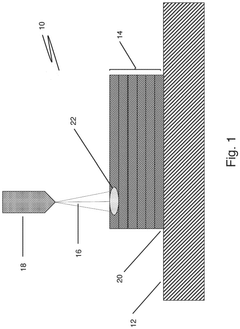
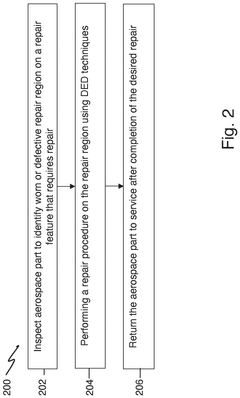
- A directed energy deposition (DED) process is used to create layers with pre-determined residual stress states by controlling parameters like powder feed rate, energy intensity, traversal speed, and auxiliary heating/cooling, enabling controlled residual stress management during the repair process.
Real-time Monitoring Technologies for DED Processes
Real-time monitoring technologies represent a critical component in the advancement of Directed Energy Deposition (DED) processes, particularly for implementing effective closed-loop control strategies. Current monitoring systems employ multiple sensor types to capture various process parameters during deposition, enabling immediate feedback for process adjustments.
Optical monitoring systems, including high-speed cameras and pyrometers, provide crucial visual and thermal data of the melt pool. These systems can detect variations in melt pool geometry, temperature distribution, and cooling rates - all essential parameters for maintaining consistent layer properties. Advanced image processing algorithms analyze these visual inputs in real-time, identifying anomalies that may indicate potential defects or process instabilities.
Thermal monitoring technologies have evolved significantly, with infrared cameras and thermocouples capable of mapping temperature gradients across the build area with increasing precision. This thermal mapping allows for detection of overheating, insufficient melting, or irregular cooling patterns that could compromise layer consistency. Recent developments in thermal imaging have reduced latency to near-zero, enabling truly real-time temperature control adjustments.
Acoustic emission sensors represent an emerging monitoring approach, detecting sound waves generated during the deposition process. These acoustic signatures can reveal valuable information about material flow, solidification dynamics, and potential defect formation that may not be visible through other monitoring methods. Machine learning algorithms are increasingly being employed to interpret these complex acoustic patterns.
Laser displacement sensors and profilometers provide dimensional feedback by measuring the actual geometry of deposited layers. These technologies enable direct comparison between intended and actual layer heights, widths, and profiles, facilitating immediate corrective actions when deviations occur. The latest systems can achieve sub-micron measurement precision at scanning rates compatible with production speeds.
Integration of these diverse monitoring technologies into unified systems represents the current frontier in DED process control. Multi-sensor data fusion approaches combine inputs from different sensor types, creating comprehensive process models that capture the complex interdependencies between process parameters. Edge computing solutions are increasingly being deployed to process this sensor data locally, reducing latency and enabling truly real-time control responses.
The effectiveness of these monitoring technologies ultimately depends on their integration with robust control algorithms capable of translating sensor data into appropriate process adjustments. Recent research focuses on developing standardized interfaces and protocols to facilitate this integration across different hardware platforms and control systems.
Optical monitoring systems, including high-speed cameras and pyrometers, provide crucial visual and thermal data of the melt pool. These systems can detect variations in melt pool geometry, temperature distribution, and cooling rates - all essential parameters for maintaining consistent layer properties. Advanced image processing algorithms analyze these visual inputs in real-time, identifying anomalies that may indicate potential defects or process instabilities.
Thermal monitoring technologies have evolved significantly, with infrared cameras and thermocouples capable of mapping temperature gradients across the build area with increasing precision. This thermal mapping allows for detection of overheating, insufficient melting, or irregular cooling patterns that could compromise layer consistency. Recent developments in thermal imaging have reduced latency to near-zero, enabling truly real-time temperature control adjustments.
Acoustic emission sensors represent an emerging monitoring approach, detecting sound waves generated during the deposition process. These acoustic signatures can reveal valuable information about material flow, solidification dynamics, and potential defect formation that may not be visible through other monitoring methods. Machine learning algorithms are increasingly being employed to interpret these complex acoustic patterns.
Laser displacement sensors and profilometers provide dimensional feedback by measuring the actual geometry of deposited layers. These technologies enable direct comparison between intended and actual layer heights, widths, and profiles, facilitating immediate corrective actions when deviations occur. The latest systems can achieve sub-micron measurement precision at scanning rates compatible with production speeds.
Integration of these diverse monitoring technologies into unified systems represents the current frontier in DED process control. Multi-sensor data fusion approaches combine inputs from different sensor types, creating comprehensive process models that capture the complex interdependencies between process parameters. Edge computing solutions are increasingly being deployed to process this sensor data locally, reducing latency and enabling truly real-time control responses.
The effectiveness of these monitoring technologies ultimately depends on their integration with robust control algorithms capable of translating sensor data into appropriate process adjustments. Recent research focuses on developing standardized interfaces and protocols to facilitate this integration across different hardware platforms and control systems.
Material-Specific Control Parameters and Optimization
The optimization of control parameters for specific materials represents a critical frontier in Directed Energy Deposition (DED) technology. Different materials exhibit unique thermal properties, melting points, and solidification behaviors that significantly impact the deposition process. For instance, titanium alloys require different laser power settings and travel speeds compared to nickel-based superalloys due to their distinct thermal conductivity and oxidation characteristics. Research indicates that parameter optimization must consider not only the base material properties but also the intended microstructure and mechanical properties of the final component.
Material-specific control parameters typically include laser power density, powder feed rate, travel speed, and layer thickness. These parameters must be dynamically adjusted based on real-time feedback from the process. Studies have demonstrated that titanium alloys often require lower travel speeds and carefully controlled atmosphere conditions to prevent oxidation, while steel alloys may tolerate higher deposition rates but require precise temperature control to manage residual stresses.
Thermal history monitoring has emerged as a crucial aspect of material-specific optimization. Advanced systems now incorporate infrared cameras and pyrometers to track the melt pool temperature profile, which varies significantly between materials. For aluminum alloys, maintaining a narrow temperature window is essential to prevent porosity formation, whereas for refractory metals, higher and more sustained temperatures are necessary for proper fusion.
Machine learning algorithms have revolutionized material-specific parameter optimization by analyzing vast datasets of deposition outcomes across different parameter combinations. These algorithms can identify non-intuitive relationships between process parameters and material behavior, enabling the development of material-specific process maps. Recent research has shown that neural networks trained on material-specific deposition data can predict optimal parameters with up to 85% accuracy, significantly reducing the experimental iterations required.
The development of material libraries containing pre-optimized parameter sets represents another significant advancement. These libraries incorporate not just basic material properties but also account for powder morphology, size distribution, and flow characteristics. For hybrid materials or functionally graded components, parameter optimization becomes even more complex, requiring sophisticated transition strategies between different material zones to maintain consistent layer quality.
Future developments in this area will likely focus on in-situ adaptive control systems that can automatically recognize material variations and adjust parameters accordingly, even compensating for batch-to-batch variations in powder feedstock. This capability will be particularly valuable for industries requiring high repeatability and certification, such as aerospace and medical device manufacturing.
Material-specific control parameters typically include laser power density, powder feed rate, travel speed, and layer thickness. These parameters must be dynamically adjusted based on real-time feedback from the process. Studies have demonstrated that titanium alloys often require lower travel speeds and carefully controlled atmosphere conditions to prevent oxidation, while steel alloys may tolerate higher deposition rates but require precise temperature control to manage residual stresses.
Thermal history monitoring has emerged as a crucial aspect of material-specific optimization. Advanced systems now incorporate infrared cameras and pyrometers to track the melt pool temperature profile, which varies significantly between materials. For aluminum alloys, maintaining a narrow temperature window is essential to prevent porosity formation, whereas for refractory metals, higher and more sustained temperatures are necessary for proper fusion.
Machine learning algorithms have revolutionized material-specific parameter optimization by analyzing vast datasets of deposition outcomes across different parameter combinations. These algorithms can identify non-intuitive relationships between process parameters and material behavior, enabling the development of material-specific process maps. Recent research has shown that neural networks trained on material-specific deposition data can predict optimal parameters with up to 85% accuracy, significantly reducing the experimental iterations required.
The development of material libraries containing pre-optimized parameter sets represents another significant advancement. These libraries incorporate not just basic material properties but also account for powder morphology, size distribution, and flow characteristics. For hybrid materials or functionally graded components, parameter optimization becomes even more complex, requiring sophisticated transition strategies between different material zones to maintain consistent layer quality.
Future developments in this area will likely focus on in-situ adaptive control systems that can automatically recognize material variations and adjust parameters accordingly, even compensating for batch-to-batch variations in powder feedstock. This capability will be particularly valuable for industries requiring high repeatability and certification, such as aerospace and medical device manufacturing.
Unlock deeper insights with PatSnap Eureka Quick Research — get a full tech report to explore trends and direct your research. Try now!
Generate Your Research Report Instantly with AI Agent
Supercharge your innovation with PatSnap Eureka AI Agent Platform!