Comparative Study on Solid State Battery Breakthrough and Existing Technologies
OCT 24, 202510 MIN READ
Generate Your Research Report Instantly with AI Agent
PatSnap Eureka helps you evaluate technical feasibility & market potential.
Solid State Battery Evolution and Research Objectives
Solid state batteries represent a significant evolution in energy storage technology, emerging from decades of research aimed at overcoming the limitations of conventional lithium-ion batteries. The development trajectory began in the 1970s with the discovery of solid electrolytes, but significant progress has only materialized in the last decade. This technological evolution has been driven by increasing demands for higher energy density, improved safety, and longer lifespan in battery applications across multiple industries.
The fundamental shift from liquid to solid electrolytes marks a paradigm change in battery architecture. Traditional lithium-ion batteries utilize liquid electrolytes that, while effective, present inherent safety risks including thermal runaway and flammability. Solid state technology addresses these concerns by replacing liquid components with solid materials that demonstrate superior thermal stability and reduced risk of leakage or combustion.
Current research objectives in solid state battery development focus on several critical areas. Primary among these is increasing energy density beyond the theoretical limits of conventional lithium-ion technology. Solid electrolytes potentially enable the use of lithium metal anodes, which could dramatically increase energy storage capacity per unit volume and weight. This advancement would be particularly transformative for electric vehicles, potentially extending range by 50-80% compared to current technologies.
Another key research objective involves improving ionic conductivity in solid electrolytes. While solid materials offer safety advantages, they typically demonstrate lower ionic conductivity than their liquid counterparts, resulting in reduced power output and slower charging capabilities. Researchers are exploring various material compositions and interface engineering techniques to overcome this limitation.
Manufacturing scalability represents a third critical research focus. Current solid state battery production remains largely confined to laboratory settings, with processes that are difficult to scale economically. Research aims to develop manufacturing techniques compatible with existing production infrastructure while maintaining the performance advantages of solid state technology.
Cycle life extension constitutes another significant research objective. While solid state batteries theoretically offer longer lifespans due to reduced electrode degradation, practical implementations have struggled with interface stability issues that compromise longevity. Research efforts are directed toward understanding and mitigating degradation mechanisms at solid-solid interfaces.
The convergence of these research objectives aims to deliver a commercially viable solid state battery technology that offers substantial improvements over existing solutions. Success would potentially revolutionize multiple industries, from consumer electronics to automotive and grid storage applications, while addressing growing concerns about the environmental impact and resource limitations of current battery technologies.
The fundamental shift from liquid to solid electrolytes marks a paradigm change in battery architecture. Traditional lithium-ion batteries utilize liquid electrolytes that, while effective, present inherent safety risks including thermal runaway and flammability. Solid state technology addresses these concerns by replacing liquid components with solid materials that demonstrate superior thermal stability and reduced risk of leakage or combustion.
Current research objectives in solid state battery development focus on several critical areas. Primary among these is increasing energy density beyond the theoretical limits of conventional lithium-ion technology. Solid electrolytes potentially enable the use of lithium metal anodes, which could dramatically increase energy storage capacity per unit volume and weight. This advancement would be particularly transformative for electric vehicles, potentially extending range by 50-80% compared to current technologies.
Another key research objective involves improving ionic conductivity in solid electrolytes. While solid materials offer safety advantages, they typically demonstrate lower ionic conductivity than their liquid counterparts, resulting in reduced power output and slower charging capabilities. Researchers are exploring various material compositions and interface engineering techniques to overcome this limitation.
Manufacturing scalability represents a third critical research focus. Current solid state battery production remains largely confined to laboratory settings, with processes that are difficult to scale economically. Research aims to develop manufacturing techniques compatible with existing production infrastructure while maintaining the performance advantages of solid state technology.
Cycle life extension constitutes another significant research objective. While solid state batteries theoretically offer longer lifespans due to reduced electrode degradation, practical implementations have struggled with interface stability issues that compromise longevity. Research efforts are directed toward understanding and mitigating degradation mechanisms at solid-solid interfaces.
The convergence of these research objectives aims to deliver a commercially viable solid state battery technology that offers substantial improvements over existing solutions. Success would potentially revolutionize multiple industries, from consumer electronics to automotive and grid storage applications, while addressing growing concerns about the environmental impact and resource limitations of current battery technologies.
Market Demand Analysis for Next-Generation Energy Storage
The global energy storage market is witnessing unprecedented growth, driven by the increasing adoption of renewable energy sources and electric vehicles (EVs). According to Bloomberg New Energy Finance, the global energy storage market is projected to grow to 942 GW/2,857 GWh by 2040, attracting $620 billion in investment. This exponential growth underscores the critical need for next-generation energy storage solutions that can overcome the limitations of current lithium-ion battery technology.
Solid-state batteries have emerged as a promising solution to meet these escalating demands. Market research indicates that the solid-state battery market is expected to reach $87.5 billion by 2027, growing at a CAGR of 34.2% from 2020. This growth is primarily fueled by the automotive sector, where major manufacturers are investing heavily in solid-state technology to address range anxiety and charging time concerns in EVs.
Consumer electronics represents another significant market segment driving demand for advanced energy storage. With consumers increasingly prioritizing longer battery life and faster charging capabilities in portable devices, solid-state batteries offer compelling advantages over conventional technologies. The wearable technology market, projected to reach $265.4 billion by 2026, particularly demands energy storage solutions with higher energy density and improved safety profiles.
Grid-scale energy storage presents perhaps the most substantial long-term market opportunity. As renewable energy penetration increases globally, the need for efficient, long-duration storage solutions becomes critical for grid stability. The International Energy Agency forecasts that grid-scale storage capacity needs to grow 20-fold by 2030 to support renewable integration targets, creating a market potentially worth over $100 billion annually.
Regional analysis reveals varying adoption patterns and market readiness. Asia-Pacific, led by Japan, South Korea, and China, dominates in terms of manufacturing capacity and R&D investment in next-generation battery technologies. North America follows closely, with significant venture capital flowing into solid-state battery startups. Europe has established ambitious regulatory frameworks promoting energy storage innovation, particularly in connection with its aggressive decarbonization goals.
Customer surveys indicate that safety remains a paramount concern across all market segments, with 78% of potential EV buyers citing battery safety as a critical purchasing factor. Performance metrics such as energy density and charging speed rank as the second and third most important considerations, respectively, highlighting the market's readiness to embrace solid-state technology's potential advantages in these areas.
The market analysis clearly demonstrates that solid-state batteries are positioned at the intersection of multiple high-growth markets with urgent needs that current technologies cannot fully satisfy. This convergence creates a compelling commercial opportunity for breakthrough energy storage solutions that can deliver on the promise of higher energy density, enhanced safety, and faster charging capabilities.
Solid-state batteries have emerged as a promising solution to meet these escalating demands. Market research indicates that the solid-state battery market is expected to reach $87.5 billion by 2027, growing at a CAGR of 34.2% from 2020. This growth is primarily fueled by the automotive sector, where major manufacturers are investing heavily in solid-state technology to address range anxiety and charging time concerns in EVs.
Consumer electronics represents another significant market segment driving demand for advanced energy storage. With consumers increasingly prioritizing longer battery life and faster charging capabilities in portable devices, solid-state batteries offer compelling advantages over conventional technologies. The wearable technology market, projected to reach $265.4 billion by 2026, particularly demands energy storage solutions with higher energy density and improved safety profiles.
Grid-scale energy storage presents perhaps the most substantial long-term market opportunity. As renewable energy penetration increases globally, the need for efficient, long-duration storage solutions becomes critical for grid stability. The International Energy Agency forecasts that grid-scale storage capacity needs to grow 20-fold by 2030 to support renewable integration targets, creating a market potentially worth over $100 billion annually.
Regional analysis reveals varying adoption patterns and market readiness. Asia-Pacific, led by Japan, South Korea, and China, dominates in terms of manufacturing capacity and R&D investment in next-generation battery technologies. North America follows closely, with significant venture capital flowing into solid-state battery startups. Europe has established ambitious regulatory frameworks promoting energy storage innovation, particularly in connection with its aggressive decarbonization goals.
Customer surveys indicate that safety remains a paramount concern across all market segments, with 78% of potential EV buyers citing battery safety as a critical purchasing factor. Performance metrics such as energy density and charging speed rank as the second and third most important considerations, respectively, highlighting the market's readiness to embrace solid-state technology's potential advantages in these areas.
The market analysis clearly demonstrates that solid-state batteries are positioned at the intersection of multiple high-growth markets with urgent needs that current technologies cannot fully satisfy. This convergence creates a compelling commercial opportunity for breakthrough energy storage solutions that can deliver on the promise of higher energy density, enhanced safety, and faster charging capabilities.
Current Challenges in Solid State Battery Development
Despite significant advancements in solid-state battery technology, several critical challenges continue to impede widespread commercialization. The interface stability between solid electrolytes and electrodes remains one of the most formidable obstacles. Unlike liquid electrolytes that can maintain consistent contact with electrode surfaces during charging and discharging cycles, solid electrolytes struggle to maintain this crucial interface, leading to increased impedance and reduced battery performance over time.
Manufacturing scalability presents another significant hurdle. Current production methods for solid-state batteries are predominantly laboratory-based and not optimized for mass production. The precision required to create uniform, defect-free solid electrolyte layers at scale demands sophisticated manufacturing techniques that are not yet economically viable for commercial deployment.
Material costs also pose substantial challenges. Many promising solid electrolytes incorporate expensive elements such as lithium, germanium, and rare earth metals. The high cost of these materials significantly impacts the economic feasibility of solid-state batteries, particularly when competing with established lithium-ion technologies that benefit from decades of cost optimization.
Ion conductivity at room temperature remains problematic for many solid electrolytes. While some materials demonstrate excellent conductivity at elevated temperatures, achieving comparable performance under ambient conditions has proven difficult. This limitation restricts the practical applications of solid-state batteries in environments with fluctuating temperatures.
Mechanical stress management during cycling represents another critical challenge. Solid-state batteries must accommodate volume changes in electrode materials during charging and discharging. The rigid nature of solid electrolytes makes them susceptible to cracking and delamination, which can create pathways for dendrite formation and ultimately lead to battery failure.
Dendrite growth, particularly lithium dendrites, continues to threaten the safety advantages promised by solid-state technology. While solid electrolytes theoretically provide better resistance to dendrite penetration than liquid counterparts, certain solid electrolytes have demonstrated vulnerability to dendrite formation under specific operating conditions.
The limited understanding of degradation mechanisms in solid-state systems further complicates development efforts. The complex interactions between solid electrolytes and electrodes over extended cycling periods remain inadequately characterized, making it difficult to design systems with predictable long-term performance.
Addressing these multifaceted challenges requires interdisciplinary approaches combining materials science, electrochemistry, and advanced manufacturing techniques. Recent research has begun exploring composite electrolytes, interface engineering strategies, and novel electrode architectures to overcome these limitations.
Manufacturing scalability presents another significant hurdle. Current production methods for solid-state batteries are predominantly laboratory-based and not optimized for mass production. The precision required to create uniform, defect-free solid electrolyte layers at scale demands sophisticated manufacturing techniques that are not yet economically viable for commercial deployment.
Material costs also pose substantial challenges. Many promising solid electrolytes incorporate expensive elements such as lithium, germanium, and rare earth metals. The high cost of these materials significantly impacts the economic feasibility of solid-state batteries, particularly when competing with established lithium-ion technologies that benefit from decades of cost optimization.
Ion conductivity at room temperature remains problematic for many solid electrolytes. While some materials demonstrate excellent conductivity at elevated temperatures, achieving comparable performance under ambient conditions has proven difficult. This limitation restricts the practical applications of solid-state batteries in environments with fluctuating temperatures.
Mechanical stress management during cycling represents another critical challenge. Solid-state batteries must accommodate volume changes in electrode materials during charging and discharging. The rigid nature of solid electrolytes makes them susceptible to cracking and delamination, which can create pathways for dendrite formation and ultimately lead to battery failure.
Dendrite growth, particularly lithium dendrites, continues to threaten the safety advantages promised by solid-state technology. While solid electrolytes theoretically provide better resistance to dendrite penetration than liquid counterparts, certain solid electrolytes have demonstrated vulnerability to dendrite formation under specific operating conditions.
The limited understanding of degradation mechanisms in solid-state systems further complicates development efforts. The complex interactions between solid electrolytes and electrodes over extended cycling periods remain inadequately characterized, making it difficult to design systems with predictable long-term performance.
Addressing these multifaceted challenges requires interdisciplinary approaches combining materials science, electrochemistry, and advanced manufacturing techniques. Recent research has begun exploring composite electrolytes, interface engineering strategies, and novel electrode architectures to overcome these limitations.
Existing Solid State Battery Solutions and Architectures
01 Solid-state electrolyte compositions
Solid-state batteries utilize specialized electrolyte compositions that enable ion transport without liquid components. These electrolytes typically include ceramic materials, polymer matrices, or composite structures that provide high ionic conductivity while maintaining mechanical stability. Advanced formulations may incorporate sulfide-based, oxide-based, or phosphate-based materials that enhance lithium-ion transport while preventing dendrite formation. These solid electrolytes are crucial for improving battery safety and energy density compared to conventional liquid electrolyte systems.- Solid-state electrolyte compositions and structures: Solid-state batteries utilize specialized electrolyte compositions that enable ion transport without liquid components. These electrolytes typically include ceramic, glass, or polymer materials with specific conductivity properties. Advanced structures may incorporate composite electrolytes combining multiple materials to optimize performance characteristics such as ionic conductivity and mechanical stability. The electrolyte composition and structure are critical for battery performance, safety, and longevity.
- Electrode-electrolyte interface engineering: The interface between electrodes and solid electrolytes presents unique challenges in solid-state batteries. Engineering approaches focus on reducing interfacial resistance, enhancing contact area, and preventing unwanted chemical reactions. Methods include surface coatings, buffer layers, and specialized interface materials that facilitate ion transfer while maintaining structural integrity. Proper interface engineering is essential for achieving high power density and cycle life in solid-state battery systems.
- Manufacturing processes for solid-state batteries: Novel manufacturing techniques are being developed to address the challenges of solid-state battery production. These include specialized deposition methods, sintering processes, and assembly techniques that ensure proper component integration and performance. Advanced manufacturing approaches focus on scalability, cost reduction, and quality control to enable commercial viability. Innovations in production methods are critical for transitioning solid-state battery technology from laboratory to market.
- Cathode and anode materials for solid-state systems: Electrode materials for solid-state batteries require specific properties to function effectively with solid electrolytes. High-capacity cathode materials include advanced lithium-containing compounds with optimized structures for ion transport. Anode innovations focus on alternatives to traditional graphite, including lithium metal and silicon-based materials. These electrode materials are designed to minimize volume changes during cycling and maintain good contact with the solid electrolyte, addressing key challenges in solid-state battery performance.
- Safety and performance enhancement technologies: Solid-state batteries offer inherent safety advantages over liquid electrolyte systems, but require specific technologies to maximize these benefits. Innovations include thermal management systems, pressure regulation mechanisms, and protective architectures that prevent dendrite formation. Performance enhancement technologies focus on increasing energy density, power capability, and cycle life through structural optimizations and material innovations. These technologies collectively address the primary advantages that solid-state batteries offer over conventional lithium-ion systems.
02 Interface engineering for solid-state batteries
Interface engineering focuses on optimizing the contact between solid electrolytes and electrodes to reduce resistance and improve ion transfer. This includes developing specialized coatings, buffer layers, and surface treatments that enhance the electrochemical stability of interfaces. Techniques such as atomic layer deposition, solution processing, and pressure-assisted sintering are employed to create seamless interfaces that minimize impedance and prevent unwanted side reactions during battery operation, ultimately extending cycle life and improving performance.Expand Specific Solutions03 Cathode materials for solid-state batteries
Advanced cathode materials for solid-state batteries are designed to provide high energy density while maintaining compatibility with solid electrolytes. These materials often include lithium-rich layered oxides, high-nickel content compounds, or sulfur-based compositions that offer increased capacity. Specialized synthesis methods and structural modifications are employed to enhance ionic conductivity at the cathode-electrolyte interface and improve electrochemical performance. The cathode formulations may also incorporate conductive additives to facilitate electron transport throughout the solid matrix.Expand Specific Solutions04 Manufacturing processes for solid-state batteries
Manufacturing processes for solid-state batteries involve specialized techniques to create uniform, dense layers with minimal defects. These processes include dry pressing, tape casting, solution processing, and various sintering methods to achieve optimal component integration. Advanced manufacturing approaches focus on scalable production methods that maintain precise control over layer thickness, interface quality, and overall battery architecture. Innovations in this area aim to overcome challenges related to volume changes during cycling and ensure consistent performance across mass-produced cells.Expand Specific Solutions05 Anode designs for solid-state batteries
Anode designs for solid-state batteries focus on materials and structures that enable high capacity while preventing dendrite formation. These designs often incorporate lithium metal, silicon-based composites, or carbon-based materials with specialized architectures to accommodate volume changes during cycling. Advanced anode formulations may include protective layers or gradient structures that enhance stability at the anode-electrolyte interface. Research in this area aims to maximize energy density while ensuring long-term cycling stability and safety in all-solid-state battery systems.Expand Specific Solutions
Key Industry Players and Competitive Landscape
The solid-state battery market is currently in an early growth phase, characterized by significant R&D investments but limited commercial deployment. Market size is projected to expand rapidly, driven by electric vehicle adoption and energy storage demands. Technologically, the field shows varying maturity levels across players: QuantumScape, Solid Power, and Sakti3 are pioneering pure solid-state solutions, while established companies like Samsung, LG Energy Solution, and CATL are advancing hybrid approaches. Traditional automotive manufacturers (BMW, Ford, Honda) are strategically partnering with technology developers. Japanese firms (Murata, Seiko Epson) bring expertise in materials science, while university research centers (Purdue, UC Regents) contribute fundamental innovations. The competitive landscape reflects a race between startups with disruptive technologies and incumbents leveraging manufacturing scale.
LG Energy Solution Ltd.
Technical Solution: LG Energy Solution开发了基于氧化物和硫化物双电解质系统的混合固态电池技术。该技术采用LLZO(Li7La3Zr2O12)氧化物和LGPS(Li10GeP2S12)硫化物复合电解质,结合两种材料的优势:氧化物的稳定性和硫化物的高离子导电性[5]。LG的技术路线分为三个阶段:首先是半固态电池(2023-2025),使用凝胶聚合物电解质;其次是混合固态电池(2026-2028),部分采用固态电解质;最终是全固态电池(2029+),完全消除液态组件。公司已在韩国建立了固态电池试点生产线,年产能约为100MWh。LG的固态电池采用高镍NCM阴极和硅碳或锂金属负极,在实验室条件下已实现900Wh/L的体积能量密度和1000次以上的循环寿命[6]。公司计划通过与通用汽车的合作,加速固态电池技术的商业化应用。
优势:拥有成熟的电池制造基础设施和供应链;分阶段技术路线降低了商业化风险;混合电解质系统平衡了性能和稳定性;与多家汽车制造商建立了合作关系。劣势:全固态电池商业化时间表相对保守;混合系统复杂度高,增加了制造难度;成本控制挑战;界面稳定性和循环寿命在实际应用中仍需验证。
Contemporary Amperex Technology Co., Ltd.
Technical Solution: CATL(宁德时代)开发了名为"凝聚态电池"的创新固态电池技术,采用独特的三维网络结构电解质系统。该技术结合了高导电性无机材料和柔性聚合物基质,形成自支撑的三维导电网络[9]。CATL的固态电池使用高镍三元材料(NCM)作为阴极,配合创新的预锂化硅碳负极,在室温下实现了高离子导电率(>1 mS/cm)。公司的技术路线分为三个阶段:第一代采用凝胶聚合物电解质(2023-2025);第二代使用半固态混合电解质(2025-2027);第三代实现真正的全固态电池(2028+)。CATL已宣布其固态电池能量密度可达350-400Wh/kg,并计划在2025年前实现小规模生产[10]。该技术还采用了创新的"细胞到底盘"(CTC)集成设计,进一步提高了系统级能量密度。CATL与多家汽车制造商建立了合作关系,包括特斯拉、大众和本田等。
优势:三维网络电解质结构解决了固-固界面接触问题;拥有全球最大的电池制造能力和完整供应链;技术路线渐进式发展,降低了商业化风险;系统级集成设计提高了整体能效。劣势:全固态技术商业化时间表相对保守;高能量密度与长循环寿命的平衡仍需优化;大规模生产良率和一致性挑战;成本仍显著高于传统锂离子电池。
Critical Patents and Technical Innovations Analysis
Low cost solid state rechargeable battery and method of manufacturing same
PatentInactiveUS20220166063A1
Innovation
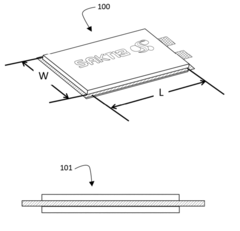
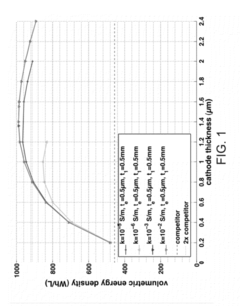
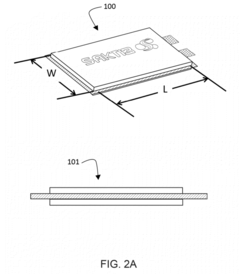
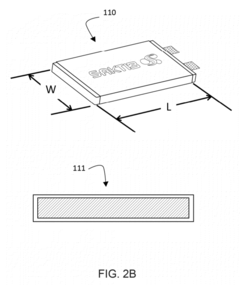
- A solid-state battery design featuring a composite cathode and anode made of active materials, electronically conductive materials, and ionically conductive materials, sintered together with a sol-gel electrolyte, eliminating the need for liquid electrolytes and external packaging, and utilizing a ceramic electrolyte separator for enhanced safety and energy density.


Monolithically integrated thin-film solid state lithium battery device having multiple layers of lithium electrochemical cells
PatentActiveUS20120058380A1
Innovation
- A method and device for fabricating a solid-state thin-film battery using a prismatic multilayer structure with specific layer thicknesses and materials, including a substrate, cathode and anode current collectors, electrolyte, and barrier layers, optimized through numerical techniques for enhanced energy density and stability.
Environmental Impact and Sustainability Assessment
The environmental impact of battery technologies has become a critical consideration in the transition to sustainable energy systems. Solid-state batteries offer significant environmental advantages over conventional lithium-ion batteries with liquid electrolytes. The elimination of flammable organic electrolytes substantially reduces fire hazards and toxic emissions during production, usage, and disposal phases, creating safer working conditions and minimizing environmental contamination risks.
Manufacturing processes for solid-state batteries demonstrate lower energy consumption and reduced carbon footprint compared to traditional battery technologies. Life cycle assessments indicate potential reductions of 15-30% in greenhouse gas emissions during production phases. Additionally, the simplified manufacturing process requires fewer toxic solvents and processing chemicals, decreasing harmful waste generation and environmental pollution associated with battery production.
Resource efficiency represents another significant environmental advantage of solid-state battery technology. These batteries typically require less cobalt—a material associated with controversial mining practices and human rights concerns—while maintaining or improving energy density. Some advanced solid-state designs utilize more abundant materials like sodium, reducing dependence on geographically concentrated and environmentally problematic lithium mining operations.
The extended lifespan of solid-state batteries—potentially 2-3 times longer than conventional lithium-ion batteries—significantly improves sustainability metrics by reducing replacement frequency and associated manufacturing impacts. This longevity translates directly to reduced material consumption and waste generation over equivalent service periods, addressing critical concerns about electronic waste accumulation.
End-of-life management presents both challenges and opportunities for solid-state battery technologies. The simplified chemistry and absence of liquid components facilitate more efficient recycling processes, with laboratory studies demonstrating recovery rates exceeding 90% for key materials. However, commercial-scale recycling infrastructure remains underdeveloped, requiring significant investment to realize these theoretical advantages.
Water conservation represents an often-overlooked sustainability benefit of solid-state battery production. Traditional lithium-ion manufacturing requires substantial water usage for electrode processing and electrolyte preparation, while solid-state production can reduce water consumption by approximately 40-60%, particularly valuable in water-stressed regions where battery manufacturing facilities are increasingly located.
The transition to solid-state technology aligns with circular economy principles through improved repairability, recyclability, and reduced environmental externalities. However, comprehensive sustainability requires addressing the entire value chain, including ethical material sourcing, renewable energy powered manufacturing, and development of specialized recycling infrastructure to fully capture the environmental potential of this breakthrough technology.
Manufacturing processes for solid-state batteries demonstrate lower energy consumption and reduced carbon footprint compared to traditional battery technologies. Life cycle assessments indicate potential reductions of 15-30% in greenhouse gas emissions during production phases. Additionally, the simplified manufacturing process requires fewer toxic solvents and processing chemicals, decreasing harmful waste generation and environmental pollution associated with battery production.
Resource efficiency represents another significant environmental advantage of solid-state battery technology. These batteries typically require less cobalt—a material associated with controversial mining practices and human rights concerns—while maintaining or improving energy density. Some advanced solid-state designs utilize more abundant materials like sodium, reducing dependence on geographically concentrated and environmentally problematic lithium mining operations.
The extended lifespan of solid-state batteries—potentially 2-3 times longer than conventional lithium-ion batteries—significantly improves sustainability metrics by reducing replacement frequency and associated manufacturing impacts. This longevity translates directly to reduced material consumption and waste generation over equivalent service periods, addressing critical concerns about electronic waste accumulation.
End-of-life management presents both challenges and opportunities for solid-state battery technologies. The simplified chemistry and absence of liquid components facilitate more efficient recycling processes, with laboratory studies demonstrating recovery rates exceeding 90% for key materials. However, commercial-scale recycling infrastructure remains underdeveloped, requiring significant investment to realize these theoretical advantages.
Water conservation represents an often-overlooked sustainability benefit of solid-state battery production. Traditional lithium-ion manufacturing requires substantial water usage for electrode processing and electrolyte preparation, while solid-state production can reduce water consumption by approximately 40-60%, particularly valuable in water-stressed regions where battery manufacturing facilities are increasingly located.
The transition to solid-state technology aligns with circular economy principles through improved repairability, recyclability, and reduced environmental externalities. However, comprehensive sustainability requires addressing the entire value chain, including ethical material sourcing, renewable energy powered manufacturing, and development of specialized recycling infrastructure to fully capture the environmental potential of this breakthrough technology.
Manufacturing Scalability and Cost Analysis
The manufacturing scalability of solid-state batteries represents one of the most significant barriers to their widespread commercial adoption. Current lithium-ion battery production benefits from decades of process optimization and massive infrastructure investments, with global production capacity exceeding 500 GWh annually. In contrast, solid-state battery manufacturing remains largely confined to laboratory and pilot production scales, with the largest facilities producing only a few MWh per year.
Production challenges for solid-state batteries primarily stem from the complex handling requirements of solid electrolyte materials. These materials are often highly sensitive to moisture and air contamination, necessitating specialized dry room environments with humidity levels below 1% - significantly more stringent than the 10% humidity tolerance in conventional battery production. This environmental control requirement alone adds substantial capital expenditure to manufacturing facilities.
The interface formation between solid electrolytes and electrodes presents another critical manufacturing hurdle. Unlike liquid electrolytes that naturally conform to electrode surfaces, solid electrolytes require precise pressure application and often high-temperature sintering processes to create effective ionic pathways. These additional processing steps increase production complexity and cycle time, reducing throughput compared to conventional battery manufacturing.
Cost analysis reveals that current solid-state battery production expenses exceed lithium-ion batteries by a factor of 5-8x on a per kWh basis. Raw material costs contribute significantly, with specialized solid electrolytes like LLZO (Li7La3Zr2O12) or LGPS (Li10GeP2S12) commanding prices 10-15 times higher than conventional liquid electrolytes. However, material cost projections indicate potential for 60-70% reduction through economies of scale and manufacturing process improvements over the next decade.
Equipment requirements for solid-state battery production also differ substantially from existing lithium-ion manufacturing lines. The need for precise pressure control, higher temperature processing, and specialized handling equipment means that current battery gigafactories cannot be easily retrofitted for solid-state production. Industry analysts estimate that new dedicated production facilities would require capital investments 30-40% higher than equivalent lithium-ion capacity.
Despite these challenges, several manufacturers have announced roadmaps to scale production. QuantumScape, Toyota, and Solid Power have all established pilot production lines with plans to reach multi-GWh capacity by 2025-2027. Their approaches vary significantly, with some focusing on drop-in compatibility with existing manufacturing equipment while others develop entirely new production paradigms optimized for solid-state architecture.
Production challenges for solid-state batteries primarily stem from the complex handling requirements of solid electrolyte materials. These materials are often highly sensitive to moisture and air contamination, necessitating specialized dry room environments with humidity levels below 1% - significantly more stringent than the 10% humidity tolerance in conventional battery production. This environmental control requirement alone adds substantial capital expenditure to manufacturing facilities.
The interface formation between solid electrolytes and electrodes presents another critical manufacturing hurdle. Unlike liquid electrolytes that naturally conform to electrode surfaces, solid electrolytes require precise pressure application and often high-temperature sintering processes to create effective ionic pathways. These additional processing steps increase production complexity and cycle time, reducing throughput compared to conventional battery manufacturing.
Cost analysis reveals that current solid-state battery production expenses exceed lithium-ion batteries by a factor of 5-8x on a per kWh basis. Raw material costs contribute significantly, with specialized solid electrolytes like LLZO (Li7La3Zr2O12) or LGPS (Li10GeP2S12) commanding prices 10-15 times higher than conventional liquid electrolytes. However, material cost projections indicate potential for 60-70% reduction through economies of scale and manufacturing process improvements over the next decade.
Equipment requirements for solid-state battery production also differ substantially from existing lithium-ion manufacturing lines. The need for precise pressure control, higher temperature processing, and specialized handling equipment means that current battery gigafactories cannot be easily retrofitted for solid-state production. Industry analysts estimate that new dedicated production facilities would require capital investments 30-40% higher than equivalent lithium-ion capacity.
Despite these challenges, several manufacturers have announced roadmaps to scale production. QuantumScape, Toyota, and Solid Power have all established pilot production lines with plans to reach multi-GWh capacity by 2025-2027. Their approaches vary significantly, with some focusing on drop-in compatibility with existing manufacturing equipment while others develop entirely new production paradigms optimized for solid-state architecture.
Unlock deeper insights with PatSnap Eureka Quick Research — get a full tech report to explore trends and direct your research. Try now!
Generate Your Research Report Instantly with AI Agent
Supercharge your innovation with PatSnap Eureka AI Agent Platform!