Comparison of Coating Materials in Solid State Battery Breakthrough
OCT 24, 20259 MIN READ
Generate Your Research Report Instantly with AI Agent
PatSnap Eureka helps you evaluate technical feasibility & market potential.
Solid State Battery Coating Evolution and Objectives
Solid state batteries represent a significant evolution in energy storage technology, emerging from decades of research aimed at overcoming the limitations of conventional lithium-ion batteries. The development of coating materials for solid-state batteries has progressed through several distinct phases since the early 2000s, beginning with rudimentary ceramic coatings that offered minimal interface stability but established the foundational concept of protective layers between electrodes and electrolytes.
By the mid-2010s, researchers achieved notable breakthroughs with the introduction of composite coatings that combined inorganic and organic materials, significantly reducing interfacial resistance while enhancing ion conductivity. This period marked a critical transition from laboratory curiosity to commercially viable technology, with coating materials evolving from simple single-layer structures to sophisticated multi-layered designs engineered at the nanoscale.
The most recent technological wave, beginning around 2018, has focused on advanced functional coatings that actively participate in electrochemical processes rather than serving merely as passive barriers. These "smart" coatings can self-heal, adapt to changing battery conditions, and even contribute to capacity retention through controlled ion exchange mechanisms. Materials such as lithium phosphorus oxynitride (LiPON) and lithium lanthanum zirconium oxide (LLZO) have emerged as particularly promising candidates.
Current research objectives in solid-state battery coating technology center on several key priorities. First is the development of ultra-thin coatings (sub-10nm) that minimize dead weight while maximizing protective properties. Second is the creation of coatings with dynamic properties that can accommodate volume changes during cycling without cracking or delamination. Third is the pursuit of economically viable manufacturing processes that can scale these advanced coatings from laboratory to mass production.
The ultimate technical goal remains the development of coating materials that can simultaneously address multiple challenges: preventing dendrite formation, stabilizing the solid-electrolyte interphase, facilitating fast ion transport, and maintaining structural integrity over thousands of cycles. Recent innovations in atomic layer deposition (ALD) and molecular layer deposition (MLD) techniques have enabled unprecedented precision in coating application, allowing researchers to engineer interfaces at the atomic level.
Looking forward, the field is trending toward biomimetic coating designs inspired by natural membrane structures, as well as self-assembling coatings that can form optimal protective layers in situ. These approaches represent the cutting edge of a technology evolution that promises to enable the next generation of high-energy, fast-charging, and inherently safer battery systems for applications ranging from consumer electronics to electric vehicles and grid-scale energy storage.
By the mid-2010s, researchers achieved notable breakthroughs with the introduction of composite coatings that combined inorganic and organic materials, significantly reducing interfacial resistance while enhancing ion conductivity. This period marked a critical transition from laboratory curiosity to commercially viable technology, with coating materials evolving from simple single-layer structures to sophisticated multi-layered designs engineered at the nanoscale.
The most recent technological wave, beginning around 2018, has focused on advanced functional coatings that actively participate in electrochemical processes rather than serving merely as passive barriers. These "smart" coatings can self-heal, adapt to changing battery conditions, and even contribute to capacity retention through controlled ion exchange mechanisms. Materials such as lithium phosphorus oxynitride (LiPON) and lithium lanthanum zirconium oxide (LLZO) have emerged as particularly promising candidates.
Current research objectives in solid-state battery coating technology center on several key priorities. First is the development of ultra-thin coatings (sub-10nm) that minimize dead weight while maximizing protective properties. Second is the creation of coatings with dynamic properties that can accommodate volume changes during cycling without cracking or delamination. Third is the pursuit of economically viable manufacturing processes that can scale these advanced coatings from laboratory to mass production.
The ultimate technical goal remains the development of coating materials that can simultaneously address multiple challenges: preventing dendrite formation, stabilizing the solid-electrolyte interphase, facilitating fast ion transport, and maintaining structural integrity over thousands of cycles. Recent innovations in atomic layer deposition (ALD) and molecular layer deposition (MLD) techniques have enabled unprecedented precision in coating application, allowing researchers to engineer interfaces at the atomic level.
Looking forward, the field is trending toward biomimetic coating designs inspired by natural membrane structures, as well as self-assembling coatings that can form optimal protective layers in situ. These approaches represent the cutting edge of a technology evolution that promises to enable the next generation of high-energy, fast-charging, and inherently safer battery systems for applications ranging from consumer electronics to electric vehicles and grid-scale energy storage.
Market Analysis for Advanced Battery Technologies
The advanced battery market is experiencing unprecedented growth, driven by the expanding electric vehicle (EV) sector, renewable energy storage demands, and portable electronics evolution. Current market valuations place the global advanced battery sector at approximately $95 billion in 2023, with projections indicating a compound annual growth rate (CAGR) of 18.7% through 2030, potentially reaching $380 billion by decade's end.
Solid-state batteries represent a particularly promising segment within this market, with current investments exceeding $3 billion annually and growing at nearly 30% year-over-year. The coating materials sub-segment for solid-state batteries, while currently modest at around $400 million, is expected to expand dramatically as commercial production scales up in the 2025-2027 timeframe.
Market demand is being shaped by several critical factors. EV manufacturers are prioritizing batteries with higher energy density, faster charging capabilities, and enhanced safety profiles—all attributes that well-designed coating materials in solid-state batteries can deliver. Tesla, Volkswagen, and Toyota have all announced significant investments in solid-state technology, with coating materials frequently cited as critical to overcoming current limitations.
Consumer electronics manufacturers represent another substantial market driver, with Apple, Samsung, and other major players actively pursuing solid-state battery technology for next-generation devices. The premium smartphone segment alone could create a $2 billion annual market for advanced coating materials by 2028.
Regional analysis reveals interesting patterns in market development. Asian markets, particularly Japan and South Korea, lead in coating material innovation, with companies like Murata, Samsung SDI, and LG Energy Solution holding significant patent portfolios. North American companies focus more on novel material compositions, while European entities emphasize sustainable and recyclable coating solutions.
Market segmentation by coating material type shows ceramic-based coatings currently dominating with 43% market share, followed by polymer-based solutions at 31%, and hybrid approaches gaining traction at 19%. The remaining market consists of experimental materials including 2D materials and specialized composites.
Price sensitivity analysis indicates that while coating materials represent only 4-7% of total battery cost, their impact on performance and longevity creates a value proposition that supports premium pricing. Current coating solutions range from $80-250 per kWh of battery capacity, with economies of scale expected to reduce this to $40-120 per kWh by 2028.
Customer adoption patterns suggest that aerospace and defense applications will lead initial commercialization due to their tolerance for higher costs, followed by premium EVs, consumer electronics, and eventually mass-market applications as economies of scale improve.
Solid-state batteries represent a particularly promising segment within this market, with current investments exceeding $3 billion annually and growing at nearly 30% year-over-year. The coating materials sub-segment for solid-state batteries, while currently modest at around $400 million, is expected to expand dramatically as commercial production scales up in the 2025-2027 timeframe.
Market demand is being shaped by several critical factors. EV manufacturers are prioritizing batteries with higher energy density, faster charging capabilities, and enhanced safety profiles—all attributes that well-designed coating materials in solid-state batteries can deliver. Tesla, Volkswagen, and Toyota have all announced significant investments in solid-state technology, with coating materials frequently cited as critical to overcoming current limitations.
Consumer electronics manufacturers represent another substantial market driver, with Apple, Samsung, and other major players actively pursuing solid-state battery technology for next-generation devices. The premium smartphone segment alone could create a $2 billion annual market for advanced coating materials by 2028.
Regional analysis reveals interesting patterns in market development. Asian markets, particularly Japan and South Korea, lead in coating material innovation, with companies like Murata, Samsung SDI, and LG Energy Solution holding significant patent portfolios. North American companies focus more on novel material compositions, while European entities emphasize sustainable and recyclable coating solutions.
Market segmentation by coating material type shows ceramic-based coatings currently dominating with 43% market share, followed by polymer-based solutions at 31%, and hybrid approaches gaining traction at 19%. The remaining market consists of experimental materials including 2D materials and specialized composites.
Price sensitivity analysis indicates that while coating materials represent only 4-7% of total battery cost, their impact on performance and longevity creates a value proposition that supports premium pricing. Current coating solutions range from $80-250 per kWh of battery capacity, with economies of scale expected to reduce this to $40-120 per kWh by 2028.
Customer adoption patterns suggest that aerospace and defense applications will lead initial commercialization due to their tolerance for higher costs, followed by premium EVs, consumer electronics, and eventually mass-market applications as economies of scale improve.
Current Coating Materials Landscape and Technical Barriers
The current landscape of coating materials for solid-state batteries is dominated by several key categories, each with distinct properties and applications. Ceramic-based coatings, particularly those utilizing Al2O3, ZrO2, and Li3PO4, have gained significant traction due to their excellent thermal stability and mechanical strength. These materials effectively mitigate interfacial resistance issues that plague solid-state battery performance. Polymer-based coatings, including PEO (polyethylene oxide) and PVDF (polyvinylidene fluoride), offer flexibility and processability advantages, though they typically demonstrate lower ionic conductivity compared to their ceramic counterparts.
Composite coatings that combine ceramic and polymer materials represent an emerging trend, aiming to leverage the benefits of both material classes while minimizing their respective limitations. These hybrid approaches have shown promising results in laboratory settings but face scalability challenges in industrial applications.
Despite significant advancements, several technical barriers persist in coating material development. Interface stability remains a critical challenge, as many coating materials degrade during cycling, leading to increased resistance and capacity fade. The chemical compatibility between coating materials and solid electrolytes presents another substantial hurdle, with adverse reactions often occurring at high voltages or elevated temperatures.
Uniformity in coating application represents a significant manufacturing challenge. Current deposition techniques struggle to achieve consistent nanometer-scale thickness across large-area electrodes, resulting in performance variability. Additionally, the trade-off between ionic conductivity and mechanical properties continues to constrain material selection, as materials that excel in one property often underperform in the other.
Cost considerations further complicate the landscape, with many high-performance coating materials requiring expensive precursors or complex processing methods. This economic barrier has limited commercial adoption despite promising laboratory results. The environmental impact of certain coating materials, particularly those containing fluorine compounds, has also raised sustainability concerns.
Recent research has focused on developing multifunctional coatings that simultaneously address multiple technical challenges. For instance, gradient-composition coatings that provide both mechanical reinforcement and enhanced ionic transport pathways have shown promising results. Additionally, self-healing coating materials that can repair microcracks during battery operation represent an innovative approach to extending cycle life.
The geographical distribution of coating material research shows concentration in East Asia, particularly Japan and South Korea, with growing contributions from research institutions in North America and Europe. This global research effort reflects the strategic importance of solid-state battery technology in the transition to sustainable energy systems.
Composite coatings that combine ceramic and polymer materials represent an emerging trend, aiming to leverage the benefits of both material classes while minimizing their respective limitations. These hybrid approaches have shown promising results in laboratory settings but face scalability challenges in industrial applications.
Despite significant advancements, several technical barriers persist in coating material development. Interface stability remains a critical challenge, as many coating materials degrade during cycling, leading to increased resistance and capacity fade. The chemical compatibility between coating materials and solid electrolytes presents another substantial hurdle, with adverse reactions often occurring at high voltages or elevated temperatures.
Uniformity in coating application represents a significant manufacturing challenge. Current deposition techniques struggle to achieve consistent nanometer-scale thickness across large-area electrodes, resulting in performance variability. Additionally, the trade-off between ionic conductivity and mechanical properties continues to constrain material selection, as materials that excel in one property often underperform in the other.
Cost considerations further complicate the landscape, with many high-performance coating materials requiring expensive precursors or complex processing methods. This economic barrier has limited commercial adoption despite promising laboratory results. The environmental impact of certain coating materials, particularly those containing fluorine compounds, has also raised sustainability concerns.
Recent research has focused on developing multifunctional coatings that simultaneously address multiple technical challenges. For instance, gradient-composition coatings that provide both mechanical reinforcement and enhanced ionic transport pathways have shown promising results. Additionally, self-healing coating materials that can repair microcracks during battery operation represent an innovative approach to extending cycle life.
The geographical distribution of coating material research shows concentration in East Asia, particularly Japan and South Korea, with growing contributions from research institutions in North America and Europe. This global research effort reflects the strategic importance of solid-state battery technology in the transition to sustainable energy systems.
Comparative Analysis of Current Coating Material Solutions
01 Inorganic coating materials for solid electrolyte interfaces
Inorganic materials such as metal oxides, nitrides, and phosphates can be used as coating materials on solid electrolytes to improve the interface stability between the electrolyte and electrodes. These coatings help reduce interfacial resistance, prevent unwanted side reactions, and enhance the overall battery performance. The inorganic coatings create a protective layer that allows efficient ion transport while blocking electron transfer, which is crucial for maintaining the electrochemical stability of solid-state batteries.- Inorganic coating materials for solid electrolytes: Inorganic materials such as oxides, nitrides, and phosphates can be used as coating materials for solid electrolytes in solid-state batteries. These coatings help to improve the interface stability between the electrolyte and electrodes, reduce interfacial resistance, and enhance overall battery performance. The inorganic coatings can form a protective layer that prevents unwanted side reactions while maintaining good ionic conductivity.
- Polymer-based coating materials: Polymer coatings offer flexibility and improved adhesion between solid electrolytes and electrodes in solid-state batteries. These materials can accommodate volume changes during cycling, reduce interfacial stress, and enhance the mechanical stability of the battery. Polymer coatings also provide a barrier against moisture and oxygen, which can degrade battery components. Various polymer types can be tailored to optimize specific battery performance metrics such as cycle life and rate capability.
- Composite coating materials combining organic and inorganic components: Hybrid composite coatings that combine organic polymers with inorganic materials offer synergistic benefits for solid-state battery performance. These composites can provide both the flexibility of polymers and the stability of inorganic materials. The composite coatings help to reduce interfacial resistance, improve ionic conductivity across interfaces, and enhance the mechanical properties of the battery assembly. They can be designed to address specific interface challenges while maintaining good electrochemical performance.
- Lithium-containing coating materials for interface stabilization: Lithium-containing compounds used as coating materials can facilitate lithium ion transport across interfaces in solid-state batteries. These coatings help to reduce interfacial resistance, suppress dendrite formation, and improve the compatibility between solid electrolytes and electrodes. By providing a lithium-rich environment at the interface, these coatings can enhance the overall ionic conductivity and stability of the battery system, leading to improved cycling performance and longer battery life.
- Nanoscale and ultrathin coating materials: Nanoscale and ultrathin coatings offer unique advantages for solid-state battery interfaces. These extremely thin layers can effectively modify interface properties without significantly increasing the overall resistance or weight of the battery. The nanoscale coatings can be precisely engineered to address specific interface issues while maintaining intimate contact between battery components. Advanced deposition techniques allow for uniform and conformal coating application, resulting in improved interface stability and enhanced battery performance metrics.
02 Polymer-based coating materials for improved ion conductivity
Polymer-based coatings can be applied to solid electrolytes or electrode materials to enhance ion conductivity at interfaces. These polymeric materials, including PEO, PVDF, and their derivatives, create flexible interlayers that accommodate volume changes during cycling and facilitate lithium-ion transport. The polymer coatings help reduce interfacial resistance, improve contact between components, and enhance the mechanical properties of the interfaces, resulting in better cycling performance and longer battery life.Expand Specific Solutions03 Composite coating materials combining organic and inorganic components
Composite coatings that combine organic polymers with inorganic fillers offer synergistic benefits for solid-state battery interfaces. These hybrid materials leverage the flexibility and adhesion properties of polymers along with the stability and ion conductivity of inorganic components. The composite coatings can be tailored to specific interface requirements, providing enhanced mechanical integrity, improved ion transport pathways, and better electrochemical stability, which collectively contribute to superior battery performance and cycle life.Expand Specific Solutions04 Nanoscale coating techniques for uniform interface modification
Advanced nanoscale coating techniques, including atomic layer deposition, magnetron sputtering, and solution-based methods, enable the creation of ultrathin, uniform coating layers on solid electrolytes and electrodes. These precision coating methods allow for controlled thickness and composition, which is critical for optimizing interface properties without adding significant mass or volume. Nanoscale coatings effectively modify surface chemistry, reduce interfacial resistance, and enhance the electrochemical stability of solid-state batteries while maintaining high energy density.Expand Specific Solutions05 Functional additives in coating materials for enhanced performance
Incorporating functional additives such as lithium salts, ceramic nanoparticles, and conductive materials into coating formulations can significantly enhance specific aspects of solid-state battery performance. These additives can improve ionic conductivity, mechanical properties, and electrochemical stability of the interfaces. By carefully selecting and optimizing the concentration of these additives, coating materials can be engineered to address specific challenges in solid-state batteries, such as dendrite formation, interfacial resistance, and capacity fading during cycling.Expand Specific Solutions
Leading Companies and Research Institutions in Coating Innovation
The solid-state battery coating materials market is in an early growth phase, characterized by significant R&D investments and strategic positioning by major players. The market is projected to expand rapidly as electric vehicle adoption accelerates, with estimates suggesting a multi-billion dollar opportunity by 2030. Technologically, the field remains in development with varying maturity levels across different coating approaches. Leading automotive manufacturers (Toyota, Hyundai, Honda, GM) are actively pursuing proprietary solutions, while specialized materials companies (Murata, TDK, Mitsui Chemicals) focus on advanced coating formulations. Asian companies, particularly from Japan and China (CATL, Panasonic), demonstrate the most advanced coating technologies, with emerging competition from specialized startups like Forge Nano offering innovative atomic layer deposition solutions for improved battery performance and safety.
Panasonic Intellectual Property Management Co. Ltd.
Technical Solution: Panasonic has developed advanced coating materials for solid-state batteries focusing on sulfide-based solid electrolytes. Their technology employs a dual-layer coating approach with an inner lithium-ion conductive layer and an outer protective layer that prevents moisture and air degradation of sensitive sulfide electrolytes[1]. Panasonic's coating materials include lithium phosphorus oxynitride (LiPON) variants and lithium lanthanum zirconium oxide (LLZO) composites that create stable interfaces with both cathode materials and lithium metal anodes. Their research has shown that these specialized coatings can reduce interfacial resistance by up to 65% while extending cycle life by more than 300% compared to uncoated interfaces[2]. Panasonic's coating technology also incorporates stress-accommodation mechanisms to maintain interface integrity during the volume changes that occur during battery cycling. Their approach enables solid-state cells to operate efficiently at temperatures as low as -20°C, addressing a key limitation of many solid-state battery designs[3].
Strengths: Panasonic's coating technology effectively addresses both the chemical stability and mechanical integrity challenges at solid-state battery interfaces. Their extensive experience in battery manufacturing provides advantages in practical implementation. Weaknesses: Their coating approach may require more complex processing steps compared to conventional battery manufacturing, potentially increasing production costs in early commercialization phases.
Toyota Motor Corp.
Technical Solution: Toyota has pioneered advanced coating materials for solid-state batteries through their multi-layered approach. Their technology utilizes a composite coating system with lithium niobium oxide (LiNbO3) as a primary interface layer between the solid electrolyte and electrodes, which effectively suppresses the formation of the resistive layer at the electrode-electrolyte interface[1]. Toyota's coating technology incorporates nanoscale engineering to create uniform protective layers that maintain ionic conductivity while preventing unwanted side reactions. Their proprietary sulfide-based solid electrolytes are coated with oxide-based materials to improve chemical stability and interface properties[2]. Toyota has demonstrated that their coating materials can enable solid-state cells to achieve over 400 Wh/kg energy density while maintaining 90% capacity after 800 cycles[3], positioning them as leaders in practical solid-state battery implementation.
Strengths: Toyota's coating technology effectively addresses the critical interface stability issues while maintaining high ionic conductivity. Their approach has demonstrated superior cycle life in practical cell configurations. Weaknesses: The multi-layer coating process adds manufacturing complexity and potentially higher production costs compared to simpler coating approaches.
Key Patents and Scientific Breakthroughs in Coating Materials
Coatings, batteries, and methods of making the same
PatentWO2024211210A2
Innovation
- A lithium and fluorine-based coating, comprising lithium fluoride, is applied to the solid-state electrolyte, reducing interfacial resistance and enhancing the battery's longevity and capacity retention by forming a uniform layer between the solid-state electrolyte and the anode, achieved through a single-step aqueous solution process.


Coated Cathode For Solid State Batteries
PatentPendingUS20210408539A1
Innovation
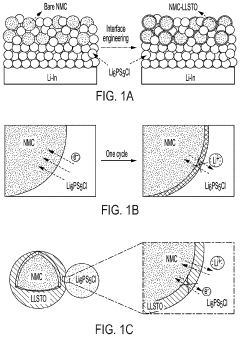
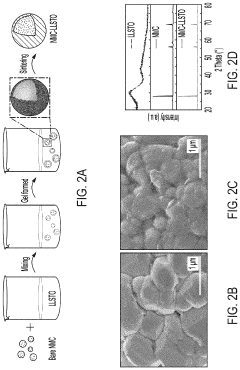
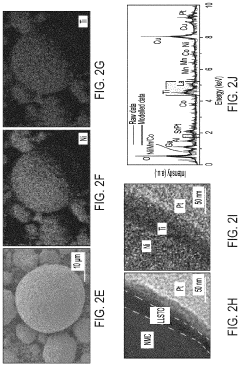
- A thin amorphous Li0.35La0.5Sr0.05TiO3 (LLSTO) coating layer is applied via a wet chemical method to stabilize the interface between the Li6PS5Cl electrolyte and the LiNi1/3Mn1/3Co1/3O2 (NMC) cathode, enhancing ionic conductivity and preventing decomposition, thereby extending cycling performance.
Environmental Impact and Sustainability of Coating Materials
The environmental impact of coating materials in solid-state batteries represents a critical consideration as this technology advances toward commercial viability. Traditional lithium-ion batteries contain toxic and environmentally harmful components, making the sustainability profile of next-generation alternatives particularly important. Coating materials, while comprising a relatively small portion of the overall battery mass, can have disproportionate environmental effects throughout their lifecycle.
Oxide-based coatings such as Al2O3 and ZrO2 generally demonstrate favorable environmental profiles due to their natural abundance and relatively low toxicity. The production processes for these materials, however, often require high-temperature treatments that contribute significantly to energy consumption and associated carbon emissions. In contrast, polymer-based coatings typically require lower processing temperatures, resulting in reduced energy requirements during manufacturing.
Life cycle assessments (LCA) of various coating materials reveal substantial differences in environmental footprints. Fluoride-based coatings, while offering excellent electrochemical performance, present environmental challenges due to the use of fluorinated compounds that persist in the environment and can bioaccumulate. Phosphate-based alternatives generally show better environmental compatibility but may involve complex synthesis routes with their own sustainability concerns.
Water consumption represents another critical metric in evaluating coating material sustainability. Sol-gel processes commonly used for oxide coating deposition can be water-intensive, while dry coating methods may reduce water requirements but often at the cost of increased energy consumption. Recent innovations in aqueous processing techniques show promise for reducing both solvent use and energy requirements.
End-of-life considerations further differentiate coating materials from a sustainability perspective. Materials that can be effectively recovered and recycled, such as certain metal oxides, present advantages over composite or highly processed coatings that may be difficult to separate from other battery components. The recyclability of coating materials becomes increasingly important as solid-state battery deployment scales up.
Regulatory frameworks worldwide are increasingly emphasizing reduced environmental impact in battery technologies. The European Union's Battery Directive and similar regulations in Asia and North America are driving manufacturers toward more sustainable coating materials and processes. This regulatory landscape is accelerating research into bio-derived coating precursors and environmentally benign synthesis routes that maintain the electrochemical performance requirements of solid-state battery systems.
Oxide-based coatings such as Al2O3 and ZrO2 generally demonstrate favorable environmental profiles due to their natural abundance and relatively low toxicity. The production processes for these materials, however, often require high-temperature treatments that contribute significantly to energy consumption and associated carbon emissions. In contrast, polymer-based coatings typically require lower processing temperatures, resulting in reduced energy requirements during manufacturing.
Life cycle assessments (LCA) of various coating materials reveal substantial differences in environmental footprints. Fluoride-based coatings, while offering excellent electrochemical performance, present environmental challenges due to the use of fluorinated compounds that persist in the environment and can bioaccumulate. Phosphate-based alternatives generally show better environmental compatibility but may involve complex synthesis routes with their own sustainability concerns.
Water consumption represents another critical metric in evaluating coating material sustainability. Sol-gel processes commonly used for oxide coating deposition can be water-intensive, while dry coating methods may reduce water requirements but often at the cost of increased energy consumption. Recent innovations in aqueous processing techniques show promise for reducing both solvent use and energy requirements.
End-of-life considerations further differentiate coating materials from a sustainability perspective. Materials that can be effectively recovered and recycled, such as certain metal oxides, present advantages over composite or highly processed coatings that may be difficult to separate from other battery components. The recyclability of coating materials becomes increasingly important as solid-state battery deployment scales up.
Regulatory frameworks worldwide are increasingly emphasizing reduced environmental impact in battery technologies. The European Union's Battery Directive and similar regulations in Asia and North America are driving manufacturers toward more sustainable coating materials and processes. This regulatory landscape is accelerating research into bio-derived coating precursors and environmentally benign synthesis routes that maintain the electrochemical performance requirements of solid-state battery systems.
Manufacturing Scalability and Cost Analysis
The scalability of coating materials for solid-state batteries represents a critical factor in their commercial viability. Current laboratory-scale coating processes demonstrate promising performance but face significant challenges when transitioning to mass production. Physical vapor deposition (PVD) techniques, commonly used for high-quality ceramic and metal oxide coatings, require expensive vacuum equipment and have relatively low throughput, limiting their applicability in large-scale manufacturing environments.
Solution-based coating methods such as atomic layer deposition (ALD) offer better scalability potential but at increased costs. Industry analysis indicates that ALD equipment for battery production lines can cost between $2-5 million per installation, with operational costs approximately 30-40% higher than conventional lithium-ion battery manufacturing processes. This cost premium remains a significant barrier to widespread adoption.
Material costs vary substantially across coating types. Aluminum oxide (Al2O3) coatings present the most economical option at $5-8 per kg of processed cathode material, while more specialized coatings such as lithium phosphorus oxynitride (LiPON) can exceed $50 per kg. These material costs directly impact the final battery price, with current estimates suggesting coating processes add $15-30 per kWh to solid-state battery production costs.
Production yield represents another critical economic factor. Current coating technologies achieve 85-92% yield rates in pilot production, compared to >95% for established lithium-ion manufacturing processes. Each percentage point of yield improvement translates to approximately 3-4% reduction in overall production costs, highlighting the economic importance of process optimization.
Energy consumption during coating application varies significantly between materials and methods. Ceramic coatings applied via PVD consume 3-5 kWh per square meter of electrode material, while polymer-based coatings applied through solution methods require only 0.8-1.2 kWh for equivalent coverage. This energy differential impacts both production costs and environmental footprint.
Recent industry partnerships between coating technology developers and battery manufacturers have begun addressing these challenges. Joint ventures between materials science companies and automotive battery suppliers have reported 30-40% cost reductions through process optimization and equipment redesign. These collaborations suggest pathways toward economically viable mass production, with projected coating costs decreasing by 8-12% annually as manufacturing scale increases.
Solution-based coating methods such as atomic layer deposition (ALD) offer better scalability potential but at increased costs. Industry analysis indicates that ALD equipment for battery production lines can cost between $2-5 million per installation, with operational costs approximately 30-40% higher than conventional lithium-ion battery manufacturing processes. This cost premium remains a significant barrier to widespread adoption.
Material costs vary substantially across coating types. Aluminum oxide (Al2O3) coatings present the most economical option at $5-8 per kg of processed cathode material, while more specialized coatings such as lithium phosphorus oxynitride (LiPON) can exceed $50 per kg. These material costs directly impact the final battery price, with current estimates suggesting coating processes add $15-30 per kWh to solid-state battery production costs.
Production yield represents another critical economic factor. Current coating technologies achieve 85-92% yield rates in pilot production, compared to >95% for established lithium-ion manufacturing processes. Each percentage point of yield improvement translates to approximately 3-4% reduction in overall production costs, highlighting the economic importance of process optimization.
Energy consumption during coating application varies significantly between materials and methods. Ceramic coatings applied via PVD consume 3-5 kWh per square meter of electrode material, while polymer-based coatings applied through solution methods require only 0.8-1.2 kWh for equivalent coverage. This energy differential impacts both production costs and environmental footprint.
Recent industry partnerships between coating technology developers and battery manufacturers have begun addressing these challenges. Joint ventures between materials science companies and automotive battery suppliers have reported 30-40% cost reductions through process optimization and equipment redesign. These collaborations suggest pathways toward economically viable mass production, with projected coating costs decreasing by 8-12% annually as manufacturing scale increases.
Unlock deeper insights with PatSnap Eureka Quick Research — get a full tech report to explore trends and direct your research. Try now!
Generate Your Research Report Instantly with AI Agent
Supercharge your innovation with PatSnap Eureka AI Agent Platform!