Comparison of SERS Substrates in Different Material Matrices
OCT 11, 202510 MIN READ
Generate Your Research Report Instantly with AI Agent
Patsnap Eureka helps you evaluate technical feasibility & market potential.
SERS Substrate Development History and Objectives
Surface-Enhanced Raman Spectroscopy (SERS) emerged in the late 1970s when researchers observed anomalously enhanced Raman signals from pyridine molecules adsorbed on roughened silver electrodes. This discovery marked the beginning of a revolutionary analytical technique that combines the molecular specificity of Raman spectroscopy with significantly enhanced sensitivity. The initial development focused primarily on silver substrates, with Martin Fleischmann, Patrick Hendra, and James McQuillan publishing their groundbreaking observations in 1974.
Throughout the 1980s and early 1990s, the theoretical understanding of SERS mechanisms evolved substantially. Two primary enhancement mechanisms were identified: electromagnetic enhancement due to localized surface plasmon resonances and chemical enhancement through charge transfer between the substrate and analyte molecules. This period saw the exploration of various noble metal substrates, predominantly silver, gold, and copper, due to their favorable plasmonic properties in the visible and near-infrared regions.
The late 1990s witnessed a significant shift toward nanofabrication techniques for SERS substrate development. Colloidal nanoparticles, nanolithography-based substrates, and electrochemically roughened surfaces became common approaches. Each material matrix offered distinct advantages in terms of enhancement factors, reproducibility, and stability. Gold substrates gained popularity due to their chemical stability and biocompatibility, despite silver generally providing higher enhancement factors.
The 2000s marked the beginning of commercial SERS substrate production, with companies like Klarite introducing standardized substrates. This period also saw increased interest in non-traditional substrate materials, including semiconductor-based SERS substrates, graphene-enhanced platforms, and hybrid materials combining multiple enhancement mechanisms.
The current technological objectives in SERS substrate development focus on several key areas: achieving ultrahigh sensitivity with single-molecule detection capabilities, improving reproducibility for quantitative analysis, enhancing substrate stability for field applications, and developing cost-effective manufacturing processes for widespread adoption. Researchers are particularly interested in creating universal SERS substrates capable of detecting diverse analytes across various sample matrices.
Recent trends include the development of flexible SERS substrates for wearable sensing applications, environmentally friendly "green" SERS substrates, and stimuli-responsive smart SERS platforms. The integration of SERS substrates with microfluidic systems and portable Raman spectrometers represents another significant direction, aiming to transform SERS from a laboratory technique into a field-deployable analytical tool for applications ranging from environmental monitoring to point-of-care diagnostics.
Throughout the 1980s and early 1990s, the theoretical understanding of SERS mechanisms evolved substantially. Two primary enhancement mechanisms were identified: electromagnetic enhancement due to localized surface plasmon resonances and chemical enhancement through charge transfer between the substrate and analyte molecules. This period saw the exploration of various noble metal substrates, predominantly silver, gold, and copper, due to their favorable plasmonic properties in the visible and near-infrared regions.
The late 1990s witnessed a significant shift toward nanofabrication techniques for SERS substrate development. Colloidal nanoparticles, nanolithography-based substrates, and electrochemically roughened surfaces became common approaches. Each material matrix offered distinct advantages in terms of enhancement factors, reproducibility, and stability. Gold substrates gained popularity due to their chemical stability and biocompatibility, despite silver generally providing higher enhancement factors.
The 2000s marked the beginning of commercial SERS substrate production, with companies like Klarite introducing standardized substrates. This period also saw increased interest in non-traditional substrate materials, including semiconductor-based SERS substrates, graphene-enhanced platforms, and hybrid materials combining multiple enhancement mechanisms.
The current technological objectives in SERS substrate development focus on several key areas: achieving ultrahigh sensitivity with single-molecule detection capabilities, improving reproducibility for quantitative analysis, enhancing substrate stability for field applications, and developing cost-effective manufacturing processes for widespread adoption. Researchers are particularly interested in creating universal SERS substrates capable of detecting diverse analytes across various sample matrices.
Recent trends include the development of flexible SERS substrates for wearable sensing applications, environmentally friendly "green" SERS substrates, and stimuli-responsive smart SERS platforms. The integration of SERS substrates with microfluidic systems and portable Raman spectrometers represents another significant direction, aiming to transform SERS from a laboratory technique into a field-deployable analytical tool for applications ranging from environmental monitoring to point-of-care diagnostics.
Market Analysis for SERS-based Sensing Applications
The global market for Surface-Enhanced Raman Spectroscopy (SERS)-based sensing applications has experienced significant growth in recent years, driven by increasing demand for highly sensitive detection methods across multiple industries. The market size was valued at approximately $250 million in 2022 and is projected to reach $450 million by 2027, representing a compound annual growth rate (CAGR) of 12.5%.
Healthcare and life sciences currently dominate the SERS market, accounting for nearly 40% of the total market share. Within this sector, applications in disease diagnosis, biomarker detection, and drug discovery are particularly prominent. The pharmaceutical industry has increasingly adopted SERS technology for quality control processes and counterfeit drug detection, contributing to market expansion.
Environmental monitoring represents another rapidly growing segment, with a projected CAGR of 15% through 2027. Government regulations mandating stricter monitoring of pollutants and contaminants have accelerated adoption in this sector. Water quality testing applications alone are expected to grow by 18% annually as municipalities and private companies implement more sophisticated testing protocols.
Food safety testing applications have emerged as a high-potential market segment, particularly in developed economies with stringent food safety regulations. The ability of SERS to detect pesticides, antibiotics, and pathogens at trace levels has made it increasingly valuable to food producers and regulatory agencies.
Regional analysis reveals North America as the largest market for SERS-based sensing applications, holding approximately 35% of the global market share. However, the Asia-Pacific region is experiencing the fastest growth rate at 16% annually, driven by increasing industrialization, research funding, and adoption of advanced analytical technologies in countries like China, Japan, and South Korea.
The market dynamics are heavily influenced by substrate material selection. Gold and silver-based SERS substrates currently dominate commercial applications, accounting for over 70% of the market. However, novel substrate materials including graphene, semiconductor, and hybrid materials are gaining traction due to their enhanced performance characteristics and expanding application potential.
End-user preferences indicate growing demand for disposable, standardized SERS substrates that offer consistent enhancement factors and reproducible results. This trend is particularly evident in clinical diagnostics and point-of-care testing applications, where reliability and ease of use are paramount considerations.
Market challenges include the relatively high cost of high-quality SERS substrates, technical expertise requirements, and competition from alternative sensing technologies. However, ongoing advancements in nanofabrication techniques and increasing commercial availability of standardized SERS substrates are gradually addressing these barriers to wider market adoption.
Healthcare and life sciences currently dominate the SERS market, accounting for nearly 40% of the total market share. Within this sector, applications in disease diagnosis, biomarker detection, and drug discovery are particularly prominent. The pharmaceutical industry has increasingly adopted SERS technology for quality control processes and counterfeit drug detection, contributing to market expansion.
Environmental monitoring represents another rapidly growing segment, with a projected CAGR of 15% through 2027. Government regulations mandating stricter monitoring of pollutants and contaminants have accelerated adoption in this sector. Water quality testing applications alone are expected to grow by 18% annually as municipalities and private companies implement more sophisticated testing protocols.
Food safety testing applications have emerged as a high-potential market segment, particularly in developed economies with stringent food safety regulations. The ability of SERS to detect pesticides, antibiotics, and pathogens at trace levels has made it increasingly valuable to food producers and regulatory agencies.
Regional analysis reveals North America as the largest market for SERS-based sensing applications, holding approximately 35% of the global market share. However, the Asia-Pacific region is experiencing the fastest growth rate at 16% annually, driven by increasing industrialization, research funding, and adoption of advanced analytical technologies in countries like China, Japan, and South Korea.
The market dynamics are heavily influenced by substrate material selection. Gold and silver-based SERS substrates currently dominate commercial applications, accounting for over 70% of the market. However, novel substrate materials including graphene, semiconductor, and hybrid materials are gaining traction due to their enhanced performance characteristics and expanding application potential.
End-user preferences indicate growing demand for disposable, standardized SERS substrates that offer consistent enhancement factors and reproducible results. This trend is particularly evident in clinical diagnostics and point-of-care testing applications, where reliability and ease of use are paramount considerations.
Market challenges include the relatively high cost of high-quality SERS substrates, technical expertise requirements, and competition from alternative sensing technologies. However, ongoing advancements in nanofabrication techniques and increasing commercial availability of standardized SERS substrates are gradually addressing these barriers to wider market adoption.
Current SERS Substrate Technologies and Limitations
Surface-Enhanced Raman Spectroscopy (SERS) substrates have evolved significantly over the past decades, with various materials and fabrication techniques being developed to enhance Raman signals. Currently, the most widely used SERS substrates can be categorized into several major types based on their material composition and structural characteristics.
Metal nanoparticle-based substrates, particularly those utilizing gold and silver, remain the most common SERS platforms due to their strong plasmonic properties. Gold nanoparticles offer excellent stability and biocompatibility, making them suitable for biological applications, while silver nanoparticles typically provide higher enhancement factors but suffer from oxidation issues. Copper nanoparticles represent a more cost-effective alternative but generally deliver lower enhancement factors compared to gold and silver.
Nanopatterned metallic surfaces constitute another significant category, including nanopillar arrays, nanoholes, and nanogratings fabricated through techniques such as electron-beam lithography, nanoimprint lithography, and focused ion beam milling. These substrates offer high reproducibility and uniformity but often require sophisticated fabrication equipment.
Hybrid substrates combining metallic nanostructures with other materials have gained increasing attention. Metal-dielectric composites, metal-semiconductor interfaces, and metal-polymer nanocomposites have demonstrated promising enhancement capabilities by leveraging both electromagnetic and chemical enhancement mechanisms.
Despite these advancements, current SERS substrate technologies face several critical limitations. Reproducibility remains a significant challenge, with batch-to-batch variations affecting quantitative analysis reliability. Many high-performance substrates suffer from limited shelf-life due to oxidation, contamination, or structural degradation over time.
Substrate specificity presents another limitation, as most SERS substrates are optimized for specific analyte types or wavelength ranges, restricting their versatility across different applications. The trade-off between enhancement factor and uniformity continues to challenge researchers, as substrates with extremely high enhancement factors often exhibit poor spatial uniformity.
Manufacturing scalability constitutes a persistent bottleneck, with many high-performance SERS substrates requiring complex fabrication processes that are difficult to scale up for mass production. This directly impacts cost-effectiveness, making many advanced SERS substrates prohibitively expensive for routine analytical applications.
Biocompatibility limitations affect biological and medical applications, as some substrate materials may interfere with biological samples or exhibit cytotoxicity. Additionally, most current substrates demonstrate limited performance in complex matrices such as blood, soil, or food samples, where interference from matrix components can significantly reduce sensitivity.
Metal nanoparticle-based substrates, particularly those utilizing gold and silver, remain the most common SERS platforms due to their strong plasmonic properties. Gold nanoparticles offer excellent stability and biocompatibility, making them suitable for biological applications, while silver nanoparticles typically provide higher enhancement factors but suffer from oxidation issues. Copper nanoparticles represent a more cost-effective alternative but generally deliver lower enhancement factors compared to gold and silver.
Nanopatterned metallic surfaces constitute another significant category, including nanopillar arrays, nanoholes, and nanogratings fabricated through techniques such as electron-beam lithography, nanoimprint lithography, and focused ion beam milling. These substrates offer high reproducibility and uniformity but often require sophisticated fabrication equipment.
Hybrid substrates combining metallic nanostructures with other materials have gained increasing attention. Metal-dielectric composites, metal-semiconductor interfaces, and metal-polymer nanocomposites have demonstrated promising enhancement capabilities by leveraging both electromagnetic and chemical enhancement mechanisms.
Despite these advancements, current SERS substrate technologies face several critical limitations. Reproducibility remains a significant challenge, with batch-to-batch variations affecting quantitative analysis reliability. Many high-performance substrates suffer from limited shelf-life due to oxidation, contamination, or structural degradation over time.
Substrate specificity presents another limitation, as most SERS substrates are optimized for specific analyte types or wavelength ranges, restricting their versatility across different applications. The trade-off between enhancement factor and uniformity continues to challenge researchers, as substrates with extremely high enhancement factors often exhibit poor spatial uniformity.
Manufacturing scalability constitutes a persistent bottleneck, with many high-performance SERS substrates requiring complex fabrication processes that are difficult to scale up for mass production. This directly impacts cost-effectiveness, making many advanced SERS substrates prohibitively expensive for routine analytical applications.
Biocompatibility limitations affect biological and medical applications, as some substrate materials may interfere with biological samples or exhibit cytotoxicity. Additionally, most current substrates demonstrate limited performance in complex matrices such as blood, soil, or food samples, where interference from matrix components can significantly reduce sensitivity.
Comparative Analysis of Material Matrices for SERS Substrates
01 Nanostructured SERS substrates
Nanostructured materials are widely used as SERS substrates due to their ability to enhance Raman signals. These substrates typically feature metallic nanoparticles or nanostructures that create localized surface plasmon resonances. The performance of these substrates depends on factors such as nanoparticle size, shape, spacing, and arrangement. Various fabrication methods including lithography, self-assembly, and chemical synthesis are employed to create optimized nanostructured SERS substrates with high enhancement factors.- Substrate material composition for enhanced SERS performance: Different substrate materials significantly impact SERS performance. Metal nanostructures, particularly those made of gold, silver, and copper, are commonly used due to their plasmonic properties. Novel composite materials combining metallic elements with other materials like graphene, polymers, or semiconductors can provide improved sensitivity and reproducibility. The specific composition affects the enhancement factor, signal-to-noise ratio, and detection limits in SERS applications.
- Nanostructure geometry and morphology effects: The geometry and morphology of SERS substrates critically influence their performance. Various nanostructures including nanospheres, nanorods, nanostars, and hierarchical structures offer different enhancement capabilities. The size, shape, spacing, and arrangement of nanostructures determine the creation of hot spots where electromagnetic fields are concentrated. Controlled fabrication of specific geometries enables optimization of SERS enhancement factors and reproducibility across the substrate surface.
- Fabrication methods comparison for SERS substrates: Various fabrication techniques produce SERS substrates with different performance characteristics. Top-down approaches like lithography offer precise control over nanostructure arrangement but may be costly. Bottom-up methods such as chemical synthesis provide scalability but with less uniformity. Self-assembly techniques balance cost and performance. Advanced hybrid fabrication methods combining multiple approaches can create optimized substrates with enhanced sensitivity, reproducibility, and stability for specific analytical applications.
- Stability and reproducibility assessment: The stability and reproducibility of SERS substrates are critical performance metrics. Factors affecting stability include resistance to oxidation, mechanical durability, and shelf-life. Reproducibility encompasses batch-to-batch consistency, signal uniformity across the substrate, and measurement repeatability. Various protective coatings and stabilization techniques can enhance long-term stability. Standardized testing protocols and reference materials enable objective comparison between different substrate technologies and manufacturing processes.
- Application-specific performance optimization: SERS substrates can be optimized for specific applications by tailoring their properties. Biomedical applications may require biocompatible materials and specific molecular recognition elements. Environmental monitoring applications need durability in harsh conditions. Food safety testing requires substrates compatible with complex matrices. Performance metrics vary by application, including detection limits, dynamic range, selectivity, and multiplexing capability. Comparative analysis of different substrates across application-relevant parameters enables selection of optimal SERS platforms for specific use cases.
02 Measurement and characterization techniques
Various techniques are employed to evaluate and compare the performance of SERS substrates. These include enhancement factor calculations, signal-to-noise ratio measurements, reproducibility testing, and stability assessments. Advanced spectroscopic methods and imaging techniques help characterize the optical properties and surface morphology of SERS substrates. Standardized testing protocols enable objective comparison between different substrate types, which is crucial for determining their suitability for specific analytical applications.Expand Specific Solutions03 Novel materials for SERS enhancement
Research has focused on developing novel materials beyond traditional gold and silver substrates to improve SERS performance. These include hybrid materials, composite structures, 2D materials like graphene, and semiconductor-metal combinations. Some approaches incorporate organic molecules or polymers to create functional SERS platforms with improved sensitivity and selectivity. These novel materials often demonstrate unique enhancement mechanisms and can offer advantages such as broader wavelength response, improved stability, or biocompatibility.Expand Specific Solutions04 Portable and integrated SERS systems
Advancements in SERS substrate technology have enabled the development of portable and integrated sensing systems. These systems combine optimized SERS substrates with miniaturized spectrometers, light sources, and data processing capabilities. Such integration allows for field-deployable SERS analysis with performance comparable to laboratory systems. Various designs focus on sample handling, substrate positioning, and signal collection to maximize sensitivity while maintaining portability and ease of use.Expand Specific Solutions05 Application-specific SERS substrate optimization
SERS substrates can be optimized for specific applications by tailoring their properties to match particular analytes or detection environments. This includes surface functionalization for selective binding, pH-responsive elements, or environmentally stable coatings. Performance comparisons show that application-specific optimization can significantly improve detection limits, selectivity, and reliability. Different substrate designs may excel in different contexts, such as biological sample analysis, environmental monitoring, or food safety testing.Expand Specific Solutions
Leading Manufacturers and Research Institutions in SERS
The SERS substrate market is currently in a growth phase, characterized by increasing adoption across analytical chemistry, biomedical diagnostics, and environmental monitoring applications. The global market size is estimated to reach approximately $150 million by 2025, with a CAGR of 10-12%. Technical maturity varies significantly across substrate types, with established players like IBM and Huawei focusing on commercial applications, while research institutions such as Agency for Science, Technology & Research, University of Houston, and National Research Laboratory lead fundamental innovations. Academic-industry collaborations are accelerating, particularly in Asia where China Jiliang University, Jiangnan University, and Korean institutes are developing cost-effective manufacturing processes. The competitive landscape shows a balance between specialized companies like Suzhou Nawei Life Technology and Bright Quantum focusing on niche applications, and larger corporations integrating SERS into broader analytical platforms.
Suzhou Nawei Life Technology Co., Ltd.
Technical Solution: Suzhou Nawei has developed proprietary SERS substrates utilizing noble metal nanostructures (primarily gold and silver) on silicon wafers with precisely controlled nanogap spacing. Their technology employs a unique combination of electron beam lithography and chemical synthesis to create highly uniform and reproducible SERS-active sites. The company's substrates feature hierarchical 3D nanostructures that maximize the electromagnetic enhancement effect, achieving enhancement factors exceeding 10^8 for consistent molecular detection. Their recent innovation includes a polymer-stabilized SERS substrate that maintains signal stability in complex biological matrices, addressing a key challenge in bioanalytical applications. Nawei's substrates incorporate specialized surface chemistry modifications to enhance compatibility with different sample matrices including biological fluids, environmental samples, and food extracts.
Strengths: Exceptional reproducibility with <10% RSD across batches; excellent stability in complex biological matrices; high sensitivity with detection limits in the femtomolar range. Weaknesses: Higher production costs compared to chemical synthesis methods; limited substrate flexibility for curved surfaces; requires specialized instrumentation for optimal performance.
Naval Research Laboratory
Technical Solution: The Naval Research Laboratory has developed advanced SERS substrates specifically engineered for harsh environmental matrices and field-deployable applications. Their technology utilizes nanoporous gold structures created through a proprietary dealloying process that produces a sponge-like architecture with an exceptionally high density of SERS-active "hot spots." These substrates demonstrate remarkable durability in marine environments, maintaining enhancement properties even after extended exposure to seawater. NRL researchers have pioneered specialized surface functionalization approaches that enable selective detection of trace contaminants in complex environmental matrices including seawater, soil extracts, and industrial effluents. Their recent innovations include a reusable SERS substrate with a self-cleaning mechanism activated by UV light exposure, addressing a key limitation in field applications. The laboratory has also developed portable SERS detection systems that integrate their specialized substrates with miniaturized spectrometers for real-time environmental monitoring applications.
Strengths: Exceptional durability in harsh environments; reusable design with self-cleaning capabilities; excellent performance in high-salt matrices like seawater. Weaknesses: Less effective for large biomolecule detection; more specialized for environmental applications than biological matrices; higher initial development costs.
Key Patents and Breakthroughs in SERS Substrate Design
Substrates for surface enhanced raman spectroscopy
PatentInactiveUS20160274031A1
Innovation
- A method involving high dose metal ion implantation into substrates to form metal nano-particle/substrate composites, where the substrate is ion implanted with metal ions to exceed solid solubility limits, followed by thermal annealing and selective etching to expose nano-particles, allowing for controlled particle size and separation, and enabling the use of various substrate materials and geometries.
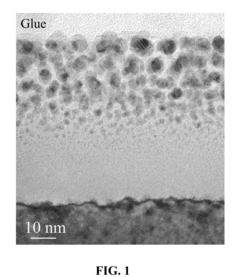
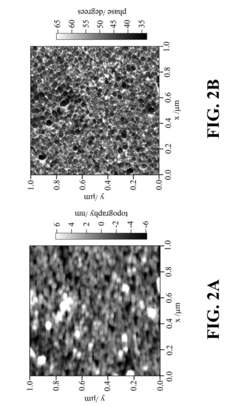
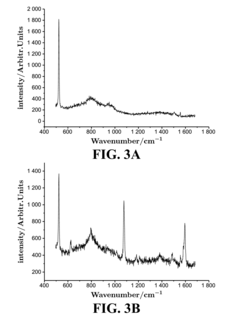
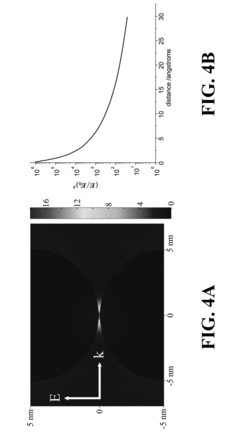
Surface-enhanced raman spectroscopy substrate for arsenic sensing in groundwater
PatentActiveUS9057705B2
Innovation
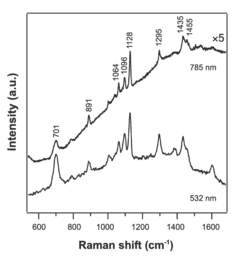
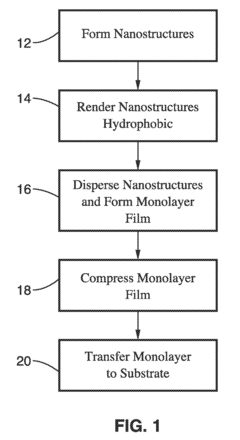
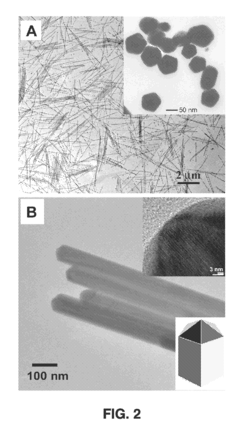
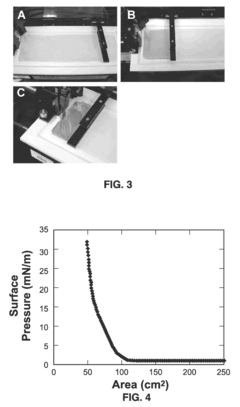
- The Langmuir-Blodgett technique is adapted to assemble monolayers of nanostructures by surface functionalization, allowing for the formation of ordered monolayers of silver nanowires with controlled shapes, such as cube-shaped, plate-shaped, rod-shaped, and hexagon-shaped nanostructures, and their subsequent compression to create aligned, close-packed arrays that function as surface-enhanced Raman spectroscopy (SERS) substrates.
Standardization and Reproducibility Challenges
One of the most significant challenges in SERS substrate comparison across different material matrices is the lack of standardized protocols for substrate preparation, measurement, and data analysis. This inconsistency creates substantial barriers to reproducibility, making it difficult to compare results between different research groups or even within the same laboratory over time. Current manufacturing processes for SERS substrates often suffer from batch-to-batch variations, leading to inconsistent enhancement factors and detection sensitivities.
The heterogeneity in substrate morphology represents another critical challenge. Even minor variations in nanostructure geometry, spacing, or surface roughness can dramatically alter SERS performance. This is particularly problematic when comparing substrates composed of different materials, as each material system may require unique optimization parameters that are not directly transferable to other systems.
Environmental factors further complicate standardization efforts. Temperature fluctuations, humidity levels, and ambient light conditions can all influence SERS measurements, especially for certain material matrices that exhibit environmental sensitivity. Without standardized environmental controls, meaningful comparisons between different substrate materials become increasingly difficult.
Analytical methodology inconsistencies also contribute to reproducibility issues. Variations in laser wavelength, power settings, acquisition times, and data processing algorithms can significantly impact SERS spectra. The scientific community has yet to establish universal protocols for these parameters, leading to discrepancies when comparing results across different studies.
Sample preparation techniques represent another variable that affects reproducibility. The interaction between analytes and different substrate materials can vary substantially, requiring material-specific optimization of sample deposition methods. Without standardized approaches for each material matrix, direct comparisons may lead to misleading conclusions about relative performance.
Quantification metrics present additional challenges. While enhancement factor (EF) is commonly used to evaluate SERS substrates, its calculation methods vary widely across the literature. Some researchers focus on average enhancement, while others report maximum values, making direct comparisons between different material matrices problematic without standardized reporting frameworks.
Addressing these challenges requires collaborative efforts across the SERS community to develop consensus-based standards for substrate characterization, measurement protocols, and performance metrics. Recent initiatives by international standards organizations have begun to address these issues, but significant work remains to establish universally accepted methodologies for comparing SERS substrates across different material matrices.
The heterogeneity in substrate morphology represents another critical challenge. Even minor variations in nanostructure geometry, spacing, or surface roughness can dramatically alter SERS performance. This is particularly problematic when comparing substrates composed of different materials, as each material system may require unique optimization parameters that are not directly transferable to other systems.
Environmental factors further complicate standardization efforts. Temperature fluctuations, humidity levels, and ambient light conditions can all influence SERS measurements, especially for certain material matrices that exhibit environmental sensitivity. Without standardized environmental controls, meaningful comparisons between different substrate materials become increasingly difficult.
Analytical methodology inconsistencies also contribute to reproducibility issues. Variations in laser wavelength, power settings, acquisition times, and data processing algorithms can significantly impact SERS spectra. The scientific community has yet to establish universal protocols for these parameters, leading to discrepancies when comparing results across different studies.
Sample preparation techniques represent another variable that affects reproducibility. The interaction between analytes and different substrate materials can vary substantially, requiring material-specific optimization of sample deposition methods. Without standardized approaches for each material matrix, direct comparisons may lead to misleading conclusions about relative performance.
Quantification metrics present additional challenges. While enhancement factor (EF) is commonly used to evaluate SERS substrates, its calculation methods vary widely across the literature. Some researchers focus on average enhancement, while others report maximum values, making direct comparisons between different material matrices problematic without standardized reporting frameworks.
Addressing these challenges requires collaborative efforts across the SERS community to develop consensus-based standards for substrate characterization, measurement protocols, and performance metrics. Recent initiatives by international standards organizations have begun to address these issues, but significant work remains to establish universally accepted methodologies for comparing SERS substrates across different material matrices.
Environmental and Biocompatibility Considerations
The environmental impact and biocompatibility of SERS substrates represent critical considerations for their practical application, particularly in biological and environmental sensing contexts. Different material matrices used in SERS substrates exhibit varying degrees of environmental persistence, degradability, and toxicity profiles that must be carefully evaluated before deployment in real-world scenarios.
Noble metal-based SERS substrates, particularly those utilizing silver and gold nanostructures, present distinct environmental challenges. Silver nanoparticles demonstrate significant antimicrobial properties that, while beneficial in certain applications, may disrupt microbial ecosystems when released into the environment. Gold nanostructures generally exhibit lower toxicity profiles compared to silver, making them potentially more suitable for biological applications, though their environmental persistence remains a concern due to their non-biodegradable nature.
Carbon-based SERS substrates, including graphene and carbon nanotubes, offer improved biocompatibility compared to certain metallic alternatives. However, their environmental fate and potential for bioaccumulation require further investigation. Recent studies suggest that functionalization of carbon-based materials can significantly alter their environmental behavior and toxicity profiles, potentially mitigating adverse effects.
Polymer-based SERS substrates present promising biocompatibility characteristics, particularly when composed of biodegradable polymers such as polylactic acid (PLA) or polycaprolactone (PCL). These materials can be designed to degrade into non-toxic byproducts, reducing long-term environmental impact. However, the degradation products and their potential interactions with environmental systems must be thoroughly characterized.
Hybrid SERS substrates combining multiple material classes often aim to balance performance with biocompatibility. For instance, core-shell structures with biocompatible coatings over metallic cores can reduce direct exposure to potentially toxic elements while maintaining enhanced SERS activity. Similarly, embedding metallic nanoparticles within biodegradable polymer matrices can provide controlled release and eventual degradation pathways.
Regulatory frameworks increasingly demand comprehensive assessment of nanomaterial environmental impact and biocompatibility. Testing protocols typically include cytotoxicity assays, hemolysis studies, immunogenicity assessments, and ecotoxicological evaluations. The development of standardized testing methodologies specific to SERS substrates remains an active area of research, as current approaches may not fully capture the unique properties and potential impacts of these specialized materials.
Future directions in SERS substrate development increasingly emphasize "green synthesis" approaches and biomimetic designs that inherently reduce environmental impact while maintaining or enhancing analytical performance. These environmentally conscious design principles represent a promising pathway toward sustainable SERS technologies suitable for widespread deployment in environmental monitoring and biomedical applications.
Noble metal-based SERS substrates, particularly those utilizing silver and gold nanostructures, present distinct environmental challenges. Silver nanoparticles demonstrate significant antimicrobial properties that, while beneficial in certain applications, may disrupt microbial ecosystems when released into the environment. Gold nanostructures generally exhibit lower toxicity profiles compared to silver, making them potentially more suitable for biological applications, though their environmental persistence remains a concern due to their non-biodegradable nature.
Carbon-based SERS substrates, including graphene and carbon nanotubes, offer improved biocompatibility compared to certain metallic alternatives. However, their environmental fate and potential for bioaccumulation require further investigation. Recent studies suggest that functionalization of carbon-based materials can significantly alter their environmental behavior and toxicity profiles, potentially mitigating adverse effects.
Polymer-based SERS substrates present promising biocompatibility characteristics, particularly when composed of biodegradable polymers such as polylactic acid (PLA) or polycaprolactone (PCL). These materials can be designed to degrade into non-toxic byproducts, reducing long-term environmental impact. However, the degradation products and their potential interactions with environmental systems must be thoroughly characterized.
Hybrid SERS substrates combining multiple material classes often aim to balance performance with biocompatibility. For instance, core-shell structures with biocompatible coatings over metallic cores can reduce direct exposure to potentially toxic elements while maintaining enhanced SERS activity. Similarly, embedding metallic nanoparticles within biodegradable polymer matrices can provide controlled release and eventual degradation pathways.
Regulatory frameworks increasingly demand comprehensive assessment of nanomaterial environmental impact and biocompatibility. Testing protocols typically include cytotoxicity assays, hemolysis studies, immunogenicity assessments, and ecotoxicological evaluations. The development of standardized testing methodologies specific to SERS substrates remains an active area of research, as current approaches may not fully capture the unique properties and potential impacts of these specialized materials.
Future directions in SERS substrate development increasingly emphasize "green synthesis" approaches and biomimetic designs that inherently reduce environmental impact while maintaining or enhancing analytical performance. These environmentally conscious design principles represent a promising pathway toward sustainable SERS technologies suitable for widespread deployment in environmental monitoring and biomedical applications.
Unlock deeper insights with Patsnap Eureka Quick Research — get a full tech report to explore trends and direct your research. Try now!
Generate Your Research Report Instantly with AI Agent
Supercharge your innovation with Patsnap Eureka AI Agent Platform!