Field-Strength Modulation in NMR Relaxation Experiments
SEP 22, 202510 MIN READ
Generate Your Research Report Instantly with AI Agent
PatSnap Eureka helps you evaluate technical feasibility & market potential.
NMR Field-Strength Modulation Background and Objectives
Nuclear Magnetic Resonance (NMR) spectroscopy has evolved significantly since its discovery in the 1940s, becoming an indispensable analytical tool across various scientific disciplines. Field-Strength Modulation in NMR relaxation experiments represents a sophisticated advancement in this technology, enabling researchers to extract more detailed molecular information by systematically varying the magnetic field strength during measurements.
The evolution of NMR technology has progressed from simple continuous wave instruments to complex multi-dimensional pulse sequences and high-field superconducting magnets. Field-Strength Modulation techniques emerged in the late 1990s as researchers sought methods to enhance resolution and extract additional parameters from relaxation measurements. This approach has gained significant traction in the past decade with improvements in hardware capabilities and pulse sequence design.
The fundamental principle behind Field-Strength Modulation involves the controlled variation of the external magnetic field during relaxation measurements, allowing for the observation of field-dependent relaxation phenomena. This technique provides unique insights into molecular dynamics, particularly for systems with complex relaxation mechanisms that exhibit field-dependent behavior.
Current technological trends indicate a growing integration of Field-Strength Modulation with other advanced NMR methodologies, including hyperpolarization techniques, ultrafast acquisition methods, and machine learning approaches for data analysis. The convergence of these technologies promises to expand the applicability and information content of NMR experiments significantly.
The primary objectives of Field-Strength Modulation research include enhancing the sensitivity and specificity of NMR relaxation measurements, particularly for complex biological systems and materials with heterogeneous structures. Researchers aim to develop standardized protocols that can be implemented across different NMR platforms, ensuring reproducibility and facilitating broader adoption in both academic and industrial settings.
Another critical goal involves the development of comprehensive theoretical frameworks that accurately model field-dependent relaxation phenomena, enabling more precise interpretation of experimental data. This includes accounting for various relaxation mechanisms, including dipolar interactions, chemical exchange, and paramagnetic effects, which exhibit distinct field-strength dependencies.
From an instrumentation perspective, objectives include designing more stable and precise field modulation hardware, reducing artifacts, and extending the range of accessible field strengths. Parallel efforts focus on optimizing pulse sequences and data processing algorithms to maximize the information extracted from field-modulated experiments while minimizing acquisition times.
The long-term vision for this technology encompasses its integration into routine analytical workflows, particularly in pharmaceutical research, materials science, and medical diagnostics, where detailed molecular characterization can significantly impact product development and clinical outcomes.
The evolution of NMR technology has progressed from simple continuous wave instruments to complex multi-dimensional pulse sequences and high-field superconducting magnets. Field-Strength Modulation techniques emerged in the late 1990s as researchers sought methods to enhance resolution and extract additional parameters from relaxation measurements. This approach has gained significant traction in the past decade with improvements in hardware capabilities and pulse sequence design.
The fundamental principle behind Field-Strength Modulation involves the controlled variation of the external magnetic field during relaxation measurements, allowing for the observation of field-dependent relaxation phenomena. This technique provides unique insights into molecular dynamics, particularly for systems with complex relaxation mechanisms that exhibit field-dependent behavior.
Current technological trends indicate a growing integration of Field-Strength Modulation with other advanced NMR methodologies, including hyperpolarization techniques, ultrafast acquisition methods, and machine learning approaches for data analysis. The convergence of these technologies promises to expand the applicability and information content of NMR experiments significantly.
The primary objectives of Field-Strength Modulation research include enhancing the sensitivity and specificity of NMR relaxation measurements, particularly for complex biological systems and materials with heterogeneous structures. Researchers aim to develop standardized protocols that can be implemented across different NMR platforms, ensuring reproducibility and facilitating broader adoption in both academic and industrial settings.
Another critical goal involves the development of comprehensive theoretical frameworks that accurately model field-dependent relaxation phenomena, enabling more precise interpretation of experimental data. This includes accounting for various relaxation mechanisms, including dipolar interactions, chemical exchange, and paramagnetic effects, which exhibit distinct field-strength dependencies.
From an instrumentation perspective, objectives include designing more stable and precise field modulation hardware, reducing artifacts, and extending the range of accessible field strengths. Parallel efforts focus on optimizing pulse sequences and data processing algorithms to maximize the information extracted from field-modulated experiments while minimizing acquisition times.
The long-term vision for this technology encompasses its integration into routine analytical workflows, particularly in pharmaceutical research, materials science, and medical diagnostics, where detailed molecular characterization can significantly impact product development and clinical outcomes.
Market Applications of Field-Strength Modulated NMR
Field-strength modulated NMR technology has established significant market applications across multiple industries, transforming analytical capabilities in sectors where molecular characterization is critical. The healthcare and pharmaceutical industries represent the largest market segment, with field-strength modulation techniques enabling more precise drug development processes through enhanced relaxation measurements that reveal crucial information about molecular dynamics and interactions.
In clinical diagnostics, these advanced NMR techniques are increasingly deployed for metabolomic profiling, allowing for more accurate disease biomarker identification with reduced measurement time. The market for NMR-based diagnostic tools is projected to grow substantially as hospitals and research institutions adopt these more sensitive detection methods.
The food and beverage industry has embraced field-strength modulated NMR for quality control applications, where it provides superior detection of adulterants and contaminants compared to conventional analytical methods. Major food manufacturers have implemented these systems to verify product authenticity and ensure regulatory compliance, creating a steady market demand for specialized NMR equipment.
In materials science and polymer research, field-strength modulation techniques have opened new commercial opportunities by enabling more detailed characterization of material properties at the molecular level. This has proven particularly valuable for developing advanced composites and smart materials with precisely engineered characteristics.
The petrochemical industry represents another significant market application, where modulated NMR relaxation experiments provide critical insights into complex hydrocarbon mixtures, improving refining processes and product quality. Several major oil companies have invested in these advanced NMR systems to optimize their production workflows.
Environmental monitoring applications have emerged as a growing market segment, with field-strength modulated NMR techniques being adapted for the analysis of soil samples, water contaminants, and atmospheric compounds. The enhanced sensitivity allows for detection of pollutants at lower concentrations than previously possible.
Academic and research institutions continue to drive market demand for cutting-edge NMR technologies, particularly as field-strength modulation techniques become more accessible through commercial instrument packages. This has expanded the potential user base beyond specialized NMR experts to broader scientific communities.
The global market for advanced NMR technologies incorporating field-strength modulation capabilities shows regional variations, with North America and Europe currently representing the largest market shares, while Asia-Pacific regions demonstrate the fastest growth rates as research infrastructure expands in countries like China, Japan, and South Korea.
In clinical diagnostics, these advanced NMR techniques are increasingly deployed for metabolomic profiling, allowing for more accurate disease biomarker identification with reduced measurement time. The market for NMR-based diagnostic tools is projected to grow substantially as hospitals and research institutions adopt these more sensitive detection methods.
The food and beverage industry has embraced field-strength modulated NMR for quality control applications, where it provides superior detection of adulterants and contaminants compared to conventional analytical methods. Major food manufacturers have implemented these systems to verify product authenticity and ensure regulatory compliance, creating a steady market demand for specialized NMR equipment.
In materials science and polymer research, field-strength modulation techniques have opened new commercial opportunities by enabling more detailed characterization of material properties at the molecular level. This has proven particularly valuable for developing advanced composites and smart materials with precisely engineered characteristics.
The petrochemical industry represents another significant market application, where modulated NMR relaxation experiments provide critical insights into complex hydrocarbon mixtures, improving refining processes and product quality. Several major oil companies have invested in these advanced NMR systems to optimize their production workflows.
Environmental monitoring applications have emerged as a growing market segment, with field-strength modulated NMR techniques being adapted for the analysis of soil samples, water contaminants, and atmospheric compounds. The enhanced sensitivity allows for detection of pollutants at lower concentrations than previously possible.
Academic and research institutions continue to drive market demand for cutting-edge NMR technologies, particularly as field-strength modulation techniques become more accessible through commercial instrument packages. This has expanded the potential user base beyond specialized NMR experts to broader scientific communities.
The global market for advanced NMR technologies incorporating field-strength modulation capabilities shows regional variations, with North America and Europe currently representing the largest market shares, while Asia-Pacific regions demonstrate the fastest growth rates as research infrastructure expands in countries like China, Japan, and South Korea.
Technical Challenges in NMR Relaxation Experiments
Nuclear Magnetic Resonance (NMR) relaxation experiments face several significant technical challenges that limit their application and accuracy. The modulation of field strength, a critical parameter in these experiments, presents particularly complex issues that researchers continue to address through various methodological innovations.
One of the primary challenges involves achieving uniform field strength across the entire sample volume. Magnetic field inhomogeneities can significantly distort relaxation measurements, leading to inaccurate interpretation of molecular dynamics. These inhomogeneities arise from imperfections in magnet design, environmental factors, and sample-induced distortions, particularly in heterogeneous samples or those with varying magnetic susceptibility.
Temperature stability represents another crucial challenge in field-strength modulation. NMR relaxation rates are highly temperature-dependent, and even minor fluctuations can introduce substantial errors in measurements. The high-power radiofrequency pulses used in many relaxation sequences generate heat that can create temperature gradients within the sample, further complicating the maintenance of stable field conditions.
The technical limitations of current hardware systems also pose significant obstacles. Generating precisely controlled, rapidly switchable magnetic field gradients requires sophisticated electronics and gradient coils with minimal settling times. Current systems often struggle with the competing demands of field strength, stability, and switching speed, particularly in advanced relaxation experiments that require complex pulse sequences.
Signal-to-noise ratio (SNR) optimization presents additional difficulties in field-strength modulation experiments. While higher field strengths generally improve SNR, they also enhance certain relaxation mechanisms while suppressing others, potentially obscuring important molecular information. Researchers must carefully balance field strength against relaxation behavior to maximize experimental sensitivity without distorting the underlying molecular dynamics.
Data processing and analysis challenges further complicate field-strength modulation experiments. The mathematical models used to extract relaxation parameters from experimental data often make simplifying assumptions that may not hold across different field strengths. Multi-exponential decay patterns, common in complex biological samples, become increasingly difficult to deconvolute as experimental conditions vary.
For quantitative relaxation studies, calibration across different field strengths remains problematic. Reference standards behave differently under varying field conditions, making absolute comparisons challenging. This is particularly relevant for multi-field studies attempting to characterize field-dependent relaxation phenomena.
Recent technological advances have begun addressing these challenges through improved hardware designs, novel pulse sequences, and more sophisticated computational approaches. However, significant work remains to fully overcome the technical limitations that currently constrain the precision and applicability of field-strength modulation in NMR relaxation experiments.
One of the primary challenges involves achieving uniform field strength across the entire sample volume. Magnetic field inhomogeneities can significantly distort relaxation measurements, leading to inaccurate interpretation of molecular dynamics. These inhomogeneities arise from imperfections in magnet design, environmental factors, and sample-induced distortions, particularly in heterogeneous samples or those with varying magnetic susceptibility.
Temperature stability represents another crucial challenge in field-strength modulation. NMR relaxation rates are highly temperature-dependent, and even minor fluctuations can introduce substantial errors in measurements. The high-power radiofrequency pulses used in many relaxation sequences generate heat that can create temperature gradients within the sample, further complicating the maintenance of stable field conditions.
The technical limitations of current hardware systems also pose significant obstacles. Generating precisely controlled, rapidly switchable magnetic field gradients requires sophisticated electronics and gradient coils with minimal settling times. Current systems often struggle with the competing demands of field strength, stability, and switching speed, particularly in advanced relaxation experiments that require complex pulse sequences.
Signal-to-noise ratio (SNR) optimization presents additional difficulties in field-strength modulation experiments. While higher field strengths generally improve SNR, they also enhance certain relaxation mechanisms while suppressing others, potentially obscuring important molecular information. Researchers must carefully balance field strength against relaxation behavior to maximize experimental sensitivity without distorting the underlying molecular dynamics.
Data processing and analysis challenges further complicate field-strength modulation experiments. The mathematical models used to extract relaxation parameters from experimental data often make simplifying assumptions that may not hold across different field strengths. Multi-exponential decay patterns, common in complex biological samples, become increasingly difficult to deconvolute as experimental conditions vary.
For quantitative relaxation studies, calibration across different field strengths remains problematic. Reference standards behave differently under varying field conditions, making absolute comparisons challenging. This is particularly relevant for multi-field studies attempting to characterize field-dependent relaxation phenomena.
Recent technological advances have begun addressing these challenges through improved hardware designs, novel pulse sequences, and more sophisticated computational approaches. However, significant work remains to fully overcome the technical limitations that currently constrain the precision and applicability of field-strength modulation in NMR relaxation experiments.
Current Field-Strength Modulation Methodologies
01 Field-strength modulation techniques for NMR measurements
Various techniques for modulating magnetic field strength in NMR measurements to enhance signal quality and information content. These methods involve controlled variation of the magnetic field during relaxation measurements to extract additional parameters about the sample being analyzed. Field-strength modulation can help distinguish between different relaxation mechanisms and improve the accuracy of T1 and T2 measurements.- Field-strength modulation techniques for enhanced NMR measurements: Various techniques involve modulating the magnetic field strength during NMR measurements to enhance signal quality and information content. These methods include applying controlled variations to the main magnetic field to manipulate spin dynamics, enabling better characterization of relaxation processes. Field-strength modulation can be used to separate different relaxation mechanisms and improve the sensitivity of NMR experiments, particularly in complex samples where conventional methods may be limited.
- Relaxation time measurement using variable field strength: Methods for measuring NMR relaxation times (T1, T2) by systematically varying the magnetic field strength during the measurement process. By analyzing how relaxation parameters change with field strength, these techniques provide deeper insights into molecular dynamics and structure. Variable field strength approaches allow for better discrimination between different relaxation mechanisms and can reveal information about molecular motion that would be difficult to obtain at a single field strength.
- Pulse sequence designs for field-modulated NMR relaxation: Specialized pulse sequences designed to work with field-strength modulation for studying relaxation phenomena. These sequences incorporate timing and phase adjustments to account for the changing field conditions, enabling more accurate measurements of relaxation parameters. The pulse designs can include compensation elements to minimize artifacts caused by field transitions and optimize signal acquisition during field modulation.
- Hardware systems for field-strength modulation in NMR: Hardware configurations specifically designed to enable precise control of magnetic field strength during NMR experiments. These systems include specialized gradient coils, field modulation circuits, and control systems that can rapidly and accurately adjust the magnetic field experienced by the sample. Advanced hardware implementations allow for complex field modulation patterns while maintaining the stability and homogeneity required for high-quality NMR measurements.
- Applications of field-modulated relaxation in material characterization: Practical applications of field-strength modulation in NMR relaxation for characterizing various materials and systems. These applications include analysis of porous media, biological tissues, polymers, and other complex materials where conventional NMR methods may provide limited information. By examining how relaxation behavior changes with field strength, these techniques can reveal structural details, molecular dynamics, and composition information that would otherwise be difficult to obtain.
02 Relaxation time measurement with variable magnetic fields
Methods for measuring NMR relaxation times by applying variable magnetic fields to samples. These techniques involve systematically changing the magnetic field strength during the measurement process to observe how relaxation parameters change with field strength. This approach provides insights into molecular dynamics and can help characterize complex materials by revealing field-dependent relaxation behavior.Expand Specific Solutions03 Advanced pulse sequences for field-modulated NMR
Specialized pulse sequences designed for NMR experiments with modulated magnetic fields. These sequences coordinate the timing of RF pulses with field strength variations to extract specific information about molecular structure and dynamics. By carefully controlling both the RF excitation and the magnetic field strength, these methods can enhance contrast between different sample components and improve the specificity of NMR measurements.Expand Specific Solutions04 Hardware systems for field-strength modulation
Specialized hardware configurations designed to enable precise control of magnetic field strength during NMR experiments. These systems include modified magnets, gradient coils, and electronic controllers that can rapidly and accurately adjust the magnetic field experienced by the sample. The hardware innovations allow for implementation of complex field modulation protocols while maintaining the stability needed for high-quality NMR measurements.Expand Specific Solutions05 Applications of field-modulated NMR relaxation
Practical applications of field-strength modulation in NMR relaxation measurements across various fields. These applications include enhanced characterization of porous media, improved medical imaging techniques, more accurate analysis of petroleum reservoirs, and advanced materials science investigations. By exploiting the relationship between field strength and relaxation behavior, these methods provide unique insights that cannot be obtained from conventional fixed-field NMR experiments.Expand Specific Solutions
Leading Research Groups and Industry Players
Field-Strength Modulation in NMR Relaxation Experiments is currently in a growth phase, with the market expanding due to increasing applications in oil and gas exploration, materials science, and medical diagnostics. The global NMR technology market is estimated at $1.2-1.5 billion, growing at 3-5% annually. Leading players include established corporations like Schlumberger, Baker Hughes, and Halliburton in the energy sector, alongside specialized instrumentation companies such as Bruker Switzerland and Nanalysis Corp. Academic institutions including Xiamen University and Yale University contribute significant research advancements. The technology shows varying maturity levels across sectors, with high maturity in laboratory applications but emerging innovations in portable and field applications, particularly in downhole oil exploration where Schlumberger and Baker Hughes maintain technological leadership.
Schlumberger Technologies, Inc.
Technical Solution: Schlumberger has pioneered advanced Field-Strength Modulation techniques in NMR relaxation experiments specifically for downhole well logging applications. Their technology employs variable magnetic field gradients to manipulate the NMR signal phase and amplitude during measurement sequences. This approach enables precise control over the spatial distribution of the magnetic field, allowing for enhanced differentiation between fluid types in complex reservoir environments. Their proprietary pulse sequences incorporate dynamic field modulation to overcome the inherent limitations of traditional constant-field NMR measurements in heterogeneous geological formations. The company has developed specialized hardware components including modulated gradient coils and advanced signal processing algorithms that can extract meaningful relaxation data even in the presence of significant magnetic field inhomogeneities commonly encountered in wellbore environments.
Strengths: Superior performance in heterogeneous geological formations; excellent signal-to-noise ratio in challenging downhole conditions; ability to differentiate between different fluid phases in complex reservoirs. Weaknesses: Higher power requirements compared to conventional NMR systems; increased complexity of data interpretation; requires specialized equipment that increases operational costs.
Nanalysis Corp.
Technical Solution: Nanalysis has pioneered compact Field-Strength Modulation technology for benchtop NMR systems, making advanced relaxation experiments accessible outside of traditional NMR facilities. Their approach utilizes innovative permanent magnet designs with integrated gradient systems capable of generating controlled field variations during relaxation measurements. The company's NMR systems incorporate digital gradient controllers that can produce complex modulation waveforms synchronized with RF pulse sequences. Nanalysis has developed specialized pulse sequences that leverage field modulation to enhance relaxation contrast in samples with multiple components, particularly valuable for material characterization and quality control applications. Their technology includes proprietary signal processing algorithms that can extract detailed relaxation distribution information from modulated measurements, enabling sophisticated analysis of complex mixtures and heterogeneous materials on compact instrumentation.
Strengths: Exceptional accessibility and portability compared to conventional high-field systems; lower operational costs; simplified maintenance requirements. Weaknesses: Lower absolute sensitivity compared to high-field systems; more limited spectral resolution; narrower range of applicable gradient strengths for modulation experiments.
Key Patents and Breakthroughs in NMR Relaxation
A method of and a system for determining protein concentration in a selected material by nuclear magnetic resonance relaxometry
PatentWO2021089707A1
Innovation
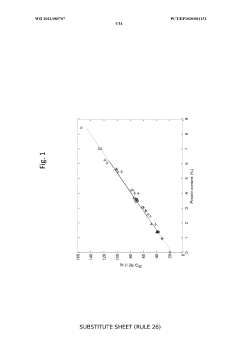
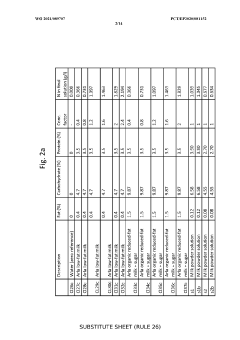
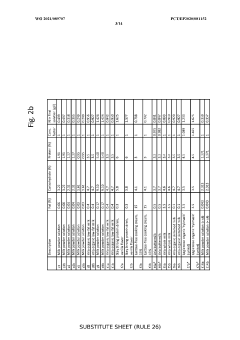
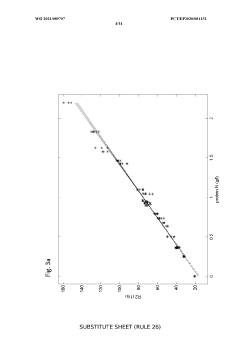
- A method using Nuclear Magnetic Resonance (NMR) to determine protein concentration by measuring the relaxation rate of isotopes of selected ions like alkali metals and halogen elements, correlating these rates to a standard curve for precise protein concentration calculation.
Relaxation nuclear magnetic resonance method for measuring glucose content in liquid biological sample
PatentWO2022099972A1
Innovation
- Using glucose oxidase and acidified potassium permanganate as reaction substrates, organic reagents are used to remove protein interference in biological samples, and 1H-NMR is used to detect changes in the relaxation time of potassium permanganate to calculate glucose content and improve detection sensitivity. and accuracy.


Hardware Requirements and Instrumentation Advances
Field-Strength Modulation in NMR relaxation experiments requires sophisticated hardware configurations and advanced instrumentation to achieve precise magnetic field manipulation. The core hardware components include high-performance magnets capable of generating stable and uniform magnetic fields, typically ranging from 1.5T to 21T for modern systems. These magnets must maintain field homogeneity within parts per billion across the sample volume to ensure accurate relaxation measurements.
Radio frequency (RF) pulse generators represent another critical hardware element, as they must deliver precisely timed and shaped pulses with nanosecond accuracy. Recent advances in digital waveform synthesis have significantly improved pulse sequence flexibility, allowing for complex modulation schemes that were previously unattainable. Modern systems employ direct digital synthesis (DDS) technology, enabling phase-coherent frequency switching with sub-degree phase accuracy.
Gradient coils and amplifiers constitute essential components for field-strength modulation, requiring rapid switching capabilities (rise times <100 μs) and excellent linearity across the operational range. The latest gradient systems incorporate active shielding to minimize eddy currents and feature water cooling to manage heat dissipation during intensive pulse sequences.
Signal detection hardware has evolved substantially, with cryogenically cooled RF coils and preamplifiers reducing the noise floor by factors of 3-5 compared to conventional room-temperature systems. This enhancement significantly improves the signal-to-noise ratio, enabling detection of subtle relaxation phenomena previously masked by thermal noise.
Data acquisition systems have advanced to accommodate wider bandwidth requirements, with modern digitizers offering sampling rates exceeding 100 MS/s and dynamic ranges over 16 bits. Field-programmable gate arrays (FPGAs) now handle real-time signal processing, allowing for on-the-fly adjustments to field modulation parameters based on incoming data.
Recent instrumentation innovations include integrated field monitoring systems that employ auxiliary NMR probes to track field fluctuations during experiments, enabling dynamic compensation algorithms. Additionally, parallel receiver architectures have emerged, supporting simultaneous multi-nuclear detection for correlative relaxation studies.
The miniaturization trend has led to more compact console designs with reduced electromagnetic interference and improved thermal stability. These systems feature enhanced digital interfaces that facilitate seamless integration with laboratory automation platforms and remote operation capabilities, expanding the accessibility of advanced relaxation experiments beyond specialized research centers.
Radio frequency (RF) pulse generators represent another critical hardware element, as they must deliver precisely timed and shaped pulses with nanosecond accuracy. Recent advances in digital waveform synthesis have significantly improved pulse sequence flexibility, allowing for complex modulation schemes that were previously unattainable. Modern systems employ direct digital synthesis (DDS) technology, enabling phase-coherent frequency switching with sub-degree phase accuracy.
Gradient coils and amplifiers constitute essential components for field-strength modulation, requiring rapid switching capabilities (rise times <100 μs) and excellent linearity across the operational range. The latest gradient systems incorporate active shielding to minimize eddy currents and feature water cooling to manage heat dissipation during intensive pulse sequences.
Signal detection hardware has evolved substantially, with cryogenically cooled RF coils and preamplifiers reducing the noise floor by factors of 3-5 compared to conventional room-temperature systems. This enhancement significantly improves the signal-to-noise ratio, enabling detection of subtle relaxation phenomena previously masked by thermal noise.
Data acquisition systems have advanced to accommodate wider bandwidth requirements, with modern digitizers offering sampling rates exceeding 100 MS/s and dynamic ranges over 16 bits. Field-programmable gate arrays (FPGAs) now handle real-time signal processing, allowing for on-the-fly adjustments to field modulation parameters based on incoming data.
Recent instrumentation innovations include integrated field monitoring systems that employ auxiliary NMR probes to track field fluctuations during experiments, enabling dynamic compensation algorithms. Additionally, parallel receiver architectures have emerged, supporting simultaneous multi-nuclear detection for correlative relaxation studies.
The miniaturization trend has led to more compact console designs with reduced electromagnetic interference and improved thermal stability. These systems feature enhanced digital interfaces that facilitate seamless integration with laboratory automation platforms and remote operation capabilities, expanding the accessibility of advanced relaxation experiments beyond specialized research centers.
Data Processing Algorithms for Modulated NMR Signals
The processing of data from field-strength modulated NMR relaxation experiments requires sophisticated algorithms to extract meaningful information from complex signal patterns. Traditional NMR data processing methods often prove inadequate when dealing with modulated signals, necessitating specialized approaches that can account for the unique characteristics of field-strength variations.
Signal deconvolution algorithms represent a critical component in processing modulated NMR data. These algorithms separate overlapping spectral components that result from field-strength modulation, enabling researchers to isolate individual relaxation processes. Advanced deconvolution techniques incorporate mathematical models that account for the specific modulation patterns applied during experiments, significantly improving spectral resolution and data quality.
Fourier transform methods adapted specifically for modulated signals have emerged as powerful tools in this domain. These modified approaches incorporate windowing functions designed to minimize artifacts introduced by field-strength variations. Two-dimensional Fourier transform techniques have proven particularly valuable, allowing simultaneous analysis of both frequency and modulation dimensions, thereby revealing correlations that would remain hidden in conventional one-dimensional analysis.
Machine learning algorithms have recently revolutionized NMR data processing capabilities. Neural networks trained on extensive datasets can identify subtle patterns in modulated signals that traditional algorithms might miss. Convolutional neural networks (CNNs) have demonstrated remarkable efficiency in filtering noise from modulated NMR data, while recurrent neural networks (RNNs) excel at tracking temporal changes in relaxation parameters during modulation sequences.
Bayesian statistical methods offer robust frameworks for handling the inherent uncertainties in modulated NMR data. These probabilistic approaches provide not just point estimates of relaxation parameters but complete probability distributions, offering researchers more comprehensive insights into data reliability. Markov Chain Monte Carlo (MCMC) techniques have proven particularly effective for complex modulation patterns where analytical solutions are intractable.
Real-time processing algorithms represent another frontier in modulated NMR signal analysis. These approaches enable on-the-fly adjustment of experimental parameters based on incoming data, optimizing field-strength modulation patterns during measurement. Such adaptive algorithms significantly reduce experimental time while maximizing information content, particularly valuable for time-sensitive samples or when studying dynamic processes.
Integration of quantum computing principles into data processing workflows shows promise for handling the exponentially complex calculations required for analyzing modulated multi-dimensional NMR data. Though still largely theoretical, quantum-inspired algorithms may eventually overcome computational bottlenecks that currently limit the application of field-strength modulation techniques to extremely complex molecular systems.
Signal deconvolution algorithms represent a critical component in processing modulated NMR data. These algorithms separate overlapping spectral components that result from field-strength modulation, enabling researchers to isolate individual relaxation processes. Advanced deconvolution techniques incorporate mathematical models that account for the specific modulation patterns applied during experiments, significantly improving spectral resolution and data quality.
Fourier transform methods adapted specifically for modulated signals have emerged as powerful tools in this domain. These modified approaches incorporate windowing functions designed to minimize artifacts introduced by field-strength variations. Two-dimensional Fourier transform techniques have proven particularly valuable, allowing simultaneous analysis of both frequency and modulation dimensions, thereby revealing correlations that would remain hidden in conventional one-dimensional analysis.
Machine learning algorithms have recently revolutionized NMR data processing capabilities. Neural networks trained on extensive datasets can identify subtle patterns in modulated signals that traditional algorithms might miss. Convolutional neural networks (CNNs) have demonstrated remarkable efficiency in filtering noise from modulated NMR data, while recurrent neural networks (RNNs) excel at tracking temporal changes in relaxation parameters during modulation sequences.
Bayesian statistical methods offer robust frameworks for handling the inherent uncertainties in modulated NMR data. These probabilistic approaches provide not just point estimates of relaxation parameters but complete probability distributions, offering researchers more comprehensive insights into data reliability. Markov Chain Monte Carlo (MCMC) techniques have proven particularly effective for complex modulation patterns where analytical solutions are intractable.
Real-time processing algorithms represent another frontier in modulated NMR signal analysis. These approaches enable on-the-fly adjustment of experimental parameters based on incoming data, optimizing field-strength modulation patterns during measurement. Such adaptive algorithms significantly reduce experimental time while maximizing information content, particularly valuable for time-sensitive samples or when studying dynamic processes.
Integration of quantum computing principles into data processing workflows shows promise for handling the exponentially complex calculations required for analyzing modulated multi-dimensional NMR data. Though still largely theoretical, quantum-inspired algorithms may eventually overcome computational bottlenecks that currently limit the application of field-strength modulation techniques to extremely complex molecular systems.
Unlock deeper insights with PatSnap Eureka Quick Research — get a full tech report to explore trends and direct your research. Try now!
Generate Your Research Report Instantly with AI Agent
Supercharge your innovation with PatSnap Eureka AI Agent Platform!