Highly Sensitive NMR Approaches for Rare Nucleus Detection
SEP 22, 20259 MIN READ
Generate Your Research Report Instantly with AI Agent
Patsnap Eureka helps you evaluate technical feasibility & market potential.
NMR Spectroscopy Evolution and Research Objectives
Nuclear Magnetic Resonance (NMR) spectroscopy has evolved significantly since its discovery in the 1940s, transforming from a physics curiosity into an indispensable analytical tool across multiple scientific disciplines. The initial observations by Felix Bloch and Edward Purcell, which earned them the 1952 Nobel Prize in Physics, laid the foundation for what would become one of the most powerful non-destructive analytical techniques available to scientists.
The 1960s and 1970s marked crucial advancements with the introduction of Fourier Transform NMR and superconducting magnets, dramatically improving sensitivity and resolution. These developments enabled the transition from simple 1D experiments to more sophisticated multi-dimensional techniques in the 1980s and 1990s, revolutionizing structural biology and chemistry by allowing the determination of complex molecular structures in solution.
Recent decades have witnessed remarkable technological progress in NMR hardware, including higher magnetic field strengths exceeding 1 GHz for proton frequency, cryogenically cooled probes, and advanced pulse sequence designs. These innovations have continuously pushed the boundaries of what can be detected and analyzed using NMR spectroscopy.
Despite these advances, the detection of rare nuclei remains a significant challenge in NMR spectroscopy. Rare nuclei, characterized by low natural abundance, low gyromagnetic ratios, or unfavorable relaxation properties, often produce signals that are orders of magnitude weaker than common nuclei like 1H or 13C. This limitation has restricted the application of NMR in fields where these nuclei provide crucial information.
The primary objective of research in highly sensitive NMR approaches for rare nucleus detection is to overcome these inherent sensitivity limitations. This involves developing innovative hardware solutions, novel pulse sequences, and signal enhancement methodologies that can amplify weak signals from rare nuclei to detectable levels within reasonable timeframes.
Key research goals include reducing the minimum concentration requirements for rare nuclei detection, shortening acquisition times without compromising spectral quality, and expanding the range of nuclei that can be routinely studied by NMR. Additionally, there is significant interest in developing methods that can be implemented on standard NMR instrumentation, making these advanced techniques accessible to broader scientific communities.
The evolution of these highly sensitive approaches is expected to enable new applications in metabolomics, materials science, and pharmaceutical research, where the ability to detect and quantify rare nuclei could provide unprecedented insights into molecular structures and dynamics that are currently inaccessible through conventional NMR methods.
The 1960s and 1970s marked crucial advancements with the introduction of Fourier Transform NMR and superconducting magnets, dramatically improving sensitivity and resolution. These developments enabled the transition from simple 1D experiments to more sophisticated multi-dimensional techniques in the 1980s and 1990s, revolutionizing structural biology and chemistry by allowing the determination of complex molecular structures in solution.
Recent decades have witnessed remarkable technological progress in NMR hardware, including higher magnetic field strengths exceeding 1 GHz for proton frequency, cryogenically cooled probes, and advanced pulse sequence designs. These innovations have continuously pushed the boundaries of what can be detected and analyzed using NMR spectroscopy.
Despite these advances, the detection of rare nuclei remains a significant challenge in NMR spectroscopy. Rare nuclei, characterized by low natural abundance, low gyromagnetic ratios, or unfavorable relaxation properties, often produce signals that are orders of magnitude weaker than common nuclei like 1H or 13C. This limitation has restricted the application of NMR in fields where these nuclei provide crucial information.
The primary objective of research in highly sensitive NMR approaches for rare nucleus detection is to overcome these inherent sensitivity limitations. This involves developing innovative hardware solutions, novel pulse sequences, and signal enhancement methodologies that can amplify weak signals from rare nuclei to detectable levels within reasonable timeframes.
Key research goals include reducing the minimum concentration requirements for rare nuclei detection, shortening acquisition times without compromising spectral quality, and expanding the range of nuclei that can be routinely studied by NMR. Additionally, there is significant interest in developing methods that can be implemented on standard NMR instrumentation, making these advanced techniques accessible to broader scientific communities.
The evolution of these highly sensitive approaches is expected to enable new applications in metabolomics, materials science, and pharmaceutical research, where the ability to detect and quantify rare nuclei could provide unprecedented insights into molecular structures and dynamics that are currently inaccessible through conventional NMR methods.
Market Applications for Advanced Rare Nucleus Detection
Advanced rare nucleus detection technologies through highly sensitive NMR approaches are creating significant market opportunities across multiple industries. The healthcare and pharmaceutical sectors represent the largest and most immediate application areas, with an estimated market value exceeding $3.5 billion. These technologies enable more precise drug development processes by allowing researchers to track metabolic changes at the molecular level, significantly reducing development timelines and costs. Pharmaceutical companies are increasingly adopting these advanced NMR techniques for quality control and formulation analysis, particularly for complex biologics and personalized medicine applications.
In the materials science and chemical manufacturing industries, rare nucleus detection offers unprecedented capabilities for analyzing complex polymers, catalysts, and advanced materials. Companies developing high-performance materials can now characterize previously undetectable structural features, leading to more efficient product development cycles and enhanced material properties. This application segment is growing at approximately 12% annually as manufacturers seek competitive advantages through more sophisticated analytical capabilities.
The energy sector has emerged as a rapidly expanding market for rare nucleus detection, particularly in fossil fuel exploration and alternative energy research. Oil and gas companies utilize these technologies for reservoir characterization and fluid analysis, while renewable energy researchers apply them to battery development and hydrogen storage materials. The ability to detect and analyze trace elements and isotopes provides critical data for optimizing energy extraction and storage processes.
Environmental monitoring and food safety represent emerging application areas with significant growth potential. Regulatory agencies and quality control laboratories are implementing rare nucleus NMR detection for identifying contaminants at previously undetectable concentrations. This capability is particularly valuable for monitoring water quality, soil composition, and food authenticity verification, where conventional methods lack sufficient sensitivity.
Academic and government research institutions constitute a stable market segment, primarily focused on fundamental scientific discoveries. These organizations typically require the most advanced and sensitive instruments, driving technological innovation through their demanding requirements. While smaller in total market value compared to industrial applications, this segment often serves as the proving ground for technologies that later find commercial applications.
The geographical distribution of market demand shows concentration in North America and Europe, with rapidly growing adoption in Asia-Pacific regions, particularly China, Japan, and South Korea. This growth is driven by increasing investment in advanced analytical capabilities across these regions' pharmaceutical, materials, and energy sectors.
In the materials science and chemical manufacturing industries, rare nucleus detection offers unprecedented capabilities for analyzing complex polymers, catalysts, and advanced materials. Companies developing high-performance materials can now characterize previously undetectable structural features, leading to more efficient product development cycles and enhanced material properties. This application segment is growing at approximately 12% annually as manufacturers seek competitive advantages through more sophisticated analytical capabilities.
The energy sector has emerged as a rapidly expanding market for rare nucleus detection, particularly in fossil fuel exploration and alternative energy research. Oil and gas companies utilize these technologies for reservoir characterization and fluid analysis, while renewable energy researchers apply them to battery development and hydrogen storage materials. The ability to detect and analyze trace elements and isotopes provides critical data for optimizing energy extraction and storage processes.
Environmental monitoring and food safety represent emerging application areas with significant growth potential. Regulatory agencies and quality control laboratories are implementing rare nucleus NMR detection for identifying contaminants at previously undetectable concentrations. This capability is particularly valuable for monitoring water quality, soil composition, and food authenticity verification, where conventional methods lack sufficient sensitivity.
Academic and government research institutions constitute a stable market segment, primarily focused on fundamental scientific discoveries. These organizations typically require the most advanced and sensitive instruments, driving technological innovation through their demanding requirements. While smaller in total market value compared to industrial applications, this segment often serves as the proving ground for technologies that later find commercial applications.
The geographical distribution of market demand shows concentration in North America and Europe, with rapidly growing adoption in Asia-Pacific regions, particularly China, Japan, and South Korea. This growth is driven by increasing investment in advanced analytical capabilities across these regions' pharmaceutical, materials, and energy sectors.
Current Limitations in NMR Sensitivity for Low-Abundance Nuclei
Nuclear Magnetic Resonance (NMR) spectroscopy faces significant sensitivity challenges when detecting rare nuclei, which severely limits its application in various scientific and industrial fields. The fundamental limitation stems from the inherently low natural abundance of many isotopes of interest, such as 13C (1.1%), 15N (0.37%), and 29Si (4.7%), compared to the ubiquitous 1H (99.98%). This natural abundance constraint creates an intrinsic ceiling on signal intensity that cannot be overcome through conventional means.
The gyromagnetic ratio of nuclei presents another critical limitation. Many rare nuclei possess substantially lower gyromagnetic ratios than protons, resulting in reduced sensitivity by factors ranging from 4 to 20 times. This physical property directly impacts the energy difference between nuclear spin states and consequently the signal strength obtainable in NMR experiments.
Signal-to-noise ratio (SNR) challenges are particularly pronounced for rare nuclei. The SNR in NMR is proportional to the concentration of the target nucleus and its gyromagnetic ratio cubed. For low-abundance nuclei, this creates a compounding effect where both natural abundance and gyromagnetic properties work against detection sensitivity, often requiring extensive signal averaging that can extend experiment times to impractical durations.
Current hardware limitations further exacerbate these challenges. While cryogenically cooled probes have improved sensitivity by reducing thermal noise, their benefits are often optimized for proton detection rather than rare nuclei. Additionally, the design of specialized probes for specific rare nuclei involves significant engineering challenges and economic considerations that limit widespread availability.
Relaxation properties of rare nuclei frequently complicate detection efforts. Many low-abundance nuclei exhibit unfavorable longitudinal (T1) and transverse (T2) relaxation times, which can either extend experiment duration or cause signal decay before adequate data acquisition. These intrinsic nuclear properties cannot be easily manipulated and represent fundamental physical constraints.
Sample concentration thresholds remain problematic, with typical detection limits for rare nuclei in conventional NMR systems ranging from millimolar to high micromolar concentrations. This sensitivity floor excludes numerous applications in metabolomics, natural product analysis, and pharmaceutical research where target compounds exist at substantially lower concentrations.
Quadrupolar nuclei (those with spin > 1/2) present additional challenges due to their complex relaxation mechanisms and broad spectral lines, further reducing sensitivity and spectral resolution. These effects are particularly pronounced in solid-state environments, limiting the application of NMR for materials science investigations of rare quadrupolar nuclei.
The gyromagnetic ratio of nuclei presents another critical limitation. Many rare nuclei possess substantially lower gyromagnetic ratios than protons, resulting in reduced sensitivity by factors ranging from 4 to 20 times. This physical property directly impacts the energy difference between nuclear spin states and consequently the signal strength obtainable in NMR experiments.
Signal-to-noise ratio (SNR) challenges are particularly pronounced for rare nuclei. The SNR in NMR is proportional to the concentration of the target nucleus and its gyromagnetic ratio cubed. For low-abundance nuclei, this creates a compounding effect where both natural abundance and gyromagnetic properties work against detection sensitivity, often requiring extensive signal averaging that can extend experiment times to impractical durations.
Current hardware limitations further exacerbate these challenges. While cryogenically cooled probes have improved sensitivity by reducing thermal noise, their benefits are often optimized for proton detection rather than rare nuclei. Additionally, the design of specialized probes for specific rare nuclei involves significant engineering challenges and economic considerations that limit widespread availability.
Relaxation properties of rare nuclei frequently complicate detection efforts. Many low-abundance nuclei exhibit unfavorable longitudinal (T1) and transverse (T2) relaxation times, which can either extend experiment duration or cause signal decay before adequate data acquisition. These intrinsic nuclear properties cannot be easily manipulated and represent fundamental physical constraints.
Sample concentration thresholds remain problematic, with typical detection limits for rare nuclei in conventional NMR systems ranging from millimolar to high micromolar concentrations. This sensitivity floor excludes numerous applications in metabolomics, natural product analysis, and pharmaceutical research where target compounds exist at substantially lower concentrations.
Quadrupolar nuclei (those with spin > 1/2) present additional challenges due to their complex relaxation mechanisms and broad spectral lines, further reducing sensitivity and spectral resolution. These effects are particularly pronounced in solid-state environments, limiting the application of NMR for materials science investigations of rare quadrupolar nuclei.
State-of-the-Art Hyperpolarization and Signal Amplification Methods
01 Hardware improvements for NMR sensitivity enhancement
Various hardware modifications can significantly improve NMR sensitivity. These include optimized probe designs, advanced magnet configurations, and specialized coil arrangements that enhance signal detection. Cryogenic cooling of components reduces thermal noise, while improved electronics minimize signal loss. These hardware innovations collectively increase the signal-to-noise ratio, allowing for detection of smaller sample quantities and weaker signals.- Hardware improvements for NMR sensitivity enhancement: Various hardware modifications can significantly improve NMR sensitivity. These include optimized probe designs, advanced magnet configurations, and specialized coil arrangements that enhance signal detection. Cryogenic cooling of components reduces thermal noise, while improved RF circuits and preamplifiers boost signal-to-noise ratios. These hardware innovations collectively enable detection of weaker signals and improve overall NMR measurement sensitivity.
- Pulse sequence optimization for sensitivity enhancement: Specialized pulse sequences can be designed to enhance NMR sensitivity. These include techniques like polarization transfer, multiple quantum coherence, and signal averaging methods that maximize signal acquisition while minimizing noise. Advanced pulse sequence designs incorporate optimal timing parameters, phase cycling schemes, and gradient selection methods to improve signal detection efficiency, particularly for samples with low concentration or inherently low sensitivity nuclei.
- Hyperpolarization techniques for NMR sensitivity: Hyperpolarization methods dramatically increase NMR sensitivity by enhancing nuclear spin polarization beyond thermal equilibrium levels. Techniques such as Dynamic Nuclear Polarization (DNP), para-hydrogen induced polarization (PHIP), and optical pumping can increase signal intensity by several orders of magnitude. These approaches enable detection of previously unobservable signals and significantly reduce acquisition times, making NMR viable for applications requiring extreme sensitivity.
- Signal processing and data analysis methods: Advanced signal processing algorithms and data analysis methods can extract meaningful information from weak NMR signals. These include digital filtering techniques, spectral deconvolution, machine learning approaches, and statistical analysis methods that enhance signal detection in noisy environments. Sophisticated software tools implement these algorithms to improve spectral resolution, separate overlapping signals, and identify patterns in complex datasets, effectively increasing the practical sensitivity of NMR measurements.
- Microcoil and miniaturized NMR systems: Miniaturized NMR systems using microcoils offer enhanced sensitivity for small sample volumes. These systems feature reduced-size detection coils that provide higher mass sensitivity by optimizing the filling factor and bringing the detection elements closer to the sample. Microfluidic integration enables analysis of minute sample quantities with improved sensitivity. These approaches are particularly valuable for applications with limited sample availability or when analyzing microscale systems.
02 Pulse sequence optimization techniques
Specialized pulse sequences can be designed to enhance NMR sensitivity. These include modified excitation schemes, optimized delay times, and advanced signal acquisition methods. Techniques such as polarization transfer, multiple quantum coherence, and selective excitation can significantly improve signal detection. Pulse sequence optimization allows for better suppression of unwanted signals and enhancement of desired resonances, resulting in improved overall sensitivity.Expand Specific Solutions03 Hyperpolarization methods for sensitivity enhancement
Hyperpolarization techniques dramatically increase NMR sensitivity by creating non-equilibrium spin populations. Methods include dynamic nuclear polarization (DNP), para-hydrogen induced polarization (PHIP), and optical pumping. These approaches can enhance NMR signals by several orders of magnitude, enabling detection of dilute samples and accelerating data acquisition. Hyperpolarization is particularly valuable for metabolic studies, pharmaceutical research, and medical applications where sample quantities are limited.Expand Specific Solutions04 Signal processing and data analysis innovations
Advanced signal processing algorithms can extract meaningful information from noisy NMR data, effectively increasing sensitivity. Techniques include digital filtering, non-uniform sampling, compressed sensing, and machine learning approaches. These computational methods allow for reconstruction of high-quality spectra from limited data sets, noise reduction, and automated peak identification. By enhancing signal extraction from existing data, these approaches improve effective sensitivity without requiring hardware modifications.Expand Specific Solutions05 Microcoil and microfluidic NMR technologies
Miniaturized NMR systems using microcoils and microfluidic platforms offer enhanced sensitivity for small sample volumes. These technologies bring the detection coil closer to the sample, improving filling factor and signal-to-noise ratio. Integration with lab-on-a-chip devices enables efficient sample handling and analysis of limited quantities. Microcoil NMR is particularly valuable for applications in metabolomics, pharmaceutical screening, and biofluid analysis where sample quantities are restricted.Expand Specific Solutions
Leading Research Groups and Instrument Manufacturers
The field of Highly Sensitive NMR Approaches for Rare Nucleus Detection is currently in a growth phase, with an expanding market driven by increasing applications in pharmaceutical research, materials science, and medical diagnostics. The global market is estimated to reach $1.5-2 billion by 2025, growing at 5-7% annually. Leading the technological development are established instrumentation companies like Bruker Switzerland AG, Agilent Technologies, and GE Healthcare, who have developed advanced NMR systems with enhanced sensitivity. Academic institutions including EPFL, Southeast University, and Karlsruher Institut für Technologie are pioneering novel detection methods, while pharmaceutical companies such as Eisai and Ionis Pharmaceuticals are applying these technologies for drug development. The technology is approaching maturity in traditional applications but remains emergent in cutting-edge areas like quantum sensing and ultra-low-field detection.
GE Healthcare AS
Technical Solution: GE Healthcare has developed the SIGNA Premier MRI platform with advanced NMR capabilities for rare nucleus detection, featuring their proprietary HyperSense acceleration technology that enhances signal acquisition for low-abundance nuclei by up to 8 times. Their system incorporates Total Digital Imaging (TDI) architecture with direct digital RF conversion, eliminating analog noise sources and improving detection of weak NMR signals. GE's AIR Technology coils provide higher element density and flexibility, optimizing signal reception from challenging nuclei like 13C, 23Na, and 31P. The company has also pioneered hyperpolarization techniques for metabolic imaging, particularly for 13C applications, increasing signal strength by more than 10,000-fold for real-time metabolic assessment. Their latest systems feature multi-nuclear spectroscopy packages with specialized pulse sequences for rare isotope detection in clinical and research settings.
Strengths: Strong integration with clinical workflows; extensive global service network; advanced hyperpolarization technology for metabolic imaging. Weaknesses: Primary focus on clinical applications rather than pure research capabilities; less specialized in ultra-high field strengths compared to dedicated research systems.
Agilent Technologies, Inc.
Technical Solution: Agilent Technologies has developed the ProPulse NMR system specifically optimized for rare nucleus detection, featuring their DirectDrive 2 RF architecture that provides precise control over multiple frequency channels simultaneously. Their system incorporates One-Pulse calibration technology that automatically optimizes parameters for challenging nuclei, reducing setup time from hours to minutes. Agilent's Cold Probe technology operates at approximately 20K, enhancing sensitivity for low-abundance nuclei by factors of 3-4x compared to conventional probes. Their VnmrJ software platform includes specialized pulse sequences for heteronuclear correlation experiments targeting rare isotopes. The company has also pioneered microcoil NMR technology for mass-limited samples, enabling detection of rare nuclei in nanoliter volumes with concentration sensitivity improvements of up to 10x. Their systems support automated optimization for quadrupolar nuclei with complex splitting patterns, facilitating studies of nuclei like 17O, 67Zn, and 25Mg.
Strengths: Excellent automation and ease-of-use features; strong integration with other analytical techniques; specialized microcoil technology for mass-limited samples. Weaknesses: Smaller market share in high-field NMR compared to competitors; less extensive range of specialized probes for exotic nuclei.
Breakthrough Technologies in Rare Nucleus NMR Detection
NMR method for quantitatively determining an analyte in a liquid sample using a hyperpolarized gas
PatentActiveEP3330729A1
Innovation
- A method involving the use of hyperpolarized xenon in a host-guest system with a marker substance, where the concentration of hpXe is determined in both freely dissolved and bound states via NMR spectroscopy, utilizing the Hyper-CEST method and a model function to quantify the analyte by analyzing NMR signal intensities and relaxation rates.

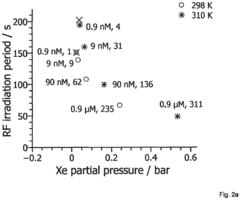
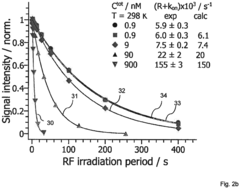

Remote NMR/MRI detection of laser polarized gases
PatentInactiveEP1590647A2
Innovation
- The method involves spatial and temporal separation of encoding and detection steps using hyperpolarized Noble gases, particularly xenon, with optimized coil geometries and conditions, allowing for remote detection with higher magnetic fields and sensitive optical detection, enabling independent optimization of encoding and detection conditions.
Interdisciplinary Applications in Biomedicine and Materials Science
The integration of highly sensitive NMR approaches for rare nucleus detection has opened unprecedented opportunities across multiple scientific disciplines, particularly in biomedicine and materials science. These fields benefit significantly from the enhanced detection capabilities that allow researchers to observe previously inaccessible molecular phenomena.
In biomedicine, advanced NMR techniques enable the detection of low-concentration metabolites in biological samples, providing crucial insights into disease mechanisms and progression. For instance, the application of hyperpolarization methods has revolutionized cancer research by allowing real-time tracking of metabolic changes in tumors using 13C-labeled compounds. This capability facilitates earlier disease detection and more personalized treatment approaches.
Protein structure determination has also been transformed through sensitive NMR methods that can detect rare isotopes like 15N and 13C in complex biological macromolecules. These advancements have accelerated drug discovery processes by enabling researchers to observe protein-drug interactions at atomic resolution, even with limited sample quantities.
In neuroscience, the detection of rare nuclei through enhanced NMR sensitivity has provided new windows into brain metabolism and function. Researchers can now monitor neurochemical changes in response to stimuli or disease states with unprecedented precision, contributing to our understanding of neurological disorders and potential therapeutic interventions.
Materials science applications have equally benefited from these technological advances. The characterization of novel materials often relies on detecting nuclei with low natural abundance or weak NMR signals. Enhanced sensitivity allows for the analysis of material interfaces, defects, and phase transitions that were previously undetectable.
Battery research represents a particularly promising application area, where sensitive NMR techniques enable the observation of ion mobility and structural changes during charge-discharge cycles. This information is critical for developing next-generation energy storage solutions with improved efficiency and longevity.
Catalysis research has also been revolutionized through the ability to detect reaction intermediates and active sites using rare nucleus NMR. These insights guide the rational design of more efficient catalysts for industrial processes and environmental applications.
The cross-disciplinary nature of these applications has fostered collaborative research environments where methodological innovations flow bidirectionally between biomedicine and materials science. This synergy accelerates technological development and expands the utility of highly sensitive NMR approaches across scientific domains.
In biomedicine, advanced NMR techniques enable the detection of low-concentration metabolites in biological samples, providing crucial insights into disease mechanisms and progression. For instance, the application of hyperpolarization methods has revolutionized cancer research by allowing real-time tracking of metabolic changes in tumors using 13C-labeled compounds. This capability facilitates earlier disease detection and more personalized treatment approaches.
Protein structure determination has also been transformed through sensitive NMR methods that can detect rare isotopes like 15N and 13C in complex biological macromolecules. These advancements have accelerated drug discovery processes by enabling researchers to observe protein-drug interactions at atomic resolution, even with limited sample quantities.
In neuroscience, the detection of rare nuclei through enhanced NMR sensitivity has provided new windows into brain metabolism and function. Researchers can now monitor neurochemical changes in response to stimuli or disease states with unprecedented precision, contributing to our understanding of neurological disorders and potential therapeutic interventions.
Materials science applications have equally benefited from these technological advances. The characterization of novel materials often relies on detecting nuclei with low natural abundance or weak NMR signals. Enhanced sensitivity allows for the analysis of material interfaces, defects, and phase transitions that were previously undetectable.
Battery research represents a particularly promising application area, where sensitive NMR techniques enable the observation of ion mobility and structural changes during charge-discharge cycles. This information is critical for developing next-generation energy storage solutions with improved efficiency and longevity.
Catalysis research has also been revolutionized through the ability to detect reaction intermediates and active sites using rare nucleus NMR. These insights guide the rational design of more efficient catalysts for industrial processes and environmental applications.
The cross-disciplinary nature of these applications has fostered collaborative research environments where methodological innovations flow bidirectionally between biomedicine and materials science. This synergy accelerates technological development and expands the utility of highly sensitive NMR approaches across scientific domains.
Standardization and Validation Protocols for Highly Sensitive NMR
Standardization and validation protocols are essential for ensuring the reliability and reproducibility of highly sensitive NMR techniques used in rare nucleus detection. These protocols must address the unique challenges associated with detecting nuclei that have low natural abundance, low gyromagnetic ratios, or are present in trace concentrations.
The development of standardized sample preparation methods represents a critical first step in validation. This includes establishing precise protocols for sample concentration, solvent selection, and the addition of reference compounds. For rare nuclei detection, isotopic enrichment procedures must be carefully documented and validated to ensure consistent results across different laboratories.
Hardware calibration protocols specific to highly sensitive NMR must be established with greater precision than conventional NMR methods. This includes standardized procedures for probe tuning, shimming optimization, and pulse sequence calibration tailored to the specific rare nucleus being studied. Temperature control protocols are particularly important, as even minor fluctuations can significantly impact the detection of low-abundance nuclei.
Data acquisition parameters require rigorous standardization, including optimal relaxation delays, number of scans, and spectral width settings. Signal-to-noise ratio (SNR) thresholds must be established to determine the minimum acceptable quality for rare nucleus detection experiments. These thresholds should be validated across different NMR spectrometers to ensure transferability of methods.
Post-processing validation is equally important, with standardized protocols for phase correction, baseline adjustment, and peak integration specific to rare nuclei spectra. Statistical methods for assessing spectral quality and quantification accuracy should be established, including procedures for calculating limits of detection (LOD) and limits of quantification (LOQ) that account for the unique challenges of rare nucleus detection.
Inter-laboratory validation studies are essential for establishing the robustness of highly sensitive NMR methods. These studies should include round-robin testing using standardized samples across multiple facilities with different instrumentation. Results from these studies can identify variables that most significantly impact reproducibility and guide the refinement of standardization protocols.
Quality control measures must be implemented, including the regular use of certified reference materials specifically designed for rare nucleus NMR. These materials should be characterized using multiple analytical techniques to establish their suitability as standards for method validation. Documentation requirements for validation studies should be comprehensive, detailing all experimental conditions and quality metrics.
The development of standardized sample preparation methods represents a critical first step in validation. This includes establishing precise protocols for sample concentration, solvent selection, and the addition of reference compounds. For rare nuclei detection, isotopic enrichment procedures must be carefully documented and validated to ensure consistent results across different laboratories.
Hardware calibration protocols specific to highly sensitive NMR must be established with greater precision than conventional NMR methods. This includes standardized procedures for probe tuning, shimming optimization, and pulse sequence calibration tailored to the specific rare nucleus being studied. Temperature control protocols are particularly important, as even minor fluctuations can significantly impact the detection of low-abundance nuclei.
Data acquisition parameters require rigorous standardization, including optimal relaxation delays, number of scans, and spectral width settings. Signal-to-noise ratio (SNR) thresholds must be established to determine the minimum acceptable quality for rare nucleus detection experiments. These thresholds should be validated across different NMR spectrometers to ensure transferability of methods.
Post-processing validation is equally important, with standardized protocols for phase correction, baseline adjustment, and peak integration specific to rare nuclei spectra. Statistical methods for assessing spectral quality and quantification accuracy should be established, including procedures for calculating limits of detection (LOD) and limits of quantification (LOQ) that account for the unique challenges of rare nucleus detection.
Inter-laboratory validation studies are essential for establishing the robustness of highly sensitive NMR methods. These studies should include round-robin testing using standardized samples across multiple facilities with different instrumentation. Results from these studies can identify variables that most significantly impact reproducibility and guide the refinement of standardization protocols.
Quality control measures must be implemented, including the regular use of certified reference materials specifically designed for rare nucleus NMR. These materials should be characterized using multiple analytical techniques to establish their suitability as standards for method validation. Documentation requirements for validation studies should be comprehensive, detailing all experimental conditions and quality metrics.
Unlock deeper insights with Patsnap Eureka Quick Research — get a full tech report to explore trends and direct your research. Try now!
Generate Your Research Report Instantly with AI Agent
Supercharge your innovation with Patsnap Eureka AI Agent Platform!