
Adjusting NMR Attenuation for Maximum Sample Sensitivity
SEP 22, 20259 MIN READ
Generate Your Research Report Instantly with AI Agent
Patsnap Eureka helps you evaluate technical feasibility & market potential.
NMR Attenuation Background and Objectives
Nuclear Magnetic Resonance (NMR) spectroscopy has evolved significantly since its discovery in the 1940s, becoming an indispensable analytical tool across various scientific disciplines. The technique leverages the magnetic properties of atomic nuclei to provide detailed structural and dynamic information about molecules. Over the decades, NMR technology has progressed from simple one-dimensional experiments to sophisticated multi-dimensional techniques capable of elucidating complex molecular structures and interactions.
Attenuation in NMR refers to the reduction of signal strength during the measurement process. This parameter plays a critical role in determining the quality and reliability of spectral data. Historically, NMR attenuation settings were largely determined through empirical methods, often resulting in suboptimal sensitivity and resolution. The evolution of digital signal processing and hardware improvements has opened new avenues for optimizing these parameters.
The technological trajectory of NMR attenuation control has moved from manual adjustment systems to automated, algorithm-driven approaches. Early NMR spectrometers required operators to manually set attenuation levels based on experience and trial-and-error. Modern systems incorporate sophisticated feedback mechanisms and predictive algorithms to dynamically adjust attenuation settings based on sample characteristics and experimental objectives.
Recent advancements in quantum computing and artificial intelligence have begun to influence NMR technology, particularly in the realm of signal processing and attenuation optimization. These emerging technologies promise to further enhance the sensitivity and resolution of NMR measurements through more precise control of signal attenuation.
The primary objective of optimizing NMR attenuation is to maximize sample sensitivity while maintaining spectral integrity. This involves striking a delicate balance between signal amplification and noise reduction. Too little attenuation can lead to receiver saturation and distorted spectra, while excessive attenuation reduces signal-to-noise ratio and diminishes spectral quality.
Secondary objectives include improving quantitative accuracy, enhancing detection limits for trace components, and reducing experimental time requirements. These goals are particularly relevant in applications such as metabolomics, pharmaceutical analysis, and materials science, where sample quantities may be limited and analytical throughput is critical.
Looking forward, the field aims to develop adaptive attenuation systems capable of real-time optimization based on sample characteristics and experimental conditions. Such systems would ideally incorporate machine learning algorithms to predict optimal attenuation settings for novel sample types, further democratizing access to high-quality NMR data across scientific disciplines.
Attenuation in NMR refers to the reduction of signal strength during the measurement process. This parameter plays a critical role in determining the quality and reliability of spectral data. Historically, NMR attenuation settings were largely determined through empirical methods, often resulting in suboptimal sensitivity and resolution. The evolution of digital signal processing and hardware improvements has opened new avenues for optimizing these parameters.
The technological trajectory of NMR attenuation control has moved from manual adjustment systems to automated, algorithm-driven approaches. Early NMR spectrometers required operators to manually set attenuation levels based on experience and trial-and-error. Modern systems incorporate sophisticated feedback mechanisms and predictive algorithms to dynamically adjust attenuation settings based on sample characteristics and experimental objectives.
Recent advancements in quantum computing and artificial intelligence have begun to influence NMR technology, particularly in the realm of signal processing and attenuation optimization. These emerging technologies promise to further enhance the sensitivity and resolution of NMR measurements through more precise control of signal attenuation.
The primary objective of optimizing NMR attenuation is to maximize sample sensitivity while maintaining spectral integrity. This involves striking a delicate balance between signal amplification and noise reduction. Too little attenuation can lead to receiver saturation and distorted spectra, while excessive attenuation reduces signal-to-noise ratio and diminishes spectral quality.
Secondary objectives include improving quantitative accuracy, enhancing detection limits for trace components, and reducing experimental time requirements. These goals are particularly relevant in applications such as metabolomics, pharmaceutical analysis, and materials science, where sample quantities may be limited and analytical throughput is critical.
Looking forward, the field aims to develop adaptive attenuation systems capable of real-time optimization based on sample characteristics and experimental conditions. Such systems would ideally incorporate machine learning algorithms to predict optimal attenuation settings for novel sample types, further democratizing access to high-quality NMR data across scientific disciplines.
Market Analysis for High-Sensitivity NMR Applications
The global market for high-sensitivity NMR applications continues to expand significantly, driven by increasing demand across pharmaceutical research, biotechnology, materials science, and food safety sectors. Current market valuations place the NMR spectroscopy market at approximately 930 million USD in 2023, with projections indicating growth to reach 1.2 billion USD by 2028, representing a compound annual growth rate of 5.2%.
Pharmaceutical and biotechnology sectors remain the dominant market segments, collectively accounting for over 60% of NMR application demand. This dominance stems from the critical role high-sensitivity NMR plays in drug discovery processes, protein structure analysis, and metabolomics research. The ability to detect and analyze smaller sample quantities with greater precision directly translates to cost savings and accelerated research timelines for these industries.
Academic research institutions constitute another significant market segment, representing approximately 25% of the total market share. These institutions primarily utilize high-sensitivity NMR for fundamental research in chemistry, biochemistry, and materials science. Government funding patterns for scientific research directly impact this segment, with regions demonstrating stronger public research investment showing correspondingly higher NMR technology adoption rates.
Geographically, North America leads the market with approximately 40% share, followed by Europe at 30% and Asia-Pacific at 25%. The Asia-Pacific region, particularly China and India, demonstrates the fastest growth trajectory, driven by increasing research investments and expanding pharmaceutical manufacturing capabilities. This regional growth is expected to continue outpacing other markets through 2028.
Key customer demands driving market evolution include requirements for higher magnetic field strengths, improved signal-to-noise ratios, and enhanced automation capabilities. End-users increasingly prioritize systems offering maximum sample sensitivity with minimal sample volume requirements. This trend directly connects to the technical challenge of optimizing NMR attenuation for maximum sensitivity, as organizations seek to extract more data from smaller sample quantities.
The market demonstrates price sensitivity variations across segments. While academic institutions remain highly price-sensitive, pharmaceutical companies show greater willingness to invest in premium systems offering superior sensitivity and resolution. This bifurcation creates distinct market opportunities for both high-end, maximum-sensitivity systems and more accessible instruments with adequate sensitivity for routine applications.
Emerging application areas showing significant growth potential include food safety testing, environmental monitoring, and clinical diagnostics. These sectors represent relatively untapped markets where high-sensitivity NMR could provide substantial analytical advantages over current methodologies, particularly when sample quantities are limited or contain complex matrices requiring sophisticated analysis.
Pharmaceutical and biotechnology sectors remain the dominant market segments, collectively accounting for over 60% of NMR application demand. This dominance stems from the critical role high-sensitivity NMR plays in drug discovery processes, protein structure analysis, and metabolomics research. The ability to detect and analyze smaller sample quantities with greater precision directly translates to cost savings and accelerated research timelines for these industries.
Academic research institutions constitute another significant market segment, representing approximately 25% of the total market share. These institutions primarily utilize high-sensitivity NMR for fundamental research in chemistry, biochemistry, and materials science. Government funding patterns for scientific research directly impact this segment, with regions demonstrating stronger public research investment showing correspondingly higher NMR technology adoption rates.
Geographically, North America leads the market with approximately 40% share, followed by Europe at 30% and Asia-Pacific at 25%. The Asia-Pacific region, particularly China and India, demonstrates the fastest growth trajectory, driven by increasing research investments and expanding pharmaceutical manufacturing capabilities. This regional growth is expected to continue outpacing other markets through 2028.
Key customer demands driving market evolution include requirements for higher magnetic field strengths, improved signal-to-noise ratios, and enhanced automation capabilities. End-users increasingly prioritize systems offering maximum sample sensitivity with minimal sample volume requirements. This trend directly connects to the technical challenge of optimizing NMR attenuation for maximum sensitivity, as organizations seek to extract more data from smaller sample quantities.
The market demonstrates price sensitivity variations across segments. While academic institutions remain highly price-sensitive, pharmaceutical companies show greater willingness to invest in premium systems offering superior sensitivity and resolution. This bifurcation creates distinct market opportunities for both high-end, maximum-sensitivity systems and more accessible instruments with adequate sensitivity for routine applications.
Emerging application areas showing significant growth potential include food safety testing, environmental monitoring, and clinical diagnostics. These sectors represent relatively untapped markets where high-sensitivity NMR could provide substantial analytical advantages over current methodologies, particularly when sample quantities are limited or contain complex matrices requiring sophisticated analysis.
Current NMR Attenuation Challenges and Limitations
Nuclear Magnetic Resonance (NMR) spectroscopy faces significant challenges in achieving optimal signal attenuation while maximizing sample sensitivity. Current attenuation methods often struggle with the fundamental trade-off between signal strength and noise reduction. When attenuation settings are too aggressive, critical spectral information may be lost, particularly for dilute samples or nuclei with low natural abundance. Conversely, insufficient attenuation can lead to signal distortion, baseline artifacts, and compromised spectral resolution.
One major limitation in current NMR attenuation technology is the inability to dynamically adjust to varying sample concentrations and molecular compositions within a single experiment. This creates particular difficulties when analyzing complex mixtures or biological samples with components spanning several orders of magnitude in concentration. The static nature of most attenuation protocols means they must be optimized for either the strongest or weakest signals, inevitably compromising detection capabilities across the full spectrum.
Hardware constraints further complicate attenuation optimization. Many NMR systems, especially older models, offer limited granularity in attenuation settings, forcing researchers to select from predetermined levels that may not be ideal for specific experimental conditions. Additionally, the electronic components responsible for signal attenuation can introduce their own noise or phase distortions, particularly at extreme attenuation settings, further degrading spectral quality.
Temperature fluctuations and environmental factors present another challenge, as they can affect the performance of attenuation circuits and introduce variability in signal processing. This is especially problematic for long-duration experiments where maintaining consistent attenuation parameters is crucial for reliable quantitative analysis.
The integration of digital signal processing with traditional analog attenuation methods has created hybrid systems with complex calibration requirements. Many laboratories struggle with proper calibration procedures, leading to suboptimal performance and reproducibility issues across different instruments and facilities.
For multinuclear experiments, the challenge becomes even more pronounced as optimal attenuation settings vary significantly between different nuclei. Current systems often lack the flexibility to provide nucleus-specific attenuation optimization without manual reconfiguration between experiments, reducing throughput and increasing the potential for operator error.
Recent advances in machine learning approaches for automated attenuation adjustment show promise but remain in early development stages. These systems require extensive training datasets and still struggle with novel sample types or unconventional experimental parameters. The computational overhead of real-time attenuation optimization also presents implementation challenges for high-throughput NMR facilities.
One major limitation in current NMR attenuation technology is the inability to dynamically adjust to varying sample concentrations and molecular compositions within a single experiment. This creates particular difficulties when analyzing complex mixtures or biological samples with components spanning several orders of magnitude in concentration. The static nature of most attenuation protocols means they must be optimized for either the strongest or weakest signals, inevitably compromising detection capabilities across the full spectrum.
Hardware constraints further complicate attenuation optimization. Many NMR systems, especially older models, offer limited granularity in attenuation settings, forcing researchers to select from predetermined levels that may not be ideal for specific experimental conditions. Additionally, the electronic components responsible for signal attenuation can introduce their own noise or phase distortions, particularly at extreme attenuation settings, further degrading spectral quality.
Temperature fluctuations and environmental factors present another challenge, as they can affect the performance of attenuation circuits and introduce variability in signal processing. This is especially problematic for long-duration experiments where maintaining consistent attenuation parameters is crucial for reliable quantitative analysis.
The integration of digital signal processing with traditional analog attenuation methods has created hybrid systems with complex calibration requirements. Many laboratories struggle with proper calibration procedures, leading to suboptimal performance and reproducibility issues across different instruments and facilities.
For multinuclear experiments, the challenge becomes even more pronounced as optimal attenuation settings vary significantly between different nuclei. Current systems often lack the flexibility to provide nucleus-specific attenuation optimization without manual reconfiguration between experiments, reducing throughput and increasing the potential for operator error.
Recent advances in machine learning approaches for automated attenuation adjustment show promise but remain in early development stages. These systems require extensive training datasets and still struggle with novel sample types or unconventional experimental parameters. The computational overhead of real-time attenuation optimization also presents implementation challenges for high-throughput NMR facilities.
Current Methodologies for NMR Attenuation Adjustment
01 Hardware improvements for NMR sensitivity enhancement
Various hardware modifications can significantly improve NMR sensitivity. These include optimized probe designs, advanced magnet configurations, and specialized coil arrangements that enhance signal detection. Cryogenic cooling of components reduces thermal noise, while improved RF circuits and preamplifiers boost signal quality. These hardware innovations collectively increase the signal-to-noise ratio, enabling detection of smaller sample quantities and weaker signals.- Hardware improvements for NMR sensitivity enhancement: Various hardware modifications can significantly improve NMR sensitivity. These include optimized probe designs, advanced magnet configurations, and specialized coil arrangements that enhance signal detection. Cryogenic cooling of components reduces thermal noise, while improved RF circuits and amplifiers increase signal-to-noise ratio. These hardware innovations collectively enable detection of smaller sample quantities and weaker signals.
- Pulse sequence optimization techniques: Specialized pulse sequences can be designed to enhance NMR sensitivity. These techniques include modified excitation schemes, optimized delay times, and signal averaging methods that maximize signal while minimizing noise. Advanced pulse sequence designs incorporate coherence pathway selection, polarization transfer, and relaxation optimization to improve detection of low-concentration analytes and nuclei with low gyromagnetic ratios.
- Hyperpolarization methods for sensitivity enhancement: Hyperpolarization techniques dramatically increase NMR sensitivity by creating non-equilibrium nuclear spin populations. Methods such as dynamic nuclear polarization (DNP), para-hydrogen induced polarization (PHIP), and spin-exchange optical pumping (SEOP) can enhance NMR signals by several orders of magnitude. These approaches enable detection of previously unobservable molecular species and significantly reduce acquisition times for spectroscopy and imaging applications.
- Signal processing and data analysis innovations: Advanced computational methods can extract meaningful signals from noisy NMR data, effectively increasing sensitivity. These include sophisticated filtering algorithms, machine learning approaches for pattern recognition, and statistical methods for noise reduction. Techniques such as non-uniform sampling, multidimensional signal processing, and compressed sensing enable faster data acquisition while maintaining or improving sensitivity.
- Microcoil and miniaturized NMR systems: Miniaturized NMR systems using microcoils can achieve enhanced sensitivity for small sample volumes. By reducing the detector size to match the sample dimensions, these systems maximize filling factor and improve signal-to-noise ratio. Microcoil designs include solenoid, planar, and microstrip configurations optimized for specific applications. These miniaturized systems enable NMR analysis of mass-limited samples and can be integrated into lab-on-a-chip devices for portable applications.
02 Pulse sequence optimization techniques
Specialized pulse sequences can enhance NMR sensitivity by manipulating nuclear spins more efficiently. These techniques include advanced polarization transfer methods, multi-dimensional acquisition strategies, and signal enhancement protocols that maximize coherence. Optimized timing parameters and phase cycling schemes help reduce artifacts while improving signal detection. These methodological improvements allow for better sensitivity without requiring hardware modifications.Expand Specific Solutions03 Hyperpolarization and dynamic nuclear polarization
Hyperpolarization techniques dramatically increase NMR sensitivity by enhancing nuclear spin polarization beyond thermal equilibrium levels. Methods such as dynamic nuclear polarization (DNP), para-hydrogen induced polarization, and optical pumping can increase signal strength by orders of magnitude. These approaches temporarily create non-equilibrium spin states that generate significantly stronger NMR signals, enabling detection of dilute samples and accelerating acquisition times.Expand Specific Solutions04 Microcoil and miniaturized NMR systems
Miniaturized NMR systems using microcoils offer enhanced sensitivity for small sample volumes. These systems feature reduced-size detection coils that provide higher filling factors and improved signal-to-noise ratios for limited sample quantities. Microfluidic integration allows for efficient sample handling while maintaining sensitivity. These compact designs are particularly valuable for applications requiring minimal sample consumption or portable NMR analysis.Expand Specific Solutions05 Signal processing and computational methods
Advanced signal processing algorithms significantly improve NMR sensitivity through sophisticated data analysis. These computational approaches include noise filtering techniques, spectral reconstruction methods, and machine learning algorithms that extract meaningful signals from noisy data. Non-uniform sampling strategies reduce acquisition time while maintaining spectral quality. These software-based enhancements complement hardware improvements by maximizing information extraction from raw NMR data.Expand Specific Solutions
Leading NMR Technology Providers and Research Institutions
The NMR attenuation adjustment technology market is currently in a growth phase, with increasing demand for enhanced sample sensitivity across research and clinical applications. The market is characterized by established players like Bruker BioSpin, JEOL, and Siemens Healthineers dominating with mature solutions, while academic institutions such as Johns Hopkins University and Kyoto University drive innovation through research partnerships. Technology maturity varies, with companies like Bruker Switzerland AG and JEOL Ltd. offering advanced commercial systems featuring sophisticated attenuation adjustment capabilities, while newer entrants like Wuhan Zhongke-Niujin Magnetic Resonance Technology are developing specialized solutions for emerging markets. The competitive landscape is further shaped by cross-sector collaborations between industry leaders and research institutions, accelerating technological advancement in sample sensitivity optimization.
Bruker Switzerland AG
Technical Solution: Bruker Switzerland AG has developed advanced NMR attenuation adjustment technologies through their CryoProbe™ system, which significantly enhances sample sensitivity. Their approach combines hardware and software solutions to optimize signal-to-noise ratio (SNR). The CryoProbe technology cools the NMR detection coils and preamplifiers to cryogenic temperatures (approximately 20K), dramatically reducing thermal noise[1]. This is complemented by their SmartVT system that precisely controls sample temperature to minimize thermal fluctuations affecting sensitivity. Bruker's AVANCE NEO console incorporates digital signal processing algorithms that dynamically adjust receiver gain and attenuation parameters based on real-time sample analysis. Their TopSpin software suite features automated optimization protocols that can adjust multiple attenuation parameters simultaneously to achieve maximum sensitivity for specific sample types[2]. The company has also implemented gradient shimming technology that automatically corrects field inhomogeneities, further enhancing spectral resolution and sensitivity.
Strengths: Industry-leading sensitivity enhancement (up to 4-5 times higher SNR compared to conventional probes); comprehensive integration between hardware and software components; automated optimization reduces operator expertise requirements. Weaknesses: High cost of cryogenic systems; requires regular maintenance of cooling systems; optimization algorithms may struggle with highly unusual or complex samples.
Koninklijke Philips NV
Technical Solution: Koninklijke Philips NV has developed sophisticated NMR attenuation adjustment technologies primarily focused on medical imaging applications. Their dStream digital broadband technology represents a fundamental shift from analog to digital signal processing, converting the NMR signal to digital form directly at the coil element to minimize signal degradation and noise introduction[7]. Philips' MultiTransmit technology utilizes multiple independent RF transmission channels with individual attenuation control, allowing for patient-specific optimization of B1 field uniformity. Their SmartSelect feature automatically determines the optimal combination of coil elements for specific anatomical regions, adjusting individual channel attenuation to maximize sensitivity where needed. Philips has implemented adaptive noise cancellation algorithms that dynamically identify and suppress environmental noise sources during acquisition. Their FlexStream workflow incorporates automated pre-scan procedures that determine optimal attenuation settings based on loading conditions and desired contrast parameters[8]. Additionally, Philips' ScanWise Implant technology automatically adjusts RF attenuation parameters to ensure safe scanning while maximizing sensitivity near implanted devices. Their systems also feature dynamic receiver bandwidth adjustment that optimizes the trade-off between signal bandwidth and noise filtering based on the specific application requirements.
Strengths: Superior digital signal processing architecture minimizes analog signal degradation; excellent clinical workflow integration; advanced multi-channel optimization capabilities. Weaknesses: Solutions primarily optimized for imaging rather than spectroscopic applications; less flexibility for highly specialized research applications; optimization algorithms prioritize clinical robustness over maximum theoretical sensitivity.
Key Innovations in NMR Signal-to-Noise Optimization
Method and apparatus for increasing the detection sensitivity in a high resolution NMR analysis
PatentInactiveUS7205764B1
Innovation
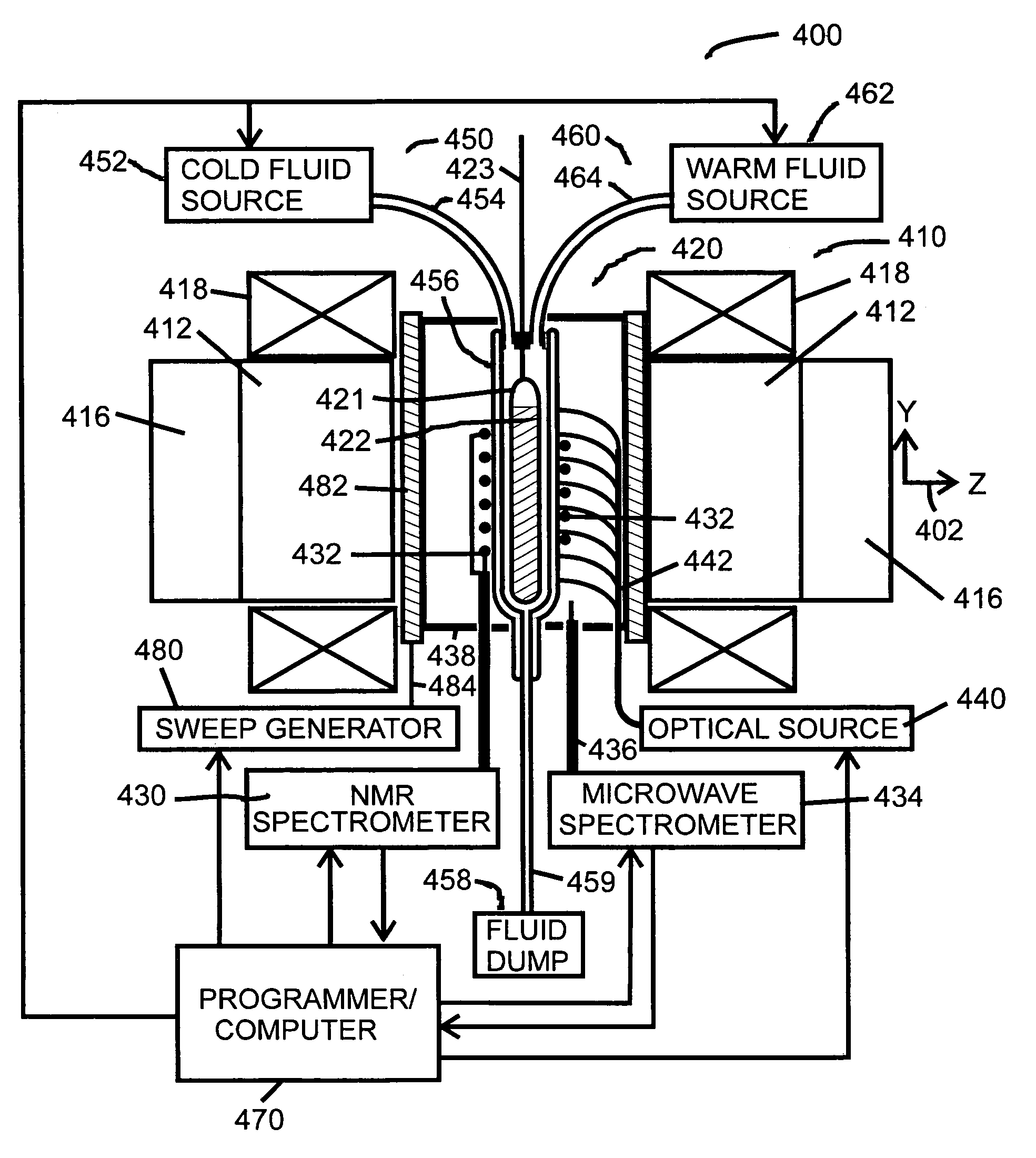
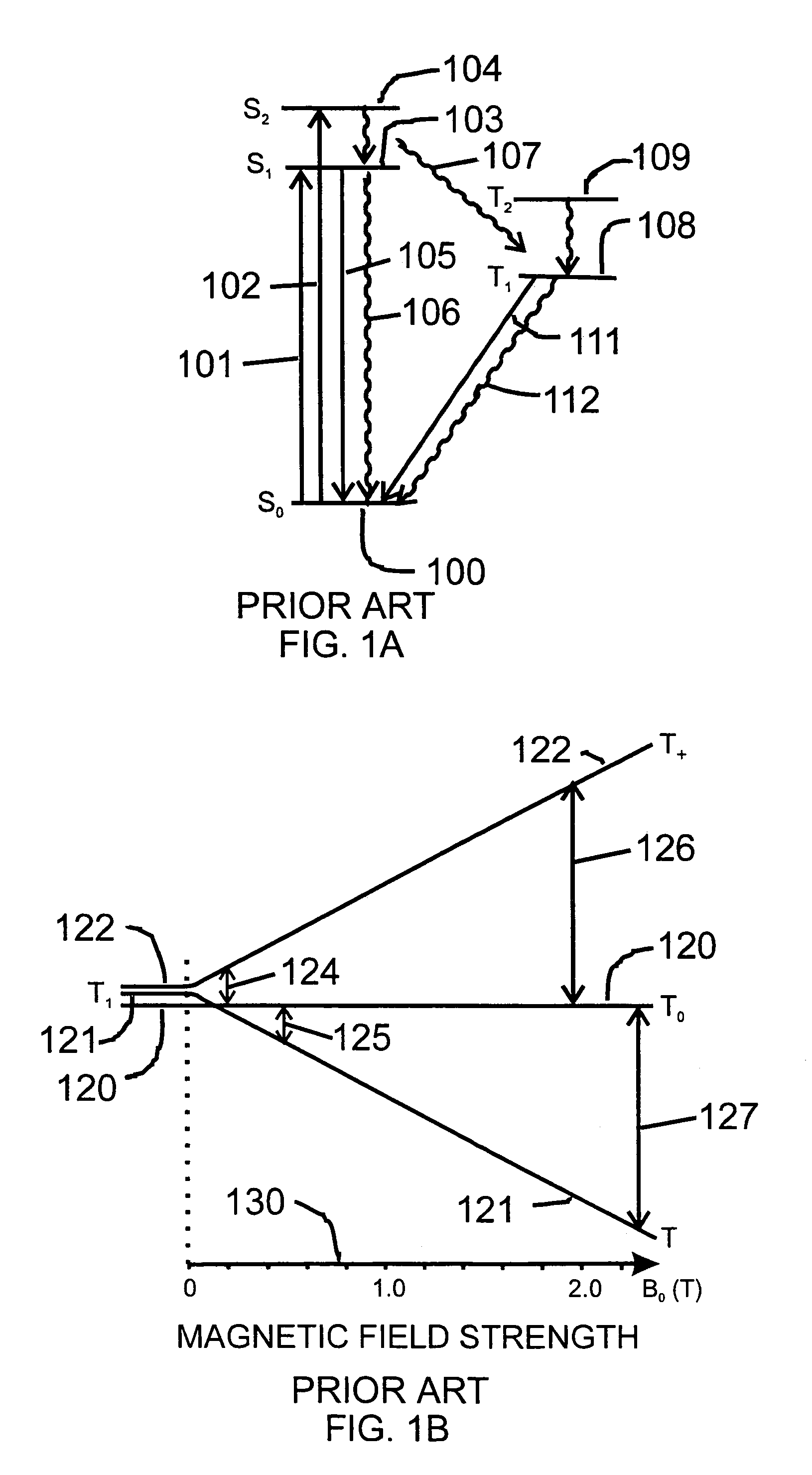
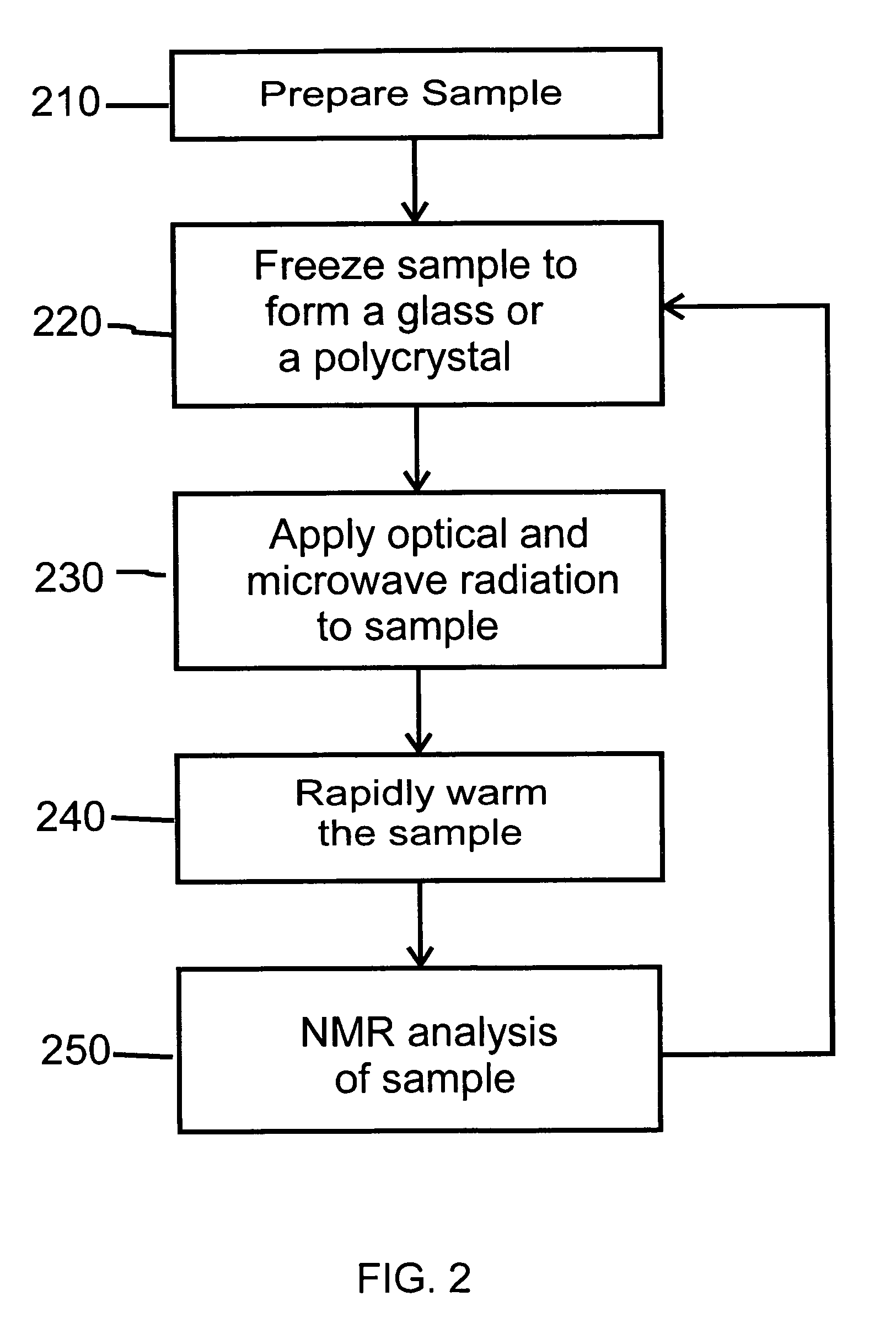
- A method involving a solvent with photo-excitable triplet-state molecules is used, where the sample is frozen, exposed to optical and microwave radiation to achieve high nuclear polarization without low temperatures, and then melted for NMR analysis, eliminating the need for low temperatures and avoiding paramagnetic broadening.
Method for controlling an excitation and detection circuit for nuclear magnetic resonance
PatentInactiveEP2068164A1
Innovation
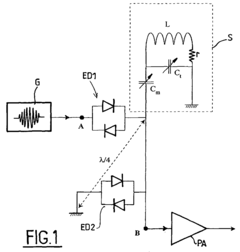
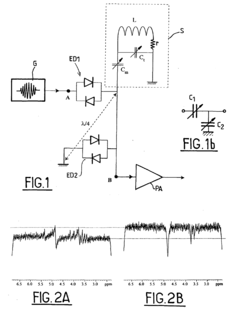
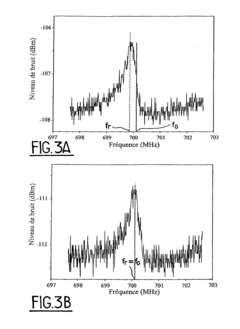
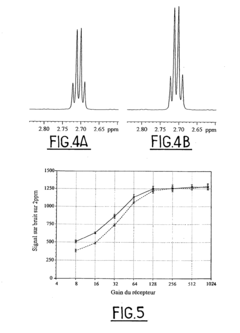
- The method involves adjusting the resonance frequency of the reception circuit in NMR probes to match the Larmor frequency of the nuclear spins, using adjustable capacitors and reactive circuits to optimize the quality factor and impedance matching, ensuring that the reception frequency aligns with the emission frequency, thereby enhancing the signal power and noise levels.
Calibration Standards and Quality Control Protocols
Establishing reliable calibration standards and implementing rigorous quality control protocols are essential for achieving maximum sensitivity in NMR spectroscopy. The calibration process begins with the selection of appropriate reference standards that exhibit stable chemical shifts and well-defined peak patterns. Common calibration standards include tetramethylsilane (TMS) for organic solvents and 4,4-dimethyl-4-silapentane-1-sulfonic acid (DSS) for aqueous solutions. These standards serve as benchmarks for chemical shift referencing and for validating the instrument's performance parameters.
A comprehensive calibration protocol should address multiple aspects of NMR performance, including magnetic field homogeneity, pulse width optimization, and receiver gain settings. The 90° pulse calibration is particularly critical as it directly impacts signal intensity and phase accuracy. This calibration should be performed regularly using standard samples with known relaxation properties to ensure consistent excitation across the spectral width.
Quality control measures must be implemented at various stages of the NMR workflow. Daily system performance checks using standardized samples help identify drift in instrument parameters before they significantly impact experimental results. These checks typically include assessments of sensitivity (signal-to-noise ratio), resolution (line width at half-height), and water suppression efficiency for biological samples.
Documentation plays a vital role in maintaining calibration integrity. Detailed records of calibration procedures, including dates, operators, and observed parameters, should be maintained in electronic logs. These records facilitate trend analysis to detect gradual performance degradation that might otherwise go unnoticed in day-to-day operations.
Automated quality control software has emerged as a valuable tool for modern NMR facilities. These systems can perform scheduled diagnostic tests, compare results against established thresholds, and alert operators when parameters drift beyond acceptable limits. Integration of these automated systems with laboratory information management systems (LIMS) enables comprehensive tracking of instrument performance over time.
For quantitative NMR applications, additional calibration steps are necessary. External calibration curves using certified reference materials at multiple concentration levels ensure accurate quantification. Internal standards added directly to samples provide further validation and can compensate for matrix effects that might influence signal intensity.
Inter-laboratory comparison studies represent the highest level of quality assurance. Participation in such programs allows facilities to benchmark their performance against peer institutions and identify systematic biases in their calibration protocols. These collaborative efforts contribute to the establishment of industry-wide best practices for NMR attenuation adjustment and sensitivity optimization.
A comprehensive calibration protocol should address multiple aspects of NMR performance, including magnetic field homogeneity, pulse width optimization, and receiver gain settings. The 90° pulse calibration is particularly critical as it directly impacts signal intensity and phase accuracy. This calibration should be performed regularly using standard samples with known relaxation properties to ensure consistent excitation across the spectral width.
Quality control measures must be implemented at various stages of the NMR workflow. Daily system performance checks using standardized samples help identify drift in instrument parameters before they significantly impact experimental results. These checks typically include assessments of sensitivity (signal-to-noise ratio), resolution (line width at half-height), and water suppression efficiency for biological samples.
Documentation plays a vital role in maintaining calibration integrity. Detailed records of calibration procedures, including dates, operators, and observed parameters, should be maintained in electronic logs. These records facilitate trend analysis to detect gradual performance degradation that might otherwise go unnoticed in day-to-day operations.
Automated quality control software has emerged as a valuable tool for modern NMR facilities. These systems can perform scheduled diagnostic tests, compare results against established thresholds, and alert operators when parameters drift beyond acceptable limits. Integration of these automated systems with laboratory information management systems (LIMS) enables comprehensive tracking of instrument performance over time.
For quantitative NMR applications, additional calibration steps are necessary. External calibration curves using certified reference materials at multiple concentration levels ensure accurate quantification. Internal standards added directly to samples provide further validation and can compensate for matrix effects that might influence signal intensity.
Inter-laboratory comparison studies represent the highest level of quality assurance. Participation in such programs allows facilities to benchmark their performance against peer institutions and identify systematic biases in their calibration protocols. These collaborative efforts contribute to the establishment of industry-wide best practices for NMR attenuation adjustment and sensitivity optimization.
Cost-Benefit Analysis of Advanced NMR Attenuation Solutions
When evaluating advanced NMR attenuation solutions, a comprehensive cost-benefit analysis reveals significant financial considerations that must be weighed against performance improvements. Initial investment costs for high-end attenuation systems typically range from $50,000 to $250,000, depending on specifications and capabilities. These systems often require specialized installation environments, adding $10,000-30,000 in facility modification expenses.
Operational costs present another significant consideration. Advanced attenuation solutions generally consume 15-25% more power than standard systems, translating to approximately $3,000-7,000 in additional annual utility expenses. Maintenance contracts for sophisticated equipment average $8,000-15,000 annually, with specialized components often requiring replacement every 3-5 years at considerable cost.
Against these expenses, quantifiable benefits must be measured. Enhanced sample sensitivity through optimized attenuation typically reduces experiment duration by 30-45%, significantly increasing laboratory throughput. This efficiency gain can translate to processing 2-3 additional samples daily in high-volume settings, potentially generating $100,000-300,000 in additional annual revenue for commercial laboratories.
Data quality improvements represent another substantial benefit. Advanced attenuation solutions demonstrate 25-40% higher signal-to-noise ratios, reducing false positives/negatives by approximately 15-20%. For pharmaceutical applications, this improved accuracy can accelerate drug development timelines by 3-6 months, representing millions in potential market advantage.
Return on investment calculations indicate most facilities achieve financial breakeven within 18-36 months, depending on utilization rates and application focus. Research institutions primarily benefit from enhanced publication quality and grant competitiveness, while commercial entities see more direct financial returns through increased throughput and accuracy.
Long-term cost considerations include technology obsolescence risk, with most advanced systems maintaining competitive performance for 7-10 years before significant upgrades become necessary. Modular systems offering component-level upgrades typically demonstrate 15-25% lower total cost of ownership over a decade compared to systems requiring complete replacement.
Organizations must also consider personnel training investments, averaging $5,000-10,000 initially plus ongoing education. However, these costs are offset by reduced sample preparation time and decreased need for experiment repetition, resulting in 20-30% lower per-sample labor costs over time.
Operational costs present another significant consideration. Advanced attenuation solutions generally consume 15-25% more power than standard systems, translating to approximately $3,000-7,000 in additional annual utility expenses. Maintenance contracts for sophisticated equipment average $8,000-15,000 annually, with specialized components often requiring replacement every 3-5 years at considerable cost.
Against these expenses, quantifiable benefits must be measured. Enhanced sample sensitivity through optimized attenuation typically reduces experiment duration by 30-45%, significantly increasing laboratory throughput. This efficiency gain can translate to processing 2-3 additional samples daily in high-volume settings, potentially generating $100,000-300,000 in additional annual revenue for commercial laboratories.
Data quality improvements represent another substantial benefit. Advanced attenuation solutions demonstrate 25-40% higher signal-to-noise ratios, reducing false positives/negatives by approximately 15-20%. For pharmaceutical applications, this improved accuracy can accelerate drug development timelines by 3-6 months, representing millions in potential market advantage.
Return on investment calculations indicate most facilities achieve financial breakeven within 18-36 months, depending on utilization rates and application focus. Research institutions primarily benefit from enhanced publication quality and grant competitiveness, while commercial entities see more direct financial returns through increased throughput and accuracy.
Long-term cost considerations include technology obsolescence risk, with most advanced systems maintaining competitive performance for 7-10 years before significant upgrades become necessary. Modular systems offering component-level upgrades typically demonstrate 15-25% lower total cost of ownership over a decade compared to systems requiring complete replacement.
Organizations must also consider personnel training investments, averaging $5,000-10,000 initially plus ongoing education. However, these costs are offset by reduced sample preparation time and decreased need for experiment repetition, resulting in 20-30% lower per-sample labor costs over time.
Unlock deeper insights with Patsnap Eureka Quick Research — get a full tech report to explore trends and direct your research. Try now!
Generate Your Research Report Instantly with AI Agent
Supercharge your innovation with Patsnap Eureka AI Agent Platform!