
How Solid State Battery Breakthrough Influences Global Regulatory Trends?
OCT 24, 202510 MIN READ
Generate Your Research Report Instantly with AI Agent
Patsnap Eureka helps you evaluate technical feasibility & market potential.
Solid State Battery Evolution and Development Goals
Solid state batteries represent a significant evolution in energy storage technology, emerging from decades of research into safer and more efficient alternatives to conventional lithium-ion batteries. The development trajectory began in the 1970s with initial explorations of solid electrolytes, progressing through various material innovations including ceramic, polymer, and composite electrolytes. Each iteration has addressed fundamental challenges while pushing energy density and safety parameters beyond previous limitations.
The technological progression accelerated notably after 2010, with breakthrough research in sulfide-based solid electrolytes demonstrating ionic conductivity comparable to liquid electrolytes. This milestone catalyzed increased investment and research activity across academic institutions and industry laboratories worldwide. By 2015-2018, early prototypes from companies like Toyota and Quantumscape demonstrated the practical viability of solid-state technology, though significant manufacturing challenges remained unresolved.
Current development goals focus on several critical parameters that will determine market readiness and regulatory impact. Primary among these is achieving energy density exceeding 400 Wh/kg at the cell level, representing approximately 80% improvement over advanced lithium-ion batteries. This threshold is considered essential for enabling electric vehicles with ranges comparable to conventional vehicles without weight penalties.
Safety enhancement remains a cornerstone objective, with solid-state technology aiming to eliminate thermal runaway risks inherent in liquid electrolyte systems. This safety profile directly influences regulatory frameworks, as batteries demonstrating inherent safety characteristics may qualify for streamlined certification processes and less stringent transportation regulations.
Manufacturing scalability represents perhaps the most significant technical hurdle, with current laboratory processes requiring translation to mass production environments. Development goals include reducing processing temperatures below 200°C and eliminating the need for high-pressure formation techniques that complicate manufacturing.
Cycle life targets exceed 1,000 complete charge-discharge cycles while maintaining 80% capacity, with accelerated testing protocols being developed to validate long-term performance. Fast charging capability, targeting 80% charge in under 15 minutes without degradation, represents another critical benchmark for commercial viability.
The convergence of these development goals is expected to produce commercially viable solid-state batteries by 2025-2027, with mass market penetration following in subsequent years. This timeline aligns with regulatory roadmaps in multiple jurisdictions, suggesting a coordinated evolution of technology capabilities and compliance frameworks.
The technological progression accelerated notably after 2010, with breakthrough research in sulfide-based solid electrolytes demonstrating ionic conductivity comparable to liquid electrolytes. This milestone catalyzed increased investment and research activity across academic institutions and industry laboratories worldwide. By 2015-2018, early prototypes from companies like Toyota and Quantumscape demonstrated the practical viability of solid-state technology, though significant manufacturing challenges remained unresolved.
Current development goals focus on several critical parameters that will determine market readiness and regulatory impact. Primary among these is achieving energy density exceeding 400 Wh/kg at the cell level, representing approximately 80% improvement over advanced lithium-ion batteries. This threshold is considered essential for enabling electric vehicles with ranges comparable to conventional vehicles without weight penalties.
Safety enhancement remains a cornerstone objective, with solid-state technology aiming to eliminate thermal runaway risks inherent in liquid electrolyte systems. This safety profile directly influences regulatory frameworks, as batteries demonstrating inherent safety characteristics may qualify for streamlined certification processes and less stringent transportation regulations.
Manufacturing scalability represents perhaps the most significant technical hurdle, with current laboratory processes requiring translation to mass production environments. Development goals include reducing processing temperatures below 200°C and eliminating the need for high-pressure formation techniques that complicate manufacturing.
Cycle life targets exceed 1,000 complete charge-discharge cycles while maintaining 80% capacity, with accelerated testing protocols being developed to validate long-term performance. Fast charging capability, targeting 80% charge in under 15 minutes without degradation, represents another critical benchmark for commercial viability.
The convergence of these development goals is expected to produce commercially viable solid-state batteries by 2025-2027, with mass market penetration following in subsequent years. This timeline aligns with regulatory roadmaps in multiple jurisdictions, suggesting a coordinated evolution of technology capabilities and compliance frameworks.
Market Demand Analysis for Next-Generation Energy Storage
The global energy storage market is witnessing unprecedented growth, driven primarily by the increasing adoption of renewable energy sources and electric vehicles (EVs). Current projections indicate that the global energy storage market will reach approximately $546 billion by 2035, with a compound annual growth rate of 20-25% between 2023 and 2035. This exponential growth trajectory underscores the critical need for next-generation energy storage solutions that can overcome the limitations of conventional lithium-ion batteries.
Solid-state batteries represent a revolutionary advancement in energy storage technology, addressing many of the shortcomings of traditional battery systems. Market research indicates that consumer demand for longer-lasting, faster-charging, and safer batteries is intensifying across multiple sectors. In the automotive industry, range anxiety remains a significant barrier to EV adoption, with surveys showing that 78% of potential EV buyers consider battery range a decisive factor in their purchasing decisions.
The industrial sector presents another substantial market opportunity for advanced energy storage solutions. Manufacturing facilities, data centers, and telecommunications infrastructure increasingly require reliable, high-capacity energy storage systems to ensure operational continuity and manage peak load demands. The industrial energy storage market segment is expected to grow at a rate of 22% annually through 2030, outpacing even consumer electronics applications.
Geographically, the demand landscape shows significant regional variations. Asia-Pacific, particularly China, Japan, and South Korea, currently leads in both production capacity and market demand for advanced battery technologies. However, North America and Europe are rapidly accelerating their investments in next-generation energy storage, driven by ambitious climate policies and industrial strategy considerations. The European Union's Green Deal and the United States' Inflation Reduction Act have created substantial market incentives for domestic battery production and deployment.
Consumer electronics manufacturers represent another major demand driver, seeking batteries with higher energy density, improved safety profiles, and longer cycle life. The wearable technology segment, in particular, is projected to grow at 18% annually through 2028, creating significant opportunities for compact, high-performance energy storage solutions.
Regulatory trends are increasingly shaping market demand patterns. Stringent safety regulations following high-profile battery failure incidents have accelerated interest in solid-state technologies, which offer inherently safer operation compared to liquid electrolyte systems. Additionally, environmental regulations concerning battery recycling and material sourcing are creating market preferences for technologies with reduced environmental footprints and improved recyclability characteristics.
The convergence of these market forces indicates that solid-state battery technology is positioned at a critical inflection point, where technological breakthroughs could rapidly translate into substantial market adoption across multiple sectors, reshaping global energy storage paradigms and regulatory frameworks simultaneously.
Solid-state batteries represent a revolutionary advancement in energy storage technology, addressing many of the shortcomings of traditional battery systems. Market research indicates that consumer demand for longer-lasting, faster-charging, and safer batteries is intensifying across multiple sectors. In the automotive industry, range anxiety remains a significant barrier to EV adoption, with surveys showing that 78% of potential EV buyers consider battery range a decisive factor in their purchasing decisions.
The industrial sector presents another substantial market opportunity for advanced energy storage solutions. Manufacturing facilities, data centers, and telecommunications infrastructure increasingly require reliable, high-capacity energy storage systems to ensure operational continuity and manage peak load demands. The industrial energy storage market segment is expected to grow at a rate of 22% annually through 2030, outpacing even consumer electronics applications.
Geographically, the demand landscape shows significant regional variations. Asia-Pacific, particularly China, Japan, and South Korea, currently leads in both production capacity and market demand for advanced battery technologies. However, North America and Europe are rapidly accelerating their investments in next-generation energy storage, driven by ambitious climate policies and industrial strategy considerations. The European Union's Green Deal and the United States' Inflation Reduction Act have created substantial market incentives for domestic battery production and deployment.
Consumer electronics manufacturers represent another major demand driver, seeking batteries with higher energy density, improved safety profiles, and longer cycle life. The wearable technology segment, in particular, is projected to grow at 18% annually through 2028, creating significant opportunities for compact, high-performance energy storage solutions.
Regulatory trends are increasingly shaping market demand patterns. Stringent safety regulations following high-profile battery failure incidents have accelerated interest in solid-state technologies, which offer inherently safer operation compared to liquid electrolyte systems. Additionally, environmental regulations concerning battery recycling and material sourcing are creating market preferences for technologies with reduced environmental footprints and improved recyclability characteristics.
The convergence of these market forces indicates that solid-state battery technology is positioned at a critical inflection point, where technological breakthroughs could rapidly translate into substantial market adoption across multiple sectors, reshaping global energy storage paradigms and regulatory frameworks simultaneously.
Technical Challenges and Global Development Status
Solid state batteries represent a significant technological leap in energy storage, yet their development faces substantial technical hurdles. The primary challenge remains the solid electrolyte interface, where issues of ion conductivity at room temperature significantly lag behind traditional liquid electrolytes. Current solid electrolytes achieve conductivities of 10^-4 to 10^-3 S/cm, whereas commercial applications require at least 10^-2 S/cm. This conductivity gap necessitates operation at elevated temperatures, limiting practical applications.
Material stability presents another critical challenge, particularly at the cathode-electrolyte interface where chemical reactions can form resistive layers. These interfacial resistances increase over cycling, leading to capacity fade and shortened battery life. Additionally, mechanical stress during charging and discharging causes volume changes that can create microcracks in solid electrolytes, further degrading performance.
Manufacturing scalability remains problematic, with current production methods primarily limited to laboratory settings. The transition from small-scale prototypes to mass production faces significant hurdles in maintaining consistent material properties and performance across large-scale manufacturing processes. The precision required for thin-film deposition of solid electrolytes presents particular difficulties.
Globally, solid state battery development shows distinct regional characteristics. Japan leads in patents and commercial development, with companies like Toyota and Panasonic making substantial investments. Their approach focuses on sulfide-based electrolytes, which offer high conductivity but present safety and stability challenges. South Korea follows closely, with significant research into polymer-based systems.
European development centers on oxide-based electrolytes, prioritizing safety and stability over maximum energy density. The European Union's Battery 2030+ initiative coordinates research efforts across multiple countries, focusing on standardization and sustainable manufacturing processes.
In North America, development is characterized by diverse approaches, with significant venture capital funding supporting startups exploring novel materials and architectures. The United States Department of Energy's Battery500 Consortium specifically targets solid state technology as a pathway to next-generation energy storage.
China has rapidly accelerated its research efforts, focusing on integrating solid state batteries into its dominant battery manufacturing ecosystem. Chinese approaches emphasize cost-effective manufacturing techniques and materials that can be scaled quickly, though technical sophistication sometimes lags behind Japanese and European efforts.
Regulatory frameworks vary significantly across regions, with Japan and the European Union establishing the most comprehensive safety standards specifically addressing solid state technologies. These regional differences in technical approaches and regulatory environments create a complex landscape for global commercialization.
Material stability presents another critical challenge, particularly at the cathode-electrolyte interface where chemical reactions can form resistive layers. These interfacial resistances increase over cycling, leading to capacity fade and shortened battery life. Additionally, mechanical stress during charging and discharging causes volume changes that can create microcracks in solid electrolytes, further degrading performance.
Manufacturing scalability remains problematic, with current production methods primarily limited to laboratory settings. The transition from small-scale prototypes to mass production faces significant hurdles in maintaining consistent material properties and performance across large-scale manufacturing processes. The precision required for thin-film deposition of solid electrolytes presents particular difficulties.
Globally, solid state battery development shows distinct regional characteristics. Japan leads in patents and commercial development, with companies like Toyota and Panasonic making substantial investments. Their approach focuses on sulfide-based electrolytes, which offer high conductivity but present safety and stability challenges. South Korea follows closely, with significant research into polymer-based systems.
European development centers on oxide-based electrolytes, prioritizing safety and stability over maximum energy density. The European Union's Battery 2030+ initiative coordinates research efforts across multiple countries, focusing on standardization and sustainable manufacturing processes.
In North America, development is characterized by diverse approaches, with significant venture capital funding supporting startups exploring novel materials and architectures. The United States Department of Energy's Battery500 Consortium specifically targets solid state technology as a pathway to next-generation energy storage.
China has rapidly accelerated its research efforts, focusing on integrating solid state batteries into its dominant battery manufacturing ecosystem. Chinese approaches emphasize cost-effective manufacturing techniques and materials that can be scaled quickly, though technical sophistication sometimes lags behind Japanese and European efforts.
Regulatory frameworks vary significantly across regions, with Japan and the European Union establishing the most comprehensive safety standards specifically addressing solid state technologies. These regional differences in technical approaches and regulatory environments create a complex landscape for global commercialization.
Current Solid State Battery Solutions and Implementations
01 Safety regulations and standards for solid state batteries
Regulatory frameworks are being developed to address the unique safety characteristics of solid state batteries. These regulations focus on thermal stability, mechanical integrity, and failure modes that differ from traditional lithium-ion batteries. Standards organizations are establishing testing protocols specific to solid electrolytes and their interaction with electrode materials. These safety regulations aim to ensure consumer protection while enabling the commercialization of this emerging technology.- Safety regulations for solid-state battery manufacturing: Regulatory frameworks are evolving to address the unique safety considerations in solid-state battery production. These regulations focus on manufacturing processes, material handling protocols, and quality control standards specific to solid electrolytes. Compared to traditional lithium-ion batteries with liquid electrolytes, solid-state batteries present different safety challenges that require specialized regulatory approaches to ensure safe production and deployment.
- Environmental compliance and sustainability standards: Emerging regulations are emphasizing environmental aspects of solid-state battery technology, including sustainable material sourcing, reduced toxic components, and end-of-life recycling requirements. Regulatory bodies are developing frameworks that mandate lower environmental footprints throughout the battery lifecycle. These standards aim to minimize waste generation and promote circular economy principles in the solid-state battery industry.
- Transportation and storage regulations: Specialized regulatory frameworks are being developed for the transportation and storage of solid-state batteries. These regulations address the unique characteristics and potential hazards of solid electrolytes during shipping, handling, and warehousing. While solid-state batteries generally present lower fire risks than conventional lithium-ion batteries, their transportation still requires specific safety protocols and documentation to comply with international shipping standards.
- Performance certification and standardization: Regulatory trends include the development of standardized testing protocols and performance certification requirements specific to solid-state battery technology. These standards aim to establish consistent methods for evaluating capacity, cycle life, temperature performance, and safety characteristics. Certification frameworks help ensure that solid-state batteries meet minimum performance thresholds before market entry, providing confidence to consumers and downstream manufacturers.
- Market access and international harmonization efforts: Global regulatory bodies are working toward harmonizing solid-state battery regulations across different jurisdictions to facilitate international trade and technology adoption. These efforts include aligning safety standards, testing protocols, and certification requirements. Regulatory frameworks are being developed to address market access requirements, intellectual property protections, and technology transfer considerations specific to solid-state battery technologies in various regions.
02 Environmental compliance and sustainability requirements
Regulatory trends are increasingly focusing on the environmental impact of solid state battery production, use, and disposal. This includes regulations on material sourcing, manufacturing processes, and end-of-life management. Manufacturers must comply with restrictions on hazardous substances and demonstrate sustainable practices throughout the battery lifecycle. Recycling protocols specific to solid state battery components are being developed to address resource conservation and waste reduction concerns.Expand Specific Solutions03 Transportation and shipping regulations
Regulatory frameworks governing the transportation of solid state batteries are evolving to address their unique characteristics. While solid state batteries generally present lower fire risks than conventional lithium-ion batteries, specific protocols for their classification, packaging, and handling during transport are being established. International shipping regulations are being updated to accommodate these new battery technologies while ensuring safety across different modes of transportation.Expand Specific Solutions04 Performance certification and standardization
Regulatory bodies are developing standardized testing protocols and certification requirements for solid state battery performance claims. These standards address energy density, power capability, cycle life, and operating temperature ranges. Manufacturers must validate their performance claims through standardized testing procedures to ensure market transparency and consumer protection. These certification standards help establish benchmarks for comparing different solid state battery technologies and accelerate their market adoption.Expand Specific Solutions05 Manufacturing process regulations and quality control
Regulatory frameworks are emerging for manufacturing processes specific to solid state batteries, focusing on quality control and consistency. These regulations address the unique challenges in solid electrolyte production, interface engineering, and cell assembly. Manufacturing facilities must comply with specific environmental controls, material handling procedures, and quality assurance protocols. These manufacturing regulations aim to ensure product reliability while enabling scaled production of solid state batteries for commercial applications.Expand Specific Solutions
Key Industry Players and Competitive Landscape
The solid-state battery market is currently in an early growth phase, characterized by significant R&D investment but limited commercial deployment. Market size is projected to expand rapidly, reaching approximately $6-8 billion by 2030, driven by automotive sector demand from companies like Honda, Hyundai, and Kia. Technical maturity varies across players: QuantumScape, Solid Power, and LG Energy Solution lead in technology development, while traditional battery manufacturers like Murata and Samsung Electro-Mechanics leverage their manufacturing expertise. Research institutions including University of California and Chinese Academy of Sciences contribute fundamental breakthroughs. Automotive OEMs are increasingly forming strategic partnerships with battery developers, indicating the technology's growing commercial viability despite remaining challenges in scalability and production costs.
Honda Motor Co., Ltd.
Technical Solution: Honda has developed a fluoride-based solid-state battery technology that represents a significant departure from conventional lithium-ion approaches. Their solid-state design utilizes a fluoride ion exchange mechanism that theoretically enables higher energy density (potentially exceeding 1,000 Wh/L) while addressing safety concerns associated with lithium-ion batteries. Honda's approach incorporates a proprietary solid electrolyte material that demonstrates stable performance across a wide temperature range (-20°C to 60°C). The company has integrated this technology into their broader electrification strategy, with plans to implement solid-state batteries in both hybrid and fully electric vehicles. Honda has established a dedicated solid-state battery production facility in Japan for prototype manufacturing and testing, with initial capacity of approximately 1 MWh annually. Their development roadmap targets initial commercial implementation in hybrid vehicles by 2025, followed by full EV applications by 2028-2030.
Strengths: Innovative fluoride-based chemistry offers potential energy density advantages; vertical integration capabilities as both battery developer and vehicle manufacturer; established global regulatory compliance expertise; strong materials science foundation. Weaknesses: Limited public disclosure of performance metrics compared to competitors; fluoride-based systems face challenges with ionic conductivity at room temperature; manufacturing complexity may impact production costs; later commercialization timeline for full EV applications.
LG Energy Solution Ltd.
Technical Solution: LG Energy Solution has developed an advanced solid-state battery technology utilizing a composite structure of sulfide solid electrolytes combined with proprietary protective coating layers. Their approach focuses on addressing the critical interface issues between solid electrolytes and electrodes that have historically limited solid-state performance. The company has demonstrated prototype cells achieving energy densities exceeding 900 Wh/L while maintaining stability over 200+ cycles. LG's manufacturing strategy leverages their existing global battery production infrastructure, with plans to implement solid-state technology through gradual integration into current production lines. Their solid-state roadmap includes initial commercialization in consumer electronics by 2026, followed by automotive applications by 2027-2028. The company has invested over $150 million in solid-state R&D and has established partnerships with automotive OEMs to accelerate development and regulatory compliance.
Strengths: Extensive battery manufacturing expertise and established global production capacity; strong existing relationships with automotive OEMs; ability to leverage current production infrastructure; comprehensive intellectual property portfolio in battery technologies. Weaknesses: Later market entry timeline compared to some pure-play solid-state competitors; technical challenges in scaling sulfide electrolyte production; potential regulatory hurdles in multiple global markets; balancing solid-state development with ongoing liquid electrolyte battery business.
Critical Patents and Technical Innovations Analysis
Solid-state nanofiber polymer multilayer composite electrolytes and cells
PatentActiveUS11923501B2
Innovation
- The development of ceramic lithium-conducting nanofibers integrated with polymer electrolytes, specifically using LLZO-PEO composite thin films, to enhance ionic conductivity and electrochemical stability, with nanofibers forming a three-dimensional network for improved ion transport and mechanical robustness.
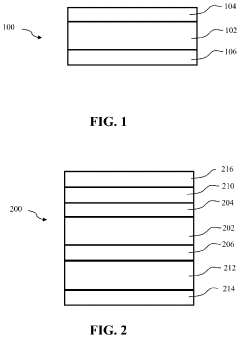
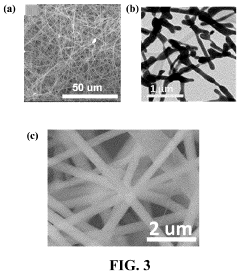
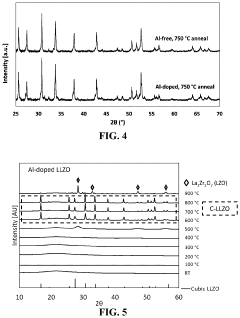
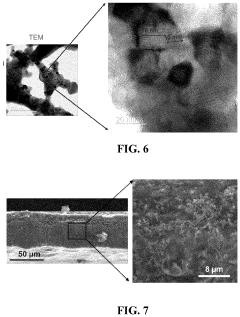
Method of manufacturing a solid-state lithium battery and a battery manufactured by the method
PatentActiveUS20230044416A1
Innovation
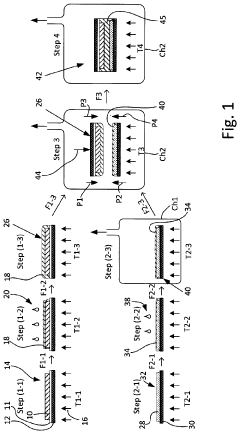
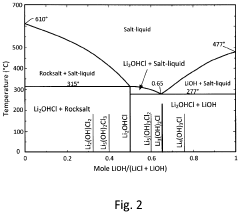
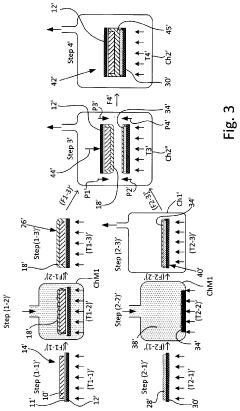
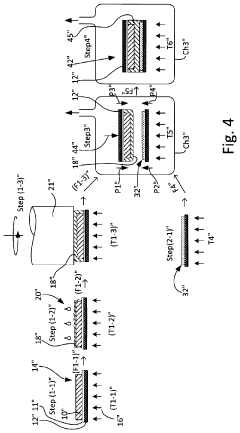
- A method involving the coating of anode and cathode units with solid-state electrolyte precursors, followed by pressing them together at elevated temperatures and mechanical pressure to form a pre-final solid-state battery unit, with controlled heating and pressure to manage redundant water and hydrogen, ensuring the formation of an integral solid-state electrolyte.
Regulatory Framework and Policy Implications
The evolving landscape of solid-state battery technology is prompting significant shifts in regulatory frameworks worldwide. Current regulations governing lithium-ion batteries are proving inadequate for addressing the unique characteristics and safety profiles of solid-state alternatives. Regulatory bodies across major markets are actively developing new standards specifically tailored to solid-state battery technologies, focusing on safety certification, performance metrics, and lifecycle management.
In the United States, the Department of Energy and the Environmental Protection Agency are collaborating to establish comprehensive guidelines for solid-state battery manufacturing, deployment, and disposal. These emerging regulations emphasize reduced environmental impact and enhanced safety requirements compared to traditional lithium-ion batteries. Similarly, the European Union is revising its Battery Directive to incorporate provisions specifically addressing solid-state technologies, with particular attention to recycling protocols and material recovery rates.
Asian markets, particularly Japan and South Korea, are pioneering regulatory approaches that balance innovation promotion with safety assurance. Their frameworks include expedited approval pathways for solid-state batteries that demonstrate significant safety improvements over conventional technologies, creating regulatory incentives for technological advancement.
The international standardization landscape is equally dynamic, with organizations like ISO and IEC developing testing protocols and safety standards specifically for solid-state battery technologies. These standards are crucial for ensuring cross-border compatibility and facilitating global market access for manufacturers.
Policy implications extend beyond direct regulation into broader energy transition strategies. Many governments are incorporating solid-state battery development into their industrial policies and clean energy initiatives. Tax incentives, research grants, and public procurement preferences are being deployed to accelerate commercialization of solid-state battery technologies, reflecting their strategic importance to energy security and climate goals.
Regulatory divergence remains a significant challenge, with different jurisdictions adopting varied approaches to certification requirements, safety thresholds, and environmental standards. This fragmentation creates compliance complexities for manufacturers operating in global markets and potentially impedes technology diffusion. Industry stakeholders are advocating for greater international harmonization of regulatory frameworks to reduce these barriers.
The evolving regulatory landscape also presents opportunities for first-movers in establishing industry best practices. Companies demonstrating leadership in safety, sustainability, and performance are actively shaping regulatory expectations, potentially securing competitive advantages as standards solidify.
In the United States, the Department of Energy and the Environmental Protection Agency are collaborating to establish comprehensive guidelines for solid-state battery manufacturing, deployment, and disposal. These emerging regulations emphasize reduced environmental impact and enhanced safety requirements compared to traditional lithium-ion batteries. Similarly, the European Union is revising its Battery Directive to incorporate provisions specifically addressing solid-state technologies, with particular attention to recycling protocols and material recovery rates.
Asian markets, particularly Japan and South Korea, are pioneering regulatory approaches that balance innovation promotion with safety assurance. Their frameworks include expedited approval pathways for solid-state batteries that demonstrate significant safety improvements over conventional technologies, creating regulatory incentives for technological advancement.
The international standardization landscape is equally dynamic, with organizations like ISO and IEC developing testing protocols and safety standards specifically for solid-state battery technologies. These standards are crucial for ensuring cross-border compatibility and facilitating global market access for manufacturers.
Policy implications extend beyond direct regulation into broader energy transition strategies. Many governments are incorporating solid-state battery development into their industrial policies and clean energy initiatives. Tax incentives, research grants, and public procurement preferences are being deployed to accelerate commercialization of solid-state battery technologies, reflecting their strategic importance to energy security and climate goals.
Regulatory divergence remains a significant challenge, with different jurisdictions adopting varied approaches to certification requirements, safety thresholds, and environmental standards. This fragmentation creates compliance complexities for manufacturers operating in global markets and potentially impedes technology diffusion. Industry stakeholders are advocating for greater international harmonization of regulatory frameworks to reduce these barriers.
The evolving regulatory landscape also presents opportunities for first-movers in establishing industry best practices. Companies demonstrating leadership in safety, sustainability, and performance are actively shaping regulatory expectations, potentially securing competitive advantages as standards solidify.
Environmental Impact and Sustainability Considerations
Solid state battery technology represents a significant advancement in energy storage with profound environmental implications. The transition from conventional lithium-ion batteries to solid state alternatives offers substantial environmental benefits, primarily through the elimination of liquid electrolytes that pose fire risks and contain toxic materials. This shift reduces the environmental hazards associated with battery production, usage, and disposal while minimizing the risk of catastrophic failures that could release harmful substances into ecosystems.
The manufacturing process for solid state batteries demonstrates improved sustainability metrics compared to traditional battery technologies. Research indicates a potential reduction in carbon footprint by 15-30% during production phases, attributed to simplified manufacturing processes and decreased reliance on environmentally intensive materials. Additionally, the extended lifecycle of solid state batteries—potentially 2-3 times longer than conventional lithium-ion counterparts—significantly reduces waste generation and resource consumption associated with frequent battery replacements.
Critical raw material considerations present both challenges and opportunities for environmental sustainability. While solid state batteries may reduce dependence on certain problematic materials like cobalt, they introduce demand for other materials such as lithium, ceramic compounds, and specialized solid electrolytes. This shifting material profile necessitates new approaches to responsible sourcing, particularly as regulatory frameworks evolve to address emerging supply chains and extraction practices.
End-of-life management represents another crucial environmental dimension. The simplified composition of solid state batteries, lacking liquid components, potentially facilitates more efficient recycling processes. Early studies suggest recovery rates for key materials could increase by 20-40% compared to conventional batteries, creating opportunities for circular economy approaches that regulatory frameworks are increasingly emphasizing.
Water conservation emerges as an additional environmental benefit, as solid state battery production typically requires significantly less water than conventional battery manufacturing. This aspect becomes increasingly important as water scarcity concerns intensify globally and regulatory bodies implement stricter water management requirements for industrial processes.
These environmental advantages are driving regulatory responses worldwide, with authorities increasingly incorporating sustainability metrics into battery regulations. The EU Battery Directive revisions, China's industrial policies, and emerging frameworks in North America all reflect growing recognition that solid state battery technology offers pathways to meet increasingly stringent environmental standards while supporting decarbonization goals across transportation and energy storage sectors.
The manufacturing process for solid state batteries demonstrates improved sustainability metrics compared to traditional battery technologies. Research indicates a potential reduction in carbon footprint by 15-30% during production phases, attributed to simplified manufacturing processes and decreased reliance on environmentally intensive materials. Additionally, the extended lifecycle of solid state batteries—potentially 2-3 times longer than conventional lithium-ion counterparts—significantly reduces waste generation and resource consumption associated with frequent battery replacements.
Critical raw material considerations present both challenges and opportunities for environmental sustainability. While solid state batteries may reduce dependence on certain problematic materials like cobalt, they introduce demand for other materials such as lithium, ceramic compounds, and specialized solid electrolytes. This shifting material profile necessitates new approaches to responsible sourcing, particularly as regulatory frameworks evolve to address emerging supply chains and extraction practices.
End-of-life management represents another crucial environmental dimension. The simplified composition of solid state batteries, lacking liquid components, potentially facilitates more efficient recycling processes. Early studies suggest recovery rates for key materials could increase by 20-40% compared to conventional batteries, creating opportunities for circular economy approaches that regulatory frameworks are increasingly emphasizing.
Water conservation emerges as an additional environmental benefit, as solid state battery production typically requires significantly less water than conventional battery manufacturing. This aspect becomes increasingly important as water scarcity concerns intensify globally and regulatory bodies implement stricter water management requirements for industrial processes.
These environmental advantages are driving regulatory responses worldwide, with authorities increasingly incorporating sustainability metrics into battery regulations. The EU Battery Directive revisions, China's industrial policies, and emerging frameworks in North America all reflect growing recognition that solid state battery technology offers pathways to meet increasingly stringent environmental standards while supporting decarbonization goals across transportation and energy storage sectors.
Unlock deeper insights with Patsnap Eureka Quick Research — get a full tech report to explore trends and direct your research. Try now!
Generate Your Research Report Instantly with AI Agent
Supercharge your innovation with Patsnap Eureka AI Agent Platform!