
How to Enhance FTIR Sensitivity for Trace Analysis
SEP 22, 20259 MIN READ
Generate Your Research Report Instantly with AI Agent
Patsnap Eureka helps you evaluate technical feasibility & market potential.
FTIR Trace Analysis Background and Objectives
Fourier Transform Infrared Spectroscopy (FTIR) has evolved significantly since its inception in the mid-20th century, becoming a cornerstone analytical technique in various scientific and industrial applications. The technology's development trajectory has been characterized by continuous improvements in resolution, speed, and sensitivity, driven by advances in interferometer design, detector technology, and data processing algorithms.
The fundamental challenge in trace analysis using FTIR lies in detecting and accurately quantifying extremely low concentrations of target analytes, often in complex matrices with numerous interfering compounds. Traditional FTIR systems typically have detection limits in the parts per million (ppm) range, which is insufficient for many contemporary analytical requirements in environmental monitoring, pharmaceutical quality control, forensic science, and advanced materials characterization.
Recent technological trends indicate a shift toward enhancing FTIR sensitivity through multiple complementary approaches, including advanced sampling techniques, novel optical configurations, and sophisticated signal processing methods. The integration of FTIR with other analytical techniques, such as chromatography and mass spectrometry, has also emerged as a promising direction for overcoming sensitivity limitations.
The primary objective of this technical research is to comprehensively evaluate existing and emerging strategies for enhancing FTIR sensitivity specifically for trace analysis applications. We aim to identify the most promising technological approaches that can push detection limits into the parts per billion (ppb) or even parts per trillion (ppt) range while maintaining the inherent advantages of FTIR, such as rapid analysis, minimal sample preparation, and non-destructive measurement capabilities.
Additionally, this research seeks to establish a clear understanding of the theoretical and practical limitations of FTIR sensitivity enhancement, considering fundamental physical constraints such as signal-to-noise ratio optimization, optical throughput limitations, and detector quantum efficiency. By mapping these boundaries, we can better direct research efforts toward approaches with the highest potential for breakthrough improvements.
The scope of this investigation encompasses both hardware innovations (including novel optical components, detector technologies, and sampling accessories) and software advancements (such as chemometric methods, machine learning algorithms for spectral analysis, and advanced signal processing techniques). Special attention will be given to emerging technologies that demonstrate potential for significant sensitivity improvements in real-world analytical scenarios rather than just controlled laboratory conditions.
Through this comprehensive technical assessment, we aim to provide a roadmap for future research and development efforts in FTIR sensitivity enhancement, ultimately enabling new applications in fields where trace analysis capabilities are increasingly critical.
The fundamental challenge in trace analysis using FTIR lies in detecting and accurately quantifying extremely low concentrations of target analytes, often in complex matrices with numerous interfering compounds. Traditional FTIR systems typically have detection limits in the parts per million (ppm) range, which is insufficient for many contemporary analytical requirements in environmental monitoring, pharmaceutical quality control, forensic science, and advanced materials characterization.
Recent technological trends indicate a shift toward enhancing FTIR sensitivity through multiple complementary approaches, including advanced sampling techniques, novel optical configurations, and sophisticated signal processing methods. The integration of FTIR with other analytical techniques, such as chromatography and mass spectrometry, has also emerged as a promising direction for overcoming sensitivity limitations.
The primary objective of this technical research is to comprehensively evaluate existing and emerging strategies for enhancing FTIR sensitivity specifically for trace analysis applications. We aim to identify the most promising technological approaches that can push detection limits into the parts per billion (ppb) or even parts per trillion (ppt) range while maintaining the inherent advantages of FTIR, such as rapid analysis, minimal sample preparation, and non-destructive measurement capabilities.
Additionally, this research seeks to establish a clear understanding of the theoretical and practical limitations of FTIR sensitivity enhancement, considering fundamental physical constraints such as signal-to-noise ratio optimization, optical throughput limitations, and detector quantum efficiency. By mapping these boundaries, we can better direct research efforts toward approaches with the highest potential for breakthrough improvements.
The scope of this investigation encompasses both hardware innovations (including novel optical components, detector technologies, and sampling accessories) and software advancements (such as chemometric methods, machine learning algorithms for spectral analysis, and advanced signal processing techniques). Special attention will be given to emerging technologies that demonstrate potential for significant sensitivity improvements in real-world analytical scenarios rather than just controlled laboratory conditions.
Through this comprehensive technical assessment, we aim to provide a roadmap for future research and development efforts in FTIR sensitivity enhancement, ultimately enabling new applications in fields where trace analysis capabilities are increasingly critical.
Market Demand for Enhanced FTIR Sensitivity
The global market for enhanced FTIR sensitivity in trace analysis is experiencing robust growth, driven by increasing demands across multiple sectors. The pharmaceutical industry represents one of the largest market segments, where high-sensitivity FTIR is critical for drug development, quality control, and counterfeit detection. According to recent market analyses, pharmaceutical applications account for approximately 30% of the total FTIR market demand, with particular emphasis on trace contaminant detection capabilities.
Environmental monitoring constitutes another significant market driver, as regulatory bodies worldwide implement increasingly stringent standards for pollutant detection. The need to identify trace levels of environmental contaminants in air, water, and soil samples has created substantial demand for advanced FTIR systems capable of parts-per-billion sensitivity. This sector has seen annual growth rates exceeding the overall analytical instrument market average.
The food and beverage industry has emerged as a rapidly expanding market segment, particularly as food safety concerns gain prominence globally. Applications include detection of adulterants, contaminants, and verification of product authenticity, where even minute quantities of unwanted substances must be reliably identified. Market research indicates that food safety testing using advanced spectroscopic methods has been growing steadily over the past five years.
Academic and research institutions represent a stable market segment with consistent demand for high-sensitivity FTIR systems. These organizations typically seek cutting-edge capabilities for fundamental research across chemistry, materials science, and biology fields, often serving as early adopters for technological innovations in spectroscopy.
Forensic science applications have created a specialized but high-value market niche, where enhanced sensitivity enables the analysis of trace evidence from crime scenes. This segment values reliability and defensibility of results above all other factors, creating demand for systems with exceptional reproducibility alongside sensitivity improvements.
Industrial quality control applications across manufacturing sectors constitute a broad market base, with particular growth in semiconductor, polymer, and advanced materials industries. These applications typically require high-throughput capabilities alongside sensitivity enhancements, presenting unique market requirements.
Market forecasts indicate that regions with stringent regulatory environments, particularly North America and Europe, currently represent the largest markets for enhanced-sensitivity FTIR systems. However, the Asia-Pacific region is projected to experience the fastest growth rate over the next five years, driven by expanding industrial bases, increasing environmental concerns, and growing investment in analytical infrastructure.
Environmental monitoring constitutes another significant market driver, as regulatory bodies worldwide implement increasingly stringent standards for pollutant detection. The need to identify trace levels of environmental contaminants in air, water, and soil samples has created substantial demand for advanced FTIR systems capable of parts-per-billion sensitivity. This sector has seen annual growth rates exceeding the overall analytical instrument market average.
The food and beverage industry has emerged as a rapidly expanding market segment, particularly as food safety concerns gain prominence globally. Applications include detection of adulterants, contaminants, and verification of product authenticity, where even minute quantities of unwanted substances must be reliably identified. Market research indicates that food safety testing using advanced spectroscopic methods has been growing steadily over the past five years.
Academic and research institutions represent a stable market segment with consistent demand for high-sensitivity FTIR systems. These organizations typically seek cutting-edge capabilities for fundamental research across chemistry, materials science, and biology fields, often serving as early adopters for technological innovations in spectroscopy.
Forensic science applications have created a specialized but high-value market niche, where enhanced sensitivity enables the analysis of trace evidence from crime scenes. This segment values reliability and defensibility of results above all other factors, creating demand for systems with exceptional reproducibility alongside sensitivity improvements.
Industrial quality control applications across manufacturing sectors constitute a broad market base, with particular growth in semiconductor, polymer, and advanced materials industries. These applications typically require high-throughput capabilities alongside sensitivity enhancements, presenting unique market requirements.
Market forecasts indicate that regions with stringent regulatory environments, particularly North America and Europe, currently represent the largest markets for enhanced-sensitivity FTIR systems. However, the Asia-Pacific region is projected to experience the fastest growth rate over the next five years, driven by expanding industrial bases, increasing environmental concerns, and growing investment in analytical infrastructure.
Current Limitations in FTIR Trace Detection
Despite significant advancements in FTIR spectroscopy, several fundamental limitations continue to hinder its sensitivity for trace analysis applications. The signal-to-noise ratio (SNR) remains a critical bottleneck, particularly when detecting compounds at concentrations below parts per million (ppm). Conventional FTIR systems typically struggle to achieve detection limits better than 10-100 ppm without specialized sampling techniques, which significantly restricts their utility in environmental monitoring, forensic analysis, and pharmaceutical quality control.
Optical limitations present another significant challenge. The infrared light sources commonly employed in commercial FTIR instruments (typically silicon carbide globars or tungsten-halogen lamps) produce relatively low-intensity radiation compared to sources used in other spectroscopic techniques. This inherent limitation in source brightness directly impacts the achievable signal strength, especially when analyzing minute sample quantities or when requiring high spatial resolution.
Detector performance constitutes a third major constraint. While mercury cadmium telluride (MCT) detectors offer superior sensitivity compared to deuterated triglycine sulfate (DTGS) detectors, they require liquid nitrogen cooling, adding complexity and operational costs. Furthermore, even MCT detectors exhibit quantum efficiency limitations in certain spectral regions, particularly at longer wavelengths in the mid-IR range where many characteristic molecular vibrations occur.
Sample preparation and presentation methods also impose significant restrictions on FTIR sensitivity. Traditional transmission measurements often require relatively large sample volumes, while attenuated total reflection (ATR) techniques, though more convenient, suffer from limited effective path lengths that reduce sensitivity for dilute samples. For gas-phase analyses, the required long path length cells introduce alignment challenges and increased instrument footprint.
Interferometric noise represents another fundamental limitation. The Fourier transform process inherently distributes noise across the entire spectrum, and any instabilities in the interferometer mechanism directly impact spectral quality. Mechanical vibrations, thermal fluctuations, and air turbulence within the optical path can all contribute to baseline instabilities and reduced spectral reproducibility.
Data processing challenges further compound these physical limitations. While mathematical techniques like spectral averaging can improve SNR, they often require longer acquisition times, limiting throughput. Advanced chemometric methods can enhance analytical sensitivity but demand sophisticated software and expertise to implement effectively. Additionally, spectral interferences from atmospheric water vapor and carbon dioxide frequently mask weak analyte signals, necessitating complex background correction procedures.
Optical limitations present another significant challenge. The infrared light sources commonly employed in commercial FTIR instruments (typically silicon carbide globars or tungsten-halogen lamps) produce relatively low-intensity radiation compared to sources used in other spectroscopic techniques. This inherent limitation in source brightness directly impacts the achievable signal strength, especially when analyzing minute sample quantities or when requiring high spatial resolution.
Detector performance constitutes a third major constraint. While mercury cadmium telluride (MCT) detectors offer superior sensitivity compared to deuterated triglycine sulfate (DTGS) detectors, they require liquid nitrogen cooling, adding complexity and operational costs. Furthermore, even MCT detectors exhibit quantum efficiency limitations in certain spectral regions, particularly at longer wavelengths in the mid-IR range where many characteristic molecular vibrations occur.
Sample preparation and presentation methods also impose significant restrictions on FTIR sensitivity. Traditional transmission measurements often require relatively large sample volumes, while attenuated total reflection (ATR) techniques, though more convenient, suffer from limited effective path lengths that reduce sensitivity for dilute samples. For gas-phase analyses, the required long path length cells introduce alignment challenges and increased instrument footprint.
Interferometric noise represents another fundamental limitation. The Fourier transform process inherently distributes noise across the entire spectrum, and any instabilities in the interferometer mechanism directly impact spectral quality. Mechanical vibrations, thermal fluctuations, and air turbulence within the optical path can all contribute to baseline instabilities and reduced spectral reproducibility.
Data processing challenges further compound these physical limitations. While mathematical techniques like spectral averaging can improve SNR, they often require longer acquisition times, limiting throughput. Advanced chemometric methods can enhance analytical sensitivity but demand sophisticated software and expertise to implement effectively. Additionally, spectral interferences from atmospheric water vapor and carbon dioxide frequently mask weak analyte signals, necessitating complex background correction procedures.
Current Methodologies for FTIR Sensitivity Improvement
01 Enhanced detection sensitivity in FTIR systems
Various techniques have been developed to enhance the detection sensitivity of FTIR spectroscopy systems. These include improved optical configurations, advanced detector technologies, and signal processing methods that can significantly lower detection limits. Enhanced sensitivity allows for the identification and quantification of trace compounds that would otherwise be undetectable using conventional FTIR methods.- Enhanced detection methods for FTIR sensitivity improvement: Various detection methods have been developed to enhance FTIR sensitivity, including advanced detectors and signal processing techniques. These improvements allow for detection of lower concentrations of analytes and better discrimination between similar compounds. Enhanced detection systems often incorporate specialized optical components and algorithms to reduce noise and increase signal-to-noise ratio, resulting in more accurate spectral analysis even with minimal sample quantities.
- Sample preparation techniques for improved FTIR sensitivity: Specialized sample preparation methods significantly impact FTIR sensitivity. These techniques include concentration enhancement, purification processes, and novel sample holders that maximize interaction between infrared radiation and the sample. Proper preparation can reduce interference from contaminants and enhance the detection of target compounds, allowing for analysis of complex mixtures at lower concentrations and improving overall spectral quality.
- Miniaturized and portable FTIR systems with high sensitivity: Recent advancements have led to the development of miniaturized and portable FTIR systems that maintain high sensitivity. These compact devices incorporate innovative optical designs and microelectromechanical systems (MEMS) technology to achieve performance comparable to laboratory instruments. Portable systems enable on-site analysis with enhanced sensitivity through specialized components and optimized data processing algorithms, making them suitable for field applications where traditional FTIR would be impractical.
- Integration of artificial intelligence for sensitivity enhancement: Artificial intelligence and machine learning algorithms are being integrated into FTIR systems to enhance sensitivity and spectral interpretation. These computational approaches can identify patterns in complex spectral data that might be missed by conventional analysis methods. AI-enhanced systems can filter noise, correct baseline issues, and identify subtle spectral features, significantly improving detection limits and enabling more accurate identification of compounds present at very low concentrations.
- Specialized FTIR configurations for specific applications: Customized FTIR configurations have been developed for specific applications requiring enhanced sensitivity. These include attenuated total reflection (ATR) setups, diffuse reflectance accessories, and specialized sampling interfaces designed for particular sample types or environments. Application-specific configurations optimize the interaction between infrared radiation and samples, resulting in improved sensitivity for targeted analyses such as environmental monitoring, pharmaceutical quality control, and biological sample characterization.
02 Sample preparation techniques for improved FTIR sensitivity
Specialized sample preparation methods can significantly improve FTIR sensitivity. These techniques include concentration enhancement procedures, sample purification protocols, and substrate selection for attenuated total reflection (ATR) measurements. Proper sample preparation minimizes interference from background noise and maximizes the signal-to-noise ratio, resulting in more accurate and sensitive spectral measurements.Expand Specific Solutions03 Miniaturized and portable FTIR systems with high sensitivity
Recent advancements have led to the development of miniaturized and portable FTIR systems that maintain high sensitivity. These compact systems incorporate innovative optical designs, micro-electromechanical systems (MEMS), and specialized components to achieve performance comparable to benchtop instruments. Portable high-sensitivity FTIR devices enable on-site analysis in various applications including environmental monitoring, food safety, and pharmaceutical quality control.Expand Specific Solutions04 Integration of FTIR with other analytical techniques for sensitivity enhancement
Combining FTIR spectroscopy with complementary analytical techniques can significantly enhance overall sensitivity. Hybrid systems that integrate FTIR with mass spectrometry, chromatography, or microscopy provide multi-dimensional data that improves detection capabilities. These integrated approaches allow for more comprehensive analysis and can overcome the limitations of individual techniques, particularly for complex sample matrices.Expand Specific Solutions05 Advanced data processing algorithms for FTIR sensitivity improvement
Sophisticated data processing algorithms have been developed to enhance FTIR sensitivity through improved signal extraction and noise reduction. These include machine learning approaches, chemometric methods, and advanced mathematical transformations that can reveal spectral features that would otherwise be obscured by noise. Computational techniques enable the detection of weak signals and subtle spectral changes, effectively increasing the practical sensitivity of FTIR measurements.Expand Specific Solutions
Leading Manufacturers and Research Institutions
The FTIR trace analysis market is currently in a growth phase, with increasing demand for higher sensitivity solutions across pharmaceutical, environmental, and security sectors. The market size is expanding due to stringent regulatory requirements and growing applications in material science. Technologically, companies are at varying maturity levels: established players like Bruker Nano, Horiba, and MKS offer advanced commercial solutions with enhanced sensitivity through ATR techniques and specialized detectors, while research institutions (University of California, Hefei Institutes) focus on novel approaches including quantum cascade lasers. Emerging companies like QuantaRed and Dxcover are developing niche applications leveraging specialized sampling techniques. The competitive landscape shows a mix of instrumentation giants and specialized innovators working to overcome fundamental sensitivity limitations through optical, computational, and sample preparation innovations.
Horiba Ltd.
Technical Solution: Horiba has developed advanced FTIR systems incorporating multiple reflection ATR (Attenuated Total Reflection) accessories that significantly increase the effective pathlength of infrared light through samples. Their LabRAM HR Evolution platform integrates high-brightness sources with specialized optics to achieve up to 10x sensitivity improvements for trace analysis. The company has pioneered the combination of FTIR with surface-enhanced techniques (SEIRA) using metallic nanostructures that create localized field enhancements, allowing detection limits in the sub-ppb range. Horiba's systems employ advanced MCT (Mercury Cadmium Telluride) detectors with multi-stage cooling systems that reduce thermal noise by approximately 40% compared to standard detectors. Their proprietary signal processing algorithms implement advanced baseline correction and chemometric analysis to extract meaningful data from complex matrices.
Strengths: Industry-leading detector technology with exceptional signal-to-noise ratios; comprehensive software suite for data analysis; extensive application expertise across multiple industries. Weaknesses: Higher price point than competitors; some solutions require specialized training; system complexity can increase maintenance requirements.
Daylight Solutions, Inc.
Technical Solution: Daylight Solutions has revolutionized FTIR sensitivity through their quantum cascade laser (QCL) technology, which provides mid-infrared light sources with brightness levels up to 10,000 times greater than traditional globar sources. Their patented External Cavity-QCL (EC-QCL) design allows for broadly tunable, high-power infrared emission precisely targeted at specific molecular absorption bands. This approach dramatically improves signal-to-noise ratios for trace analysis applications. The company's Spero-QT platform integrates these advanced light sources with proprietary optical designs and detector arrays to achieve detection limits in the parts-per-trillion range for certain compounds. Daylight Solutions has also developed specialized sampling accessories that maximize light throughput while minimizing interference from environmental factors, including temperature-stabilized sample chambers and automated purge systems that reduce water vapor and CO2 interference by over 95%.
Strengths: Revolutionary QCL technology provides unmatched brightness and spectral purity; exceptional detection limits for targeted compounds; rapid scanning capabilities reduce analysis time. Weaknesses: Higher initial investment compared to traditional FTIR; more complex system maintenance; specialized expertise required for optimal performance.
Key Innovations in FTIR Signal Enhancement
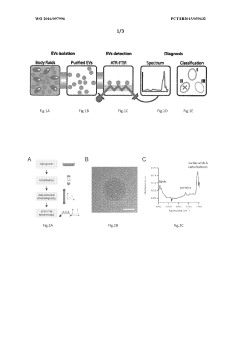
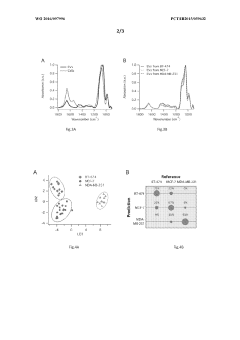
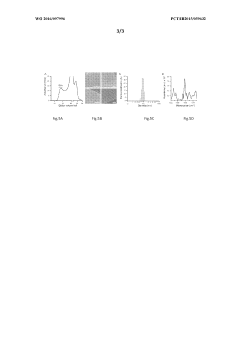
Use of fourier transform infrared spectroscopy analysis of extracellular vesicles isolated from body fluids for diagnosing, prognosing and monitoring pathophysiological states and method therfor
PatentWO2016097996A1
Innovation
- The use of Fourier Transform Infrared Spectroscopy (FTIR) to analyze extracellular vesicles (EVs) isolated from body fluids, combined with multivariate analysis, provides a non-invasive and label-free method for classifying EVs based on their molecular composition, enabling early diagnosis, prognosis, and monitoring of cancer and other proliferative diseases.
FTIR System and Method for Compositional Analysis of Matter
PatentInactiveUS20170059411A1
Innovation
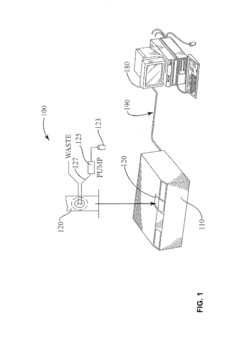
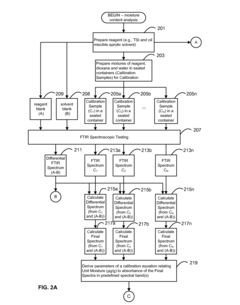
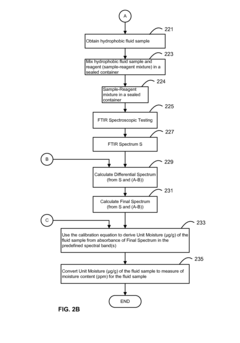
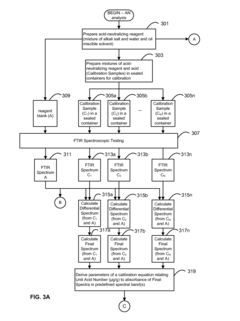
- A system and method using FTIR spectroscopy that involves preparing reagents reacting with the sample to produce carbon dioxide gas, allowing for calibration equations to be derived from standard mixtures, enabling precise measurement of moisture, acidity, or basicity by analyzing absorbance in specific spectral bands, which can be applied to various hydrophobic fluids and solid matrices.
Sample Preparation Optimization Strategies
Sample preparation represents a critical determinant in achieving enhanced sensitivity for Fourier Transform Infrared (FTIR) spectroscopy when analyzing trace components. Optimization of these preparatory techniques can significantly improve detection limits and overall analytical performance. The selection of appropriate sample preparation methods depends on the sample matrix, target analytes, and required sensitivity levels.
Concentration techniques serve as fundamental approaches for trace analysis enhancement. Methods such as solid-phase extraction (SPE), liquid-liquid extraction (LLE), and supercritical fluid extraction (SFE) can effectively isolate and concentrate target analytes from complex matrices. Recent advancements in micro-extraction techniques, including solid-phase microextraction (SPME) and dispersive liquid-liquid microextraction (DLLME), have demonstrated remarkable concentration factors exceeding 1000-fold while requiring minimal solvent volumes.
Matrix modification strategies represent another crucial aspect of sample preparation optimization. The addition of specific reagents can enhance spectral features of target analytes or reduce interference from matrix components. For instance, derivatization reactions that introduce functional groups with strong IR absorption characteristics (such as carbonyl or nitrile groups) can significantly improve detection sensitivity for compounds with weak IR signals. Additionally, the use of nanoparticles as surface enhancers has emerged as a promising approach, with gold and silver nanostructures demonstrating enhancement factors of 10^3-10^5 in surface-enhanced infrared absorption spectroscopy (SEIRA).
Physical sample presentation techniques also play a vital role in sensitivity enhancement. Attenuated Total Reflection (ATR) accessories with optimized crystal materials and incident angles can maximize interaction between IR radiation and trace analytes. The development of advanced thin-film sample preparation methods, including Langmuir-Blodgett films and spin-coating techniques, enables the creation of uniform sample layers with controlled thickness, significantly improving reproducibility and detection limits.
Automation and standardization of sample preparation protocols represent emerging trends in this field. Robotic sample preparation systems reduce human error and improve precision, while microfluidic devices enable precise handling of microliter sample volumes with integrated concentration and purification steps. These technological advancements are particularly valuable for high-throughput applications requiring consistent analytical performance across large sample sets.
Environmental considerations during sample preparation cannot be overlooked. Temperature control, humidity regulation, and contamination prevention are essential factors that can significantly impact FTIR sensitivity. The implementation of clean room protocols and specialized sample handling equipment can minimize background interference and improve signal-to-noise ratios for trace analysis applications.
Concentration techniques serve as fundamental approaches for trace analysis enhancement. Methods such as solid-phase extraction (SPE), liquid-liquid extraction (LLE), and supercritical fluid extraction (SFE) can effectively isolate and concentrate target analytes from complex matrices. Recent advancements in micro-extraction techniques, including solid-phase microextraction (SPME) and dispersive liquid-liquid microextraction (DLLME), have demonstrated remarkable concentration factors exceeding 1000-fold while requiring minimal solvent volumes.
Matrix modification strategies represent another crucial aspect of sample preparation optimization. The addition of specific reagents can enhance spectral features of target analytes or reduce interference from matrix components. For instance, derivatization reactions that introduce functional groups with strong IR absorption characteristics (such as carbonyl or nitrile groups) can significantly improve detection sensitivity for compounds with weak IR signals. Additionally, the use of nanoparticles as surface enhancers has emerged as a promising approach, with gold and silver nanostructures demonstrating enhancement factors of 10^3-10^5 in surface-enhanced infrared absorption spectroscopy (SEIRA).
Physical sample presentation techniques also play a vital role in sensitivity enhancement. Attenuated Total Reflection (ATR) accessories with optimized crystal materials and incident angles can maximize interaction between IR radiation and trace analytes. The development of advanced thin-film sample preparation methods, including Langmuir-Blodgett films and spin-coating techniques, enables the creation of uniform sample layers with controlled thickness, significantly improving reproducibility and detection limits.
Automation and standardization of sample preparation protocols represent emerging trends in this field. Robotic sample preparation systems reduce human error and improve precision, while microfluidic devices enable precise handling of microliter sample volumes with integrated concentration and purification steps. These technological advancements are particularly valuable for high-throughput applications requiring consistent analytical performance across large sample sets.
Environmental considerations during sample preparation cannot be overlooked. Temperature control, humidity regulation, and contamination prevention are essential factors that can significantly impact FTIR sensitivity. The implementation of clean room protocols and specialized sample handling equipment can minimize background interference and improve signal-to-noise ratios for trace analysis applications.
Interdisciplinary Applications and Future Prospects
The enhanced sensitivity of FTIR spectroscopy has catalyzed its adoption across numerous scientific disciplines beyond traditional analytical chemistry. In environmental science, highly sensitive FTIR techniques are revolutionizing the monitoring of atmospheric pollutants and greenhouse gases at previously undetectable concentrations, enabling more accurate climate models and pollution control strategies. These advancements allow researchers to track trace contaminants in soil, water, and air with unprecedented precision.
In pharmaceutical research, enhanced FTIR sensitivity has become instrumental in drug discovery and quality control processes. The ability to detect minute impurities and structural variations in drug compounds ensures higher safety standards and more efficient development pipelines. Metabolomics research has similarly benefited, with researchers now able to identify biomarkers at concentrations previously requiring more complex analytical techniques.
The food industry has embraced sensitive FTIR methods for authentication and adulteration detection, protecting consumers from fraudulent products while ensuring regulatory compliance. Trace analysis capabilities allow for the identification of contaminants, allergens, and additives at levels well below regulatory thresholds, significantly improving food safety protocols.
Forensic science represents another frontier where enhanced FTIR sensitivity is making substantial contributions. The ability to analyze microscopic evidence samples, including fibers, paint chips, and biological residues, provides investigators with critical information while preserving limited evidence. This non-destructive analytical approach maintains sample integrity for subsequent testing when necessary.
Looking toward the future, the integration of artificial intelligence and machine learning algorithms with highly sensitive FTIR systems promises to automate spectral interpretation and enhance pattern recognition capabilities. This computational approach will likely overcome current limitations in complex mixture analysis and enable real-time monitoring applications across multiple industries.
Miniaturization trends suggest that portable, highly sensitive FTIR devices will become increasingly available, democratizing access to sophisticated analytical capabilities in field settings, remote locations, and resource-limited environments. These developments will particularly benefit environmental monitoring, point-of-care diagnostics, and on-site quality control applications.
The convergence of enhanced FTIR sensitivity with complementary analytical techniques, such as Raman spectroscopy and mass spectrometry, will likely create powerful hybrid approaches that overcome the limitations of individual methods while capitalizing on their respective strengths.
In pharmaceutical research, enhanced FTIR sensitivity has become instrumental in drug discovery and quality control processes. The ability to detect minute impurities and structural variations in drug compounds ensures higher safety standards and more efficient development pipelines. Metabolomics research has similarly benefited, with researchers now able to identify biomarkers at concentrations previously requiring more complex analytical techniques.
The food industry has embraced sensitive FTIR methods for authentication and adulteration detection, protecting consumers from fraudulent products while ensuring regulatory compliance. Trace analysis capabilities allow for the identification of contaminants, allergens, and additives at levels well below regulatory thresholds, significantly improving food safety protocols.
Forensic science represents another frontier where enhanced FTIR sensitivity is making substantial contributions. The ability to analyze microscopic evidence samples, including fibers, paint chips, and biological residues, provides investigators with critical information while preserving limited evidence. This non-destructive analytical approach maintains sample integrity for subsequent testing when necessary.
Looking toward the future, the integration of artificial intelligence and machine learning algorithms with highly sensitive FTIR systems promises to automate spectral interpretation and enhance pattern recognition capabilities. This computational approach will likely overcome current limitations in complex mixture analysis and enable real-time monitoring applications across multiple industries.
Miniaturization trends suggest that portable, highly sensitive FTIR devices will become increasingly available, democratizing access to sophisticated analytical capabilities in field settings, remote locations, and resource-limited environments. These developments will particularly benefit environmental monitoring, point-of-care diagnostics, and on-site quality control applications.
The convergence of enhanced FTIR sensitivity with complementary analytical techniques, such as Raman spectroscopy and mass spectrometry, will likely create powerful hybrid approaches that overcome the limitations of individual methods while capitalizing on their respective strengths.
Unlock deeper insights with Patsnap Eureka Quick Research — get a full tech report to explore trends and direct your research. Try now!
Generate Your Research Report Instantly with AI Agent
Supercharge your innovation with Patsnap Eureka AI Agent Platform!