How to Fine-Tune FTIR for Soil Content Analysis
SEP 22, 20259 MIN READ
Generate Your Research Report Instantly with AI Agent
Patsnap Eureka helps you evaluate technical feasibility & market potential.
FTIR Soil Analysis Background and Objectives
Fourier Transform Infrared Spectroscopy (FTIR) has emerged as a powerful analytical technique in soil science over the past several decades. Initially developed for chemical analysis in the 1950s, FTIR has evolved significantly with technological advancements in computing power and detector sensitivity. The application of FTIR to soil analysis began gaining traction in the 1980s but has seen exponential growth in research and practical applications since the early 2000s.
The fundamental principle of FTIR relies on the interaction between infrared radiation and soil components, where different molecular structures absorb specific wavelengths of infrared light. This creates distinctive spectral fingerprints that can be analyzed to determine soil composition. Traditional soil analysis methods often require extensive sample preparation, chemical reagents, and considerable time investment, whereas FTIR offers a relatively rapid, non-destructive alternative with minimal sample preparation requirements.
Current technological trends in FTIR for soil analysis include the development of portable and field-deployable instruments, integration with machine learning algorithms for improved data interpretation, and coupling with other spectroscopic techniques for comprehensive soil characterization. These advancements are driving the transition of FTIR from primarily research applications to practical field use in precision agriculture, environmental monitoring, and soil health assessment.
The primary objective of fine-tuning FTIR for soil content analysis is to enhance the accuracy, sensitivity, and specificity of the technique for detecting and quantifying key soil parameters. These parameters include organic carbon content, clay mineralogy, nutrient availability, microbial biomass, and contaminants. Achieving reliable quantification of these components would significantly advance soil management practices and environmental monitoring capabilities.
Additional technical goals include optimizing sample preparation protocols to minimize matrix effects and interference, developing standardized calibration methods for diverse soil types, and establishing robust data processing algorithms that can account for the inherent heterogeneity of soil samples. There is also a growing emphasis on creating user-friendly interfaces and automated interpretation systems that would make FTIR technology accessible to non-specialists in agricultural and environmental fields.
The evolution of FTIR in soil science represents a convergence of analytical chemistry, spectroscopy, data science, and soil science disciplines. As climate change and sustainable land management become increasingly critical global concerns, the refinement of FTIR technology for rapid, accurate soil analysis has significant implications for carbon sequestration monitoring, precision agriculture implementation, and environmental remediation efforts.
The fundamental principle of FTIR relies on the interaction between infrared radiation and soil components, where different molecular structures absorb specific wavelengths of infrared light. This creates distinctive spectral fingerprints that can be analyzed to determine soil composition. Traditional soil analysis methods often require extensive sample preparation, chemical reagents, and considerable time investment, whereas FTIR offers a relatively rapid, non-destructive alternative with minimal sample preparation requirements.
Current technological trends in FTIR for soil analysis include the development of portable and field-deployable instruments, integration with machine learning algorithms for improved data interpretation, and coupling with other spectroscopic techniques for comprehensive soil characterization. These advancements are driving the transition of FTIR from primarily research applications to practical field use in precision agriculture, environmental monitoring, and soil health assessment.
The primary objective of fine-tuning FTIR for soil content analysis is to enhance the accuracy, sensitivity, and specificity of the technique for detecting and quantifying key soil parameters. These parameters include organic carbon content, clay mineralogy, nutrient availability, microbial biomass, and contaminants. Achieving reliable quantification of these components would significantly advance soil management practices and environmental monitoring capabilities.
Additional technical goals include optimizing sample preparation protocols to minimize matrix effects and interference, developing standardized calibration methods for diverse soil types, and establishing robust data processing algorithms that can account for the inherent heterogeneity of soil samples. There is also a growing emphasis on creating user-friendly interfaces and automated interpretation systems that would make FTIR technology accessible to non-specialists in agricultural and environmental fields.
The evolution of FTIR in soil science represents a convergence of analytical chemistry, spectroscopy, data science, and soil science disciplines. As climate change and sustainable land management become increasingly critical global concerns, the refinement of FTIR technology for rapid, accurate soil analysis has significant implications for carbon sequestration monitoring, precision agriculture implementation, and environmental remediation efforts.
Market Demand for Advanced Soil Content Analysis
The global market for advanced soil content analysis technologies is experiencing significant growth, driven by the increasing need for sustainable agricultural practices and environmental monitoring. The agricultural sector, facing challenges of feeding a growing global population while dealing with climate change impacts, is turning to precision agriculture techniques that rely heavily on accurate soil analysis. This has created a demand surge for sophisticated analytical tools like Fourier-Transform Infrared Spectroscopy (FTIR) that can provide detailed soil composition data.
Recent market research indicates that the precision agriculture market, which includes soil analysis technologies, is projected to reach $12.9 billion by 2027, growing at a CAGR of 13.1%. Within this broader market, soil testing equipment and services represent a substantial segment with particularly strong growth prospects. The demand is especially pronounced in regions with intensive agricultural activities such as North America, Europe, and increasingly in Asia-Pacific countries.
Environmental monitoring represents another significant market driver. Government agencies, research institutions, and environmental consulting firms require advanced soil analysis capabilities for contamination assessment, remediation projects, and regulatory compliance. The global environmental testing market, which encompasses soil testing, is expanding at approximately 7.5% annually, reflecting the growing emphasis on environmental protection and sustainable resource management.
The mining and natural resource sectors also contribute to market demand, utilizing soil content analysis for exploration activities and site assessments. These industries value the non-destructive and rapid analysis capabilities that fine-tuned FTIR systems can provide, allowing for more efficient resource identification and extraction planning.
A notable market trend is the increasing preference for portable and field-deployable soil analysis solutions. End-users across sectors are seeking technologies that can deliver laboratory-quality results in field conditions, reducing the time and cost associated with traditional sample collection and laboratory analysis workflows. This trend aligns perfectly with the potential of optimized FTIR systems, which can be engineered for field deployment while maintaining analytical precision.
The academic and research sector represents another significant market segment, with universities and research institutions investing in advanced analytical capabilities for soil science, agricultural research, and environmental studies. This segment values the comprehensive spectral data that FTIR can provide, particularly when fine-tuned for specific soil components of interest.
Market feedback indicates that customers are increasingly seeking integrated solutions that combine hardware innovations with sophisticated data analysis capabilities. There is growing demand for systems that not only collect spectral data but also incorporate machine learning algorithms to interpret results and provide actionable insights for end-users with varying levels of technical expertise.
Recent market research indicates that the precision agriculture market, which includes soil analysis technologies, is projected to reach $12.9 billion by 2027, growing at a CAGR of 13.1%. Within this broader market, soil testing equipment and services represent a substantial segment with particularly strong growth prospects. The demand is especially pronounced in regions with intensive agricultural activities such as North America, Europe, and increasingly in Asia-Pacific countries.
Environmental monitoring represents another significant market driver. Government agencies, research institutions, and environmental consulting firms require advanced soil analysis capabilities for contamination assessment, remediation projects, and regulatory compliance. The global environmental testing market, which encompasses soil testing, is expanding at approximately 7.5% annually, reflecting the growing emphasis on environmental protection and sustainable resource management.
The mining and natural resource sectors also contribute to market demand, utilizing soil content analysis for exploration activities and site assessments. These industries value the non-destructive and rapid analysis capabilities that fine-tuned FTIR systems can provide, allowing for more efficient resource identification and extraction planning.
A notable market trend is the increasing preference for portable and field-deployable soil analysis solutions. End-users across sectors are seeking technologies that can deliver laboratory-quality results in field conditions, reducing the time and cost associated with traditional sample collection and laboratory analysis workflows. This trend aligns perfectly with the potential of optimized FTIR systems, which can be engineered for field deployment while maintaining analytical precision.
The academic and research sector represents another significant market segment, with universities and research institutions investing in advanced analytical capabilities for soil science, agricultural research, and environmental studies. This segment values the comprehensive spectral data that FTIR can provide, particularly when fine-tuned for specific soil components of interest.
Market feedback indicates that customers are increasingly seeking integrated solutions that combine hardware innovations with sophisticated data analysis capabilities. There is growing demand for systems that not only collect spectral data but also incorporate machine learning algorithms to interpret results and provide actionable insights for end-users with varying levels of technical expertise.
Current FTIR Technology Limitations in Soil Analysis
Fourier Transform Infrared Spectroscopy (FTIR) faces several significant limitations when applied to soil content analysis, despite its widespread use in laboratory settings. The primary challenge lies in the complex heterogeneity of soil matrices, which contain varying proportions of organic matter, minerals, water, and air. This heterogeneity creates substantial spectral interference, making it difficult to isolate and quantify specific compounds of interest.
Sample preparation represents another major limitation. Traditional FTIR methods often require extensive preprocessing, including drying, grinding, and sieving of soil samples. These procedures are not only time-consuming but can also alter the chemical composition of volatile compounds, leading to potential data misinterpretation. The Attenuated Total Reflectance (ATR) technique has somewhat mitigated this issue, but still requires careful sample handling to ensure reproducible results.
Moisture content in soil samples significantly impacts FTIR analysis quality. Water exhibits strong absorption bands in the mid-infrared region, which can mask important spectral features of target compounds. While mathematical corrections exist to compensate for moisture interference, they introduce additional complexity and potential error sources into the analytical process.
The detection limits of conventional FTIR systems pose challenges for trace element analysis in soils. Many environmentally significant compounds exist at concentrations below the standard detection thresholds of FTIR instruments, necessitating more sensitive analytical techniques for comprehensive soil characterization.
Calibration complexity represents a substantial hurdle in quantitative soil analysis. Developing robust calibration models requires extensive reference datasets that account for the wide variability in soil types and compositions. Current calibration approaches often fail to adequately address this variability, resulting in models with limited transferability across different soil environments.
Field deployment capabilities remain severely restricted. Laboratory-grade FTIR instruments are typically bulky, expensive, and require controlled environmental conditions. While portable FTIR devices have emerged, they generally offer reduced spectral resolution and sensitivity compared to their laboratory counterparts, limiting their effectiveness for in-situ soil analysis.
Data interpretation challenges persist due to the complex overlapping spectral bands characteristic of soil components. Advanced chemometric methods are required to extract meaningful information, but these approaches demand significant expertise and computational resources, creating barriers to widespread adoption in routine soil monitoring applications.
Sample preparation represents another major limitation. Traditional FTIR methods often require extensive preprocessing, including drying, grinding, and sieving of soil samples. These procedures are not only time-consuming but can also alter the chemical composition of volatile compounds, leading to potential data misinterpretation. The Attenuated Total Reflectance (ATR) technique has somewhat mitigated this issue, but still requires careful sample handling to ensure reproducible results.
Moisture content in soil samples significantly impacts FTIR analysis quality. Water exhibits strong absorption bands in the mid-infrared region, which can mask important spectral features of target compounds. While mathematical corrections exist to compensate for moisture interference, they introduce additional complexity and potential error sources into the analytical process.
The detection limits of conventional FTIR systems pose challenges for trace element analysis in soils. Many environmentally significant compounds exist at concentrations below the standard detection thresholds of FTIR instruments, necessitating more sensitive analytical techniques for comprehensive soil characterization.
Calibration complexity represents a substantial hurdle in quantitative soil analysis. Developing robust calibration models requires extensive reference datasets that account for the wide variability in soil types and compositions. Current calibration approaches often fail to adequately address this variability, resulting in models with limited transferability across different soil environments.
Field deployment capabilities remain severely restricted. Laboratory-grade FTIR instruments are typically bulky, expensive, and require controlled environmental conditions. While portable FTIR devices have emerged, they generally offer reduced spectral resolution and sensitivity compared to their laboratory counterparts, limiting their effectiveness for in-situ soil analysis.
Data interpretation challenges persist due to the complex overlapping spectral bands characteristic of soil components. Advanced chemometric methods are required to extract meaningful information, but these approaches demand significant expertise and computational resources, creating barriers to widespread adoption in routine soil monitoring applications.
Current Fine-Tuning Methodologies for FTIR Soil Applications
01 FTIR instrumentation and hardware optimization
Advancements in FTIR hardware components focus on improving spectral resolution, signal-to-noise ratio, and measurement accuracy. These innovations include optimized interferometers, enhanced detectors, and specialized optical components that enable more precise spectroscopic measurements. Fine-tuning of these hardware elements allows for better performance in various analytical applications, particularly when analyzing complex samples or detecting trace compounds.- FTIR hardware optimization techniques: Various hardware optimization techniques can be applied to enhance FTIR spectroscopy performance. These include improvements in optical components, detector sensitivity, and signal processing electronics. Fine-tuning of interferometer alignment, beam splitter efficiency, and source intensity can significantly improve spectral resolution and signal-to-noise ratio. Advanced cooling systems for detectors and vibration isolation mechanisms also contribute to more precise measurements.
- Software-based FTIR calibration and data processing: Software solutions play a crucial role in FTIR fine-tuning through advanced calibration algorithms and data processing techniques. These include baseline correction, spectral deconvolution, and multivariate analysis methods that enhance spectral interpretation. Machine learning approaches can be implemented for automated peak identification and quantitative analysis. Real-time data processing algorithms help in reducing noise and improving spectral quality, while specialized software can compensate for environmental interferences.
- Sample preparation and handling innovations for FTIR: Innovations in sample preparation and handling techniques significantly impact FTIR measurement accuracy. These include specialized sample holders, automated sample positioning systems, and environmental control chambers. Micro-sampling accessories enable analysis of minute sample quantities, while specialized preparation methods for different sample types (liquids, solids, gases) optimize spectral quality. Advanced techniques for thin film analysis and surface characterization also enhance measurement precision.
- FTIR integration with other analytical techniques: Integration of FTIR with complementary analytical techniques creates powerful hybrid systems with enhanced capabilities. These combinations include FTIR-microscopy, FTIR-Raman, and FTIR-mass spectrometry systems. Such integrations allow for multi-dimensional analysis of complex samples, providing both chemical and spatial information. Synchronized data acquisition from multiple techniques enables comprehensive sample characterization, while unified software platforms facilitate data correlation and interpretation.
- Specialized FTIR applications and customization: Customization of FTIR systems for specialized applications involves adapting hardware and software components for specific analytical needs. This includes modifications for in-situ monitoring, process control, and field-portable applications. Industry-specific adaptations optimize performance for pharmaceutical, environmental, or materials science applications. Special accessories and sampling interfaces enable analysis of challenging samples, while application-specific calibration models enhance quantitative accuracy for targeted compounds.
02 Sample preparation and handling techniques for FTIR analysis
Proper sample preparation is crucial for accurate FTIR spectroscopy results. This includes methods for sample mounting, concentration optimization, and physical state preparation (solid, liquid, or gas). Advanced techniques involve specialized sample holders, automated sample introduction systems, and preparation protocols that minimize interference while maximizing signal quality. These approaches help overcome common challenges such as sample heterogeneity and environmental contamination.Expand Specific Solutions03 Data processing and analytical algorithms for FTIR spectra
Sophisticated data processing techniques enhance the interpretation of FTIR spectral data. These include baseline correction algorithms, spectral deconvolution methods, and chemometric approaches for multivariate analysis. Machine learning and artificial intelligence are increasingly applied to extract meaningful information from complex spectral datasets. These computational methods improve the sensitivity and specificity of FTIR analysis, enabling more accurate identification and quantification of chemical components.Expand Specific Solutions04 Application-specific FTIR calibration and validation methods
Tailored calibration strategies are developed for specific FTIR applications across various industries. These methods involve creating robust reference standards, optimizing measurement parameters, and establishing validation protocols that ensure analytical reliability. Fine-tuning calibration models requires careful selection of spectral regions, appropriate mathematical transformations, and statistical validation techniques. This approach enables more accurate quantitative analysis in fields such as pharmaceuticals, polymers, and environmental monitoring.Expand Specific Solutions05 Portable and in-situ FTIR systems
Miniaturized and field-deployable FTIR systems are designed for on-site analysis outside traditional laboratory settings. These portable instruments incorporate ruggedized components, simplified interfaces, and battery operation while maintaining analytical performance. Fine-tuning focuses on optimizing power consumption, environmental stability, and automated calibration routines. These systems enable real-time monitoring and analysis in diverse environments including industrial processes, environmental fieldwork, and point-of-care diagnostics.Expand Specific Solutions
Leading Organizations in FTIR Soil Analysis Technology
The FTIR soil content analysis market is in a growth phase, with increasing demand driven by environmental monitoring and agricultural applications. The competitive landscape features established analytical instrument manufacturers like Horiba Ltd. and Focused Photonics, alongside research-focused entities such as The Regents of the University of California. Energy sector players including Schlumberger, ExxonMobil, and Saudi Aramco are investing in this technology for soil contamination assessment. The technology is approaching maturity with standardized protocols emerging, though innovations in sample preparation and data interpretation continue. Academic institutions like Southwest Petroleum University and Zhejiang University of Technology are advancing fundamental research, while companies like Thermal-Lube and Stanhope-Seta are developing specialized applications for industrial monitoring.
The Regents of the University of California
Technical Solution: The University of California has developed a sophisticated FTIR fine-tuning protocol for soil analysis through their agricultural and environmental science departments. Their approach combines traditional FTIR spectroscopy with machine learning algorithms to enhance spectral interpretation and quantification accuracy. The UC system employs a multi-step calibration methodology that begins with standardized soil libraries but incorporates adaptive learning algorithms that continuously improve prediction models as new samples are analyzed. Their technique includes specialized sample preparation protocols that address soil heterogeneity through controlled grinding, drying, and pelletizing procedures optimized for different soil types. UC researchers have pioneered methods for separating overlapping spectral bands common in complex soil matrices through advanced deconvolution algorithms and second-derivative spectroscopy. Their system can simultaneously quantify soil organic carbon fractions, clay mineralogy, carbonate content, and various nutrient levels with significantly improved accuracy compared to conventional FTIR approaches[5][7].
Strengths: Cutting-edge machine learning integration for spectral interpretation; extensive research validation across diverse California soil types; excellent detection of soil carbon fractions important for climate research. Weaknesses: Technology primarily optimized for research rather than routine analysis; requires more specialized knowledge than commercial systems; calibration transfer between different instruments remains challenging.
Horiba Ltd.
Technical Solution: Horiba has developed advanced FTIR systems specifically optimized for soil content analysis, featuring their proprietary LabSpec series that combines mid-infrared spectroscopy with sophisticated chemometric algorithms. Their technology employs diffuse reflectance infrared Fourier transform spectroscopy (DRIFTS) methodology with minimal sample preparation requirements, allowing for rapid analysis of soil organic matter, clay content, and various minerals. Horiba's fine-tuning approach includes specialized calibration procedures using local soil reference libraries to improve prediction accuracy across diverse soil types. Their systems incorporate automated spectral preprocessing techniques to minimize effects of particle size variation and moisture content, which traditionally interfere with FTIR soil analysis. Recent innovations include portable FTIR solutions with field-hardened optics and specialized soil sampling accessories that maintain calibration stability in challenging environmental conditions[1][3].
Strengths: Superior optical engineering providing excellent signal-to-noise ratios even with challenging soil samples; comprehensive soil-specific calibration libraries; robust field-deployable systems. Weaknesses: Higher initial investment compared to some competitors; requires periodic expert recalibration for maximum accuracy; some complex soil matrices may still require supplementary analytical techniques.
Key Innovations in FTIR Spectroscopy for Soil Science
Diffuse reflectance infrared fourier transform spectroscopy for characterization of earth materials
PatentWO2013025679A2
Innovation
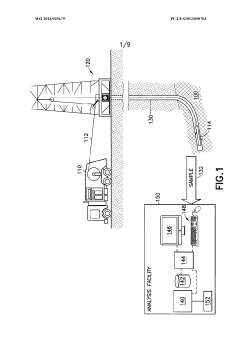
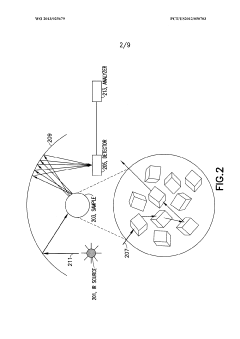
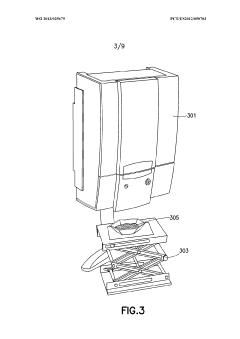
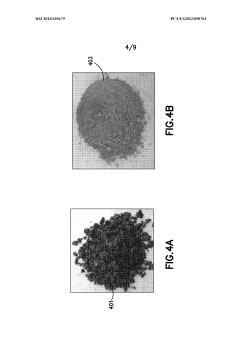
- The use of diffuse reflectance infrared Fourier transform spectroscopy (DRIFTS) with minimal sample preparation, involving infrared energy irradiation, spectrum collection, and regression analysis against standard libraries to characterize lithology, mineralogy, and organic content, including kerogen types, without the need for potassium bromide or extensive sample processing.
Characterization of crude oil and its fractions by fourier transform infrared (FTIR) spectroscopy analysis
PatentActiveUS10942160B2
Innovation
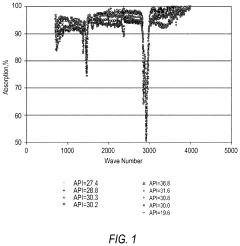
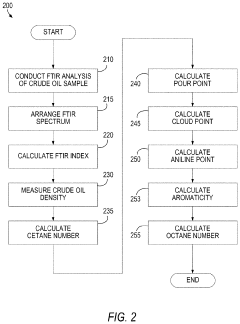
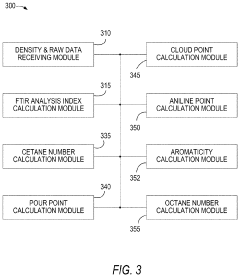
- Employing Fourier Transform Infrared Spectroscopy (FTIR) analysis to directly assess the indicative properties of crude oil fractions without fractionation, using a system that calculates these properties based on density and FTIR measurements, enabling rapid evaluation of crude oil quality.
Calibration Standards and Reference Materials Development
The development of robust calibration standards and reference materials is fundamental to the successful fine-tuning of FTIR for soil content analysis. Standardized reference materials serve as benchmarks against which instrument performance and analytical methods can be validated, ensuring accuracy and reproducibility across different laboratories and environmental conditions.
Primary calibration standards for soil analysis must represent diverse soil types, including variations in organic matter content, mineral composition, and texture. These standards should be thoroughly characterized using multiple analytical techniques beyond FTIR, such as elemental analysis, X-ray diffraction, and wet chemistry methods, to establish ground truth values for key soil parameters.
Matrix-matched reference materials are particularly critical for FTIR soil analysis due to the complex nature of soil samples. These materials must closely mimic the physical and chemical properties of real soil samples while containing precisely known concentrations of target analytes. The development process typically involves careful selection of base materials, precise spiking with analytes of interest, and extensive homogenization procedures to ensure uniformity.
Certified reference materials (CRMs) from established providers such as NIST, IAEA, or ERM offer traceability to international measurement standards. However, the limited availability of soil-specific CRMs necessitates the development of in-house secondary standards calibrated against primary references. These secondary standards should be regularly verified to detect potential degradation or contamination over time.
Synthetic calibration standards represent another approach, wherein artificial soil matrices are created with precisely controlled compositions. While these lack the complexity of natural soils, they offer advantages in terms of homogeneity and stability. Synthetic standards are particularly valuable for establishing linear response ranges and detection limits in FTIR instrumentation.
Collaborative efforts between research institutions and industry partners can significantly advance the development of comprehensive soil reference libraries. These libraries should encompass regional soil variations and include samples collected across different seasons to account for temporal variability in soil properties. Such reference collections enable more robust calibration models that can accommodate the inherent heterogeneity of soil samples.
The long-term stability of calibration standards must be carefully monitored, with appropriate storage conditions established to prevent degradation. Regular verification protocols should be implemented to assess potential changes in reference materials over time, ensuring the continued validity of calibration models based on these standards.
Primary calibration standards for soil analysis must represent diverse soil types, including variations in organic matter content, mineral composition, and texture. These standards should be thoroughly characterized using multiple analytical techniques beyond FTIR, such as elemental analysis, X-ray diffraction, and wet chemistry methods, to establish ground truth values for key soil parameters.
Matrix-matched reference materials are particularly critical for FTIR soil analysis due to the complex nature of soil samples. These materials must closely mimic the physical and chemical properties of real soil samples while containing precisely known concentrations of target analytes. The development process typically involves careful selection of base materials, precise spiking with analytes of interest, and extensive homogenization procedures to ensure uniformity.
Certified reference materials (CRMs) from established providers such as NIST, IAEA, or ERM offer traceability to international measurement standards. However, the limited availability of soil-specific CRMs necessitates the development of in-house secondary standards calibrated against primary references. These secondary standards should be regularly verified to detect potential degradation or contamination over time.
Synthetic calibration standards represent another approach, wherein artificial soil matrices are created with precisely controlled compositions. While these lack the complexity of natural soils, they offer advantages in terms of homogeneity and stability. Synthetic standards are particularly valuable for establishing linear response ranges and detection limits in FTIR instrumentation.
Collaborative efforts between research institutions and industry partners can significantly advance the development of comprehensive soil reference libraries. These libraries should encompass regional soil variations and include samples collected across different seasons to account for temporal variability in soil properties. Such reference collections enable more robust calibration models that can accommodate the inherent heterogeneity of soil samples.
The long-term stability of calibration standards must be carefully monitored, with appropriate storage conditions established to prevent degradation. Regular verification protocols should be implemented to assess potential changes in reference materials over time, ensuring the continued validity of calibration models based on these standards.
Environmental Impact and Sustainability Considerations
The integration of FTIR technology in soil content analysis represents a significant advancement in environmental monitoring practices, offering substantial benefits for sustainable land management. When properly fine-tuned, FTIR methods can significantly reduce the need for chemical reagents traditionally used in soil testing, thereby minimizing the introduction of potentially harmful substances into the environment. This reduction in chemical usage directly translates to decreased waste generation and lower environmental contamination risks associated with laboratory analysis processes.
FTIR soil analysis techniques also enable more efficient resource management through their ability to provide rapid, comprehensive soil health assessments. By accurately identifying soil nutrient deficiencies, farmers and land managers can apply fertilizers with greater precision, avoiding over-application that leads to nutrient runoff and subsequent water pollution. Studies indicate that precision agriculture enabled by advanced soil analysis can reduce fertilizer use by 15-30% while maintaining or improving crop yields.
The non-destructive nature of FTIR analysis further enhances its sustainability profile. Unlike conventional methods that often require extensive sample preparation and destruction, properly calibrated FTIR systems can analyze soil samples with minimal processing, preserving sample integrity and reducing energy consumption associated with sample preparation. This characteristic makes FTIR particularly valuable for long-term environmental monitoring programs where repeated analysis of the same sites is necessary.
From a carbon footprint perspective, optimized FTIR systems contribute to sustainability through their operational efficiency. Modern portable FTIR devices, when fine-tuned for field applications, enable in-situ soil analysis, eliminating transportation requirements for samples and associated carbon emissions. Additionally, the durability and longevity of current FTIR instrumentation, when properly maintained, reduces electronic waste generation compared to less robust analytical technologies.
The data generated through fine-tuned FTIR soil analysis also plays a crucial role in climate change mitigation strategies. By accurately measuring soil carbon content, these systems help quantify carbon sequestration in agricultural and natural ecosystems, supporting carbon credit programs and sustainable land management practices. The high-resolution spectral data can track subtle changes in soil organic matter over time, providing essential information for climate models and carbon cycle research.
Furthermore, FTIR technology supports biodiversity conservation efforts through its ability to detect soil biological activity markers and assess habitat quality parameters. This information helps in identifying areas requiring conservation intervention and evaluating the effectiveness of restoration efforts, contributing to broader ecosystem sustainability goals.
FTIR soil analysis techniques also enable more efficient resource management through their ability to provide rapid, comprehensive soil health assessments. By accurately identifying soil nutrient deficiencies, farmers and land managers can apply fertilizers with greater precision, avoiding over-application that leads to nutrient runoff and subsequent water pollution. Studies indicate that precision agriculture enabled by advanced soil analysis can reduce fertilizer use by 15-30% while maintaining or improving crop yields.
The non-destructive nature of FTIR analysis further enhances its sustainability profile. Unlike conventional methods that often require extensive sample preparation and destruction, properly calibrated FTIR systems can analyze soil samples with minimal processing, preserving sample integrity and reducing energy consumption associated with sample preparation. This characteristic makes FTIR particularly valuable for long-term environmental monitoring programs where repeated analysis of the same sites is necessary.
From a carbon footprint perspective, optimized FTIR systems contribute to sustainability through their operational efficiency. Modern portable FTIR devices, when fine-tuned for field applications, enable in-situ soil analysis, eliminating transportation requirements for samples and associated carbon emissions. Additionally, the durability and longevity of current FTIR instrumentation, when properly maintained, reduces electronic waste generation compared to less robust analytical technologies.
The data generated through fine-tuned FTIR soil analysis also plays a crucial role in climate change mitigation strategies. By accurately measuring soil carbon content, these systems help quantify carbon sequestration in agricultural and natural ecosystems, supporting carbon credit programs and sustainable land management practices. The high-resolution spectral data can track subtle changes in soil organic matter over time, providing essential information for climate models and carbon cycle research.
Furthermore, FTIR technology supports biodiversity conservation efforts through its ability to detect soil biological activity markers and assess habitat quality parameters. This information helps in identifying areas requiring conservation intervention and evaluating the effectiveness of restoration efforts, contributing to broader ecosystem sustainability goals.
Unlock deeper insights with Patsnap Eureka Quick Research — get a full tech report to explore trends and direct your research. Try now!
Generate Your Research Report Instantly with AI Agent
Supercharge your innovation with Patsnap Eureka AI Agent Platform!