

Interface compatibility in all-solid-state sodium batteries
OCT 14, 202510 MIN READ
Generate Your Research Report Instantly with AI Agent
PatSnap Eureka helps you evaluate technical feasibility & market potential.
Solid-State Sodium Battery Interface Background and Objectives
The evolution of energy storage technologies has witnessed significant advancements over the past decades, with lithium-ion batteries dominating the commercial landscape. However, concerns regarding lithium resource scarcity and cost have prompted researchers to explore alternative battery chemistries. Sodium-ion batteries have emerged as promising candidates due to sodium's natural abundance, wide geographical distribution, and similar electrochemical properties to lithium. Within this domain, all-solid-state sodium batteries (ASSBs) represent a frontier technology that addresses safety concerns associated with conventional liquid electrolyte systems.
Interface compatibility in ASSBs constitutes a critical technical challenge that has hindered their widespread commercialization. Historically, solid-state battery research began in the 1970s, but significant progress in sodium systems has only materialized in the last decade. The interfaces between electrodes and solid electrolytes present complex physicochemical interactions that affect battery performance, including ionic conductivity, mechanical stability, and electrochemical durability.
The primary objective of interface compatibility research is to develop stable, high-performance interfaces that facilitate efficient sodium ion transport while maintaining structural integrity throughout battery cycling. This involves understanding the fundamental mechanisms of interfacial reactions, identifying suitable material combinations, and developing innovative manufacturing techniques to optimize these interfaces.
Current technical goals include achieving interfacial resistance below 10 Ω·cm², maintaining stable cycling for over 1000 cycles, and ensuring compatibility across wide temperature ranges (-20°C to 80°C). Additionally, researchers aim to develop interfaces that can accommodate volume changes during sodium insertion/extraction without mechanical degradation or delamination.
The technological trajectory indicates a shift from traditional ceramic-based interfaces toward hybrid organic-inorganic interfaces and engineered interphases. Recent breakthroughs in interface engineering have demonstrated promising results, with some laboratory prototypes achieving energy densities approaching 300 Wh/kg and cycle life exceeding 500 cycles.
Understanding the complex nature of these interfaces requires multidisciplinary approaches combining materials science, electrochemistry, surface physics, and advanced characterization techniques. The development of in-situ and operando analytical methods has significantly enhanced our ability to observe interfacial phenomena during battery operation, providing crucial insights for rational interface design.
As global energy demands continue to rise and renewable energy integration accelerates, the development of cost-effective, safe, and high-performance energy storage solutions becomes increasingly important. Interface compatibility in all-solid-state sodium batteries represents a key technological enabler for next-generation energy storage systems that could complement or potentially replace current lithium-ion technologies in specific application domains.
Interface compatibility in ASSBs constitutes a critical technical challenge that has hindered their widespread commercialization. Historically, solid-state battery research began in the 1970s, but significant progress in sodium systems has only materialized in the last decade. The interfaces between electrodes and solid electrolytes present complex physicochemical interactions that affect battery performance, including ionic conductivity, mechanical stability, and electrochemical durability.
The primary objective of interface compatibility research is to develop stable, high-performance interfaces that facilitate efficient sodium ion transport while maintaining structural integrity throughout battery cycling. This involves understanding the fundamental mechanisms of interfacial reactions, identifying suitable material combinations, and developing innovative manufacturing techniques to optimize these interfaces.
Current technical goals include achieving interfacial resistance below 10 Ω·cm², maintaining stable cycling for over 1000 cycles, and ensuring compatibility across wide temperature ranges (-20°C to 80°C). Additionally, researchers aim to develop interfaces that can accommodate volume changes during sodium insertion/extraction without mechanical degradation or delamination.
The technological trajectory indicates a shift from traditional ceramic-based interfaces toward hybrid organic-inorganic interfaces and engineered interphases. Recent breakthroughs in interface engineering have demonstrated promising results, with some laboratory prototypes achieving energy densities approaching 300 Wh/kg and cycle life exceeding 500 cycles.
Understanding the complex nature of these interfaces requires multidisciplinary approaches combining materials science, electrochemistry, surface physics, and advanced characterization techniques. The development of in-situ and operando analytical methods has significantly enhanced our ability to observe interfacial phenomena during battery operation, providing crucial insights for rational interface design.
As global energy demands continue to rise and renewable energy integration accelerates, the development of cost-effective, safe, and high-performance energy storage solutions becomes increasingly important. Interface compatibility in all-solid-state sodium batteries represents a key technological enabler for next-generation energy storage systems that could complement or potentially replace current lithium-ion technologies in specific application domains.
Market Analysis for All-Solid-State Sodium Battery Technology
The global market for all-solid-state sodium batteries is experiencing significant growth, driven by increasing demand for sustainable energy storage solutions. Current market projections indicate that the all-solid-state battery sector will reach approximately $6 billion by 2030, with sodium-based technologies capturing a growing share due to their cost advantages over lithium-based alternatives.
The primary market drivers for all-solid-state sodium battery technology include the abundance and widespread geographical distribution of sodium resources, which are approximately 1,000 times more abundant than lithium. This abundance translates to potentially 30-40% lower raw material costs compared to lithium-ion batteries, making them particularly attractive for large-scale energy storage applications.
Market segmentation reveals distinct application areas where all-solid-state sodium batteries show particular promise. Grid-scale energy storage represents the largest potential market segment, with demand growing at 25% annually as renewable energy integration accelerates globally. Electric vehicles constitute another significant market opportunity, particularly in price-sensitive segments where cost advantages outweigh energy density considerations.
Consumer electronics manufacturers are also showing increased interest in sodium battery technology for applications where safety and sustainability are prioritized over maximum energy density. This segment is expected to adopt the technology more gradually, with initial applications in devices where battery safety is paramount.
Geographically, the market shows regional variations in adoption potential. Asia-Pacific leads development efforts, with China, Japan, and South Korea investing heavily in manufacturing capabilities. European markets show strong interest driven by sustainability regulations and circular economy initiatives, while North American adoption is accelerating through government-funded research programs.
Market barriers include competition from established lithium-ion technologies, which benefit from decades of optimization and manufacturing scale. The interface compatibility challenges in all-solid-state sodium batteries represent a significant technical hurdle that directly impacts commercialization timelines. Industry analysts estimate that solving these interface issues could accelerate market entry by 2-3 years.
Customer requirements analysis indicates that energy density, cycle life, and safety are the primary performance metrics valued by potential adopters. While sodium batteries currently lag behind lithium technologies in energy density by approximately 20%, their potential safety advantages and lower cost profile create distinct market opportunities where these trade-offs are acceptable.
The competitive landscape includes both established battery manufacturers pivoting toward sodium technology and specialized startups focused exclusively on solid-state sodium solutions. Strategic partnerships between material suppliers, cell manufacturers, and end-users are emerging as the dominant commercialization pathway.
The primary market drivers for all-solid-state sodium battery technology include the abundance and widespread geographical distribution of sodium resources, which are approximately 1,000 times more abundant than lithium. This abundance translates to potentially 30-40% lower raw material costs compared to lithium-ion batteries, making them particularly attractive for large-scale energy storage applications.
Market segmentation reveals distinct application areas where all-solid-state sodium batteries show particular promise. Grid-scale energy storage represents the largest potential market segment, with demand growing at 25% annually as renewable energy integration accelerates globally. Electric vehicles constitute another significant market opportunity, particularly in price-sensitive segments where cost advantages outweigh energy density considerations.
Consumer electronics manufacturers are also showing increased interest in sodium battery technology for applications where safety and sustainability are prioritized over maximum energy density. This segment is expected to adopt the technology more gradually, with initial applications in devices where battery safety is paramount.
Geographically, the market shows regional variations in adoption potential. Asia-Pacific leads development efforts, with China, Japan, and South Korea investing heavily in manufacturing capabilities. European markets show strong interest driven by sustainability regulations and circular economy initiatives, while North American adoption is accelerating through government-funded research programs.
Market barriers include competition from established lithium-ion technologies, which benefit from decades of optimization and manufacturing scale. The interface compatibility challenges in all-solid-state sodium batteries represent a significant technical hurdle that directly impacts commercialization timelines. Industry analysts estimate that solving these interface issues could accelerate market entry by 2-3 years.
Customer requirements analysis indicates that energy density, cycle life, and safety are the primary performance metrics valued by potential adopters. While sodium batteries currently lag behind lithium technologies in energy density by approximately 20%, their potential safety advantages and lower cost profile create distinct market opportunities where these trade-offs are acceptable.
The competitive landscape includes both established battery manufacturers pivoting toward sodium technology and specialized startups focused exclusively on solid-state sodium solutions. Strategic partnerships between material suppliers, cell manufacturers, and end-users are emerging as the dominant commercialization pathway.
Interface Compatibility Challenges and Global Research Status
Interface compatibility represents one of the most critical challenges in the development of all-solid-state sodium batteries (ASSBs). The solid-solid interfaces between electrodes and electrolytes exhibit complex physicochemical interactions that significantly impact battery performance, safety, and longevity. Unlike liquid electrolyte systems, where interfaces can self-adjust, solid interfaces in ASSBs remain relatively rigid, creating persistent contact issues and impedance barriers.
Current research indicates that interface incompatibility manifests in several forms: mechanical instability due to volume changes during cycling, chemical reactivity forming resistive interphases, and poor ionic conductivity across grain boundaries. These issues collectively contribute to increased interfacial resistance, limited rate capability, and accelerated capacity fading during battery operation.
Globally, research efforts addressing interface compatibility have intensified significantly since 2018, with major contributions from research institutions in China, Japan, South Korea, the United States, and Germany. The Chinese Academy of Sciences and various Chinese universities lead in publication volume, while Japanese institutions like AIST and Toyota Research have pioneered many fundamental breakthroughs in interface engineering approaches.
European research clusters, particularly in Germany and France, have focused on computational modeling of interfacial phenomena, while North American institutions have emphasized novel characterization techniques to understand interfacial degradation mechanisms in real-time. This geographical distribution of research focus has created complementary knowledge streams that collectively advance the field.
Recent technological advancements have centered on several approaches: artificial interlayers to mitigate reactivity, pressure-engineered interfaces to maintain physical contact, and gradient composition strategies to reduce mechanical and chemical mismatch. Advanced characterization techniques including in-situ TEM, synchrotron-based spectroscopy, and cryogenic electron microscopy have revolutionized researchers' ability to observe interfacial phenomena at atomic scales.
Despite progress, significant challenges persist. The dynamic nature of interfaces during cycling remains poorly understood, particularly under varied temperature conditions. The scalability of laboratory-developed interface solutions to commercial battery formats presents manufacturing hurdles. Additionally, the long-term stability of engineered interfaces over thousands of cycles requires further investigation.
The research community has recently shifted toward integrated approaches that combine multiple compatibility strategies rather than seeking single-solution approaches. This holistic perspective recognizes that interface challenges in ASSBs require multifaceted solutions addressing mechanical, chemical, and electrochemical aspects simultaneously.
Current research indicates that interface incompatibility manifests in several forms: mechanical instability due to volume changes during cycling, chemical reactivity forming resistive interphases, and poor ionic conductivity across grain boundaries. These issues collectively contribute to increased interfacial resistance, limited rate capability, and accelerated capacity fading during battery operation.
Globally, research efforts addressing interface compatibility have intensified significantly since 2018, with major contributions from research institutions in China, Japan, South Korea, the United States, and Germany. The Chinese Academy of Sciences and various Chinese universities lead in publication volume, while Japanese institutions like AIST and Toyota Research have pioneered many fundamental breakthroughs in interface engineering approaches.
European research clusters, particularly in Germany and France, have focused on computational modeling of interfacial phenomena, while North American institutions have emphasized novel characterization techniques to understand interfacial degradation mechanisms in real-time. This geographical distribution of research focus has created complementary knowledge streams that collectively advance the field.
Recent technological advancements have centered on several approaches: artificial interlayers to mitigate reactivity, pressure-engineered interfaces to maintain physical contact, and gradient composition strategies to reduce mechanical and chemical mismatch. Advanced characterization techniques including in-situ TEM, synchrotron-based spectroscopy, and cryogenic electron microscopy have revolutionized researchers' ability to observe interfacial phenomena at atomic scales.
Despite progress, significant challenges persist. The dynamic nature of interfaces during cycling remains poorly understood, particularly under varied temperature conditions. The scalability of laboratory-developed interface solutions to commercial battery formats presents manufacturing hurdles. Additionally, the long-term stability of engineered interfaces over thousands of cycles requires further investigation.
The research community has recently shifted toward integrated approaches that combine multiple compatibility strategies rather than seeking single-solution approaches. This holistic perspective recognizes that interface challenges in ASSBs require multifaceted solutions addressing mechanical, chemical, and electrochemical aspects simultaneously.
Current Interface Engineering Solutions and Approaches
01 Solid electrolyte interface modifications
Various modifications to the solid electrolyte interface can improve compatibility in all-solid-state sodium batteries. These modifications include surface coatings, buffer layers, and interface engineering techniques that reduce interfacial resistance and prevent unwanted side reactions. Such modifications help stabilize the electrode-electrolyte interface, enhancing ionic conductivity and overall battery performance.- Solid electrolyte interface modifications: Various modifications to the solid electrolyte interface can improve compatibility in all-solid-state sodium batteries. These include surface coatings, buffer layers, and interface engineering techniques that reduce interfacial resistance and prevent unwanted reactions between the electrode and electrolyte materials. Such modifications help stabilize the interface during cycling, leading to improved battery performance and longevity.
- Novel electrode materials for interface compatibility: Developing novel electrode materials with improved interface compatibility is crucial for all-solid-state sodium batteries. These materials are designed to have better structural stability and chemical compatibility with solid electrolytes, reducing interfacial resistance and preventing degradation during cycling. Examples include specially doped cathode materials, nanostructured anodes, and composite electrodes that maintain good contact with the electrolyte.
- Advanced solid electrolyte compositions: Advanced solid electrolyte compositions are being developed to enhance interface compatibility in sodium batteries. These include polymer-ceramic composites, sulfide-based electrolytes, and oxide-based materials with tailored compositions. The electrolytes are designed to have good mechanical properties, high ionic conductivity, and chemical stability against electrode materials, which collectively improve the interface compatibility and overall battery performance.
- Interface stabilization additives: Various additives can be incorporated into all-solid-state sodium batteries to stabilize the electrode-electrolyte interface. These additives work by forming protective layers, scavenging impurities, or modifying the interfacial chemistry to prevent side reactions. They help maintain good contact between components and ensure stable sodium ion transport across interfaces, leading to improved cycling stability and battery life.
- Manufacturing processes for improved interfaces: Specialized manufacturing processes can significantly improve interface compatibility in all-solid-state sodium batteries. These include advanced deposition techniques, pressure-assisted sintering methods, and controlled atmosphere processing that create more uniform and defect-free interfaces. By optimizing the fabrication conditions, these processes minimize interfacial resistance and enhance the mechanical integrity of the electrode-electrolyte interface.
02 Composite electrode structures
Developing composite electrode structures with optimized interfaces can address compatibility issues in all-solid-state sodium batteries. These structures typically combine active materials with solid electrolytes and conductive additives in specific ratios and configurations to create continuous ion and electron transport pathways. The intimate mixing of components reduces interfacial resistance and improves electrochemical performance.Expand Specific Solutions03 Novel solid electrolyte materials
Novel solid electrolyte materials with enhanced sodium ion conductivity and improved compatibility with electrode materials are being developed. These include sodium superionic conductor (NASICON) type materials, sodium beta-alumina, and polymer-based electrolytes. The chemical composition and crystal structure of these materials are designed to facilitate sodium ion transport while maintaining good mechanical and chemical stability at the interfaces.Expand Specific Solutions04 Interface stabilization additives
Various additives can be incorporated into all-solid-state sodium batteries to stabilize the electrode-electrolyte interface. These additives can form protective layers, scavenge impurities, or modify the interfacial chemistry to prevent degradation reactions. Common additives include fluoride compounds, boron-based materials, and certain metal oxides that enhance interfacial compatibility and extend battery cycle life.Expand Specific Solutions05 Advanced manufacturing techniques
Advanced manufacturing techniques can significantly improve interface compatibility in all-solid-state sodium batteries. These include specialized sintering processes, pressure-assisted assembly methods, and thin-film deposition techniques that create intimate contact between components. Such manufacturing approaches minimize interfacial voids and defects, leading to reduced resistance and enhanced electrochemical performance.Expand Specific Solutions
Leading Companies and Research Institutions in Na-ion Battery Field
The all-solid-state sodium battery market is in an early growth phase, characterized by intensive R&D activities rather than mass commercialization. Market size remains relatively modest but is projected to expand significantly as the technology matures, driven by demand for sustainable energy storage solutions. Technologically, the field shows varying maturity levels across companies. Samsung SDI, Toyota, and LG Energy Solution lead with substantial patent portfolios and prototype demonstrations addressing interface compatibility challenges. Research institutions like Shanghai Institute of Ceramics and KIST contribute fundamental innovations, while universities (UC Regents, Nagoya University) focus on novel electrolyte materials. Automotive manufacturers including Hyundai, Kia, and Honda are increasingly investing in this technology as a potential alternative to lithium-ion batteries.
SAMSUNG SDI CO LTD
Technical Solution: Samsung SDI has developed a multi-layered interface engineering approach for all-solid-state sodium batteries (ASSBs) that addresses the critical challenge of interface compatibility. Their technology employs a gradient interlayer design between the sodium metal anode and solid electrolyte, consisting of a sodium-fluoride rich protective layer that prevents direct contact between reactive sodium metal and the electrolyte. This is complemented by a secondary buffer layer containing sodium-phosphate compounds that facilitate ion transport while minimizing interfacial resistance. Samsung's approach also incorporates nano-engineered interfaces with controlled porosity to accommodate volume changes during cycling, effectively preventing delamination and maintaining physical contact between components. Their proprietary surface modification techniques apply ultrathin (<10nm) coatings to cathode particles, which stabilize the cathode-electrolyte interface and prevent unwanted side reactions that could lead to capacity fade[1][3]. Recent testing has demonstrated cells achieving over 500 cycles with less than 10% capacity degradation at room temperature.
Strengths: Samsung's multi-layered approach effectively addresses multiple interface issues simultaneously, providing comprehensive protection against chemical and mechanical degradation. Their established manufacturing infrastructure enables potential scalability. Weaknesses: The complex multi-layer design may increase production costs and complexity, potentially limiting commercial viability in price-sensitive markets. The long-term stability of these engineered interfaces under extreme temperature conditions remains a challenge.
Toyota Motor Corp.
Technical Solution: Toyota has pioneered an innovative interface stabilization strategy for all-solid-state sodium batteries focusing on sulfide-based solid electrolytes. Their approach centers on a dual-phase interface architecture that creates a thermodynamically stable boundary between the sodium anode and the solid electrolyte. Toyota's technology employs a thin (2-5μm) artificial interphase layer composed of sodium-conductive materials that are chemically compatible with both the anode and electrolyte. This layer acts as an artificial solid electrolyte interphase (SEI) that prevents continuous decomposition reactions. Additionally, Toyota has developed a gradient doping technique for cathode interfaces where the concentration of dopants (typically aluminum or titanium) gradually changes across the interface region, minimizing lattice mismatch and strain[2]. Their research has demonstrated that controlling the spatial distribution of sodium ions at these interfaces significantly reduces interfacial resistance, achieving values below 10 Ω·cm² at room temperature. Toyota's interface engineering extends to grain boundaries within polycrystalline electrolytes, where they apply nanoscale amorphous sodium phosphate coatings to facilitate ion transport between grains.
Strengths: Toyota's approach demonstrates excellent chemical stability at the critical sodium-electrolyte interface, solving one of the most challenging problems in sodium battery development. Their gradient doping technique effectively addresses mechanical stress issues during cycling. Weaknesses: The sulfide-based electrolytes used in Toyota's system are moisture-sensitive, requiring stringent manufacturing controls. The artificial interphase materials may add significant cost to production, potentially limiting mass-market adoption.
Key Patents and Innovations in Na-ion Interface Technology
Interface protection for sodium all-solid-state batteries
PatentWO2021188976A1
Innovation
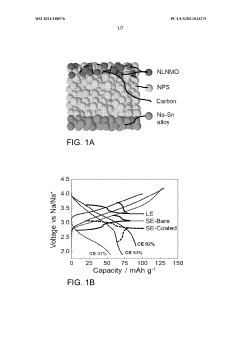
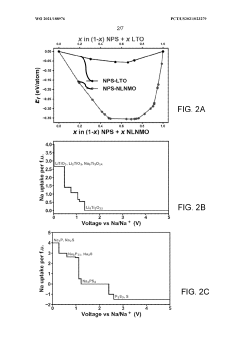
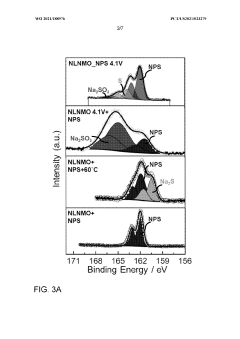
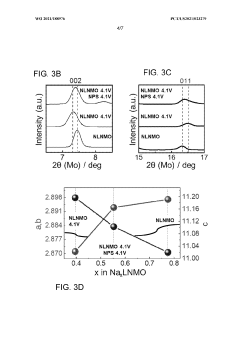
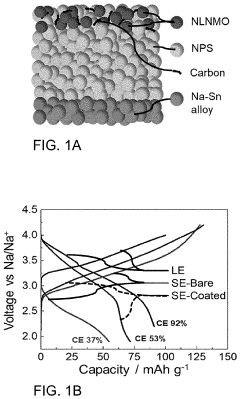
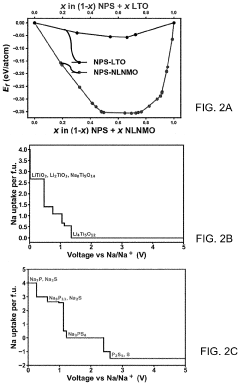
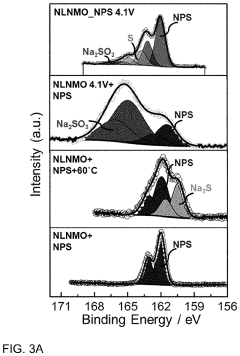
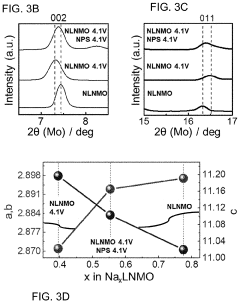
- Applying a Lithium Titanate Oxide (LTO) coating to the cathode of sodium all-solid-state batteries, specifically to the NLNMO or Nao.8[Lio.12Nio.22Mno.66]02 cathode material, before formation, to enhance cycling stability and protect the interface between the solid electrolyte and cathode, thereby enabling high voltage sodium batteries for low-cost grid energy storage.
Interface protection for all-solid-state batteries
PatentPendingUS20230113915A1
Innovation
- The application of a Li4Ti5O12 (LTO) coating at the solid-state electrolyte-cathode interface in sodium all-solid-state batteries, which is electronically insulative but ionically conductive, prevents unwanted interfacial reactions and cation inter-diffusion, enabling high voltage operation and long cycle life.
Materials Science Advancements for Sodium Battery Interfaces
Recent advancements in materials science have significantly propelled the development of sodium battery interfaces, addressing critical challenges in all-solid-state sodium batteries (ASSBs). The interface between electrodes and solid electrolytes represents one of the most crucial components determining battery performance, as it influences ionic conductivity, mechanical stability, and overall electrochemical behavior.
Materials scientists have focused on developing novel interface engineering strategies to mitigate the formation of high-impedance interphases. Ceramic-polymer composite electrolytes have emerged as promising materials that combine the high ionic conductivity of ceramics with the flexibility of polymers, creating more stable interfaces with reduced mechanical stress during cycling.
Atomic layer deposition (ALD) techniques have revolutionized interface modification by enabling precise nanoscale coating of electrode surfaces. These ultrathin protective layers effectively prevent unwanted side reactions while maintaining efficient sodium ion transport. Recent research has demonstrated that Al2O3 and TiO2 coatings can significantly enhance the cycling stability of sodium batteries by forming artificial solid electrolyte interphases with superior properties.
Computational materials science has accelerated interface design through density functional theory (DFT) and molecular dynamics simulations. These computational approaches allow researchers to predict interfacial reactions, ion transport mechanisms, and mechanical behaviors before experimental validation, substantially reducing development time and costs.
Two-dimensional materials, including MXenes and functionalized graphene, have shown exceptional promise as interfacial layers. Their unique structure provides channels for sodium ion transport while simultaneously acting as buffers to accommodate volume changes during cycling. The incorporation of these materials has led to enhanced rate capability and extended cycle life in prototype sodium batteries.
Surface chemistry modifications through functional groups have enabled better wettability between solid electrolytes and electrodes. Researchers have successfully implemented phosphate, sulfonate, and carboxylate functional groups to improve interfacial contact and reduce resistance. These modifications have proven particularly effective in polymer-based solid electrolytes where intimate contact is essential.
Gradient interface designs represent another breakthrough, where composition gradually transitions from electrode to electrolyte material, eliminating abrupt property changes that typically lead to mechanical failure. This biomimetic approach, inspired by natural interfaces in biological systems, has demonstrated superior stress distribution and enhanced electrochemical performance in laboratory-scale sodium batteries.
Materials scientists have focused on developing novel interface engineering strategies to mitigate the formation of high-impedance interphases. Ceramic-polymer composite electrolytes have emerged as promising materials that combine the high ionic conductivity of ceramics with the flexibility of polymers, creating more stable interfaces with reduced mechanical stress during cycling.
Atomic layer deposition (ALD) techniques have revolutionized interface modification by enabling precise nanoscale coating of electrode surfaces. These ultrathin protective layers effectively prevent unwanted side reactions while maintaining efficient sodium ion transport. Recent research has demonstrated that Al2O3 and TiO2 coatings can significantly enhance the cycling stability of sodium batteries by forming artificial solid electrolyte interphases with superior properties.
Computational materials science has accelerated interface design through density functional theory (DFT) and molecular dynamics simulations. These computational approaches allow researchers to predict interfacial reactions, ion transport mechanisms, and mechanical behaviors before experimental validation, substantially reducing development time and costs.
Two-dimensional materials, including MXenes and functionalized graphene, have shown exceptional promise as interfacial layers. Their unique structure provides channels for sodium ion transport while simultaneously acting as buffers to accommodate volume changes during cycling. The incorporation of these materials has led to enhanced rate capability and extended cycle life in prototype sodium batteries.
Surface chemistry modifications through functional groups have enabled better wettability between solid electrolytes and electrodes. Researchers have successfully implemented phosphate, sulfonate, and carboxylate functional groups to improve interfacial contact and reduce resistance. These modifications have proven particularly effective in polymer-based solid electrolytes where intimate contact is essential.
Gradient interface designs represent another breakthrough, where composition gradually transitions from electrode to electrolyte material, eliminating abrupt property changes that typically lead to mechanical failure. This biomimetic approach, inspired by natural interfaces in biological systems, has demonstrated superior stress distribution and enhanced electrochemical performance in laboratory-scale sodium batteries.
Sustainability and Resource Considerations for Na-ion Technology
Sodium-ion battery technology represents a promising alternative to lithium-ion batteries, particularly from a sustainability and resource perspective. The abundance of sodium in the Earth's crust (approximately 2.8% compared to lithium's 0.006%) translates to significantly lower raw material costs and reduced geopolitical supply risks. This abundance advantage becomes especially critical when considering the projected exponential growth in energy storage demand over the coming decades.
The extraction processes for sodium compounds generally require less water and energy compared to lithium extraction, particularly avoiding the water-intensive evaporation ponds used in lithium brine operations. This reduced environmental footprint extends to the carbon emissions associated with material procurement, potentially lowering the embodied carbon in battery manufacturing by 15-20% compared to lithium-ion counterparts.
For all-solid-state sodium batteries specifically, interface compatibility challenges must be addressed with sustainability in mind. Current solid electrolyte materials often contain elements like germanium or gallium that present their own resource constraints. Research is increasingly focusing on developing solid electrolytes based on earth-abundant elements while maintaining the necessary ionic conductivity and interfacial stability properties.
End-of-life considerations also favor sodium-ion technology. The absence of cobalt and nickel in many sodium-ion chemistries simplifies recycling processes. Additionally, the lower reactivity of sodium compared to lithium potentially reduces fire hazards during recycling operations. However, specialized recycling infrastructure for solid-state sodium batteries remains underdeveloped, requiring investment to maximize resource recovery.
Supply chain resilience represents another sustainability advantage. The geographical distribution of sodium resources is more evenly spread globally than lithium, reducing dependency on specific regions. This distribution can facilitate more localized production, decreasing transportation emissions and enhancing energy security for regions currently dependent on battery imports.
Water usage metrics further highlight sustainability benefits, with sodium extraction typically consuming 30-50% less water per kilogram compared to lithium. This advantage becomes particularly significant in water-stressed regions where battery manufacturing facilities might be located. The development of closed-loop water systems for sodium processing could further enhance this advantage.
When evaluating the full lifecycle environmental impact, all-solid-state sodium batteries demonstrate potential for a 25-30% reduction in global warming potential compared to conventional lithium-ion technologies, provided that interface compatibility challenges can be resolved using sustainable materials and processes.
The extraction processes for sodium compounds generally require less water and energy compared to lithium extraction, particularly avoiding the water-intensive evaporation ponds used in lithium brine operations. This reduced environmental footprint extends to the carbon emissions associated with material procurement, potentially lowering the embodied carbon in battery manufacturing by 15-20% compared to lithium-ion counterparts.
For all-solid-state sodium batteries specifically, interface compatibility challenges must be addressed with sustainability in mind. Current solid electrolyte materials often contain elements like germanium or gallium that present their own resource constraints. Research is increasingly focusing on developing solid electrolytes based on earth-abundant elements while maintaining the necessary ionic conductivity and interfacial stability properties.
End-of-life considerations also favor sodium-ion technology. The absence of cobalt and nickel in many sodium-ion chemistries simplifies recycling processes. Additionally, the lower reactivity of sodium compared to lithium potentially reduces fire hazards during recycling operations. However, specialized recycling infrastructure for solid-state sodium batteries remains underdeveloped, requiring investment to maximize resource recovery.
Supply chain resilience represents another sustainability advantage. The geographical distribution of sodium resources is more evenly spread globally than lithium, reducing dependency on specific regions. This distribution can facilitate more localized production, decreasing transportation emissions and enhancing energy security for regions currently dependent on battery imports.
Water usage metrics further highlight sustainability benefits, with sodium extraction typically consuming 30-50% less water per kilogram compared to lithium. This advantage becomes particularly significant in water-stressed regions where battery manufacturing facilities might be located. The development of closed-loop water systems for sodium processing could further enhance this advantage.
When evaluating the full lifecycle environmental impact, all-solid-state sodium batteries demonstrate potential for a 25-30% reduction in global warming potential compared to conventional lithium-ion technologies, provided that interface compatibility challenges can be resolved using sustainable materials and processes.
Unlock deeper insights with PatSnap Eureka Quick Research — get a full tech report to explore trends and direct your research. Try now!
Generate Your Research Report Instantly with AI Agent
Supercharge your innovation with PatSnap Eureka AI Agent Platform!