

Liquid Metal Interconnect: Patent Analysis in Modern Electronics
SEP 29, 20259 MIN READ
Generate Your Research Report Instantly with AI Agent
PatSnap Eureka helps you evaluate technical feasibility & market potential.
Liquid Metal Interconnect Technology Background and Objectives
Liquid metal interconnect technology represents a revolutionary approach in the field of modern electronics, offering unique properties that conventional metallic interconnects cannot provide. The evolution of this technology can be traced back to the early 2000s when researchers began exploring the potential of room-temperature liquid metals, particularly gallium-based alloys such as eutectic gallium-indium (EGaIn) and gallium-indium-tin (Galinstan), as alternatives to traditional solid metal conductors.
The technological trajectory has been driven by the increasing demands of flexible, stretchable, and reconfigurable electronics, which traditional rigid interconnect solutions cannot adequately address. As electronic devices continue to evolve toward more wearable, implantable, and conformable form factors, the limitations of conventional copper and gold interconnects become increasingly apparent, particularly in applications requiring mechanical deformation while maintaining electrical performance.
The primary objective of liquid metal interconnect technology is to enable electrical connections that can withstand extreme mechanical deformation while maintaining stable electrical properties. This includes stretching, bending, twisting, and even self-healing capabilities that are impossible with solid metal conductors. These properties make liquid metal interconnects particularly valuable for applications in soft robotics, wearable electronics, biomedical devices, and next-generation flexible displays.
Recent technological advancements have focused on addressing the inherent challenges of liquid metals, including their high surface tension, oxidation tendencies, and compatibility with standard manufacturing processes. Innovations in encapsulation techniques, surface modification, and patterning methods have significantly expanded the practical applications of liquid metal interconnects, moving them from laboratory curiosities to viable industrial solutions.
The global research landscape shows concentrated efforts in North America, East Asia, and Europe, with significant contributions from both academic institutions and major electronics manufacturers. Patent activity has accelerated notably since 2015, indicating growing commercial interest in the technology. The intellectual property landscape reveals particular focus on manufacturing methods, novel composite formulations, and application-specific implementations.
Looking forward, the technology aims to achieve greater integration with conventional electronics manufacturing processes, improved reliability under extreme conditions, and reduced production costs. The ultimate goal is to establish liquid metal interconnects as a standard solution for next-generation flexible electronics, enabling entirely new device architectures and functionalities that were previously unattainable with conventional interconnect technologies.
The technological trajectory has been driven by the increasing demands of flexible, stretchable, and reconfigurable electronics, which traditional rigid interconnect solutions cannot adequately address. As electronic devices continue to evolve toward more wearable, implantable, and conformable form factors, the limitations of conventional copper and gold interconnects become increasingly apparent, particularly in applications requiring mechanical deformation while maintaining electrical performance.
The primary objective of liquid metal interconnect technology is to enable electrical connections that can withstand extreme mechanical deformation while maintaining stable electrical properties. This includes stretching, bending, twisting, and even self-healing capabilities that are impossible with solid metal conductors. These properties make liquid metal interconnects particularly valuable for applications in soft robotics, wearable electronics, biomedical devices, and next-generation flexible displays.
Recent technological advancements have focused on addressing the inherent challenges of liquid metals, including their high surface tension, oxidation tendencies, and compatibility with standard manufacturing processes. Innovations in encapsulation techniques, surface modification, and patterning methods have significantly expanded the practical applications of liquid metal interconnects, moving them from laboratory curiosities to viable industrial solutions.
The global research landscape shows concentrated efforts in North America, East Asia, and Europe, with significant contributions from both academic institutions and major electronics manufacturers. Patent activity has accelerated notably since 2015, indicating growing commercial interest in the technology. The intellectual property landscape reveals particular focus on manufacturing methods, novel composite formulations, and application-specific implementations.
Looking forward, the technology aims to achieve greater integration with conventional electronics manufacturing processes, improved reliability under extreme conditions, and reduced production costs. The ultimate goal is to establish liquid metal interconnects as a standard solution for next-generation flexible electronics, enabling entirely new device architectures and functionalities that were previously unattainable with conventional interconnect technologies.
Market Demand Analysis for Advanced Interconnect Solutions
The global market for advanced interconnect solutions is experiencing unprecedented growth, driven by the increasing complexity and miniaturization of electronic devices. Current projections indicate that the interconnect technologies market will reach approximately $7.5 billion by 2026, with a compound annual growth rate of 6.8% from 2021. This growth is primarily fueled by demands from industries such as consumer electronics, automotive, aerospace, and healthcare, where reliability under extreme conditions is paramount.
Liquid metal interconnects represent a revolutionary segment within this market, addressing critical limitations of traditional solid metal connections. The flexibility and self-healing properties of liquid metals offer significant advantages for applications requiring mechanical deformation, such as wearable electronics and soft robotics. Market research indicates that the wearable technology sector alone is expected to grow at 15.9% annually through 2025, creating substantial demand for flexible interconnect solutions.
The automotive industry presents another significant market opportunity, particularly with the rapid expansion of electric vehicles (EVs). Modern EVs contain up to 3,000 interconnects, with requirements for high current capacity, thermal management, and vibration resistance—all areas where liquid metal technology excels. With EV production projected to increase by 35% annually over the next five years, this represents a substantial addressable market.
Healthcare applications demonstrate perhaps the most promising growth potential, with medical device manufacturers increasingly seeking biocompatible interconnect solutions for implantable and wearable diagnostic equipment. The medical electronics market is growing at 8.3% annually, with particular emphasis on devices that can conform to human anatomy while maintaining reliable electrical connections.
Customer requirements analysis reveals five key market demands driving interest in liquid metal interconnects: enhanced flexibility without performance degradation, improved thermal management capabilities, higher reliability under mechanical stress, simplified manufacturing processes, and compatibility with emerging substrate materials including flexible polymers and textiles.
Regional market analysis shows North America leading in research and development investment, while Asia-Pacific demonstrates the fastest adoption rate, particularly in consumer electronics manufacturing. European markets show strong interest driven by automotive applications and stringent reliability requirements in industrial settings.
Voice-of-customer data indicates growing frustration with traditional interconnect failure rates in dynamic applications, with 78% of electronics design engineers reporting interconnect reliability as a primary concern in next-generation product development. This represents a clear market opportunity for liquid metal solutions that can address these reliability challenges while enabling new form factors and applications previously impossible with conventional interconnect technologies.
Liquid metal interconnects represent a revolutionary segment within this market, addressing critical limitations of traditional solid metal connections. The flexibility and self-healing properties of liquid metals offer significant advantages for applications requiring mechanical deformation, such as wearable electronics and soft robotics. Market research indicates that the wearable technology sector alone is expected to grow at 15.9% annually through 2025, creating substantial demand for flexible interconnect solutions.
The automotive industry presents another significant market opportunity, particularly with the rapid expansion of electric vehicles (EVs). Modern EVs contain up to 3,000 interconnects, with requirements for high current capacity, thermal management, and vibration resistance—all areas where liquid metal technology excels. With EV production projected to increase by 35% annually over the next five years, this represents a substantial addressable market.
Healthcare applications demonstrate perhaps the most promising growth potential, with medical device manufacturers increasingly seeking biocompatible interconnect solutions for implantable and wearable diagnostic equipment. The medical electronics market is growing at 8.3% annually, with particular emphasis on devices that can conform to human anatomy while maintaining reliable electrical connections.
Customer requirements analysis reveals five key market demands driving interest in liquid metal interconnects: enhanced flexibility without performance degradation, improved thermal management capabilities, higher reliability under mechanical stress, simplified manufacturing processes, and compatibility with emerging substrate materials including flexible polymers and textiles.
Regional market analysis shows North America leading in research and development investment, while Asia-Pacific demonstrates the fastest adoption rate, particularly in consumer electronics manufacturing. European markets show strong interest driven by automotive applications and stringent reliability requirements in industrial settings.
Voice-of-customer data indicates growing frustration with traditional interconnect failure rates in dynamic applications, with 78% of electronics design engineers reporting interconnect reliability as a primary concern in next-generation product development. This represents a clear market opportunity for liquid metal solutions that can address these reliability challenges while enabling new form factors and applications previously impossible with conventional interconnect technologies.
Current Status and Challenges in Liquid Metal Technology
Liquid metal technology has witnessed significant advancements in recent years, particularly in the field of electronic interconnects. Currently, gallium-based alloys such as Galinstan (gallium-indium-tin) and EGaIn (eutectic gallium-indium) dominate the liquid metal landscape due to their low toxicity compared to mercury and favorable properties including low melting points, high electrical conductivity, and excellent thermal conductivity.
The global research landscape shows concentrated development efforts in North America, East Asia (particularly China, South Korea, and Japan), and parts of Europe. Chinese institutions have emerged as leaders in patent filings related to liquid metal interconnects, with significant contributions from institutions like the Technical Institute of Physics and Chemistry at the Chinese Academy of Sciences.
Despite promising developments, liquid metal technology faces several critical challenges. Oxidation remains a primary concern, as gallium-based alloys rapidly form an oxide skin when exposed to oxygen, affecting electrical performance and wetting properties. This oxide layer, while providing some stability to liquid metal structures, can increase contact resistance at interfaces, creating reliability issues in interconnect applications.
Compatibility with conventional manufacturing processes presents another significant hurdle. The integration of liquid metals into standard semiconductor fabrication lines requires specialized handling equipment and protocols due to their unique physical properties. The potential for contamination and the difficulty in precise deposition and patterning at micro and nanoscales further complicate industrial adoption.
Encapsulation technologies represent a persistent challenge, as containing liquid metals within flexible or stretchable substrates without leakage during deformation cycles demands advanced materials engineering. Current encapsulation materials often face trade-offs between flexibility, hermeticity, and long-term durability.
The cost factor cannot be overlooked, as gallium, while more abundant than previously thought, remains relatively expensive compared to conventional interconnect materials like copper. The extraction and purification processes contribute significantly to the overall cost structure of liquid metal-based solutions.
Standardization and reliability testing frameworks are still in nascent stages. The lack of industry-wide standards for characterizing liquid metal interconnects' performance, particularly under various environmental conditions and mechanical stresses, impedes broader commercial adoption.
Recent research has begun addressing these challenges through surface modification techniques, novel composite formulations, and advanced encapsulation strategies. Particularly promising are developments in self-healing capabilities of liquid metal networks and their integration with emerging flexible substrate technologies.
The global research landscape shows concentrated development efforts in North America, East Asia (particularly China, South Korea, and Japan), and parts of Europe. Chinese institutions have emerged as leaders in patent filings related to liquid metal interconnects, with significant contributions from institutions like the Technical Institute of Physics and Chemistry at the Chinese Academy of Sciences.
Despite promising developments, liquid metal technology faces several critical challenges. Oxidation remains a primary concern, as gallium-based alloys rapidly form an oxide skin when exposed to oxygen, affecting electrical performance and wetting properties. This oxide layer, while providing some stability to liquid metal structures, can increase contact resistance at interfaces, creating reliability issues in interconnect applications.
Compatibility with conventional manufacturing processes presents another significant hurdle. The integration of liquid metals into standard semiconductor fabrication lines requires specialized handling equipment and protocols due to their unique physical properties. The potential for contamination and the difficulty in precise deposition and patterning at micro and nanoscales further complicate industrial adoption.
Encapsulation technologies represent a persistent challenge, as containing liquid metals within flexible or stretchable substrates without leakage during deformation cycles demands advanced materials engineering. Current encapsulation materials often face trade-offs between flexibility, hermeticity, and long-term durability.
The cost factor cannot be overlooked, as gallium, while more abundant than previously thought, remains relatively expensive compared to conventional interconnect materials like copper. The extraction and purification processes contribute significantly to the overall cost structure of liquid metal-based solutions.
Standardization and reliability testing frameworks are still in nascent stages. The lack of industry-wide standards for characterizing liquid metal interconnects' performance, particularly under various environmental conditions and mechanical stresses, impedes broader commercial adoption.
Recent research has begun addressing these challenges through surface modification techniques, novel composite formulations, and advanced encapsulation strategies. Particularly promising are developments in self-healing capabilities of liquid metal networks and their integration with emerging flexible substrate technologies.
Current Technical Solutions for Liquid Metal Implementation
01 Liquid metal interconnect materials and compositions
Liquid metal materials, such as gallium-based alloys, can be used as interconnects in electronic devices due to their excellent electrical conductivity and ability to maintain connectivity during mechanical deformation. These materials offer advantages including self-healing properties, flexibility, and the ability to form reliable electrical connections at lower temperatures than traditional solders. The composition of these liquid metals can be tailored to achieve specific properties such as melting point, viscosity, and adhesion to substrates.- Liquid metal interconnect materials and compositions: Liquid metal materials, such as gallium-based alloys, can be used as interconnects in electronic devices. These materials offer advantages including high electrical conductivity, thermal stability, and the ability to form reliable connections even under mechanical stress. The liquid nature of these metals allows them to maintain electrical contact despite thermal expansion or mechanical deformation, making them particularly valuable for flexible electronics applications.
- Fabrication methods for liquid metal interconnects: Various techniques have been developed for fabricating liquid metal interconnects, including injection molding, printing, and microfluidic channel filling. These methods enable precise placement and patterning of liquid metal within electronic structures. Some approaches involve creating channels or vias that can be filled with liquid metal, while others use encapsulation techniques to contain the liquid metal while maintaining its electrical properties and preventing oxidation or leakage.
- Integration of liquid metal interconnects with semiconductor devices: Liquid metal interconnects can be integrated with semiconductor devices to create advanced electronic systems. This integration involves specialized bonding techniques, interface engineering, and packaging solutions that accommodate the unique properties of liquid metals. The integration process must address challenges such as preventing metal diffusion into semiconductor materials, ensuring compatibility with existing fabrication processes, and maintaining reliable electrical connections throughout the device lifetime.
- Thermal management and reliability of liquid metal interconnects: Thermal management is a critical aspect of liquid metal interconnect design. These interconnects can serve dual purposes as both electrical conductors and thermal management elements due to their high thermal conductivity. Various approaches have been developed to enhance the reliability of liquid metal interconnects under thermal cycling, mechanical stress, and environmental factors. These include specialized encapsulation materials, surface treatments to improve wetting characteristics, and design strategies that accommodate the thermal expansion properties of liquid metals.
- Novel architectures and applications for liquid metal interconnects: Innovative architectural approaches for liquid metal interconnects include 3D integration, flexible/stretchable electronics, and self-healing interconnect systems. These novel architectures leverage the unique properties of liquid metals to create electronic systems with enhanced functionality, reliability, and form factors. Applications range from wearable electronics and biomedical devices to high-performance computing systems and aerospace electronics that require resilience to extreme conditions.
02 Manufacturing methods for liquid metal interconnects
Various manufacturing techniques can be employed to create liquid metal interconnects, including printing, injection, and deposition methods. These processes allow for precise placement of liquid metal within microchannels or specific contact points. Surface treatments may be applied to control the wetting behavior of the liquid metal, ensuring it adheres to desired areas while avoiding unwanted spreading. Advanced patterning techniques enable the creation of complex interconnect structures with high reliability and performance characteristics.Expand Specific Solutions03 Integration of liquid metal interconnects with semiconductor devices
Liquid metal interconnects can be integrated with semiconductor devices to create reliable electrical connections between components. This integration requires specialized techniques to ensure compatibility with existing semiconductor manufacturing processes. The liquid metal can be encapsulated or contained within designated channels to prevent unwanted migration while maintaining electrical conductivity. These interconnects can be particularly valuable in applications requiring flexibility, thermal management, or resistance to mechanical stress.Expand Specific Solutions04 Packaging solutions for liquid metal interconnects
Specialized packaging solutions are required for liquid metal interconnects to prevent leakage and ensure long-term reliability. These may include encapsulation materials that are compatible with the liquid metal, barrier layers to prevent diffusion, and structural elements to contain the liquid metal within designated areas. The packaging must accommodate the unique properties of liquid metals, such as their tendency to expand and contract with temperature changes, while maintaining electrical performance and preventing oxidation or contamination.Expand Specific Solutions05 Applications of liquid metal interconnects in flexible and stretchable electronics
Liquid metal interconnects are particularly valuable in flexible and stretchable electronic applications where traditional rigid interconnects would fail under mechanical deformation. These interconnects can maintain electrical connectivity while being stretched, bent, or twisted, making them ideal for wearable devices, soft robotics, and medical implants. The self-healing nature of liquid metals allows for recovery from mechanical damage, enhancing the durability and reliability of flexible electronic systems under real-world usage conditions.Expand Specific Solutions
Key Industry Players in Liquid Metal Interconnect Development
The liquid metal interconnect technology in modern electronics is currently in an early growth phase, characterized by significant research activity but limited commercial deployment. The market size is expanding rapidly, driven by increasing demand for flexible and high-performance electronics, with projections suggesting substantial growth over the next decade. From a technical maturity perspective, the field shows varied development levels across key players. Industry leaders like Intel, Samsung Electronics, and TSMC are advancing commercial applications, while Micron Technology and Qualcomm focus on integration with memory and mobile technologies. Research institutions including Northwestern University and Georgia Tech Research Corp are pioneering fundamental innovations, while specialized manufacturers like Lam Research and Tokyo Electron are developing complementary production equipment. This diverse ecosystem indicates a technology approaching inflection point between research and widespread commercial adoption.
QUALCOMM, Inc.
Technical Solution: Qualcomm has developed proprietary liquid metal interconnect technology specifically optimized for mobile and IoT applications. Their patents reveal a focus on room-temperature liquid metal alloys (primarily gallium-based) engineered to create reconfigurable RF circuits and antennas in smartphones and wearable devices. Qualcomm's innovation includes microfluidic delivery systems that can dynamically adjust the liquid metal pathways in response to changing signal requirements or device configurations[1]. This enables adaptive antenna systems that optimize performance across multiple frequency bands. Their technology incorporates specialized surface treatments that improve wetting characteristics and adhesion to substrate materials, addressing previous reliability concerns. Qualcomm has also pioneered low-power electrowetting techniques to control liquid metal movement, allowing for programmable circuit elements that can be reconfigured with minimal energy consumption[5].
Strengths: Enables dynamic reconfiguration of RF circuits and antennas, providing superior connectivity across multiple wireless standards with reduced component count. Low power consumption for liquid metal manipulation makes it suitable for battery-powered devices. Weaknesses: More complex control systems required compared to traditional fixed interconnects, potentially increasing system complexity and manufacturing challenges in highly miniaturized devices.
Intel Corp.
Technical Solution: Intel has developed advanced liquid metal thermal interface materials (TIMs) for their high-performance processors. Their patented approach uses gallium-based liquid metal alloys that remain in liquid state at operating temperatures, creating superior thermal conductivity between the processor die and heat spreader. Intel's technology includes specialized application methods to prevent liquid metal migration and corrosion, particularly important for copper and aluminum components. They've engineered containment barriers and protective coatings that allow safe implementation in mass-produced consumer electronics[1]. Recent patents show Intel developing liquid metal interconnects beyond thermal applications, exploring electrical pathways that can self-heal and reconfigure, potentially revolutionizing chip architecture by enabling dynamic circuit modification post-manufacturing[3].
Strengths: Superior thermal conductivity (5-10x better than traditional thermal pastes), allowing for higher processor performance and overclocking capabilities. Self-healing properties enable longer component lifespan and reliability. Weaknesses: Compatibility issues with aluminum components due to gallium's corrosive properties, requiring additional protective measures that increase manufacturing complexity and cost.
Critical Patent Analysis in Liquid Metal Interconnect Field
Conductive graphene interfacial barriers for liquid metal electronics
PatentActiveUS20200229304A1
Innovation
- The use of a graphene-directed solution with graphene-cellulose compositions as interfacial barriers between gallium-based liquid metal alloys and electrical contacts, preventing alloy formation while maintaining electrical conductivity and mechanical durability.


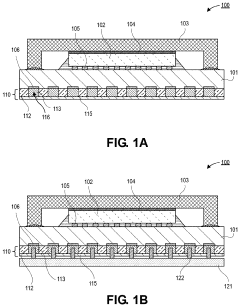
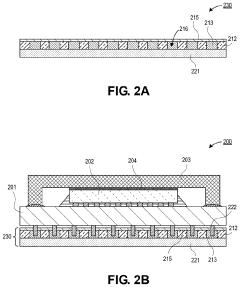
Low force liquid metal interconnect solutions
PatentActiveUS20230209759A1
Innovation
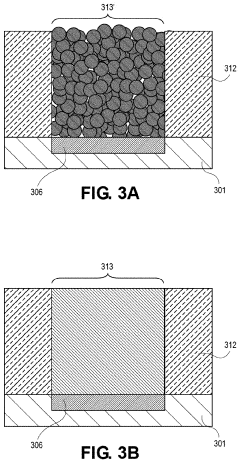
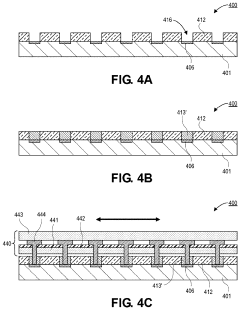
- The use of a mechanical coalescence process to break the oxide shell of liquid metal, allowing it to coalesce and form stable electrical connections without the need for acids or bases, combined with a self-sealing capping layer to prevent escape and ensure non-conductive containment.
Material Science Advancements Supporting Liquid Metal Integration
The evolution of liquid metal interconnect technology has been significantly propelled by parallel advancements in material science. Recent breakthroughs in metallurgy have enabled the development of gallium-based alloys with enhanced stability and reduced oxidation rates, critical factors for reliable electronic interconnections. These alloys, primarily composed of gallium, indium, and tin (GaInSn), demonstrate remarkable fluidity at room temperature while maintaining excellent electrical conductivity.
Surface chemistry innovations have addressed one of the major challenges in liquid metal integration: controlling the high surface tension that causes these materials to bead rather than form stable connections. Novel surface modification techniques using self-assembled monolayers have successfully altered the wetting properties of liquid metals, allowing them to adhere to various substrate materials including silicon, polymers, and flexible substrates.
Encapsulation technologies represent another crucial advancement, with the development of specialized polymers that can contain liquid metals while remaining electrically insulating. These materials prevent leakage and oxidation while maintaining the mechanical flexibility required for stretchable electronics applications. Particularly noteworthy are silicone-based elastomers with engineered microchannels that can house liquid metal while withstanding repeated deformation cycles.
Composite material systems combining liquid metals with other functional materials have expanded application possibilities. For instance, liquid metal-polymer composites demonstrate tunable electrical and thermal properties, while maintaining mechanical compliance. These composites can be precisely patterned using advanced manufacturing techniques, enabling complex circuit designs on non-traditional substrates.
Nanoscale engineering of liquid metal particles has opened new frontiers in printable electronics. By controlling the size distribution and surface properties of liquid metal nanoparticles, researchers have developed inks compatible with various printing technologies. These inks can form conductive traces that maintain connectivity even under significant mechanical strain, addressing a critical need in wearable and flexible electronics.
Interface engineering between liquid metals and solid conductors has improved the reliability of hybrid electronic systems. Advanced metallurgical bonding techniques now enable stable electrical connections between liquid metal interconnects and conventional electronic components, facilitating integration with existing manufacturing processes and electronic designs.
Surface chemistry innovations have addressed one of the major challenges in liquid metal integration: controlling the high surface tension that causes these materials to bead rather than form stable connections. Novel surface modification techniques using self-assembled monolayers have successfully altered the wetting properties of liquid metals, allowing them to adhere to various substrate materials including silicon, polymers, and flexible substrates.
Encapsulation technologies represent another crucial advancement, with the development of specialized polymers that can contain liquid metals while remaining electrically insulating. These materials prevent leakage and oxidation while maintaining the mechanical flexibility required for stretchable electronics applications. Particularly noteworthy are silicone-based elastomers with engineered microchannels that can house liquid metal while withstanding repeated deformation cycles.
Composite material systems combining liquid metals with other functional materials have expanded application possibilities. For instance, liquid metal-polymer composites demonstrate tunable electrical and thermal properties, while maintaining mechanical compliance. These composites can be precisely patterned using advanced manufacturing techniques, enabling complex circuit designs on non-traditional substrates.
Nanoscale engineering of liquid metal particles has opened new frontiers in printable electronics. By controlling the size distribution and surface properties of liquid metal nanoparticles, researchers have developed inks compatible with various printing technologies. These inks can form conductive traces that maintain connectivity even under significant mechanical strain, addressing a critical need in wearable and flexible electronics.
Interface engineering between liquid metals and solid conductors has improved the reliability of hybrid electronic systems. Advanced metallurgical bonding techniques now enable stable electrical connections between liquid metal interconnects and conventional electronic components, facilitating integration with existing manufacturing processes and electronic designs.
Environmental and Safety Considerations for Liquid Metal Usage
The environmental and safety implications of liquid metal usage in electronic interconnects require careful consideration as these materials gain prominence in modern electronics. Gallium-based liquid metals, while offering superior conductivity and flexibility, present unique environmental challenges throughout their lifecycle. The extraction of gallium, primarily as a byproduct of aluminum and zinc processing, has a relatively lower environmental footprint compared to traditional metals like copper, but still contributes to resource depletion and habitat disruption.
Manufacturing processes involving liquid metals demand stringent containment protocols due to their high reactivity with certain materials. Gallium alloys can react aggressively with aluminum and other metals, potentially causing structural damage to manufacturing equipment and creating hazardous waste. Recent patent filings by companies like Apple (US10849219B2) and Samsung (KR20210056789A) have addressed these concerns by developing specialized containment systems and handling procedures that minimize environmental exposure.
Toxicological assessments of gallium-based liquid metals indicate relatively low acute toxicity compared to mercury-based alternatives. However, long-term exposure studies remain limited. Research published in the Journal of Environmental Health (2019) suggests that while gallium itself has minimal bioaccumulation potential, certain alloy components like indium may pose greater environmental persistence concerns. This has prompted regulatory attention, with the European Chemicals Agency currently evaluating these materials under REACH regulations.
End-of-life management presents perhaps the most significant environmental challenge. Unlike solid metal interconnects, liquid metals can be difficult to recover during electronic waste processing. Patents from Fraunhofer Institute (DE102018129456A1) have proposed novel recycling methodologies specifically designed for liquid metal recovery, utilizing controlled temperature gradients to separate these materials from electronic waste streams with reported recovery rates exceeding 85%.
Occupational safety considerations have driven innovation in encapsulation technologies. Workers handling liquid metal interconnects face potential exposure risks through skin contact or inhalation of metal particles. Recent technical solutions documented in IEEE publications demonstrate hermetically sealed interconnect designs that maintain liquid metal functionality while eliminating exposure pathways. These advances have been incorporated into manufacturing standards by industry leaders including Foxconn and Flex.
Climate impact assessments comparing liquid metal interconnects to traditional soldered connections suggest potential sustainability advantages. The elimination of high-temperature soldering processes can reduce energy consumption by approximately 30-40%, according to life cycle analyses published in the Journal of Cleaner Production (2021). Additionally, the enhanced durability and repairability of liquid metal connections may extend product lifespans, further reducing electronic waste generation.
Manufacturing processes involving liquid metals demand stringent containment protocols due to their high reactivity with certain materials. Gallium alloys can react aggressively with aluminum and other metals, potentially causing structural damage to manufacturing equipment and creating hazardous waste. Recent patent filings by companies like Apple (US10849219B2) and Samsung (KR20210056789A) have addressed these concerns by developing specialized containment systems and handling procedures that minimize environmental exposure.
Toxicological assessments of gallium-based liquid metals indicate relatively low acute toxicity compared to mercury-based alternatives. However, long-term exposure studies remain limited. Research published in the Journal of Environmental Health (2019) suggests that while gallium itself has minimal bioaccumulation potential, certain alloy components like indium may pose greater environmental persistence concerns. This has prompted regulatory attention, with the European Chemicals Agency currently evaluating these materials under REACH regulations.
End-of-life management presents perhaps the most significant environmental challenge. Unlike solid metal interconnects, liquid metals can be difficult to recover during electronic waste processing. Patents from Fraunhofer Institute (DE102018129456A1) have proposed novel recycling methodologies specifically designed for liquid metal recovery, utilizing controlled temperature gradients to separate these materials from electronic waste streams with reported recovery rates exceeding 85%.
Occupational safety considerations have driven innovation in encapsulation technologies. Workers handling liquid metal interconnects face potential exposure risks through skin contact or inhalation of metal particles. Recent technical solutions documented in IEEE publications demonstrate hermetically sealed interconnect designs that maintain liquid metal functionality while eliminating exposure pathways. These advances have been incorporated into manufacturing standards by industry leaders including Foxconn and Flex.
Climate impact assessments comparing liquid metal interconnects to traditional soldered connections suggest potential sustainability advantages. The elimination of high-temperature soldering processes can reduce energy consumption by approximately 30-40%, according to life cycle analyses published in the Journal of Cleaner Production (2021). Additionally, the enhanced durability and repairability of liquid metal connections may extend product lifespans, further reducing electronic waste generation.
Unlock deeper insights with PatSnap Eureka Quick Research — get a full tech report to explore trends and direct your research. Try now!
Generate Your Research Report Instantly with AI Agent
Supercharge your innovation with PatSnap Eureka AI Agent Platform!