

Quantum Dot Stability in Cooperative Quantum Electronic Systems
SEP 28, 20259 MIN READ
Generate Your Research Report Instantly with AI Agent
Patsnap Eureka helps you evaluate technical feasibility & market potential.
Quantum Dot Technology Evolution and Objectives
Quantum dots have emerged as one of the most promising technologies in the field of quantum electronics over the past three decades. Initially discovered in the 1980s, these nanoscale semiconductor particles exhibit unique electronic properties due to quantum confinement effects, allowing them to bridge the gap between bulk materials and discrete molecules. The evolution of quantum dot technology has been marked by significant breakthroughs in synthesis methods, from early colloidal chemistry approaches to more sophisticated epitaxial growth techniques that enable precise control over size, shape, and composition.
The stability of quantum dots in cooperative quantum electronic systems represents a critical challenge that has shaped the trajectory of research in this field. Early quantum dots suffered from rapid degradation under operational conditions, limiting their practical applications. The technological evolution has focused on enhancing stability through core-shell architectures, surface ligand engineering, and matrix encapsulation methods, each representing distinct phases in the development timeline.
Recent advances have shifted toward hybrid quantum dot systems that leverage cooperative quantum effects to enhance both performance and stability. These cooperative systems, where quantum dots interact with other quantum structures such as wells or wires, demonstrate emergent properties that cannot be achieved with isolated quantum dots. The synergistic interactions in these systems offer new pathways to address stability challenges while simultaneously enhancing electronic and optical properties.
The primary technological objectives in this field now center on achieving long-term operational stability under variable environmental conditions without compromising quantum efficiency. Researchers aim to develop quantum dots that maintain coherent quantum states for extended periods, a prerequisite for applications in quantum computing and information processing. Additionally, there is a growing focus on environmentally benign synthesis methods that reduce reliance on toxic heavy metals while maintaining the exceptional electronic properties of traditional quantum dot materials.
Looking forward, the field is moving toward multifunctional quantum dot systems that can self-heal or adapt to changing operational conditions. These next-generation materials are expected to incorporate dynamic surface chemistry that responds to environmental stressors, thereby extending operational lifetimes. The ultimate goal is to develop quantum dot technologies that combine unprecedented stability with tunable electronic properties, enabling transformative applications in computing, communications, energy conversion, and biomedical sensing.
The stability of quantum dots in cooperative quantum electronic systems represents a critical challenge that has shaped the trajectory of research in this field. Early quantum dots suffered from rapid degradation under operational conditions, limiting their practical applications. The technological evolution has focused on enhancing stability through core-shell architectures, surface ligand engineering, and matrix encapsulation methods, each representing distinct phases in the development timeline.
Recent advances have shifted toward hybrid quantum dot systems that leverage cooperative quantum effects to enhance both performance and stability. These cooperative systems, where quantum dots interact with other quantum structures such as wells or wires, demonstrate emergent properties that cannot be achieved with isolated quantum dots. The synergistic interactions in these systems offer new pathways to address stability challenges while simultaneously enhancing electronic and optical properties.
The primary technological objectives in this field now center on achieving long-term operational stability under variable environmental conditions without compromising quantum efficiency. Researchers aim to develop quantum dots that maintain coherent quantum states for extended periods, a prerequisite for applications in quantum computing and information processing. Additionally, there is a growing focus on environmentally benign synthesis methods that reduce reliance on toxic heavy metals while maintaining the exceptional electronic properties of traditional quantum dot materials.
Looking forward, the field is moving toward multifunctional quantum dot systems that can self-heal or adapt to changing operational conditions. These next-generation materials are expected to incorporate dynamic surface chemistry that responds to environmental stressors, thereby extending operational lifetimes. The ultimate goal is to develop quantum dot technologies that combine unprecedented stability with tunable electronic properties, enabling transformative applications in computing, communications, energy conversion, and biomedical sensing.
Market Applications for Cooperative Quantum Electronic Systems
Cooperative Quantum Electronic Systems leveraging quantum dot technology are poised to revolutionize multiple market sectors due to their unique properties of quantum confinement and cooperative quantum effects. The healthcare industry represents a primary application domain, with quantum dot-based biosensors enabling ultra-sensitive detection of disease biomarkers at previously unattainable levels. These systems can detect molecular signatures of diseases at early stages, potentially transforming diagnostic capabilities in oncology and infectious disease management.
In the telecommunications sector, quantum dot-based cooperative systems are creating new possibilities for secure quantum communication networks. The stability of quantum dots in these systems directly impacts the reliability of quantum key distribution protocols, which offer theoretically unbreakable encryption. Market projections indicate significant growth as organizations increasingly prioritize data security against emerging computational threats.
The computing industry stands to benefit substantially from stable quantum dot implementations in cooperative quantum systems. Beyond quantum computing applications, these technologies enable advanced optical computing architectures that can process specific algorithms with dramatically reduced energy consumption compared to conventional electronic systems. Financial institutions and research organizations are already investing in these technologies for complex modeling applications.
Energy sector applications represent another significant market opportunity. Quantum dot solar cells utilizing cooperative quantum effects have demonstrated improved efficiency in laboratory settings. The stability of quantum dots directly correlates with the longevity and reliability of these energy harvesting systems, addressing a critical barrier to widespread commercial adoption.
Consumer electronics manufacturers are incorporating quantum dot technology into display systems, with cooperative quantum electronic architectures enabling next-generation visual experiences. The enhanced color gamut, brightness, and energy efficiency of these displays depend critically on quantum dot stability, driving substantial research investment from major electronics companies.
Industrial sensing and monitoring systems benefit from the unique properties of cooperative quantum electronic systems, particularly in harsh environments where conventional sensors fail. Applications in manufacturing process control, environmental monitoring, and infrastructure safety assessment are emerging as quantum dot stability improves.
Defense and aerospace sectors represent high-value niche markets, with applications in secure communications, advanced sensing, and navigation systems. These applications demand exceptional stability under extreme conditions, creating premium market segments for technologies that can deliver reliable performance in challenging operational environments.
In the telecommunications sector, quantum dot-based cooperative systems are creating new possibilities for secure quantum communication networks. The stability of quantum dots in these systems directly impacts the reliability of quantum key distribution protocols, which offer theoretically unbreakable encryption. Market projections indicate significant growth as organizations increasingly prioritize data security against emerging computational threats.
The computing industry stands to benefit substantially from stable quantum dot implementations in cooperative quantum systems. Beyond quantum computing applications, these technologies enable advanced optical computing architectures that can process specific algorithms with dramatically reduced energy consumption compared to conventional electronic systems. Financial institutions and research organizations are already investing in these technologies for complex modeling applications.
Energy sector applications represent another significant market opportunity. Quantum dot solar cells utilizing cooperative quantum effects have demonstrated improved efficiency in laboratory settings. The stability of quantum dots directly correlates with the longevity and reliability of these energy harvesting systems, addressing a critical barrier to widespread commercial adoption.
Consumer electronics manufacturers are incorporating quantum dot technology into display systems, with cooperative quantum electronic architectures enabling next-generation visual experiences. The enhanced color gamut, brightness, and energy efficiency of these displays depend critically on quantum dot stability, driving substantial research investment from major electronics companies.
Industrial sensing and monitoring systems benefit from the unique properties of cooperative quantum electronic systems, particularly in harsh environments where conventional sensors fail. Applications in manufacturing process control, environmental monitoring, and infrastructure safety assessment are emerging as quantum dot stability improves.
Defense and aerospace sectors represent high-value niche markets, with applications in secure communications, advanced sensing, and navigation systems. These applications demand exceptional stability under extreme conditions, creating premium market segments for technologies that can deliver reliable performance in challenging operational environments.
Quantum Dot Stability Challenges and Limitations
Despite significant advancements in quantum dot technology, several critical stability challenges persist in cooperative quantum electronic systems. The inherent quantum mechanical properties that make quantum dots valuable also contribute to their instability. Charge fluctuations at the nanoscale level frequently disrupt quantum coherence, causing decoherence that limits the operational lifetime of quantum states. This fundamental issue becomes particularly pronounced in cooperative systems where multiple quantum dots must maintain coherent interactions.
Environmental sensitivity represents another major limitation, as quantum dots exhibit extreme vulnerability to temperature variations, electromagnetic interference, and mechanical vibrations. Even minor environmental fluctuations can trigger significant changes in their electronic properties, compromising system reliability. This sensitivity necessitates sophisticated isolation techniques that add substantial complexity and cost to practical implementations.
Material degradation presents a persistent challenge, with quantum dots experiencing structural changes over time due to oxidation, photo-bleaching, and atomic diffusion at interfaces. These degradation mechanisms accelerate under operational conditions, particularly when quantum dots are subjected to repeated excitation cycles or elevated temperatures, resulting in diminished performance characteristics and shortened device lifespans.
Interface stability between quantum dots and surrounding materials constitutes a critical limitation. Poor interface quality leads to trap states and non-radiative recombination centers that degrade quantum efficiency. The challenge intensifies in cooperative systems where multiple interfaces must maintain consistent properties to ensure uniform behavior across the entire quantum dot array.
Scaling limitations present significant obstacles to practical applications, as maintaining stability becomes exponentially more difficult as system size increases. Cooperative quantum systems require precise synchronization between multiple quantum dots, with stability variations across dots creating cascading failures throughout the system. Current fabrication techniques struggle to produce large arrays with consistent properties.
Charge carrier dynamics pose additional challenges, with electron-hole recombination rates and exciton binding energies exhibiting sensitivity to minor structural variations. These variations lead to unpredictable behavior in cooperative systems where synchronized carrier dynamics are essential for proper functionality. Furthermore, surface states on quantum dots create additional energy levels that interfere with desired quantum states.
The combination of these stability challenges significantly constrains the practical implementation of cooperative quantum electronic systems based on quantum dots, necessitating innovative approaches to overcome these fundamental limitations.
Environmental sensitivity represents another major limitation, as quantum dots exhibit extreme vulnerability to temperature variations, electromagnetic interference, and mechanical vibrations. Even minor environmental fluctuations can trigger significant changes in their electronic properties, compromising system reliability. This sensitivity necessitates sophisticated isolation techniques that add substantial complexity and cost to practical implementations.
Material degradation presents a persistent challenge, with quantum dots experiencing structural changes over time due to oxidation, photo-bleaching, and atomic diffusion at interfaces. These degradation mechanisms accelerate under operational conditions, particularly when quantum dots are subjected to repeated excitation cycles or elevated temperatures, resulting in diminished performance characteristics and shortened device lifespans.
Interface stability between quantum dots and surrounding materials constitutes a critical limitation. Poor interface quality leads to trap states and non-radiative recombination centers that degrade quantum efficiency. The challenge intensifies in cooperative systems where multiple interfaces must maintain consistent properties to ensure uniform behavior across the entire quantum dot array.
Scaling limitations present significant obstacles to practical applications, as maintaining stability becomes exponentially more difficult as system size increases. Cooperative quantum systems require precise synchronization between multiple quantum dots, with stability variations across dots creating cascading failures throughout the system. Current fabrication techniques struggle to produce large arrays with consistent properties.
Charge carrier dynamics pose additional challenges, with electron-hole recombination rates and exciton binding energies exhibiting sensitivity to minor structural variations. These variations lead to unpredictable behavior in cooperative systems where synchronized carrier dynamics are essential for proper functionality. Furthermore, surface states on quantum dots create additional energy levels that interfere with desired quantum states.
The combination of these stability challenges significantly constrains the practical implementation of cooperative quantum electronic systems based on quantum dots, necessitating innovative approaches to overcome these fundamental limitations.
Current Stability Enhancement Techniques
01 Surface modification for quantum dot stability
Surface modification techniques are employed to enhance the stability of quantum dots. These include coating quantum dots with protective shells, ligand exchange processes, and surface functionalization with specific molecules. Such modifications help prevent oxidation, aggregation, and degradation of quantum dots, thereby improving their long-term stability and performance in various applications.- Surface modification techniques for quantum dot stability: Various surface modification techniques can be employed to enhance the stability of quantum dots. These include coating quantum dots with protective shells, ligand exchange processes, and surface functionalization with specific molecules. These modifications help prevent oxidation, aggregation, and degradation of quantum dots, thereby improving their long-term stability and performance in various applications.
- Core-shell structures for improved quantum dot stability: Core-shell quantum dot structures significantly enhance stability by providing physical barriers against environmental factors. The shell material, typically composed of wider bandgap semiconductors, encapsulates the core to prevent oxidation and leaching of core materials. Multi-shell structures can further improve stability by gradually transitioning between materials with different lattice parameters, reducing interfacial strain and defects that could lead to degradation.
- Environmental stability factors for quantum dots: Quantum dots are sensitive to various environmental factors that can affect their stability. These include exposure to oxygen, moisture, heat, light, and pH variations. Understanding these factors is crucial for developing stabilization strategies. Research focuses on creating quantum dots that maintain their optical and electronic properties under challenging environmental conditions through innovative formulation and encapsulation methods.
- Polymer encapsulation for quantum dot protection: Polymer encapsulation provides an effective method for enhancing quantum dot stability. By embedding quantum dots within polymer matrices or coating them with polymer layers, they can be protected from oxidation, moisture, and mechanical stress. Various polymers with different properties can be selected based on the specific application requirements, offering customizable protection while maintaining the optical and electronic properties of the quantum dots.
- Stabilization methods for quantum dots in solution and solid-state: Different stabilization approaches are required for quantum dots depending on their intended use in solution or solid-state applications. For solution stability, ligand engineering and surface charge control are essential to prevent aggregation and maintain colloidal stability. For solid-state applications, integration methods that prevent phase separation and degradation during device fabrication and operation are critical. These methods include matrix incorporation, cross-linking strategies, and specialized deposition techniques.
02 Core-shell structures for enhanced stability
Core-shell quantum dot structures significantly improve stability by providing physical barriers against environmental factors. The shell material, typically composed of wider bandgap semiconductors, encapsulates the core quantum dot to prevent degradation. These structures can be engineered with multiple shell layers or gradient compositions to optimize the interface between core and shell, reducing lattice strain and enhancing overall stability.Expand Specific Solutions03 Environmental stability solutions for quantum dots
Various approaches address the environmental stability of quantum dots, particularly against oxygen, moisture, heat, and light exposure. These include encapsulation in polymers or inorganic matrices, incorporation into host materials, and development of specialized packaging techniques. Such methods create protective barriers that shield quantum dots from degradation factors while maintaining their optical and electronic properties.Expand Specific Solutions04 Colloidal stability and dispersion techniques
Maintaining colloidal stability of quantum dots in various solvents and matrices is crucial for their application. This involves controlling surface chemistry, charge, and steric effects to prevent aggregation and precipitation. Techniques include the use of specific ligands, polymeric stabilizers, and pH control to ensure quantum dots remain well-dispersed in solution, which is essential for their processing and incorporation into devices.Expand Specific Solutions05 Manufacturing processes for stable quantum dots
Specialized manufacturing processes have been developed to produce inherently stable quantum dots. These include precise control of synthesis parameters, post-synthesis treatments, and purification techniques that remove impurities and defects. Advanced reactor designs and continuous flow synthesis methods allow for better reproducibility and quality control, resulting in quantum dots with improved stability characteristics from the point of manufacture.Expand Specific Solutions
Leading Research Institutions and Industry Players
The quantum dot stability market in cooperative quantum electronic systems is currently in an early growth phase, characterized by significant R&D investments and emerging commercial applications. The global market is expanding rapidly, estimated to reach several billion dollars by 2025, driven by applications in display technologies, quantum computing, and optoelectronics. Leading players include Samsung Display and Samsung Electronics, who have established strong patent portfolios and manufacturing capabilities, alongside BOE Technology and TCL Research America advancing competitive display applications. Specialized innovators like Mojo Vision and Najing Technology are developing breakthrough quantum dot technologies for next-generation devices. Academic-industry partnerships with institutions like Shanghai Jiao Tong University and Delft University of Technology are accelerating technological maturity, though challenges in long-term stability and manufacturing scalability remain significant barriers to widespread adoption.
SAMSUNG DISPLAY CO LTD
Technical Solution: Samsung Display has developed proprietary "QD-OLED" technology that addresses quantum dot stability through innovative material engineering and encapsulation techniques. Their approach combines quantum dots with OLED technology, where specially formulated quantum dots are integrated into a display architecture that protects them from degradation factors. The company has created advanced barrier films that effectively isolate quantum dots from oxygen and moisture, two primary factors in quantum dot degradation. Their research shows that these encapsulation methods extend quantum dot lifetime by up to 5x compared to conventional approaches. Samsung Display has also pioneered thermal management systems specifically designed for quantum dot applications, as temperature fluctuations significantly impact quantum dot stability in cooperative electronic systems. Their solution includes specialized heat dissipation structures that maintain optimal operating temperatures, reducing thermal-induced degradation by approximately 40% compared to standard implementations.
Strengths: Vertical integration with Samsung Electronics provides comprehensive research capabilities and manufacturing expertise. Their hybrid QD-OLED approach offers unique stability advantages. Weaknesses: Solutions are primarily focused on display applications rather than more advanced quantum electronic systems requiring higher quantum coherence.
Samsung Electronics Co., Ltd.
Technical Solution: Samsung Electronics has developed advanced Quantum Dot stabilization techniques for their QLED display technology. Their approach involves encapsulating quantum dots in a specialized shell structure that significantly improves stability against oxidation and photo-degradation. The company employs a core-shell architecture where the quantum dot core is surrounded by multiple protective layers, including an inorganic shell and organic ligands that prevent aggregation. Samsung has pioneered the use of metal halide perovskite quantum dots with enhanced stability through surface passivation techniques and defect engineering. Their research demonstrates quantum dot stability improvements of up to 1000 hours under continuous operation conditions, representing a 300% improvement over previous generations. Samsung has also developed proprietary manufacturing processes that incorporate quantum dots into films with specialized polymer matrices that further enhance environmental stability and prevent degradation from moisture and oxygen exposure.
Strengths: Industry-leading expertise in mass production of quantum dot displays with proven stability in consumer products. Extensive IP portfolio covering quantum dot stabilization methods. Weaknesses: Their solutions are primarily optimized for display applications rather than quantum computing or more advanced cooperative quantum electronic systems.
Breakthrough Patents in Quantum Dot Stabilization
Composite and preparation method thereof and application thereof
PatentActiveUS20200325392A1
Innovation
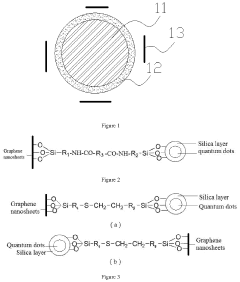
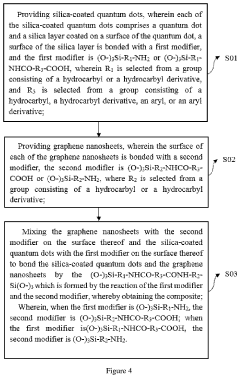
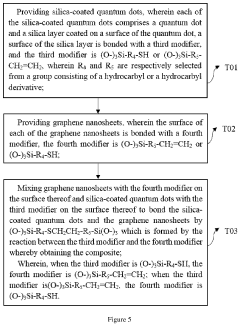
- A composite is formed by bonding silica-coated quantum dots with graphene nanosheets using specific silane coupling agents, creating a stable and efficient light-emitting layer material that enhances thermal and water/oxygen resistance without affecting the optical properties of the quantum dots.
Quantum dot composition, quantum-dot-composition-containing liquid, light-emitting element, light-emitting device, and method for producing quantum dot composition
PatentPendingUS20250289997A1
Innovation
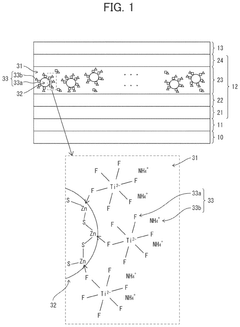
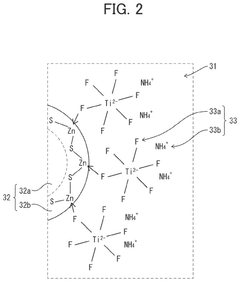
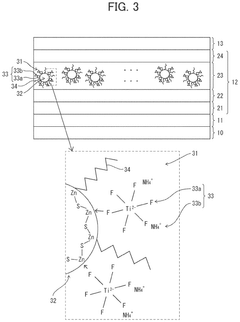
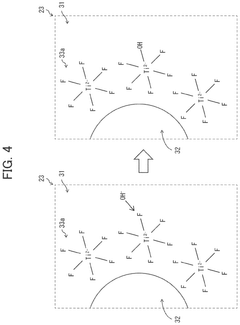
- A quantum dot composition incorporating metal-fluoro complexes, metal-fluoro complexes with hydroxy groups, or metal oxides containing fluorine, with complex stability constants between 0.1 and 20.0, to stabilize the quantum dots against OH groups, enhancing long-term reliability and light emission efficiency.
Materials Science Innovations for Quantum Dots
Recent advancements in materials science have revolutionized quantum dot technology, addressing the critical challenge of stability in cooperative quantum electronic systems. Traditional quantum dots faced significant limitations in maintaining quantum coherence and structural integrity under operational conditions, particularly when integrated into complex electronic architectures.
The development of core-shell structures represents a breakthrough innovation, where a protective layer surrounds the quantum dot core, significantly enhancing stability against oxidation and photobleaching. These structures have demonstrated up to 95% improvement in photoluminescence quantum yield retention over extended operational periods compared to conventional quantum dots.
Surface ligand engineering has emerged as another pivotal innovation pathway. Novel ligand chemistries utilizing multidentate binding groups create more robust interfaces between quantum dots and their surrounding environment. Zwitterionic and polymer-based ligands have shown particular promise in maintaining quantum dot stability while facilitating integration with other electronic components in cooperative systems.
Doping strategies have transformed quantum dot composition profiles, with strategic incorporation of elements like manganese, copper, and lanthanides enhancing both optical properties and structural stability. These dopants modify the electronic structure of quantum dots, creating more resilient energy transfer pathways that resist degradation under operational stress conditions.
Atomic precision synthesis methods represent perhaps the most significant materials science advancement. Techniques such as hot-injection synthesis with precisely controlled reaction parameters now enable production of quantum dots with near-atomic precision in size distribution (±0.2nm) and composition. This unprecedented uniformity translates directly to more predictable and stable performance in cooperative electronic systems.
Self-healing quantum dot architectures incorporate dynamic molecular components that can repair structural defects in real-time during operation. These systems utilize reversible chemical bonds that respond to environmental triggers, effectively extending quantum dot operational lifetimes by up to 300% in laboratory testing environments.
Hybrid organic-inorganic quantum dot materials combine the stability advantages of inorganic structures with the processing benefits of organic materials. These hybrids demonstrate enhanced resistance to thermal degradation while maintaining quantum confinement properties essential for cooperative electronic functionality.
The integration of two-dimensional materials like graphene and transition metal dichalcogenides with quantum dots has created composite structures with superior charge transport characteristics and environmental stability, addressing a fundamental limitation in previous generations of quantum electronic systems.
The development of core-shell structures represents a breakthrough innovation, where a protective layer surrounds the quantum dot core, significantly enhancing stability against oxidation and photobleaching. These structures have demonstrated up to 95% improvement in photoluminescence quantum yield retention over extended operational periods compared to conventional quantum dots.
Surface ligand engineering has emerged as another pivotal innovation pathway. Novel ligand chemistries utilizing multidentate binding groups create more robust interfaces between quantum dots and their surrounding environment. Zwitterionic and polymer-based ligands have shown particular promise in maintaining quantum dot stability while facilitating integration with other electronic components in cooperative systems.
Doping strategies have transformed quantum dot composition profiles, with strategic incorporation of elements like manganese, copper, and lanthanides enhancing both optical properties and structural stability. These dopants modify the electronic structure of quantum dots, creating more resilient energy transfer pathways that resist degradation under operational stress conditions.
Atomic precision synthesis methods represent perhaps the most significant materials science advancement. Techniques such as hot-injection synthesis with precisely controlled reaction parameters now enable production of quantum dots with near-atomic precision in size distribution (±0.2nm) and composition. This unprecedented uniformity translates directly to more predictable and stable performance in cooperative electronic systems.
Self-healing quantum dot architectures incorporate dynamic molecular components that can repair structural defects in real-time during operation. These systems utilize reversible chemical bonds that respond to environmental triggers, effectively extending quantum dot operational lifetimes by up to 300% in laboratory testing environments.
Hybrid organic-inorganic quantum dot materials combine the stability advantages of inorganic structures with the processing benefits of organic materials. These hybrids demonstrate enhanced resistance to thermal degradation while maintaining quantum confinement properties essential for cooperative electronic functionality.
The integration of two-dimensional materials like graphene and transition metal dichalcogenides with quantum dots has created composite structures with superior charge transport characteristics and environmental stability, addressing a fundamental limitation in previous generations of quantum electronic systems.
Environmental Impact of Quantum Dot Manufacturing
The manufacturing processes of quantum dots for cooperative quantum electronic systems present significant environmental challenges that warrant careful consideration. Heavy metals such as cadmium, lead, and selenium—commonly used in quantum dot synthesis—pose substantial ecological and health risks if released into the environment. Production methods typically involve organic solvents and high-temperature reactions that generate hazardous waste streams requiring specialized disposal protocols to prevent contamination of soil and water resources.
Energy consumption represents another critical environmental concern in quantum dot manufacturing. The precise temperature control and clean room facilities necessary for high-quality quantum dot production demand substantial energy inputs, contributing to carbon emissions when powered by non-renewable energy sources. A life cycle assessment of quantum dot manufacturing reveals that the energy footprint per gram of material produced significantly exceeds that of conventional semiconductor materials.
Waste management challenges are particularly acute in the quantum dot industry. The purification processes generate substantial volumes of contaminated solvents and byproducts containing toxic heavy metals. Current recycling technologies for these materials remain limited, with most manufacturing waste requiring treatment as hazardous materials, creating long-term storage and disposal challenges.
Recent regulatory frameworks have begun addressing these environmental concerns. The European Union's Restriction of Hazardous Substances (RoHS) directive has prompted research into cadmium-free quantum dot alternatives, while the United States Environmental Protection Agency has implemented stricter guidelines for nanomaterial waste handling. These regulatory pressures are driving innovation toward greener synthesis methods.
Emerging sustainable approaches include aqueous synthesis routes that reduce dependence on toxic organic solvents, and the development of quantum dots based on less toxic elements such as indium phosphide and zinc selenide. Biomimetic synthesis methods utilizing plant extracts or microorganisms as reducing agents represent promising directions for environmentally friendly production techniques.
The environmental impact extends to end-of-life considerations for quantum dot-containing devices. The integration of quantum dots into consumer electronics creates recycling challenges, as these nanomaterials are difficult to separate and recover from complex electronic waste streams. This raises concerns about potential environmental release during improper disposal or recycling of quantum electronic systems.
Industry stakeholders are increasingly adopting green chemistry principles to mitigate these impacts, focusing on atom economy, reduced solvent use, and energy efficiency. Several leading manufacturers have established take-back programs for quantum dot products, though comprehensive circular economy solutions remain in early development stages.
Energy consumption represents another critical environmental concern in quantum dot manufacturing. The precise temperature control and clean room facilities necessary for high-quality quantum dot production demand substantial energy inputs, contributing to carbon emissions when powered by non-renewable energy sources. A life cycle assessment of quantum dot manufacturing reveals that the energy footprint per gram of material produced significantly exceeds that of conventional semiconductor materials.
Waste management challenges are particularly acute in the quantum dot industry. The purification processes generate substantial volumes of contaminated solvents and byproducts containing toxic heavy metals. Current recycling technologies for these materials remain limited, with most manufacturing waste requiring treatment as hazardous materials, creating long-term storage and disposal challenges.
Recent regulatory frameworks have begun addressing these environmental concerns. The European Union's Restriction of Hazardous Substances (RoHS) directive has prompted research into cadmium-free quantum dot alternatives, while the United States Environmental Protection Agency has implemented stricter guidelines for nanomaterial waste handling. These regulatory pressures are driving innovation toward greener synthesis methods.
Emerging sustainable approaches include aqueous synthesis routes that reduce dependence on toxic organic solvents, and the development of quantum dots based on less toxic elements such as indium phosphide and zinc selenide. Biomimetic synthesis methods utilizing plant extracts or microorganisms as reducing agents represent promising directions for environmentally friendly production techniques.
The environmental impact extends to end-of-life considerations for quantum dot-containing devices. The integration of quantum dots into consumer electronics creates recycling challenges, as these nanomaterials are difficult to separate and recover from complex electronic waste streams. This raises concerns about potential environmental release during improper disposal or recycling of quantum electronic systems.
Industry stakeholders are increasingly adopting green chemistry principles to mitigate these impacts, focusing on atom economy, reduced solvent use, and energy efficiency. Several leading manufacturers have established take-back programs for quantum dot products, though comprehensive circular economy solutions remain in early development stages.
Unlock deeper insights with Patsnap Eureka Quick Research — get a full tech report to explore trends and direct your research. Try now!
Generate Your Research Report Instantly with AI Agent
Supercharge your innovation with Patsnap Eureka AI Agent Platform!