

Research on Coating Technologies for Nitrogen Reduction Catalyst
SEP 28, 20259 MIN READ
Generate Your Research Report Instantly with AI Agent
PatSnap Eureka helps you evaluate technical feasibility & market potential.
Nitrogen Reduction Catalyst Coating Background and Objectives
Nitrogen reduction catalysts have evolved significantly over the past century, with major breakthroughs occurring in the early 1900s through the Haber-Bosch process. This industrial-scale ammonia synthesis method revolutionized agriculture and chemical manufacturing by enabling atmospheric nitrogen fixation. The historical trajectory shows a progression from iron-based catalysts to more sophisticated materials incorporating ruthenium, molybdenum, and other transition metals, each offering incremental improvements in efficiency and selectivity.
Recent technological trends indicate a shift toward nano-engineered catalysts with precisely controlled surface structures and electronic properties. The emergence of single-atom catalysts, 2D materials, and metal-organic frameworks represents the cutting edge of nitrogen reduction catalyst development. These advanced materials demonstrate superior performance metrics but face challenges in stability and scalable production, particularly when considering coating technologies.
The primary technical objective in nitrogen reduction catalyst coating research is to develop robust, uniform, and adherent coating methodologies that preserve or enhance catalytic activity while providing protection against operational degradation. Specific goals include achieving coating uniformity at nanoscale dimensions, minimizing mass transfer limitations, and ensuring strong interfacial bonding between the catalyst and substrate materials.
Secondary objectives focus on developing coating technologies that enable precise control over catalyst loading, distribution, and accessibility. This includes creating hierarchical porous structures that maximize active site exposure while maintaining mechanical integrity under reaction conditions. The ideal coating should also facilitate electron transfer processes critical to nitrogen reduction reactions.
Long-term technological aspirations include the development of self-healing coating systems that can regenerate damaged catalyst surfaces during operation, as well as stimuli-responsive coatings that can adapt to changing reaction environments. These advanced functionalities would significantly extend catalyst lifetime and operational flexibility in industrial applications.
The evolution of coating technologies for nitrogen reduction catalysts is increasingly influenced by computational modeling and in-situ characterization techniques. These tools enable rational design approaches that predict coating-catalyst interactions before experimental implementation, accelerating development cycles and reducing empirical trial-and-error processes.
Ultimately, the technological trajectory aims toward coating systems that can be applied to diverse substrate geometries while maintaining precise control over thickness, porosity, and surface chemistry. Such versatility would expand the application scope of nitrogen reduction catalysts beyond traditional fixed-bed reactors to include membrane reactors, electrochemical cells, and photocatalytic systems.
Recent technological trends indicate a shift toward nano-engineered catalysts with precisely controlled surface structures and electronic properties. The emergence of single-atom catalysts, 2D materials, and metal-organic frameworks represents the cutting edge of nitrogen reduction catalyst development. These advanced materials demonstrate superior performance metrics but face challenges in stability and scalable production, particularly when considering coating technologies.
The primary technical objective in nitrogen reduction catalyst coating research is to develop robust, uniform, and adherent coating methodologies that preserve or enhance catalytic activity while providing protection against operational degradation. Specific goals include achieving coating uniformity at nanoscale dimensions, minimizing mass transfer limitations, and ensuring strong interfacial bonding between the catalyst and substrate materials.
Secondary objectives focus on developing coating technologies that enable precise control over catalyst loading, distribution, and accessibility. This includes creating hierarchical porous structures that maximize active site exposure while maintaining mechanical integrity under reaction conditions. The ideal coating should also facilitate electron transfer processes critical to nitrogen reduction reactions.
Long-term technological aspirations include the development of self-healing coating systems that can regenerate damaged catalyst surfaces during operation, as well as stimuli-responsive coatings that can adapt to changing reaction environments. These advanced functionalities would significantly extend catalyst lifetime and operational flexibility in industrial applications.
The evolution of coating technologies for nitrogen reduction catalysts is increasingly influenced by computational modeling and in-situ characterization techniques. These tools enable rational design approaches that predict coating-catalyst interactions before experimental implementation, accelerating development cycles and reducing empirical trial-and-error processes.
Ultimately, the technological trajectory aims toward coating systems that can be applied to diverse substrate geometries while maintaining precise control over thickness, porosity, and surface chemistry. Such versatility would expand the application scope of nitrogen reduction catalysts beyond traditional fixed-bed reactors to include membrane reactors, electrochemical cells, and photocatalytic systems.
Market Analysis for Nitrogen Reduction Technologies
The global market for nitrogen reduction technologies has witnessed significant growth in recent years, driven by increasing environmental concerns and stringent regulations on nitrogen emissions. The market size for nitrogen reduction catalysts was valued at approximately $3.2 billion in 2022 and is projected to reach $5.7 billion by 2030, growing at a CAGR of 7.5% during the forecast period.
The agricultural sector represents the largest end-user segment for nitrogen reduction technologies, accounting for nearly 40% of the market share. This dominance is attributed to the critical role of nitrogen in fertilizer production and the growing need for sustainable farming practices. The industrial sector follows closely, with applications in wastewater treatment, power generation, and chemical manufacturing collectively representing about 35% of the market.
Regionally, Asia-Pacific leads the market with a share of 38%, followed by North America (27%) and Europe (24%). China and India are the fastest-growing markets due to rapid industrialization, increasing agricultural activities, and government initiatives to reduce environmental pollution. The United States maintains a strong position due to stringent environmental regulations and substantial investments in clean technology research.
The competitive landscape is characterized by both established chemical companies and emerging technology startups. Key market players include BASF SE, Clariant AG, Johnson Matthey, Haldor Topsoe, and Honeywell UOP, collectively holding approximately 45% of the market share. These companies are actively investing in R&D to develop advanced coating technologies for nitrogen reduction catalysts.
Customer demand is increasingly shifting toward catalysts with higher efficiency, longer lifespan, and reduced environmental impact. There is a growing preference for catalysts that can operate effectively under varying conditions while maintaining performance stability. Price sensitivity varies across regions, with developed markets prioritizing performance and sustainability, while emerging markets remain more cost-conscious.
The market faces several challenges, including high initial investment costs, technical complexities in catalyst development, and varying regulatory standards across regions. However, these challenges are offset by opportunities arising from increasing environmental awareness, government incentives for clean technology adoption, and the growing demand for sustainable agricultural practices.
Future market growth is expected to be driven by innovations in coating technologies that enhance catalyst performance, reduce costs, and minimize environmental impact. The development of multi-functional catalysts capable of addressing multiple environmental concerns simultaneously represents a particularly promising market segment with potential for premium pricing and rapid adoption.
The agricultural sector represents the largest end-user segment for nitrogen reduction technologies, accounting for nearly 40% of the market share. This dominance is attributed to the critical role of nitrogen in fertilizer production and the growing need for sustainable farming practices. The industrial sector follows closely, with applications in wastewater treatment, power generation, and chemical manufacturing collectively representing about 35% of the market.
Regionally, Asia-Pacific leads the market with a share of 38%, followed by North America (27%) and Europe (24%). China and India are the fastest-growing markets due to rapid industrialization, increasing agricultural activities, and government initiatives to reduce environmental pollution. The United States maintains a strong position due to stringent environmental regulations and substantial investments in clean technology research.
The competitive landscape is characterized by both established chemical companies and emerging technology startups. Key market players include BASF SE, Clariant AG, Johnson Matthey, Haldor Topsoe, and Honeywell UOP, collectively holding approximately 45% of the market share. These companies are actively investing in R&D to develop advanced coating technologies for nitrogen reduction catalysts.
Customer demand is increasingly shifting toward catalysts with higher efficiency, longer lifespan, and reduced environmental impact. There is a growing preference for catalysts that can operate effectively under varying conditions while maintaining performance stability. Price sensitivity varies across regions, with developed markets prioritizing performance and sustainability, while emerging markets remain more cost-conscious.
The market faces several challenges, including high initial investment costs, technical complexities in catalyst development, and varying regulatory standards across regions. However, these challenges are offset by opportunities arising from increasing environmental awareness, government incentives for clean technology adoption, and the growing demand for sustainable agricultural practices.
Future market growth is expected to be driven by innovations in coating technologies that enhance catalyst performance, reduce costs, and minimize environmental impact. The development of multi-functional catalysts capable of addressing multiple environmental concerns simultaneously represents a particularly promising market segment with potential for premium pricing and rapid adoption.
Current Coating Challenges and Technical Barriers
Despite significant advancements in nitrogen reduction catalyst technologies, coating processes remain a critical bottleneck in achieving commercial viability. Current coating methods face substantial challenges in maintaining catalyst stability under operational conditions. The primary issue lies in the degradation of catalyst coatings during extended operation, with most systems showing significant performance decline after 100-200 hours of continuous use. This degradation manifests as physical delamination, chemical poisoning, or structural reorganization that diminishes active site availability.
Uniformity in coating thickness presents another major technical barrier. Conventional methods like dip-coating and spray deposition often result in heterogeneous catalyst distribution, creating localized "hot spots" that accelerate degradation and reduce overall efficiency. Studies indicate that thickness variations exceeding 15% can lead to performance disparities of up to 40% across the catalyst surface.
Adhesion between the catalyst coating and substrate materials remains problematic, particularly under the fluctuating temperature and pressure conditions typical in industrial applications. Current binding agents often compromise either the mechanical stability or the catalytic activity. Polymer-based binders offer excellent adhesion but can block active sites, while inorganic binders maintain activity but often lack sufficient mechanical strength.
Scalability of precision coating technologies represents a significant hurdle for industrial implementation. Laboratory-scale techniques that achieve excellent performance, such as atomic layer deposition (ALD) and pulsed laser deposition (PLD), face prohibitive costs and throughput limitations when scaled to production volumes. The cost-performance trade-off becomes increasingly unfavorable as reactor dimensions increase.
Porosity control during coating processes directly impacts catalyst performance but remains difficult to optimize. Ideal nitrogen reduction catalysts require hierarchical pore structures that facilitate both mass transport and reaction kinetics. Current coating technologies struggle to simultaneously achieve the necessary macropore networks (>50 nm) for reactant transport and mesopore structures (2-50 nm) for optimal active site distribution.
Environmental and safety concerns further complicate coating technology development. Many high-performance coating processes utilize toxic solvents or generate hazardous waste streams. Regulatory compliance increasingly demands greener alternatives, yet environmentally benign coating methods typically deliver inferior performance characteristics, creating a significant innovation gap in sustainable manufacturing approaches.
Uniformity in coating thickness presents another major technical barrier. Conventional methods like dip-coating and spray deposition often result in heterogeneous catalyst distribution, creating localized "hot spots" that accelerate degradation and reduce overall efficiency. Studies indicate that thickness variations exceeding 15% can lead to performance disparities of up to 40% across the catalyst surface.
Adhesion between the catalyst coating and substrate materials remains problematic, particularly under the fluctuating temperature and pressure conditions typical in industrial applications. Current binding agents often compromise either the mechanical stability or the catalytic activity. Polymer-based binders offer excellent adhesion but can block active sites, while inorganic binders maintain activity but often lack sufficient mechanical strength.
Scalability of precision coating technologies represents a significant hurdle for industrial implementation. Laboratory-scale techniques that achieve excellent performance, such as atomic layer deposition (ALD) and pulsed laser deposition (PLD), face prohibitive costs and throughput limitations when scaled to production volumes. The cost-performance trade-off becomes increasingly unfavorable as reactor dimensions increase.
Porosity control during coating processes directly impacts catalyst performance but remains difficult to optimize. Ideal nitrogen reduction catalysts require hierarchical pore structures that facilitate both mass transport and reaction kinetics. Current coating technologies struggle to simultaneously achieve the necessary macropore networks (>50 nm) for reactant transport and mesopore structures (2-50 nm) for optimal active site distribution.
Environmental and safety concerns further complicate coating technology development. Many high-performance coating processes utilize toxic solvents or generate hazardous waste streams. Regulatory compliance increasingly demands greener alternatives, yet environmentally benign coating methods typically deliver inferior performance characteristics, creating a significant innovation gap in sustainable manufacturing approaches.
State-of-the-Art Coating Solutions for Nitrogen Reduction
01 Washcoat formulations for nitrogen oxide reduction catalysts
Specialized washcoat formulations can be applied to catalyst substrates to enhance nitrogen oxide reduction performance. These formulations typically include active catalytic materials suspended in a slurry that adheres to the substrate surface. The washcoat composition may include binders, stabilizers, and promoters that improve catalyst durability and efficiency. Advanced washcoat technologies focus on optimizing porosity, surface area, and thermal stability to maintain catalytic activity under various operating conditions.- Washcoat formulations for nitrogen oxide reduction catalysts: Specialized washcoat formulations can be applied to catalyst substrates to enhance nitrogen oxide reduction performance. These formulations typically include active catalytic materials suspended in a slurry that adheres to the substrate surface. The washcoat composition may include binders, stabilizers, and promoters that improve catalyst durability and efficiency. Advanced washcoat technologies focus on optimizing particle size distribution and porosity to maximize surface area and active site accessibility.
- Metal-based coating technologies for SCR catalysts: Metal-based coatings, particularly those containing copper, iron, vanadium, and noble metals, are widely used in selective catalytic reduction (SCR) systems. These metals can be deposited on catalyst substrates through various methods including impregnation, ion exchange, and chemical vapor deposition. The metal loading, dispersion, and oxidation state significantly impact catalyst performance. Advanced formulations often incorporate multiple metals to create synergistic effects that enhance nitrogen oxide conversion efficiency across broader temperature ranges.
- Zeolite-based coating technologies for nitrogen reduction: Zeolite frameworks serve as excellent supports for nitrogen reduction catalysts due to their high surface area and tunable pore structures. Coating technologies for zeolite-based catalysts focus on methods to effectively incorporate active metals within the zeolite structure while maintaining thermal stability. These coatings often employ ion-exchange techniques to position catalytic sites at optimal locations within the zeolite framework. Advanced formulations may include modified zeolites with enhanced hydrothermal stability and resistance to poisoning.
- Nano-structured coating technologies for enhanced catalyst performance: Nano-structured coatings represent an advanced approach to catalyst design, utilizing precisely controlled nanoscale architectures to maximize active surface area and catalytic efficiency. These technologies include the development of core-shell structures, nanoparticle arrays, and hierarchical porous frameworks. Coating methods such as atomic layer deposition and sol-gel techniques enable precise control over catalyst morphology at the nanoscale. These nano-engineered catalysts demonstrate superior performance due to optimized exposure of active sites and improved mass transfer properties.
- Thermal spray and physical vapor deposition coating methods: Thermal spray and physical vapor deposition (PVD) techniques offer alternative approaches to applying catalytic coatings for nitrogen reduction. These methods enable the creation of dense, adherent catalyst layers with controlled thickness and composition. Thermal spray technologies, including plasma spray and high-velocity oxy-fuel coating, can rapidly deposit catalyst materials onto various substrate geometries. PVD methods such as sputtering and electron beam evaporation allow for precise control over coating composition and structure. These techniques are particularly valuable for creating specialized catalyst architectures that resist degradation under harsh operating conditions.
02 Metal-based coating technologies for DeNOx catalysts
Metal-based coatings, particularly those utilizing transition metals like copper, iron, and vanadium, are effective for nitrogen oxide reduction catalysts. These metals can be deposited on catalyst supports through various methods including impregnation, precipitation, and vapor deposition. Noble metals such as platinum and palladium may be incorporated in small quantities to enhance catalytic activity. The metal distribution, particle size, and oxidation state significantly influence the catalyst's performance in reducing nitrogen oxides to nitrogen gas.Expand Specific Solutions03 Zeolite and molecular sieve coating techniques
Zeolites and molecular sieves serve as effective catalyst supports for nitrogen reduction applications due to their unique porous structure and ion-exchange capabilities. Coating techniques for these materials often involve hydrothermal synthesis or direct application of pre-formed zeolites onto substrates. The coating process may include multiple layers to achieve optimal catalyst performance. These materials provide selective catalytic reduction of nitrogen oxides through their ability to trap ammonia and facilitate the reduction reaction at specific active sites within their framework.Expand Specific Solutions04 Ceramic and oxide-based coating methods
Ceramic and oxide-based coatings provide thermal stability and mechanical strength to nitrogen reduction catalysts. Materials such as alumina, titania, and ceria are commonly used as supports or promoters in these coating systems. Sol-gel methods, plasma spraying, and dip-coating techniques are employed to apply these materials onto catalyst substrates. The coating thickness, composition, and calcination conditions are carefully controlled to optimize catalyst performance while maintaining structural integrity under harsh reaction conditions.Expand Specific Solutions05 Novel coating technologies for enhanced durability and efficiency
Innovative coating technologies focus on improving catalyst durability and efficiency through advanced material combinations and application methods. These include multi-layer coatings with gradient compositions, core-shell structures, and nanostructured materials that maximize active surface area. Some approaches incorporate hydrophobic elements to prevent water poisoning or use specific additives to mitigate sulfur deactivation. These novel coating technologies aim to extend catalyst lifetime while maintaining high nitrogen oxide conversion rates under varying operational conditions.Expand Specific Solutions
Leading Companies and Research Institutions in Catalyst Coating
The nitrogen reduction catalyst coating technology market is currently in a growth phase, with increasing demand driven by environmental regulations and sustainability goals. The market size is expanding as industries seek efficient catalytic solutions for nitrogen-based emissions reduction. Technologically, the field shows moderate maturity with ongoing innovation. Leading players include Umicore SA, BASF, Johnson Matthey, and Topsoe A/S, who leverage their expertise in catalyst development and surface technologies. Academic institutions like Beijing University of Chemical Technology and University of Antwerp collaborate with industry leaders to advance fundamental research. The competitive landscape features both established chemical companies and specialized catalyst manufacturers, with automotive companies like Volkswagen and Honda increasingly investing in this technology to meet stringent emission standards.
Umicore SA
Technical Solution: Umicore has developed advanced coating technologies for nitrogen reduction catalysts through their "Sustainable Catalysis" research program. Their approach centers on wet chemical methods combined with controlled calcination protocols to create highly dispersed active sites on structured supports. Umicore specializes in mixed-metal oxide coatings incorporating transition metals (Fe, Co, Ni) with rare earth elements as promoters, achieving nitrogen activation at temperatures 50-70°C lower than conventional catalysts. Their proprietary "UniCoat" process enables precise control of coating thickness (typically 2-10 μm) and composition gradients across the catalyst surface. Umicore's technology incorporates specialized surface treatments that enhance hydrophilicity/hydrophobicity balance to optimize reactant access while facilitating product desorption. Recent innovations include the development of self-assembled monolayer coatings that create highly ordered active sites with uniform coordination environments, demonstrating up to 40% improvement in turnover frequency compared to randomly distributed catalysts. Their coatings also feature engineered porosity with bimodal distributions that optimize both mass transport and active site accessibility.
Strengths: Excellent control over active site distribution and density; superior thermal stability under reaction conditions; highly reproducible coating properties across production batches. Weaknesses: Some formulations show decreased performance in the presence of carbon monoxide; coating process requires careful control of multiple parameters; higher sensitivity to support material properties.
BASF Corp.
Technical Solution: BASF has pioneered innovative coating technologies for nitrogen reduction catalysts through their "Catalysis Research Tricentre" program. Their approach centers on multi-layer coating architectures that combine different functional materials to optimize catalyst performance. The company utilizes solution-based deposition methods including sol-gel techniques and controlled precipitation to create highly dispersed metal nanoparticles (primarily Fe, Co, and Ni) on structured supports. BASF's coating technology incorporates proprietary binders that enhance mechanical stability while maintaining high surface area (typically 150-200 m²/g). Their catalysts feature gradient compositions that optimize nitrogen adsorption at the outer layers while facilitating ammonia desorption in the inner layers. Recent developments include the integration of carbon-based materials (graphene oxide and carbon nanotubes) as co-catalysts in the coating matrix, which has demonstrated up to 30% improvement in catalytic activity under ambient conditions. BASF's coatings also incorporate specialized dopants that modify electronic properties of the catalyst surface to lower activation barriers for N₂ dissociation.
Strengths: Excellent scalability of coating processes suitable for industrial production; high mechanical stability under reaction conditions; tunable porosity for optimized mass transport. Weaknesses: Some formulations show decreased performance in the presence of water vapor; coating uniformity can be challenging to maintain across large catalyst batches; higher loading of precious metals in certain formulations increases cost.
Key Patents and Scientific Breakthroughs in Catalyst Coating
Coating for reducing nitrogen oxides
PatentActiveUS10322403B2
Innovation
- A catalyst coating comprising alkaline compounds such as alkali and alkaline earth metals, lanthanum, and zirconium is applied to enhance hydrolysis and ammonia formation, integrated with a 3D mixer structure to improve mixing and thermal stability, allowing for reduced SCR catalyst volume and efficient NOx reduction.


Catalyst for reduction of nitrogen oxides
PatentInactiveUS7691769B2
Innovation
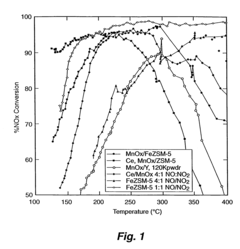
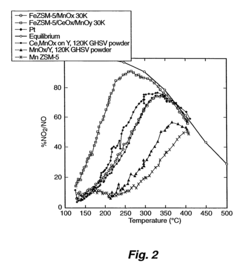
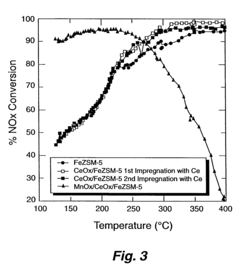
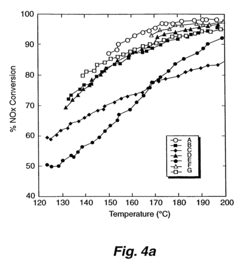
- A medium pore zeolite catalyst ion-exchanged with iron and impregnated with manganese and cerium, which acts as a hybrid catalyst for both SCR and NO oxidation, effective over a broad temperature range and high space velocities, minimizing N2O production and ammonia slip.
Environmental Impact and Sustainability Considerations
The development of coating technologies for nitrogen reduction catalysts must be evaluated not only for their technical performance but also for their environmental footprint and sustainability implications. Current coating processes often involve energy-intensive methods and hazardous chemicals that pose significant environmental concerns. The manufacturing of catalyst coatings typically requires high-temperature treatments, which contribute to substantial carbon emissions and energy consumption across the production lifecycle.
Water usage represents another critical environmental factor, as conventional coating techniques may demand large quantities of water for processing and cleaning stages. This becomes particularly problematic in regions experiencing water scarcity. Additionally, the utilization of toxic solvents and precursors in coating formulations presents risks of environmental contamination through improper handling or disposal, potentially affecting soil quality and water systems.
The sustainability of raw materials used in catalyst coatings deserves careful consideration. Many advanced catalysts incorporate rare earth elements or precious metals with limited global reserves. The extraction and processing of these materials often involve environmentally destructive mining practices and generate substantial waste streams. Developing coating technologies that reduce dependence on these critical materials or enable their efficient recycling would significantly enhance sustainability profiles.
Life cycle assessment (LCA) studies reveal that the environmental impact of catalyst coatings extends beyond manufacturing to include operational performance and end-of-life management. Coatings that improve catalyst durability and resistance to deactivation can substantially reduce the environmental burden by extending service life and decreasing replacement frequency. Furthermore, coating designs that facilitate catalyst recovery and regeneration contribute to circular economy principles.
Recent innovations in green chemistry approaches to coating technologies show promising environmental benefits. These include aqueous-based coating methods, solvent-free deposition techniques, and low-temperature processing routes that significantly reduce energy requirements. Biomimetic coating strategies inspired by natural nitrogen-fixing systems represent another frontier in environmentally responsible catalyst design, potentially eliminating dependence on energy-intensive processes altogether.
Regulatory frameworks worldwide are increasingly emphasizing environmental performance alongside technical specifications. Future coating technologies must therefore balance nitrogen reduction efficiency with minimized environmental impact to achieve market acceptance and regulatory compliance. This dual optimization challenge presents both constraints and opportunities for innovation in the catalyst coating sector.
Water usage represents another critical environmental factor, as conventional coating techniques may demand large quantities of water for processing and cleaning stages. This becomes particularly problematic in regions experiencing water scarcity. Additionally, the utilization of toxic solvents and precursors in coating formulations presents risks of environmental contamination through improper handling or disposal, potentially affecting soil quality and water systems.
The sustainability of raw materials used in catalyst coatings deserves careful consideration. Many advanced catalysts incorporate rare earth elements or precious metals with limited global reserves. The extraction and processing of these materials often involve environmentally destructive mining practices and generate substantial waste streams. Developing coating technologies that reduce dependence on these critical materials or enable their efficient recycling would significantly enhance sustainability profiles.
Life cycle assessment (LCA) studies reveal that the environmental impact of catalyst coatings extends beyond manufacturing to include operational performance and end-of-life management. Coatings that improve catalyst durability and resistance to deactivation can substantially reduce the environmental burden by extending service life and decreasing replacement frequency. Furthermore, coating designs that facilitate catalyst recovery and regeneration contribute to circular economy principles.
Recent innovations in green chemistry approaches to coating technologies show promising environmental benefits. These include aqueous-based coating methods, solvent-free deposition techniques, and low-temperature processing routes that significantly reduce energy requirements. Biomimetic coating strategies inspired by natural nitrogen-fixing systems represent another frontier in environmentally responsible catalyst design, potentially eliminating dependence on energy-intensive processes altogether.
Regulatory frameworks worldwide are increasingly emphasizing environmental performance alongside technical specifications. Future coating technologies must therefore balance nitrogen reduction efficiency with minimized environmental impact to achieve market acceptance and regulatory compliance. This dual optimization challenge presents both constraints and opportunities for innovation in the catalyst coating sector.
Scalability and Industrial Application Potential
The scalability of coating technologies for nitrogen reduction catalysts represents a critical factor in their transition from laboratory success to industrial implementation. Current coating methods demonstrate varying degrees of scalability, with physical vapor deposition (PVD) and chemical vapor deposition (CVD) showing promising results for medium-scale production but facing challenges in uniform coating distribution when scaled to industrial dimensions. Solution-based methods such as sol-gel and electrodeposition offer better scalability prospects due to their adaptability to continuous production lines and compatibility with existing manufacturing infrastructure.
Cost considerations significantly impact industrial adoption potential, with initial capital investment for vacuum-based coating systems presenting a barrier for smaller manufacturers. However, operational costs for solution-based methods remain competitive when considering throughput capacity and coating durability. Recent advancements in atmospheric pressure plasma coating techniques have shown particular promise, reducing both equipment complexity and operational costs while maintaining coating quality.
Equipment compatibility represents another crucial dimension of scalability. Many existing catalyst manufacturing facilities would require substantial modification to accommodate specialized coating equipment, particularly for vacuum-based technologies. Solution-based and spray coating methods offer advantages in this regard, as they can often be integrated into existing production lines with minimal disruption. The development of modular coating systems adaptable to various substrate geometries has emerged as a promising trend to address this challenge.
Quality control and process consistency at industrial scale remain significant hurdles. Laboratory-scale coating processes typically achieve 95-98% uniformity, while industrial implementations currently struggle to maintain consistency above 85-90% across large catalyst batches. Advanced in-line monitoring systems utilizing spectroscopic techniques have demonstrated potential to address this gap, enabling real-time adjustments to maintain coating quality during continuous production.
Environmental considerations and regulatory compliance also influence industrial application potential. Water-based coating technologies have gained attention for their reduced environmental impact compared to solvent-based alternatives, though challenges in achieving comparable performance persist. Recent developments in supercritical CO2-assisted coating processes offer promising environmental benefits while maintaining coating integrity and adhesion properties suitable for nitrogen reduction catalysts.
The timeline for industrial implementation varies by sector, with specialty chemical production likely to adopt advanced coating technologies within 2-3 years, while larger-scale fertilizer production may require 5-7 years for full implementation due to more stringent performance requirements and higher capital investment needs.
Cost considerations significantly impact industrial adoption potential, with initial capital investment for vacuum-based coating systems presenting a barrier for smaller manufacturers. However, operational costs for solution-based methods remain competitive when considering throughput capacity and coating durability. Recent advancements in atmospheric pressure plasma coating techniques have shown particular promise, reducing both equipment complexity and operational costs while maintaining coating quality.
Equipment compatibility represents another crucial dimension of scalability. Many existing catalyst manufacturing facilities would require substantial modification to accommodate specialized coating equipment, particularly for vacuum-based technologies. Solution-based and spray coating methods offer advantages in this regard, as they can often be integrated into existing production lines with minimal disruption. The development of modular coating systems adaptable to various substrate geometries has emerged as a promising trend to address this challenge.
Quality control and process consistency at industrial scale remain significant hurdles. Laboratory-scale coating processes typically achieve 95-98% uniformity, while industrial implementations currently struggle to maintain consistency above 85-90% across large catalyst batches. Advanced in-line monitoring systems utilizing spectroscopic techniques have demonstrated potential to address this gap, enabling real-time adjustments to maintain coating quality during continuous production.
Environmental considerations and regulatory compliance also influence industrial application potential. Water-based coating technologies have gained attention for their reduced environmental impact compared to solvent-based alternatives, though challenges in achieving comparable performance persist. Recent developments in supercritical CO2-assisted coating processes offer promising environmental benefits while maintaining coating integrity and adhesion properties suitable for nitrogen reduction catalysts.
The timeline for industrial implementation varies by sector, with specialty chemical production likely to adopt advanced coating technologies within 2-3 years, while larger-scale fertilizer production may require 5-7 years for full implementation due to more stringent performance requirements and higher capital investment needs.
Unlock deeper insights with PatSnap Eureka Quick Research — get a full tech report to explore trends and direct your research. Try now!
Generate Your Research Report Instantly with AI Agent
Supercharge your innovation with PatSnap Eureka AI Agent Platform!