

Solid State Battery Breakthrough: Electrode Kinetics and Performance
OCT 24, 20259 MIN READ
Generate Your Research Report Instantly with AI Agent
PatSnap Eureka helps you evaluate technical feasibility & market potential.
Solid State Battery Evolution and Objectives
Solid state batteries represent a significant evolution in energy storage technology, emerging from the limitations of conventional lithium-ion batteries that utilize liquid electrolytes. The development trajectory began in the 1970s with the discovery of solid electrolytes, but meaningful progress accelerated only in the early 2000s as materials science advanced sufficiently to address conductivity challenges.
The evolution of solid state battery technology has been characterized by three distinct phases. The initial phase (1970s-1990s) focused on fundamental research into solid electrolytes, primarily inorganic ceramics with limited ionic conductivity. The second phase (2000s-2015) saw the emergence of polymer and composite electrolytes, addressing mechanical flexibility issues while improving conductivity. The current phase (2015-present) represents a convergence of multiple approaches, with significant breakthroughs in electrode-electrolyte interfaces and manufacturing scalability.
A critical turning point occurred around 2017 when researchers demonstrated solid electrolytes with room-temperature ionic conductivities comparable to liquid counterparts. This milestone shifted industry focus toward practical implementation challenges, particularly electrode kinetics at solid-solid interfaces, which remains the primary technical bottleneck today.
The technological objectives for solid state batteries center on five key parameters: energy density exceeding 500 Wh/kg (double current lithium-ion capabilities), fast charging capabilities (80% in under 15 minutes), operational safety across wide temperature ranges (-20°C to 60°C), cycle life beyond 1,000 full cycles, and manufacturing costs competitive with conventional batteries within five years of commercialization.
Electrode kinetics specifically represents a crucial frontier, as the solid-solid interfaces between electrodes and electrolytes create unique challenges for ion transport and electrochemical reactions. Research objectives in this domain include developing interface engineering strategies to minimize resistance, creating electrode architectures that maximize active material utilization, and establishing predictive models for performance optimization.
The long-term vision extends beyond portable electronics and electric vehicles to grid-scale energy storage, enabling broader renewable energy adoption. This expansion requires further improvements in scalability, sustainability, and cost-effectiveness. Industry projections suggest commercial viability for consumer electronics applications by 2025, automotive applications by 2028, and grid applications by 2030, contingent upon resolving the electrode kinetics challenges that currently limit performance.
The evolution of solid state battery technology has been characterized by three distinct phases. The initial phase (1970s-1990s) focused on fundamental research into solid electrolytes, primarily inorganic ceramics with limited ionic conductivity. The second phase (2000s-2015) saw the emergence of polymer and composite electrolytes, addressing mechanical flexibility issues while improving conductivity. The current phase (2015-present) represents a convergence of multiple approaches, with significant breakthroughs in electrode-electrolyte interfaces and manufacturing scalability.
A critical turning point occurred around 2017 when researchers demonstrated solid electrolytes with room-temperature ionic conductivities comparable to liquid counterparts. This milestone shifted industry focus toward practical implementation challenges, particularly electrode kinetics at solid-solid interfaces, which remains the primary technical bottleneck today.
The technological objectives for solid state batteries center on five key parameters: energy density exceeding 500 Wh/kg (double current lithium-ion capabilities), fast charging capabilities (80% in under 15 minutes), operational safety across wide temperature ranges (-20°C to 60°C), cycle life beyond 1,000 full cycles, and manufacturing costs competitive with conventional batteries within five years of commercialization.
Electrode kinetics specifically represents a crucial frontier, as the solid-solid interfaces between electrodes and electrolytes create unique challenges for ion transport and electrochemical reactions. Research objectives in this domain include developing interface engineering strategies to minimize resistance, creating electrode architectures that maximize active material utilization, and establishing predictive models for performance optimization.
The long-term vision extends beyond portable electronics and electric vehicles to grid-scale energy storage, enabling broader renewable energy adoption. This expansion requires further improvements in scalability, sustainability, and cost-effectiveness. Industry projections suggest commercial viability for consumer electronics applications by 2025, automotive applications by 2028, and grid applications by 2030, contingent upon resolving the electrode kinetics challenges that currently limit performance.
Market Analysis for Next-Generation Energy Storage
The global energy storage market is experiencing unprecedented growth, driven by the increasing adoption of renewable energy sources and the electrification of transportation. The market for next-generation energy storage solutions is projected to reach $546 billion by 2035, with a compound annual growth rate of 19.7% from 2023 to 2035. Solid-state batteries represent one of the most promising segments within this market, with forecasts suggesting they could capture up to 25% of the total battery market by 2030.
Consumer electronics currently dominates the application landscape for advanced energy storage solutions, accounting for approximately 38% of market share. However, electric vehicles are rapidly gaining ground and are expected to become the largest application segment by 2026, driven by stringent environmental regulations and government incentives worldwide.
The automotive sector's demand for high-performance batteries is particularly significant, with major manufacturers committing billions to secure advanced battery technology. Companies like Toyota, Volkswagen, and BMW have collectively invested over $15 billion in solid-state battery research and development over the past five years, highlighting the strategic importance of electrode kinetics improvements in their product roadmaps.
Regional analysis reveals Asia-Pacific as the dominant market for next-generation energy storage technologies, holding 45% of the global market share. This is primarily due to the strong manufacturing base in countries like China, Japan, and South Korea. North America follows with 28% market share, while Europe accounts for 22%, with both regions showing accelerated growth rates due to aggressive climate policies.
Investor confidence in solid-state battery technology has surged, with venture capital funding increasing by 87% in 2022 compared to the previous year. This investment surge is particularly focused on companies addressing electrode kinetics challenges, which are widely recognized as the critical bottleneck in commercialization efforts.
Market segmentation by battery chemistry shows that lithium-metal solid-state batteries with enhanced electrode interfaces are gaining the most traction, with a projected market value of $89 billion by 2030. This segment's growth is directly tied to breakthroughs in electrode kinetics that enable faster charging rates and longer cycle life.
Customer surveys indicate that 78% of potential electric vehicle buyers consider charging speed a critical factor in their purchasing decisions, while 65% prioritize battery longevity. These consumer preferences align perfectly with the performance improvements promised by advanced electrode kinetics research in solid-state battery technology.
Consumer electronics currently dominates the application landscape for advanced energy storage solutions, accounting for approximately 38% of market share. However, electric vehicles are rapidly gaining ground and are expected to become the largest application segment by 2026, driven by stringent environmental regulations and government incentives worldwide.
The automotive sector's demand for high-performance batteries is particularly significant, with major manufacturers committing billions to secure advanced battery technology. Companies like Toyota, Volkswagen, and BMW have collectively invested over $15 billion in solid-state battery research and development over the past five years, highlighting the strategic importance of electrode kinetics improvements in their product roadmaps.
Regional analysis reveals Asia-Pacific as the dominant market for next-generation energy storage technologies, holding 45% of the global market share. This is primarily due to the strong manufacturing base in countries like China, Japan, and South Korea. North America follows with 28% market share, while Europe accounts for 22%, with both regions showing accelerated growth rates due to aggressive climate policies.
Investor confidence in solid-state battery technology has surged, with venture capital funding increasing by 87% in 2022 compared to the previous year. This investment surge is particularly focused on companies addressing electrode kinetics challenges, which are widely recognized as the critical bottleneck in commercialization efforts.
Market segmentation by battery chemistry shows that lithium-metal solid-state batteries with enhanced electrode interfaces are gaining the most traction, with a projected market value of $89 billion by 2030. This segment's growth is directly tied to breakthroughs in electrode kinetics that enable faster charging rates and longer cycle life.
Customer surveys indicate that 78% of potential electric vehicle buyers consider charging speed a critical factor in their purchasing decisions, while 65% prioritize battery longevity. These consumer preferences align perfectly with the performance improvements promised by advanced electrode kinetics research in solid-state battery technology.
Current Challenges in Electrode-Electrolyte Interfaces
The electrode-electrolyte interface represents the most critical and challenging component in solid-state battery development. Unlike liquid electrolyte systems, solid-state interfaces introduce unique kinetic limitations that significantly impact overall battery performance. Current research indicates that interfacial resistance at these boundaries can be orders of magnitude higher than bulk resistance, creating substantial barriers to ion transport.
A primary challenge lies in maintaining intimate contact between electrode and solid electrolyte materials. During battery cycling, electrodes undergo volume changes that can create physical gaps at the interface, leading to contact loss and increased impedance. This mechanical instability is particularly pronounced with high-capacity electrode materials like silicon and lithium metal, which experience volumetric changes exceeding 300% during operation.
Chemical instability presents another significant hurdle. Many promising solid electrolytes demonstrate thermodynamic instability when in contact with electrode materials, resulting in the formation of interphases with poor ionic conductivity. For instance, sulfide-based solid electrolytes readily react with oxide cathodes, while NASICON-type electrolytes often decompose at low potentials against lithium metal anodes. These reactions create resistive layers that impede ion transfer and progressively degrade battery performance.
Space charge effects further complicate interface dynamics. The accumulation of charged species at solid-solid interfaces creates localized electric fields that can impede ion migration. This phenomenon is particularly problematic in ceramic electrolytes, where grain boundaries and electrode interfaces can develop significant potential barriers that lithium ions must overcome.
Manufacturing challenges also contribute to interface problems. Current production techniques struggle to create atomically smooth interfaces between dissimilar materials. Surface roughness, impurities, and processing-induced defects create non-uniform current distributions and localized "hot spots" for degradation reactions. The high-temperature sintering often required for ceramic electrolytes can exacerbate these issues by promoting unwanted interfacial reactions.
Recent research has focused on interface engineering approaches, including buffer layers, gradient compositions, and surface modifications. While promising, these solutions often introduce additional complexity and manufacturing challenges. The development of in-situ characterization techniques has improved understanding of interfacial phenomena, but real-time monitoring of buried interfaces during battery operation remains technically challenging.
Computational modeling has emerged as a valuable tool for predicting interfacial behavior, though the multiscale nature of these processes—spanning from atomic interactions to macroscopic transport—requires sophisticated multi-physics approaches that are still evolving. The development of standardized testing protocols for quantifying interfacial resistance also remains an active area of research.
A primary challenge lies in maintaining intimate contact between electrode and solid electrolyte materials. During battery cycling, electrodes undergo volume changes that can create physical gaps at the interface, leading to contact loss and increased impedance. This mechanical instability is particularly pronounced with high-capacity electrode materials like silicon and lithium metal, which experience volumetric changes exceeding 300% during operation.
Chemical instability presents another significant hurdle. Many promising solid electrolytes demonstrate thermodynamic instability when in contact with electrode materials, resulting in the formation of interphases with poor ionic conductivity. For instance, sulfide-based solid electrolytes readily react with oxide cathodes, while NASICON-type electrolytes often decompose at low potentials against lithium metal anodes. These reactions create resistive layers that impede ion transfer and progressively degrade battery performance.
Space charge effects further complicate interface dynamics. The accumulation of charged species at solid-solid interfaces creates localized electric fields that can impede ion migration. This phenomenon is particularly problematic in ceramic electrolytes, where grain boundaries and electrode interfaces can develop significant potential barriers that lithium ions must overcome.
Manufacturing challenges also contribute to interface problems. Current production techniques struggle to create atomically smooth interfaces between dissimilar materials. Surface roughness, impurities, and processing-induced defects create non-uniform current distributions and localized "hot spots" for degradation reactions. The high-temperature sintering often required for ceramic electrolytes can exacerbate these issues by promoting unwanted interfacial reactions.
Recent research has focused on interface engineering approaches, including buffer layers, gradient compositions, and surface modifications. While promising, these solutions often introduce additional complexity and manufacturing challenges. The development of in-situ characterization techniques has improved understanding of interfacial phenomena, but real-time monitoring of buried interfaces during battery operation remains technically challenging.
Computational modeling has emerged as a valuable tool for predicting interfacial behavior, though the multiscale nature of these processes—spanning from atomic interactions to macroscopic transport—requires sophisticated multi-physics approaches that are still evolving. The development of standardized testing protocols for quantifying interfacial resistance also remains an active area of research.
Existing Approaches to Enhance Electrode Kinetics
01 Electrode materials for improved kinetics
Specific electrode materials can significantly enhance the kinetics and overall performance of solid-state batteries. These materials include advanced cathode compositions, novel anode structures, and specialized interface materials that facilitate faster ion transport. By carefully selecting electrode materials with optimal crystal structures and ionic conductivity properties, the rate capability and power density of solid-state batteries can be substantially improved, addressing one of the key limitations in current solid-state battery technology.- Electrode materials for improved kinetics: Specific electrode materials can significantly enhance the kinetics and overall performance of solid-state batteries. These materials include advanced cathode compositions, novel anode structures, and specialized interface materials that facilitate faster ion transport. By optimizing the electrode material composition and structure, researchers have achieved improved charge transfer rates, reduced internal resistance, and enhanced cycling stability in solid-state battery systems.
- Interface engineering for enhanced ion transport: Engineering the interfaces between electrodes and solid electrolytes is crucial for improving electrode kinetics. Various approaches include creating gradient interfaces, applying specialized coatings, and developing composite interlayers that minimize interfacial resistance. These techniques help to maintain good contact between components, reduce impedance at interfaces, and create favorable pathways for ion migration, ultimately enhancing the power density and rate capability of solid-state batteries.
- Nanostructured electrodes for performance enhancement: Nanostructuring of electrode materials offers significant advantages for solid-state battery performance. By creating nanoscale architectures such as nanoparticles, nanowires, or porous structures, researchers can shorten ion diffusion paths, increase active surface area, and improve electrode-electrolyte contact. These nanostructured designs facilitate faster ion insertion/extraction processes, leading to improved rate capability, higher capacity utilization, and better cycling stability.
- Dopants and additives for kinetic improvement: Strategic incorporation of dopants and additives into electrode materials can significantly enhance electrode kinetics in solid-state batteries. These modifications can create additional ion conduction pathways, stabilize crystal structures, reduce activation barriers for ion movement, and improve interfacial compatibility. Various elements and compounds have been identified that, when added in controlled amounts, can optimize the electronic and ionic conductivity properties of electrode materials.
- Advanced characterization and modeling techniques: Advanced characterization and computational modeling techniques are essential for understanding and optimizing electrode kinetics in solid-state batteries. These include in-situ/operando spectroscopy, impedance analysis, synchrotron-based techniques, and multi-scale computational models. By providing insights into ion transport mechanisms, interfacial phenomena, and degradation processes, these approaches enable rational design of electrode materials and structures with enhanced kinetic properties and overall battery performance.
02 Interface engineering for enhanced ion transport
Engineering the electrode-electrolyte interfaces is crucial for improving electrode kinetics in solid-state batteries. By modifying the interface structure, reducing interfacial resistance, and creating specialized interlayers, ion transport across the solid-solid interfaces can be significantly enhanced. These interface engineering approaches help minimize impedance growth during cycling and enable more efficient charge transfer, resulting in better rate performance and longer cycle life of solid-state batteries.Expand Specific Solutions03 Composite electrode structures
Composite electrode structures that combine active materials with solid electrolytes and conductive additives can dramatically improve electrode kinetics. These composite designs create extended ion and electron transport networks throughout the electrode, increasing the effective contact area between electrode and electrolyte components. By optimizing the composition, distribution, and morphology of these composite structures, the electrochemical performance of solid-state batteries can be enhanced with improved power capability and energy density.Expand Specific Solutions04 Nanostructured electrodes for kinetic enhancement
Nanostructured electrode designs offer significant advantages for solid-state battery kinetics by shortening ion diffusion paths and increasing active surface areas. These nanostructures include nanoporous architectures, nanoparticle arrays, and hierarchical structures that maximize the electrode-electrolyte contact area while maintaining structural stability. The reduced diffusion distances in nanostructured electrodes allow for faster ion transport, resulting in improved rate capability and more efficient utilization of active materials during high-rate cycling.Expand Specific Solutions05 Temperature and pressure effects on electrode performance
The operating temperature and applied pressure significantly influence electrode kinetics and overall performance in solid-state batteries. Elevated temperatures can enhance ion mobility and reduce interfacial resistance, while appropriate pressure application during both manufacturing and operation can improve physical contact between solid components. Understanding and optimizing these parameters is essential for maximizing electrode kinetics, particularly in all-solid-state configurations where intimate contact between solid components is critical for efficient ion transport and electrochemical reactions.Expand Specific Solutions
Leading Companies and Research Institutions in SSB Technology
The solid-state battery market is currently in an early growth phase, characterized by significant R&D investments but limited commercial deployment. Market size is projected to expand rapidly, reaching approximately $6-8 billion by 2030, driven by demand for higher energy density and safer battery solutions. Technical challenges in electrode kinetics and performance remain key barriers to widespread adoption. Leading automotive manufacturers (Toyota, Honda, Hyundai) are heavily investing in this technology, while specialized companies like Sila Nanotechnologies and Sakti3 focus on material innovations. Established electronics firms (Murata, Panasonic, Sony) are leveraging their expertise to improve electrode-electrolyte interfaces. Academic-industrial partnerships involving institutions like University of Michigan and Georgia Tech are accelerating breakthroughs in solid-state electrolyte materials and manufacturing processes.
Toyota Motor Corp.
Technical Solution: Toyota has pioneered solid-state battery technology with over 1,000 patents related to solid electrolytes. Their approach focuses on sulfide-based solid electrolytes with high ionic conductivity (2-5 mS/cm at room temperature) comparable to liquid electrolytes. Toyota's electrode kinetics solution involves developing composite electrodes with optimized interfaces between active materials and solid electrolytes, reducing contact resistance. They've implemented a proprietary manufacturing process that creates uniform, dense electrode structures with minimal void spaces, enhancing ion transport pathways. Toyota has demonstrated prototype cells achieving 2.5 times the volumetric energy density of conventional lithium-ion batteries while maintaining fast charging capabilities (80% in under 15 minutes). Their technology incorporates specialized coatings at electrode-electrolyte interfaces to stabilize the solid-electrolyte interphase and prevent dendrite formation during cycling.
Strengths: Superior energy density compared to conventional batteries; excellent safety profile with no flammable components; demonstrated long cycle life (>1,000 cycles with minimal capacity fade); compatibility with existing manufacturing infrastructure. Weaknesses: Higher production costs than conventional lithium-ion batteries; challenges with scaling production to commercial volumes; temperature sensitivity affecting performance in extreme conditions.
LG Energy Solution Ltd.
Technical Solution: LG Energy Solution has developed an advanced solid-state battery platform utilizing a composite electrolyte system that combines ceramic and polymer materials. Their technology addresses electrode kinetics challenges through a gradient interface design that creates a seamless transition between electrode materials and the solid electrolyte. This approach minimizes interfacial resistance while maintaining mechanical stability during cycling. LG's electrode formulation incorporates nano-engineered active materials with optimized particle morphology to maximize contact area with the electrolyte while minimizing diffusion distances for lithium ions. Their manufacturing process employs a proprietary coating technique that ensures uniform distribution of solid electrolyte within the electrode structure, creating continuous ion-conductive networks. LG has demonstrated prototype cells achieving energy densities of 900+ Wh/L while maintaining fast charging capabilities (0-80% in approximately 18 minutes) and operating effectively across a wide temperature range (-20°C to 60°C).
Strengths: Balanced performance across multiple metrics (energy density, power capability, cycle life); compatibility with existing manufacturing infrastructure; good thermal stability and safety characteristics. Weaknesses: Lower ionic conductivity at room temperature compared to liquid electrolytes; challenges with mechanical stress during cycling leading to potential contact loss; higher material costs than conventional lithium-ion batteries.
Key Innovations in Interface Engineering and Materials Science
Cermet electrode for solid state and lithium ion batteries
PatentPendingUS20200388854A1
Innovation
- A porous ceramic-metal (cermet) cathode is developed, where a metallic material acts as a binder and conductive additive, providing mechanical integrity and interconnected porosity to accommodate liquid, gel, or polymer electrolytes, and is free of conventional binders and conductive carbon, enhancing the cathode's mechanical strength and stability.
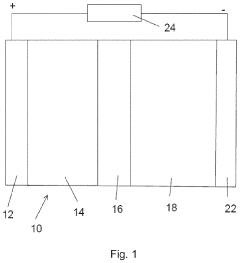
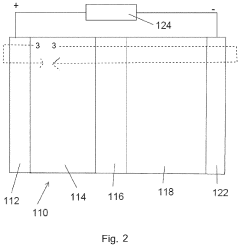
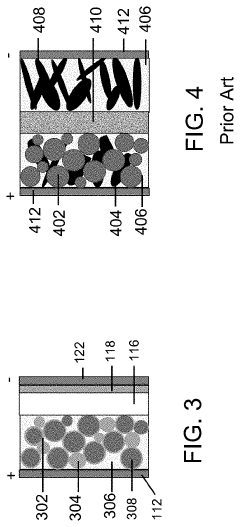
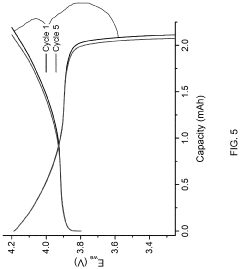
Solid-state battery electrode and method for manufacturing same, solid-state battery, and battery package
PatentWO2023181969A1
Innovation
- A solid-state battery electrode with active material particles having a porous structure and a hydrophilic organic binder, where an inorganic solid electrolyte that can be dissolved at a lower temperature is impregnated into the pores, increasing the interface area and improving conductivity.


Safety and Sustainability Considerations in SSB Manufacturing
The manufacturing of solid-state batteries (SSBs) presents unique safety advantages over conventional lithium-ion batteries, primarily due to the elimination of flammable liquid electrolytes. This fundamental design difference significantly reduces fire hazards and thermal runaway risks, making SSBs inherently safer for consumer electronics, electric vehicles, and grid storage applications. However, the safety profile during manufacturing processes requires careful consideration as new challenges emerge.
Production of solid electrolytes often involves high-temperature sintering processes that demand stringent control measures to prevent workplace hazards. The handling of reactive lithium materials continues to present safety concerns, requiring specialized containment systems and handling protocols. Additionally, the interface formation between electrodes and solid electrolytes introduces new safety considerations during manufacturing that differ from traditional battery production lines.
From a sustainability perspective, SSB manufacturing offers several promising advantages. The extended cycle life of these batteries—potentially exceeding 1,000 cycles with minimal degradation—significantly improves product longevity and reduces replacement frequency. This durability directly translates to decreased resource consumption and waste generation over the battery's lifecycle. Furthermore, many solid electrolyte materials being developed utilize more abundant elements compared to conventional battery components, potentially alleviating supply chain pressures on critical materials.
Water consumption represents another important sustainability consideration. Unlike conventional lithium-ion battery production that requires substantial water usage for slurry preparation and cleaning processes, many SSB manufacturing techniques employ dry processing methods that substantially reduce water requirements. This aspect becomes increasingly important as battery production scales globally, particularly in water-stressed regions.
End-of-life management for SSBs presents both challenges and opportunities. The absence of liquid electrolytes simplifies recycling processes by eliminating certain hazardous waste streams. However, the diverse material compositions being explored for solid electrolytes necessitate the development of specialized recycling protocols. Research into design-for-recycling approaches for SSBs is advancing, with emphasis on material recovery efficiency and closed-loop systems.
Carbon footprint assessments of SSB manufacturing indicate potential advantages over conventional batteries when considering full lifecycle impacts. The energy-intensive nature of certain solid electrolyte synthesis methods presents an initial challenge, but this may be offset by the extended operational lifetime and improved energy density of the final product. As manufacturing scales and processes mature, further efficiency improvements are anticipated that will enhance the overall sustainability profile of SSB production.
Production of solid electrolytes often involves high-temperature sintering processes that demand stringent control measures to prevent workplace hazards. The handling of reactive lithium materials continues to present safety concerns, requiring specialized containment systems and handling protocols. Additionally, the interface formation between electrodes and solid electrolytes introduces new safety considerations during manufacturing that differ from traditional battery production lines.
From a sustainability perspective, SSB manufacturing offers several promising advantages. The extended cycle life of these batteries—potentially exceeding 1,000 cycles with minimal degradation—significantly improves product longevity and reduces replacement frequency. This durability directly translates to decreased resource consumption and waste generation over the battery's lifecycle. Furthermore, many solid electrolyte materials being developed utilize more abundant elements compared to conventional battery components, potentially alleviating supply chain pressures on critical materials.
Water consumption represents another important sustainability consideration. Unlike conventional lithium-ion battery production that requires substantial water usage for slurry preparation and cleaning processes, many SSB manufacturing techniques employ dry processing methods that substantially reduce water requirements. This aspect becomes increasingly important as battery production scales globally, particularly in water-stressed regions.
End-of-life management for SSBs presents both challenges and opportunities. The absence of liquid electrolytes simplifies recycling processes by eliminating certain hazardous waste streams. However, the diverse material compositions being explored for solid electrolytes necessitate the development of specialized recycling protocols. Research into design-for-recycling approaches for SSBs is advancing, with emphasis on material recovery efficiency and closed-loop systems.
Carbon footprint assessments of SSB manufacturing indicate potential advantages over conventional batteries when considering full lifecycle impacts. The energy-intensive nature of certain solid electrolyte synthesis methods presents an initial challenge, but this may be offset by the extended operational lifetime and improved energy density of the final product. As manufacturing scales and processes mature, further efficiency improvements are anticipated that will enhance the overall sustainability profile of SSB production.
Scalability and Commercialization Pathways
The commercialization of solid-state batteries faces significant scaling challenges despite their promising electrode kinetics and performance advantages. Current manufacturing processes remain largely laboratory-scale, with production volumes typically limited to small cells suitable only for research or specialized applications. The transition to gigafactory-scale production requires substantial innovation in manufacturing techniques, particularly in areas of solid electrolyte synthesis and electrode-electrolyte interface formation.
Several commercialization pathways are emerging in the industry. The incremental approach involves gradually introducing solid-state components into existing lithium-ion battery architectures, beginning with hybrid designs that incorporate solid electrolytes while maintaining some liquid components. This strategy allows manufacturers to leverage existing production infrastructure while developing specialized processes for solid-state components.
Alternatively, the revolutionary approach focuses on developing entirely new manufacturing paradigms specifically designed for all-solid-state batteries. Companies pursuing this pathway are investing in novel deposition techniques, sintering processes, and interface engineering methods that can achieve consistent performance at scale.
Material supply chains represent another critical consideration for commercialization. The availability of high-purity lithium, sulfide-based compounds, and specialized ceramic materials must be secured at industrial scales. Current global production capacity for these materials falls significantly short of what would be required for mass-market adoption of solid-state batteries.
Cost projections indicate that initial commercial solid-state batteries will command premium pricing, with estimates suggesting 30-50% higher costs compared to conventional lithium-ion batteries. However, learning curve effects and economies of scale are expected to drive costs down over time, potentially reaching cost parity within 5-8 years of initial commercialization.
Strategic partnerships between battery startups, established automotive manufacturers, and materials suppliers have become increasingly common, creating ecosystems that address different aspects of the commercialization challenge. These collaborations often combine technological innovation with manufacturing expertise and market access.
Regulatory frameworks and standardization efforts will also play crucial roles in commercialization timelines. Safety certification processes for solid-state batteries are still evolving, with particular attention to thermal runaway prevention, mechanical stability during cycling, and long-term reliability under various operating conditions.
Several commercialization pathways are emerging in the industry. The incremental approach involves gradually introducing solid-state components into existing lithium-ion battery architectures, beginning with hybrid designs that incorporate solid electrolytes while maintaining some liquid components. This strategy allows manufacturers to leverage existing production infrastructure while developing specialized processes for solid-state components.
Alternatively, the revolutionary approach focuses on developing entirely new manufacturing paradigms specifically designed for all-solid-state batteries. Companies pursuing this pathway are investing in novel deposition techniques, sintering processes, and interface engineering methods that can achieve consistent performance at scale.
Material supply chains represent another critical consideration for commercialization. The availability of high-purity lithium, sulfide-based compounds, and specialized ceramic materials must be secured at industrial scales. Current global production capacity for these materials falls significantly short of what would be required for mass-market adoption of solid-state batteries.
Cost projections indicate that initial commercial solid-state batteries will command premium pricing, with estimates suggesting 30-50% higher costs compared to conventional lithium-ion batteries. However, learning curve effects and economies of scale are expected to drive costs down over time, potentially reaching cost parity within 5-8 years of initial commercialization.
Strategic partnerships between battery startups, established automotive manufacturers, and materials suppliers have become increasingly common, creating ecosystems that address different aspects of the commercialization challenge. These collaborations often combine technological innovation with manufacturing expertise and market access.
Regulatory frameworks and standardization efforts will also play crucial roles in commercialization timelines. Safety certification processes for solid-state batteries are still evolving, with particular attention to thermal runaway prevention, mechanical stability during cycling, and long-term reliability under various operating conditions.
Unlock deeper insights with PatSnap Eureka Quick Research — get a full tech report to explore trends and direct your research. Try now!
Generate Your Research Report Instantly with AI Agent
Supercharge your innovation with PatSnap Eureka AI Agent Platform!