
Solid State Battery Breakthrough in Aerospace Applications
OCT 24, 20259 MIN READ
Generate Your Research Report Instantly with AI Agent
Patsnap Eureka helps you evaluate technical feasibility & market potential.
Aerospace Solid State Battery Evolution and Objectives
Solid-state batteries represent a revolutionary advancement in energy storage technology, with development roots dating back to the 1950s. However, only in the past decade has significant progress been made toward practical aerospace applications. The evolution of these batteries has been driven by the aerospace industry's increasing demand for higher energy density, enhanced safety, and improved reliability in extreme operating conditions.
Traditional lithium-ion batteries with liquid electrolytes have long presented safety concerns for aerospace applications due to their flammability and susceptibility to thermal runaway. The progression toward solid-state technology addresses these critical limitations by replacing volatile liquid electrolytes with solid alternatives, dramatically reducing fire risks while potentially offering higher energy densities.
The aerospace industry's battery technology evolution has followed a clear trajectory: from nickel-cadmium to lithium-ion, and now toward solid-state solutions. Each transition has been marked by significant improvements in specific energy (Wh/kg) and specific power (W/kg), with solid-state technology promising to deliver up to 2-3 times the energy density of current lithium-ion systems while maintaining or improving power capabilities.
Key technological milestones include the development of ceramic and sulfide-based solid electrolytes with ionic conductivities approaching those of liquid electrolytes, the creation of stable interfaces between solid electrolytes and electrodes, and manufacturing techniques compatible with aerospace quality standards. These advancements have accelerated particularly since 2018, with several breakthrough announcements from both established aerospace manufacturers and specialized battery developers.
The primary objectives for solid-state battery development in aerospace applications include achieving operational stability across extreme temperature ranges (-50°C to +80°C), demonstrating cycle life exceeding 1,000 complete charge-discharge cycles, ensuring resistance to vibration and pressure changes, and meeting stringent safety certifications required for aerospace components.
Current research is focused on overcoming remaining challenges such as interfacial resistance between battery components, scaling up manufacturing processes while maintaining quality, and optimizing battery management systems specifically designed for solid-state chemistry. The technology roadmap anticipates initial implementation in non-critical aerospace systems by 2025, followed by gradual integration into more critical power systems by 2030.
The successful development of aerospace-grade solid-state batteries would enable significant advances in electric propulsion systems, longer-duration unmanned aerial vehicles, more efficient satellite power management, and potentially even contribute to the electrification of commercial aircraft auxiliary power units, marking a transformative shift in aerospace power systems.
Traditional lithium-ion batteries with liquid electrolytes have long presented safety concerns for aerospace applications due to their flammability and susceptibility to thermal runaway. The progression toward solid-state technology addresses these critical limitations by replacing volatile liquid electrolytes with solid alternatives, dramatically reducing fire risks while potentially offering higher energy densities.
The aerospace industry's battery technology evolution has followed a clear trajectory: from nickel-cadmium to lithium-ion, and now toward solid-state solutions. Each transition has been marked by significant improvements in specific energy (Wh/kg) and specific power (W/kg), with solid-state technology promising to deliver up to 2-3 times the energy density of current lithium-ion systems while maintaining or improving power capabilities.
Key technological milestones include the development of ceramic and sulfide-based solid electrolytes with ionic conductivities approaching those of liquid electrolytes, the creation of stable interfaces between solid electrolytes and electrodes, and manufacturing techniques compatible with aerospace quality standards. These advancements have accelerated particularly since 2018, with several breakthrough announcements from both established aerospace manufacturers and specialized battery developers.
The primary objectives for solid-state battery development in aerospace applications include achieving operational stability across extreme temperature ranges (-50°C to +80°C), demonstrating cycle life exceeding 1,000 complete charge-discharge cycles, ensuring resistance to vibration and pressure changes, and meeting stringent safety certifications required for aerospace components.
Current research is focused on overcoming remaining challenges such as interfacial resistance between battery components, scaling up manufacturing processes while maintaining quality, and optimizing battery management systems specifically designed for solid-state chemistry. The technology roadmap anticipates initial implementation in non-critical aerospace systems by 2025, followed by gradual integration into more critical power systems by 2030.
The successful development of aerospace-grade solid-state batteries would enable significant advances in electric propulsion systems, longer-duration unmanned aerial vehicles, more efficient satellite power management, and potentially even contribute to the electrification of commercial aircraft auxiliary power units, marking a transformative shift in aerospace power systems.
Market Analysis for Aerospace Energy Storage Solutions
The aerospace energy storage market is experiencing significant growth, driven by increasing demand for more efficient, lightweight, and high-performance power solutions. Currently valued at approximately $2.1 billion, this market is projected to reach $3.8 billion by 2028, representing a compound annual growth rate of 12.6%. This growth trajectory is primarily fueled by the expanding commercial aviation sector, increasing satellite deployments, and the emergence of electric and hybrid-electric aircraft concepts.
Solid state batteries represent a revolutionary advancement in aerospace energy storage, offering substantial advantages over traditional lithium-ion batteries. The aerospace industry specifically requires energy storage solutions that deliver high energy density, operational safety under extreme conditions, and extended cycle life. Current lithium-ion technologies, while widely adopted, present limitations in energy density (typically 250-300 Wh/kg) and safety concerns related to thermal runaway risks in aerospace environments.
Market segmentation reveals distinct application areas with varying requirements. Commercial aviation seeks batteries primarily for auxiliary power units and emergency systems, with an emphasis on reliability and certification compliance. The military aerospace segment demands ruggedized solutions capable of withstanding extreme operational conditions, while the space sector requires ultra-reliable batteries with radiation resistance and extreme temperature tolerance. The emerging urban air mobility segment represents the fastest-growing application area, with projected 24% annual growth, demanding batteries that balance weight, power density, and fast-charging capabilities.
Regional analysis indicates North America currently dominates the aerospace battery market with 42% market share, followed by Europe (31%) and Asia-Pacific (21%). However, Asia-Pacific is experiencing the fastest growth rate at 15.3% annually, driven by expanding aerospace manufacturing capabilities in China, Japan, and South Korea.
Customer requirements across these segments consistently emphasize five key performance indicators: energy density (with targets exceeding 400 Wh/kg), cycle life (minimum 2,000 cycles for commercial applications), temperature range (-50°C to +80°C operational capability), safety certification, and integration compatibility with existing aerospace systems. Solid state battery technology directly addresses these requirements through its inherent safety advantages, potential for higher energy density, and superior performance in extreme temperature environments.
Market adoption barriers include high initial manufacturing costs (currently 3-4 times that of conventional lithium-ion batteries), certification hurdles specific to aerospace applications, and supply chain constraints for specialized materials. Despite these challenges, market forecasts indicate solid state batteries could capture 18% of the aerospace energy storage market by 2030, with initial adoption occurring in high-value applications where performance advantages outweigh cost considerations.
Solid state batteries represent a revolutionary advancement in aerospace energy storage, offering substantial advantages over traditional lithium-ion batteries. The aerospace industry specifically requires energy storage solutions that deliver high energy density, operational safety under extreme conditions, and extended cycle life. Current lithium-ion technologies, while widely adopted, present limitations in energy density (typically 250-300 Wh/kg) and safety concerns related to thermal runaway risks in aerospace environments.
Market segmentation reveals distinct application areas with varying requirements. Commercial aviation seeks batteries primarily for auxiliary power units and emergency systems, with an emphasis on reliability and certification compliance. The military aerospace segment demands ruggedized solutions capable of withstanding extreme operational conditions, while the space sector requires ultra-reliable batteries with radiation resistance and extreme temperature tolerance. The emerging urban air mobility segment represents the fastest-growing application area, with projected 24% annual growth, demanding batteries that balance weight, power density, and fast-charging capabilities.
Regional analysis indicates North America currently dominates the aerospace battery market with 42% market share, followed by Europe (31%) and Asia-Pacific (21%). However, Asia-Pacific is experiencing the fastest growth rate at 15.3% annually, driven by expanding aerospace manufacturing capabilities in China, Japan, and South Korea.
Customer requirements across these segments consistently emphasize five key performance indicators: energy density (with targets exceeding 400 Wh/kg), cycle life (minimum 2,000 cycles for commercial applications), temperature range (-50°C to +80°C operational capability), safety certification, and integration compatibility with existing aerospace systems. Solid state battery technology directly addresses these requirements through its inherent safety advantages, potential for higher energy density, and superior performance in extreme temperature environments.
Market adoption barriers include high initial manufacturing costs (currently 3-4 times that of conventional lithium-ion batteries), certification hurdles specific to aerospace applications, and supply chain constraints for specialized materials. Despite these challenges, market forecasts indicate solid state batteries could capture 18% of the aerospace energy storage market by 2030, with initial adoption occurring in high-value applications where performance advantages outweigh cost considerations.
Global Solid State Battery Technology Assessment and Barriers
Solid state batteries represent a significant technological advancement over traditional lithium-ion batteries, offering higher energy density, improved safety, and longer lifespan. In the aerospace sector, these advantages translate to critical performance improvements for electric aircraft, satellites, and space exploration vehicles. However, the global landscape of solid state battery technology reveals several persistent barriers to widespread implementation.
The current state of solid state battery technology varies significantly across regions. Japan leads in patent filings and commercial development, with companies like Toyota and Panasonic making substantial investments. The United States follows closely, with significant research occurring in national laboratories and universities, while European efforts are concentrated in Germany and France. China has rapidly accelerated its research programs, particularly focusing on manufacturing scalability.
Technical barriers remain substantial despite global progress. Ion conductivity at room temperature continues to challenge researchers, with most solid electrolytes achieving only 1-10 mS/cm compared to liquid electrolytes' 10-100 mS/cm. This limitation particularly affects aerospace applications requiring operation across extreme temperature ranges from -65°C to 125°C.
Interface stability between solid electrolytes and electrodes presents another significant hurdle. The formation of high-resistance interfacial layers during cycling leads to capacity fade and performance degradation. This issue becomes more pronounced in aerospace environments where batteries must withstand vibration, pressure changes, and radiation exposure.
Manufacturing scalability represents perhaps the most formidable barrier. Current production methods for solid electrolytes and electrode-electrolyte assemblies remain largely laboratory-scale, with high costs and low throughput. The aerospace industry's stringent reliability requirements compound this challenge, necessitating production processes with exceptional quality control and consistency.
Material availability also constrains development, particularly for aerospace-grade components. Many promising solid electrolytes rely on rare elements like lithium, germanium, and lanthanum, raising concerns about supply chain security for critical aerospace applications.
Regulatory barriers further complicate implementation, with aerospace certification processes requiring extensive testing under various environmental conditions. The lack of standardized testing protocols specifically for solid state batteries in aerospace applications creates additional uncertainty for manufacturers and integrators.
Despite these challenges, recent breakthroughs in ceramic-polymer composite electrolytes and interface engineering suggest pathways to overcome current limitations. The development of manufacturing techniques adapted from semiconductor processing shows promise for scaling production while maintaining the precision required for aerospace applications.
The current state of solid state battery technology varies significantly across regions. Japan leads in patent filings and commercial development, with companies like Toyota and Panasonic making substantial investments. The United States follows closely, with significant research occurring in national laboratories and universities, while European efforts are concentrated in Germany and France. China has rapidly accelerated its research programs, particularly focusing on manufacturing scalability.
Technical barriers remain substantial despite global progress. Ion conductivity at room temperature continues to challenge researchers, with most solid electrolytes achieving only 1-10 mS/cm compared to liquid electrolytes' 10-100 mS/cm. This limitation particularly affects aerospace applications requiring operation across extreme temperature ranges from -65°C to 125°C.
Interface stability between solid electrolytes and electrodes presents another significant hurdle. The formation of high-resistance interfacial layers during cycling leads to capacity fade and performance degradation. This issue becomes more pronounced in aerospace environments where batteries must withstand vibration, pressure changes, and radiation exposure.
Manufacturing scalability represents perhaps the most formidable barrier. Current production methods for solid electrolytes and electrode-electrolyte assemblies remain largely laboratory-scale, with high costs and low throughput. The aerospace industry's stringent reliability requirements compound this challenge, necessitating production processes with exceptional quality control and consistency.
Material availability also constrains development, particularly for aerospace-grade components. Many promising solid electrolytes rely on rare elements like lithium, germanium, and lanthanum, raising concerns about supply chain security for critical aerospace applications.
Regulatory barriers further complicate implementation, with aerospace certification processes requiring extensive testing under various environmental conditions. The lack of standardized testing protocols specifically for solid state batteries in aerospace applications creates additional uncertainty for manufacturers and integrators.
Despite these challenges, recent breakthroughs in ceramic-polymer composite electrolytes and interface engineering suggest pathways to overcome current limitations. The development of manufacturing techniques adapted from semiconductor processing shows promise for scaling production while maintaining the precision required for aerospace applications.
Current Solid State Battery Solutions for Aerospace
01 Solid-state electrolyte materials and compositions
Various materials and compositions are used as solid-state electrolytes in batteries to replace traditional liquid electrolytes. These include ceramic materials, polymer electrolytes, and composite materials that offer improved safety and stability. The solid electrolytes enable ion transport between electrodes while preventing dendrite formation and reducing fire hazards associated with liquid electrolytes. These materials are engineered for optimal ionic conductivity at operating temperatures.- Solid-state electrolyte compositions: Solid-state batteries utilize specialized electrolyte compositions that enable ion transport without liquid components. These electrolytes typically include ceramic materials, polymer matrices, or composite structures that provide high ionic conductivity while maintaining mechanical stability. Advanced formulations may incorporate sulfide-based, oxide-based, or phosphate-based materials that enhance lithium-ion transport while preventing dendrite formation, which is crucial for battery safety and longevity.
- Interface engineering in solid-state batteries: Interface engineering focuses on optimizing the contact between solid electrolytes and electrodes to reduce resistance and improve ion transfer. This involves developing specialized coatings, buffer layers, or gradient structures that mitigate interfacial impedance issues. Techniques may include atomic layer deposition, solution-based treatments, or pressure-assisted methods to ensure intimate contact between components, thereby enhancing overall battery performance and cycle life.
- Electrode design for solid-state architecture: Electrode designs for solid-state batteries require specific adaptations to function effectively with solid electrolytes. This includes developing composite cathodes and anodes with optimized porosity, particle size distribution, and conductive additives to facilitate ion and electron transport. Advanced manufacturing techniques such as 3D structuring, thin-film deposition, or gradient composition approaches are employed to maximize active material utilization and power density while maintaining structural integrity during cycling.
- Manufacturing processes for solid-state batteries: Manufacturing solid-state batteries requires specialized processes that differ significantly from liquid electrolyte battery production. These include dry film casting, hot pressing, sintering, or vapor deposition techniques to create dense, defect-free layers with good interfacial contact. Advanced assembly methods may incorporate pressure-assisted sintering, cold sintering, or co-firing approaches to ensure component integration while maintaining dimensional stability and preventing undesired reactions between materials during fabrication.
- Thermal management and safety features: Solid-state batteries incorporate specific thermal management and safety features that leverage the inherent stability of solid electrolytes. These designs may include specialized heat dissipation structures, thermal runaway prevention mechanisms, or protective circuitry that monitors and controls battery operation. The absence of flammable liquid electrolytes significantly reduces fire risks, while engineered pressure management systems and mechanical reinforcements ensure structural integrity under various operating conditions, including extreme temperatures or physical impacts.
02 Electrode design and interface engineering
Advanced electrode designs and interface engineering techniques are crucial for solid-state batteries. This includes developing specialized cathode and anode materials that maintain good contact with the solid electrolyte, reducing interfacial resistance. Interface engineering focuses on creating stable interfaces between electrodes and electrolytes to prevent degradation during cycling. Various coating technologies and buffer layers are employed to improve the electrode-electrolyte interface and enhance overall battery performance.Expand Specific Solutions03 Manufacturing processes and assembly techniques
Specialized manufacturing processes and assembly techniques are developed for solid-state batteries to address challenges in production scaling. These include novel deposition methods, sintering processes, and layer-by-layer assembly approaches to create uniform, defect-free components. Advanced techniques focus on creating thin electrolyte layers while maintaining mechanical integrity and ensuring good contact between battery components. The manufacturing innovations aim to reduce production costs while improving battery quality and consistency.Expand Specific Solutions04 Battery architecture and cell design
Innovative battery architectures and cell designs are developed specifically for solid-state technology. These designs address challenges related to mechanical pressure maintenance, thermal management, and volumetric efficiency. Various cell configurations include stacked, wound, and bipolar designs optimized for solid-state components. The architectures incorporate features to accommodate volume changes during cycling while maintaining contact between components and ensuring uniform current distribution throughout the cell.Expand Specific Solutions05 Performance enhancement and stability solutions
Various approaches are developed to enhance the performance and stability of solid-state batteries. These include additives and dopants to improve ionic conductivity, strategies to operate at wider temperature ranges, and methods to extend cycle life. Solutions address challenges such as capacity fade, internal resistance growth, and mechanical degradation during cycling. Advanced engineering approaches focus on improving energy density, power capability, and fast-charging performance while maintaining the inherent safety advantages of solid-state technology.Expand Specific Solutions
Leading Aerospace and Battery Technology Companies
The solid-state battery market for aerospace applications is in an early growth phase, characterized by significant R&D investment but limited commercial deployment. Market size is projected to expand rapidly as aerospace manufacturers seek higher energy density and safer power solutions. Technologically, companies are at varying stages of development: QuantumScape and Sakti3 lead in solid-state battery innovation, while established players like NGK Insulators and Murata Manufacturing bring manufacturing expertise. Aerospace specialists including Korea Aerospace Research Institute are integrating these technologies into flight systems. Research institutions like Fraunhofer-Gesellschaft and Jilin University are advancing fundamental materials science. The competitive landscape features automotive companies (Honda, Hyundai) exploring aerospace crossover applications, indicating growing cross-industry interest in this transformative technology.
Korea Aerospace Research Institute
Technical Solution: Korea Aerospace Research Institute (KARI) has developed an advanced oxide-based solid-state battery technology optimized for satellite and spacecraft applications. Their proprietary ceramic electrolyte formulation achieves ionic conductivity of 10^-4 S/cm at operating temperatures while maintaining mechanical stability under launch vibration conditions. KARI's technology incorporates a gradient-structured cathode-electrolyte interface that minimizes impedance growth during cycling, enabling stable performance over 1000+ cycles with less than 15% capacity fade. The battery design includes specialized pressure-regulation mechanisms that accommodate the vacuum environment of space while preventing electrolyte cracking. Their cells demonstrate exceptional radiation resistance, maintaining over 90% capacity after exposure to radiation levels equivalent to 5 years in low Earth orbit. KARI has also implemented a proprietary thermal management system that enables operation across the extreme temperature ranges (-40°C to +80°C) encountered in aerospace applications.
Strengths: Purpose-built for space applications with excellent radiation resistance; robust mechanical design withstands launch vibration and vacuum conditions; exceptional temperature range performance suitable for orbital operations. Weaknesses: Lower energy density (280 Wh/kg) compared to some competing technologies; higher weight due to protective packaging requirements; manufacturing complexity increases production costs.
Sakti3, Inc.
Technical Solution: Sakti3 has developed a thin-film solid-state battery technology particularly well-suited for aerospace applications. Their approach utilizes vacuum deposition techniques to create ultra-thin layers of solid electrolyte (less than 5 microns) between lithium metal anodes and high-capacity cathodes. This manufacturing method enables precise control over interface properties, minimizing resistance and enhancing power capability. The resulting batteries achieve energy densities approaching 500 Wh/kg while maintaining excellent cycle life (over 1000 cycles with less than 20% capacity loss). Sakti3's technology employs a proprietary interlayer that prevents lithium dendrite formation while enabling high current density operation (up to 3 mA/cm²). Their solid electrolyte composition provides inherent thermal stability and eliminates fire risks associated with conventional liquid electrolytes, a critical safety advantage for aerospace applications. The thin-film architecture also allows for flexible form factors that can be integrated into structural components of aircraft or spacecraft, maximizing space utilization.
Strengths: Exceptional energy density approaching 500 Wh/kg enables longer mission durations; thin-film architecture allows integration into structural components; inherently safer than liquid electrolyte systems. Weaknesses: Vacuum deposition manufacturing process faces scaling challenges for larger aerospace batteries; higher production costs compared to conventional technologies; limited track record in actual aerospace deployment environments.
Key Patents and Research in Aerospace Battery Technology
Monolithically integrated thin-film solid state lithium battery device having multiple layers of lithium electrochemical cells
PatentActiveUS20120058380A1
Innovation
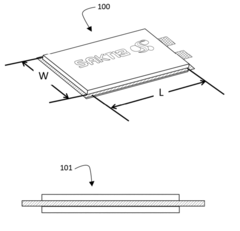
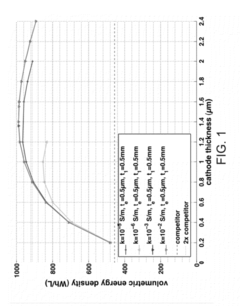
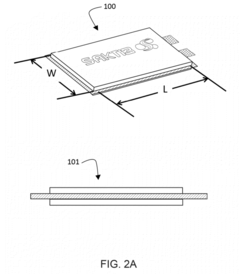
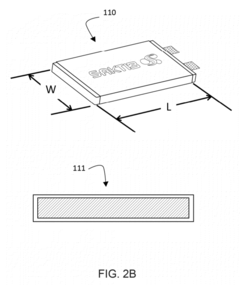
- A method and device for fabricating a solid-state thin-film battery using a prismatic multilayer structure with specific layer thicknesses and materials, including a substrate, cathode and anode current collectors, electrolyte, and barrier layers, optimized through numerical techniques for enhanced energy density and stability.
Solid-state polymer lithium battery pack and preparation method thereof
PatentActiveUS20180254514A1
Innovation
- A solid-state polymer lithium battery pack is developed, comprising high-specific-power solid-state polymer lithium-ion batteries with a laminated structure, connected in series using screw connections and sealed within a composite material battery box filled with insulating and thermally conductive sealant, ensuring reliable operation in vacuum conditions.


Safety and Certification Requirements for Aerospace Batteries
The aerospace industry imposes stringent safety requirements on battery systems that far exceed those in consumer electronics or automotive applications. For solid-state batteries to be viable in aerospace applications, they must meet rigorous certification standards established by regulatory bodies such as the Federal Aviation Administration (FAA), European Union Aviation Safety Agency (EASA), and International Civil Aviation Organization (ICAO).
Primary safety concerns include thermal runaway prevention, which is particularly critical in pressurized aircraft cabins where fire containment is challenging. Solid-state batteries offer inherent advantages in this area due to their non-flammable solid electrolytes, eliminating the risk of electrolyte leakage and significantly reducing fire hazards compared to conventional lithium-ion batteries with liquid electrolytes.
Certification processes for aerospace batteries require extensive testing under extreme conditions, including altitude testing (up to 40,000 feet), rapid decompression scenarios, and temperature cycling from -65°C to +85°C. Solid-state batteries must demonstrate resilience against vibration, shock, and acceleration forces experienced during flight operations, which can reach up to 9G in certain aircraft maneuvers.
Electromagnetic compatibility (EMC) testing ensures that battery systems neither emit electromagnetic interference that could affect critical flight systems nor are susceptible to external electromagnetic fields. This is particularly important as modern aircraft increasingly rely on fly-by-wire systems and sensitive avionics.
Lifecycle testing represents another critical certification requirement, with aerospace batteries typically needing to demonstrate reliable performance over thousands of cycles under varying operational conditions. The certification must validate that performance degradation remains within acceptable parameters throughout the expected service life, which may extend to 10-15 years for commercial aircraft applications.
Fail-safe design principles are mandatory, requiring redundant safety mechanisms and sophisticated battery management systems (BMS) that can detect and mitigate potential failure modes before they escalate. These systems must be capable of real-time monitoring of individual cells and immediate isolation of problematic components.
Recent regulatory updates have introduced more stringent requirements for transportation of lithium batteries as cargo, which solid-state technology could help address through its improved safety profile. However, manufacturers must still provide comprehensive safety data packages demonstrating compliance with standards such as DO-311A (Minimum Operational Performance Standards for Rechargeable Lithium Batteries) and DO-160 (Environmental Conditions and Test Procedures for Airborne Equipment).
Primary safety concerns include thermal runaway prevention, which is particularly critical in pressurized aircraft cabins where fire containment is challenging. Solid-state batteries offer inherent advantages in this area due to their non-flammable solid electrolytes, eliminating the risk of electrolyte leakage and significantly reducing fire hazards compared to conventional lithium-ion batteries with liquid electrolytes.
Certification processes for aerospace batteries require extensive testing under extreme conditions, including altitude testing (up to 40,000 feet), rapid decompression scenarios, and temperature cycling from -65°C to +85°C. Solid-state batteries must demonstrate resilience against vibration, shock, and acceleration forces experienced during flight operations, which can reach up to 9G in certain aircraft maneuvers.
Electromagnetic compatibility (EMC) testing ensures that battery systems neither emit electromagnetic interference that could affect critical flight systems nor are susceptible to external electromagnetic fields. This is particularly important as modern aircraft increasingly rely on fly-by-wire systems and sensitive avionics.
Lifecycle testing represents another critical certification requirement, with aerospace batteries typically needing to demonstrate reliable performance over thousands of cycles under varying operational conditions. The certification must validate that performance degradation remains within acceptable parameters throughout the expected service life, which may extend to 10-15 years for commercial aircraft applications.
Fail-safe design principles are mandatory, requiring redundant safety mechanisms and sophisticated battery management systems (BMS) that can detect and mitigate potential failure modes before they escalate. These systems must be capable of real-time monitoring of individual cells and immediate isolation of problematic components.
Recent regulatory updates have introduced more stringent requirements for transportation of lithium batteries as cargo, which solid-state technology could help address through its improved safety profile. However, manufacturers must still provide comprehensive safety data packages demonstrating compliance with standards such as DO-311A (Minimum Operational Performance Standards for Rechargeable Lithium Batteries) and DO-160 (Environmental Conditions and Test Procedures for Airborne Equipment).
Environmental Impact and Sustainability Considerations
The aerospace industry's adoption of solid-state battery technology represents a significant step toward reducing environmental impact across multiple dimensions. These advanced batteries eliminate the need for toxic and flammable liquid electrolytes found in conventional lithium-ion batteries, substantially decreasing the risk of hazardous material leakage during manufacturing, operation, and disposal phases. This reduction in harmful chemicals directly translates to safer production environments and minimized ecological contamination risks.
From a lifecycle perspective, solid-state batteries demonstrate superior sustainability credentials. Their enhanced durability and extended operational lifespan—potentially 2-3 times longer than traditional batteries—significantly reduces replacement frequency and associated waste generation. This longevity factor is particularly valuable in aerospace applications where component reliability is paramount and maintenance opportunities are limited.
The manufacturing processes for solid-state batteries are evolving toward more environmentally responsible methods. Current research focuses on reducing energy-intensive production steps and exploring less resource-depleting material alternatives. Several aerospace manufacturers have already committed to carbon-neutral production facilities for these next-generation energy storage systems, aligning with broader industry sustainability goals.
End-of-life considerations reveal another environmental advantage of solid-state technology. These batteries contain higher percentages of recoverable materials compared to conventional lithium-ion counterparts. The absence of liquid electrolytes simplifies recycling processes, enabling more efficient material recovery and creating opportunities for closed-loop manufacturing systems within the aerospace sector.
Weight reduction represents a critical environmental benefit specific to aerospace applications. The higher energy density of solid-state batteries translates to lighter power systems, directly reducing aircraft fuel consumption and associated emissions. Preliminary studies suggest that widespread adoption could contribute to a 3-5% reduction in aviation-related carbon emissions—a significant contribution to the industry's decarbonization efforts.
Regulatory frameworks are increasingly recognizing these environmental advantages. Several international aviation authorities have introduced sustainability incentives specifically targeting advanced battery technologies, accelerating industry transition toward these greener alternatives. As solid-state battery technology matures, its positive environmental impact will likely become a central factor in aerospace sustainability strategies, potentially establishing new industry standards for environmentally responsible power systems.
From a lifecycle perspective, solid-state batteries demonstrate superior sustainability credentials. Their enhanced durability and extended operational lifespan—potentially 2-3 times longer than traditional batteries—significantly reduces replacement frequency and associated waste generation. This longevity factor is particularly valuable in aerospace applications where component reliability is paramount and maintenance opportunities are limited.
The manufacturing processes for solid-state batteries are evolving toward more environmentally responsible methods. Current research focuses on reducing energy-intensive production steps and exploring less resource-depleting material alternatives. Several aerospace manufacturers have already committed to carbon-neutral production facilities for these next-generation energy storage systems, aligning with broader industry sustainability goals.
End-of-life considerations reveal another environmental advantage of solid-state technology. These batteries contain higher percentages of recoverable materials compared to conventional lithium-ion counterparts. The absence of liquid electrolytes simplifies recycling processes, enabling more efficient material recovery and creating opportunities for closed-loop manufacturing systems within the aerospace sector.
Weight reduction represents a critical environmental benefit specific to aerospace applications. The higher energy density of solid-state batteries translates to lighter power systems, directly reducing aircraft fuel consumption and associated emissions. Preliminary studies suggest that widespread adoption could contribute to a 3-5% reduction in aviation-related carbon emissions—a significant contribution to the industry's decarbonization efforts.
Regulatory frameworks are increasingly recognizing these environmental advantages. Several international aviation authorities have introduced sustainability incentives specifically targeting advanced battery technologies, accelerating industry transition toward these greener alternatives. As solid-state battery technology matures, its positive environmental impact will likely become a central factor in aerospace sustainability strategies, potentially establishing new industry standards for environmentally responsible power systems.
Unlock deeper insights with Patsnap Eureka Quick Research — get a full tech report to explore trends and direct your research. Try now!
Generate Your Research Report Instantly with AI Agent
Supercharge your innovation with Patsnap Eureka AI Agent Platform!