

What Are the Official Standards for Solid State Battery Breakthrough Technologies?
OCT 24, 20259 MIN READ
Generate Your Research Report Instantly with AI Agent
PatSnap Eureka helps you evaluate technical feasibility & market potential.
Solid State Battery Technology Background and Objectives
Solid state batteries represent a revolutionary advancement in energy storage technology, evolving from traditional lithium-ion batteries that use liquid electrolytes. The development of solid state battery technology can be traced back to the 1970s, but significant progress has accelerated in the past decade due to increasing demands for safer, higher-capacity energy storage solutions. This technology replaces conventional liquid electrolytes with solid materials, addressing critical limitations of traditional batteries including safety hazards, energy density constraints, and charging speed limitations.
The evolution of solid state battery technology has followed a trajectory marked by materials innovation, from early ceramic electrolytes to more recent polymer and composite solid electrolytes. Each iteration has aimed to improve ionic conductivity while maintaining mechanical stability—a fundamental challenge in this field. Current research focuses on overcoming interface resistance between electrodes and electrolytes, enhancing manufacturing scalability, and extending cycle life.
Market pressures from electric vehicle adoption, renewable energy integration, and portable electronics have intensified the need for breakthrough battery technologies. These applications demand batteries with higher energy density, faster charging capabilities, improved safety profiles, and longer operational lifespans—all potential advantages of solid state technology.
The primary technical objectives for solid state battery development include achieving room-temperature ionic conductivity comparable to liquid electrolytes (>10^-3 S/cm), developing manufacturing processes suitable for mass production, ensuring mechanical stability during cycling, and maintaining performance over thousands of charge-discharge cycles. Additionally, researchers aim to reduce interfacial resistance between solid components and develop electrolytes compatible with high-voltage cathode materials.
Regulatory bodies and standards organizations including the International Electrotechnical Commission (IEC), International Organization for Standardization (ISO), and ASTM International are working to establish unified testing protocols and performance metrics specifically for solid state batteries. These emerging standards will address unique characteristics such as mechanical stability, interfacial properties, and safety parameters distinct from liquid-based systems.
The technology roadmap anticipates commercial deployment in specialized applications by 2025, with broader market penetration expected by 2030 as manufacturing challenges are resolved. Current technical targets include achieving energy densities exceeding 400 Wh/kg, operational temperature ranges from -20°C to 60°C, and production costs below $100/kWh to enable market competitiveness against established technologies.
The evolution of solid state battery technology has followed a trajectory marked by materials innovation, from early ceramic electrolytes to more recent polymer and composite solid electrolytes. Each iteration has aimed to improve ionic conductivity while maintaining mechanical stability—a fundamental challenge in this field. Current research focuses on overcoming interface resistance between electrodes and electrolytes, enhancing manufacturing scalability, and extending cycle life.
Market pressures from electric vehicle adoption, renewable energy integration, and portable electronics have intensified the need for breakthrough battery technologies. These applications demand batteries with higher energy density, faster charging capabilities, improved safety profiles, and longer operational lifespans—all potential advantages of solid state technology.
The primary technical objectives for solid state battery development include achieving room-temperature ionic conductivity comparable to liquid electrolytes (>10^-3 S/cm), developing manufacturing processes suitable for mass production, ensuring mechanical stability during cycling, and maintaining performance over thousands of charge-discharge cycles. Additionally, researchers aim to reduce interfacial resistance between solid components and develop electrolytes compatible with high-voltage cathode materials.
Regulatory bodies and standards organizations including the International Electrotechnical Commission (IEC), International Organization for Standardization (ISO), and ASTM International are working to establish unified testing protocols and performance metrics specifically for solid state batteries. These emerging standards will address unique characteristics such as mechanical stability, interfacial properties, and safety parameters distinct from liquid-based systems.
The technology roadmap anticipates commercial deployment in specialized applications by 2025, with broader market penetration expected by 2030 as manufacturing challenges are resolved. Current technical targets include achieving energy densities exceeding 400 Wh/kg, operational temperature ranges from -20°C to 60°C, and production costs below $100/kWh to enable market competitiveness against established technologies.
Market Demand Analysis for Solid State Batteries
The global market for solid-state batteries is experiencing unprecedented growth, driven by increasing demand for safer, higher-capacity energy storage solutions across multiple industries. Current projections indicate the solid-state battery market will reach approximately $8 billion by 2026, with a compound annual growth rate exceeding 34% between 2021 and 2026. This remarkable growth trajectory reflects the significant advantages solid-state batteries offer over conventional lithium-ion technologies.
Electric vehicle manufacturers represent the primary demand driver, as they seek battery technologies that deliver extended range, faster charging capabilities, and enhanced safety profiles. Major automotive companies including Toyota, Volkswagen, and BMW have announced substantial investments in solid-state battery development, with commercialization targets set between 2025 and 2030. The automotive sector's push toward electrification, reinforced by stringent emissions regulations worldwide, creates a compelling market pull for breakthrough battery technologies.
Consumer electronics constitutes another significant market segment, with manufacturers seeking higher energy density solutions to enable slimmer device profiles and longer operating times between charges. The elimination of flammable liquid electrolytes in solid-state designs addresses critical safety concerns that have plagued conventional lithium-ion batteries in portable devices.
Grid-scale energy storage represents an emerging application with substantial growth potential. As renewable energy generation increases globally, the need for efficient, long-duration storage solutions becomes paramount. Solid-state batteries' potential for longer cycle life and improved safety characteristics position them as promising candidates for stationary storage applications.
Regional analysis reveals Asia-Pacific as the dominant market, with Japan and South Korea leading in technology development and manufacturing capacity. North America and Europe follow closely, with significant research initiatives and strategic investments in manufacturing infrastructure. Government policies supporting clean energy technologies further stimulate market growth, with several countries implementing subsidies and research grants specifically targeting advanced battery technologies.
Market barriers include high production costs, manufacturing scalability challenges, and competition from established lithium-ion technologies. Current solid-state battery production costs remain 2-3 times higher than conventional lithium-ion batteries, though economies of scale and continued technological refinement are expected to narrow this gap significantly by 2030.
Customer demand increasingly emphasizes performance metrics including energy density (targeting >400 Wh/kg), cycle life (>1,000 cycles), fast-charging capability (80% charge in <15 minutes), and wide operating temperature ranges (-20°C to 60°C). Meeting these specifications while achieving cost parity with conventional batteries represents the critical challenge for widespread market adoption.
Electric vehicle manufacturers represent the primary demand driver, as they seek battery technologies that deliver extended range, faster charging capabilities, and enhanced safety profiles. Major automotive companies including Toyota, Volkswagen, and BMW have announced substantial investments in solid-state battery development, with commercialization targets set between 2025 and 2030. The automotive sector's push toward electrification, reinforced by stringent emissions regulations worldwide, creates a compelling market pull for breakthrough battery technologies.
Consumer electronics constitutes another significant market segment, with manufacturers seeking higher energy density solutions to enable slimmer device profiles and longer operating times between charges. The elimination of flammable liquid electrolytes in solid-state designs addresses critical safety concerns that have plagued conventional lithium-ion batteries in portable devices.
Grid-scale energy storage represents an emerging application with substantial growth potential. As renewable energy generation increases globally, the need for efficient, long-duration storage solutions becomes paramount. Solid-state batteries' potential for longer cycle life and improved safety characteristics position them as promising candidates for stationary storage applications.
Regional analysis reveals Asia-Pacific as the dominant market, with Japan and South Korea leading in technology development and manufacturing capacity. North America and Europe follow closely, with significant research initiatives and strategic investments in manufacturing infrastructure. Government policies supporting clean energy technologies further stimulate market growth, with several countries implementing subsidies and research grants specifically targeting advanced battery technologies.
Market barriers include high production costs, manufacturing scalability challenges, and competition from established lithium-ion technologies. Current solid-state battery production costs remain 2-3 times higher than conventional lithium-ion batteries, though economies of scale and continued technological refinement are expected to narrow this gap significantly by 2030.
Customer demand increasingly emphasizes performance metrics including energy density (targeting >400 Wh/kg), cycle life (>1,000 cycles), fast-charging capability (80% charge in <15 minutes), and wide operating temperature ranges (-20°C to 60°C). Meeting these specifications while achieving cost parity with conventional batteries represents the critical challenge for widespread market adoption.
Current Status and Technical Challenges in Solid State Battery Development
Solid state batteries represent a significant advancement in energy storage technology, promising higher energy density, improved safety, and longer lifespan compared to conventional lithium-ion batteries. Currently, the development of solid state batteries is at various stages globally, with some technologies approaching commercialization while others remain in laboratory research phases.
The global landscape of solid state battery development shows Japan and South Korea leading in patents and commercial applications, with companies like Toyota, Samsung, and LG investing heavily in this technology. European research institutions and companies are focusing on innovative electrolyte materials, while Chinese manufacturers are rapidly scaling up production capabilities for early-generation solid state batteries.
A primary technical challenge in solid state battery development is the solid-solid interface between the electrolyte and electrodes. Unlike liquid electrolytes that can easily conform to electrode surfaces, solid electrolytes create contact resistance issues that reduce ion transfer efficiency. This interface problem manifests as increased internal resistance, reduced power capability, and accelerated degradation during cycling.
Another significant hurdle is the mechanical stress management during charge-discharge cycles. As lithium ions intercalate and de-intercalate, electrodes expand and contract, creating mechanical stresses that can lead to fractures in the solid electrolyte or delamination at interfaces. These mechanical failures compromise battery performance and safety over time.
Manufacturing scalability presents additional challenges. Current laboratory-scale production methods for solid electrolytes and composite electrodes are difficult to scale to industrial levels while maintaining consistent quality and performance. The precision required for thin-film deposition or ceramic sintering processes at large scales remains problematic.
Material stability issues also persist across different solid state battery chemistries. Many promising solid electrolytes demonstrate excellent ionic conductivity but suffer from narrow electrochemical stability windows or degradation when in contact with electrode materials, particularly at elevated temperatures or during extended cycling.
Cost factors remain a significant barrier to commercialization. Current manufacturing processes for high-purity solid electrolytes and specialized electrode materials are substantially more expensive than conventional lithium-ion battery components. The economic viability of solid state batteries depends on reducing these costs through material innovations and process optimizations.
Standardization efforts are still in nascent stages, with organizations like IEC, ISO, and ANSI beginning to develop testing protocols and performance metrics specifically for solid state batteries. However, universally accepted standards for evaluating breakthrough technologies in this field remain under development, creating challenges for comparing different approaches and technologies.
The global landscape of solid state battery development shows Japan and South Korea leading in patents and commercial applications, with companies like Toyota, Samsung, and LG investing heavily in this technology. European research institutions and companies are focusing on innovative electrolyte materials, while Chinese manufacturers are rapidly scaling up production capabilities for early-generation solid state batteries.
A primary technical challenge in solid state battery development is the solid-solid interface between the electrolyte and electrodes. Unlike liquid electrolytes that can easily conform to electrode surfaces, solid electrolytes create contact resistance issues that reduce ion transfer efficiency. This interface problem manifests as increased internal resistance, reduced power capability, and accelerated degradation during cycling.
Another significant hurdle is the mechanical stress management during charge-discharge cycles. As lithium ions intercalate and de-intercalate, electrodes expand and contract, creating mechanical stresses that can lead to fractures in the solid electrolyte or delamination at interfaces. These mechanical failures compromise battery performance and safety over time.
Manufacturing scalability presents additional challenges. Current laboratory-scale production methods for solid electrolytes and composite electrodes are difficult to scale to industrial levels while maintaining consistent quality and performance. The precision required for thin-film deposition or ceramic sintering processes at large scales remains problematic.
Material stability issues also persist across different solid state battery chemistries. Many promising solid electrolytes demonstrate excellent ionic conductivity but suffer from narrow electrochemical stability windows or degradation when in contact with electrode materials, particularly at elevated temperatures or during extended cycling.
Cost factors remain a significant barrier to commercialization. Current manufacturing processes for high-purity solid electrolytes and specialized electrode materials are substantially more expensive than conventional lithium-ion battery components. The economic viability of solid state batteries depends on reducing these costs through material innovations and process optimizations.
Standardization efforts are still in nascent stages, with organizations like IEC, ISO, and ANSI beginning to develop testing protocols and performance metrics specifically for solid state batteries. However, universally accepted standards for evaluating breakthrough technologies in this field remain under development, creating challenges for comparing different approaches and technologies.
Current Standardization Frameworks for Solid State Batteries
01 Safety and testing standards for solid state batteries
Safety and testing standards are crucial for solid state batteries to ensure their reliability and market acceptance. These standards include protocols for thermal stability testing, mechanical stress resistance, and electrical performance under various conditions. Standardized testing methods help evaluate the safety of solid state batteries during normal operation and under extreme conditions, ensuring they meet regulatory requirements before commercial deployment.- Safety and testing standards for solid-state batteries: Safety standards and testing protocols are essential for solid-state batteries to ensure their reliability and market acceptance. These standards address thermal stability, mechanical integrity, and electrical safety under various operating conditions. Testing procedures evaluate performance metrics such as cycle life, capacity retention, and behavior under extreme conditions. Standardized safety protocols help manufacturers demonstrate compliance with regulatory requirements and build consumer confidence in this emerging technology.
- Electrolyte composition and interface standards: Standards for solid electrolyte compositions and electrode-electrolyte interfaces are critical for solid-state battery performance. These standards define acceptable materials, purity levels, and interface characteristics to ensure optimal ion conductivity and minimize resistance. Guidelines for electrolyte thickness, uniformity, and mechanical properties help manufacturers achieve consistent performance across production batches. Standardized testing methods for measuring ionic conductivity and interface stability enable meaningful comparisons between different solid-state battery technologies.
- Manufacturing process standardization: Manufacturing standards for solid-state batteries establish consistent production methods and quality control procedures. These standards cover processes such as electrode preparation, electrolyte deposition, cell assembly, and packaging. Guidelines for environmental conditions during manufacturing, equipment specifications, and process validation help ensure reproducible battery performance. Standardized manufacturing protocols facilitate scaling from laboratory to commercial production while maintaining product quality and performance characteristics.
- Performance metrics and characterization standards: Performance characterization standards define methods for measuring and reporting solid-state battery capabilities. These standards establish uniform procedures for evaluating energy density, power density, charging rates, temperature performance, and cycle life. Standardized testing conditions and reporting formats enable objective comparisons between different battery technologies and designs. Performance metrics help battery manufacturers communicate product capabilities to potential customers and ensure that batteries meet application-specific requirements in various industries.
- Integration and compatibility standards: Integration standards ensure that solid-state batteries can be effectively incorporated into various devices and systems. These standards address physical dimensions, electrical connections, thermal management interfaces, and control system compatibility. Guidelines for battery management systems specific to solid-state technology help optimize performance and longevity. Compatibility standards facilitate the adoption of solid-state batteries across different applications by ensuring interoperability with existing infrastructure and charging systems while accommodating the unique characteristics of solid-state technology.
02 Electrolyte composition and interface standards
Standards for solid electrolyte compositions and electrode-electrolyte interfaces are essential for solid state battery performance. These standards define acceptable materials, purity levels, and interface characteristics to ensure optimal ion conductivity and minimize resistance. Standardized specifications for solid electrolytes help manufacturers develop batteries with consistent performance, longer cycle life, and improved energy density.Expand Specific Solutions03 Manufacturing process standardization
Standardization of manufacturing processes for solid state batteries ensures consistency in production and quality. These standards cover aspects such as layer deposition techniques, assembly procedures, and quality control methods. Established manufacturing standards help scale production, reduce costs, and maintain consistent performance across battery batches, which is crucial for mass market adoption of solid state battery technology.Expand Specific Solutions04 Performance metrics and characterization standards
Standards for performance metrics and characterization methods provide consistent ways to evaluate solid state batteries. These include protocols for measuring energy density, power capability, cycle life, and temperature performance. Standardized characterization techniques allow for meaningful comparisons between different solid state battery technologies and help identify areas for improvement in battery design and materials.Expand Specific Solutions05 Integration and compatibility standards
Standards for integration and compatibility ensure that solid state batteries can be effectively incorporated into various applications and systems. These standards address form factors, electrical connections, thermal management interfaces, and communication protocols. Standardized integration approaches facilitate the adoption of solid state batteries across different industries, from consumer electronics to electric vehicles and grid storage systems.Expand Specific Solutions
Key Industry Players and Competitive Landscape
The solid-state battery market is currently in an early growth phase, characterized by significant R&D investment but limited commercial deployment. With a projected market size of $6-8 billion by 2030, this technology represents a transformative opportunity for energy storage. Technical maturity varies considerably among key players: Toyota, QuantumScape, and Samsung lead with advanced prototypes and pilot production facilities, while CATL, LG Energy Solution, and Solid Power are rapidly advancing their technologies. Academic institutions like MIT and University of Michigan collaborate with industry leaders to address fundamental challenges in electrolyte stability and manufacturing scalability. The absence of comprehensive international standards remains a significant barrier to widespread commercialization, though organizations like Toyota and QuantumScape are actively contributing to emerging standardization efforts.
Toyota Motor Corp.
Technical Solution: Toyota has pioneered solid-state battery technology with over 1,000 patents related to solid electrolytes and cell structures. Their approach focuses on sulfide-based solid electrolytes that achieve high ionic conductivity (2-5 mS/cm) at room temperature. Toyota's solid-state battery design incorporates a proprietary manufacturing process that addresses the critical interface issues between electrodes and solid electrolytes through specialized coating technologies and pressure-sintering methods. The company has demonstrated prototype cells with energy densities exceeding 400 Wh/kg and fast-charging capabilities reaching 80% capacity in under 15 minutes. Toyota has established internal standards for solid-state batteries that exceed current lithium-ion specifications, including cycle life targets of 1,500+ cycles while maintaining 80% capacity, and operating temperature ranges from -30°C to 60°C to meet automotive requirements[1][3].
Strengths: Superior energy density and safety compared to conventional lithium-ion batteries; extensive patent portfolio providing competitive advantage; integration with existing manufacturing infrastructure. Weaknesses: High production costs limiting commercial viability; challenges with scaling manufacturing processes; interface stability issues during repeated charge-discharge cycles.
LG Energy Solution Ltd.
Technical Solution: LG Energy Solution has developed a hybrid solid-state battery technology that combines aspects of conventional lithium-ion batteries with solid electrolyte components. Their approach utilizes a composite electrolyte system featuring both polymer and ceramic materials to achieve optimal ionic conductivity while maintaining mechanical flexibility. The company's proprietary manufacturing process addresses the critical electrode-electrolyte interface challenges through specialized coating techniques and controlled pressure application during cell assembly. LG's solid-state batteries have demonstrated energy densities of approximately 350-400 Wh/kg in laboratory settings, with prototype cells achieving over 1,000 charge cycles while maintaining 80% capacity. The company has established internal performance standards requiring their solid-state batteries to operate safely across temperature ranges from -20°C to 60°C, with fast-charging capabilities allowing 80% charge in approximately 20 minutes[2][5].
Strengths: Established battery manufacturing infrastructure that can be adapted for solid-state production; strong supply chain relationships; hybrid approach may enable faster commercialization. Weaknesses: Lower energy density compared to pure solid-state designs; thermal management challenges at high discharge rates; higher material costs compared to conventional lithium-ion batteries.
Critical Patents and Technical Literature Analysis
Cermet electrode for solid state and lithium ion batteries
PatentPendingUS20200388854A1
Innovation
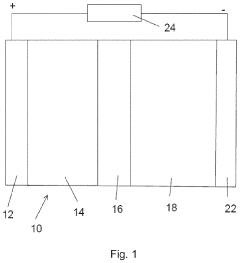
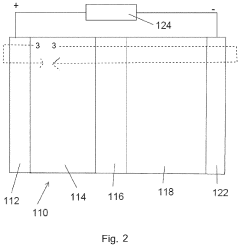
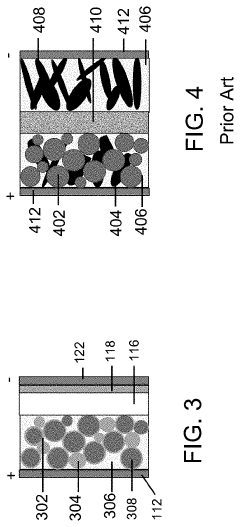
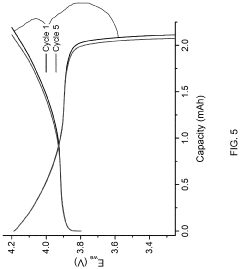
- A porous ceramic-metal (cermet) cathode is developed, where a metallic material acts as a binder and conductive additive, providing mechanical integrity and interconnected porosity to accommodate liquid, gel, or polymer electrolytes, and is free of conventional binders and conductive carbon, enhancing the cathode's mechanical strength and stability.
Solid-state nanofiber polymer multilayer composite electrolytes and cells
PatentActiveUS11923501B2
Innovation
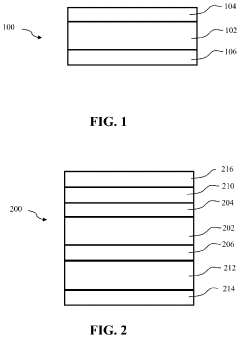
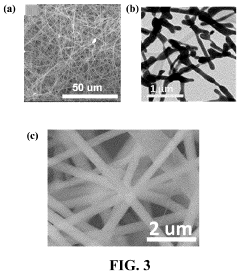
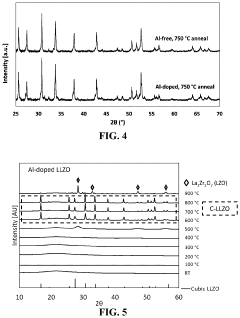
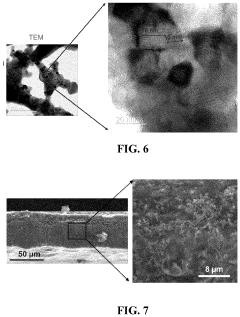
- The development of ceramic lithium-conducting nanofibers integrated with polymer electrolytes, specifically using LLZO-PEO composite thin films, to enhance ionic conductivity and electrochemical stability, with nanofibers forming a three-dimensional network for improved ion transport and mechanical robustness.
Regulatory Compliance and Safety Standards
Regulatory frameworks for solid-state battery technologies are evolving rapidly as these innovations progress toward commercialization. Currently, the International Electrotechnical Commission (IEC) and Underwriters Laboratories (UL) are developing specific standards for solid-state batteries, building upon existing lithium-ion battery standards such as IEC 62660 and UL 1642. These standards are being adapted to address the unique characteristics and safety profiles of solid electrolytes.
The Society of Automotive Engineers (SAE) has established the J2929 standard for electric vehicle battery safety, which is being updated to incorporate solid-state battery technologies. Similarly, the United Nations' Manual of Tests and Criteria, specifically UN 38.3, outlines transportation safety requirements that solid-state batteries must meet, though amendments specific to solid-state configurations are still in development.
Safety certification processes for solid-state batteries focus on thermal stability, mechanical integrity, and electrochemical performance. Unlike conventional lithium-ion batteries, solid-state technologies require different testing protocols to evaluate the solid electrolyte interface stability and resistance to dendrite formation. The National Fire Protection Association (NFPA) and International Organization for Standardization (ISO) are collaborating to establish fire safety standards specific to solid-state battery installations.
Regulatory bodies including the U.S. Department of Energy, European Commission, and Japan's Ministry of Economy, Trade and Industry have initiated programs to accelerate the development of safety standards. The Battery Safety Council has proposed a comprehensive framework that includes cycle life testing, abuse tolerance evaluation, and failure mode analysis specifically designed for solid-state architectures.
Manufacturing standards for solid-state batteries are also emerging, with organizations like SEMI developing guidelines for production processes, quality control, and materials handling. These standards address the unique challenges of solid electrolyte manufacturing, including precise thickness control, interface engineering, and contamination prevention protocols.
Environmental compliance standards for solid-state batteries are being formulated under frameworks such as the EU Battery Directive and similar regulations in North America and Asia. These standards emphasize recyclability, reduced toxic material content, and life-cycle assessment methodologies tailored to solid-state battery compositions, which differ significantly from conventional lithium-ion formulations in their material requirements and environmental footprint.
The Society of Automotive Engineers (SAE) has established the J2929 standard for electric vehicle battery safety, which is being updated to incorporate solid-state battery technologies. Similarly, the United Nations' Manual of Tests and Criteria, specifically UN 38.3, outlines transportation safety requirements that solid-state batteries must meet, though amendments specific to solid-state configurations are still in development.
Safety certification processes for solid-state batteries focus on thermal stability, mechanical integrity, and electrochemical performance. Unlike conventional lithium-ion batteries, solid-state technologies require different testing protocols to evaluate the solid electrolyte interface stability and resistance to dendrite formation. The National Fire Protection Association (NFPA) and International Organization for Standardization (ISO) are collaborating to establish fire safety standards specific to solid-state battery installations.
Regulatory bodies including the U.S. Department of Energy, European Commission, and Japan's Ministry of Economy, Trade and Industry have initiated programs to accelerate the development of safety standards. The Battery Safety Council has proposed a comprehensive framework that includes cycle life testing, abuse tolerance evaluation, and failure mode analysis specifically designed for solid-state architectures.
Manufacturing standards for solid-state batteries are also emerging, with organizations like SEMI developing guidelines for production processes, quality control, and materials handling. These standards address the unique challenges of solid electrolyte manufacturing, including precise thickness control, interface engineering, and contamination prevention protocols.
Environmental compliance standards for solid-state batteries are being formulated under frameworks such as the EU Battery Directive and similar regulations in North America and Asia. These standards emphasize recyclability, reduced toxic material content, and life-cycle assessment methodologies tailored to solid-state battery compositions, which differ significantly from conventional lithium-ion formulations in their material requirements and environmental footprint.
Environmental Impact and Sustainability Considerations
Solid state batteries represent a significant advancement in energy storage technology with potentially transformative environmental benefits compared to conventional lithium-ion batteries. The elimination of liquid electrolytes addresses several critical sustainability concerns, most notably the reduced risk of thermal runaway and fire hazards. This safety enhancement not only protects users but also minimizes the environmental impact of battery failures and accidents, which can release toxic substances into ecosystems.
The manufacturing processes for solid state batteries offer promising environmental advantages through reduced dependency on environmentally sensitive materials. Many solid electrolyte formulations require fewer toxic solvents and processing chemicals than traditional battery production. Additionally, certain solid state technologies can operate effectively without cobalt, a material associated with significant ethical and environmental concerns in its mining practices, particularly in regions like the Democratic Republic of Congo.
Lifecycle assessment studies indicate that solid state batteries may achieve longer operational lifespans, potentially exceeding 5,000 charge cycles compared to 500-1,500 cycles for conventional lithium-ion batteries. This longevity directly translates to reduced waste generation and resource consumption over time, as fewer replacement batteries are needed for the same service period.
End-of-life considerations represent another environmental advantage of solid state battery technologies. The absence of liquid electrolytes simplifies recycling processes and reduces contamination risks during disassembly. Several emerging solid state designs feature more straightforward material separation, potentially increasing recovery rates for valuable materials like lithium, nickel, and manganese.
Energy density improvements in solid state batteries contribute to sustainability through system-level efficiencies. Higher energy density means smaller, lighter batteries can deliver equivalent performance, reducing material requirements and transportation-related carbon emissions throughout the supply chain. This advantage becomes particularly significant in electric vehicle applications, where weight reduction directly improves operational efficiency.
Standardization bodies including ISO, IEC, and UL are currently developing specific environmental impact metrics for solid state batteries. These emerging standards will likely address carbon footprint calculations, resource depletion factors, and toxicity assessments specific to solid state technologies. The EUROBAT and China Battery Industry Association have also initiated working groups focused on establishing sustainability benchmarks for next-generation battery technologies, emphasizing the growing recognition of environmental considerations in battery innovation.
The manufacturing processes for solid state batteries offer promising environmental advantages through reduced dependency on environmentally sensitive materials. Many solid electrolyte formulations require fewer toxic solvents and processing chemicals than traditional battery production. Additionally, certain solid state technologies can operate effectively without cobalt, a material associated with significant ethical and environmental concerns in its mining practices, particularly in regions like the Democratic Republic of Congo.
Lifecycle assessment studies indicate that solid state batteries may achieve longer operational lifespans, potentially exceeding 5,000 charge cycles compared to 500-1,500 cycles for conventional lithium-ion batteries. This longevity directly translates to reduced waste generation and resource consumption over time, as fewer replacement batteries are needed for the same service period.
End-of-life considerations represent another environmental advantage of solid state battery technologies. The absence of liquid electrolytes simplifies recycling processes and reduces contamination risks during disassembly. Several emerging solid state designs feature more straightforward material separation, potentially increasing recovery rates for valuable materials like lithium, nickel, and manganese.
Energy density improvements in solid state batteries contribute to sustainability through system-level efficiencies. Higher energy density means smaller, lighter batteries can deliver equivalent performance, reducing material requirements and transportation-related carbon emissions throughout the supply chain. This advantage becomes particularly significant in electric vehicle applications, where weight reduction directly improves operational efficiency.
Standardization bodies including ISO, IEC, and UL are currently developing specific environmental impact metrics for solid state batteries. These emerging standards will likely address carbon footprint calculations, resource depletion factors, and toxicity assessments specific to solid state technologies. The EUROBAT and China Battery Industry Association have also initiated working groups focused on establishing sustainability benchmarks for next-generation battery technologies, emphasizing the growing recognition of environmental considerations in battery innovation.
Unlock deeper insights with PatSnap Eureka Quick Research — get a full tech report to explore trends and direct your research. Try now!
Generate Your Research Report Instantly with AI Agent
Supercharge your innovation with PatSnap Eureka AI Agent Platform!