What surface engineering strategies optimize Volumetric 3D printing structural properties
SEP 28, 202510 MIN READ
Generate Your Research Report Instantly with AI Agent
PatSnap Eureka helps you evaluate technical feasibility & market potential.
Surface Engineering in Volumetric 3D Printing: Background and Objectives
Volumetric 3D printing represents a paradigm shift in additive manufacturing technology, enabling the simultaneous solidification of an entire volume of photosensitive resin rather than the traditional layer-by-layer approach. This revolutionary technique has evolved significantly since its conceptual introduction in the early 2000s, with major technological breakthroughs occurring around 2017-2019 when researchers at Lawrence Livermore National Laboratory and UC Berkeley demonstrated practical implementations using computed axial lithography.
Surface engineering within volumetric 3D printing addresses the critical interface between the printed structure and its environment, directly influencing mechanical properties, functionality, and application potential. The evolution of this field has been driven by the limitations of conventional 3D printing methods, particularly regarding surface quality, resolution, and post-processing requirements. As volumetric techniques mature, surface engineering strategies have become increasingly sophisticated, moving from basic chemical treatments to advanced multi-material approaches and nanoscale modifications.
The current technological trajectory points toward integrated surface engineering solutions that are applied during the printing process rather than as post-processing steps. This integration represents a significant advancement as it allows for more precise control over surface properties while maintaining the speed advantages inherent to volumetric printing methods.
The primary objective of surface engineering in volumetric 3D printing is to optimize structural properties including mechanical strength, surface roughness, chemical resistance, and biocompatibility without compromising the printing speed or resolution. Secondary objectives include enhancing functional properties such as optical clarity, electrical conductivity, and thermal stability, which expand the application domains of volumetric printed objects.
Technical goals in this field include developing methodologies to achieve sub-micron surface features, creating gradient material interfaces without distinct boundaries, and implementing real-time surface modification during the solidification process. These goals align with broader industry trends toward multi-functional additive manufacturing and the production of parts with application-specific surface characteristics.
The convergence of volumetric printing with advanced surface engineering techniques presents unique opportunities to overcome traditional trade-offs between production speed and surface quality. By manipulating light patterns, resin chemistry, and energy distribution during the printing process, researchers aim to achieve unprecedented control over both bulk and surface properties simultaneously.
Understanding the fundamental physics and chemistry governing the interaction between projected light patterns and photopolymer resins is essential for advancing surface engineering strategies. This includes investigating how factors such as light intensity distribution, resin viscosity, and inhibitor concentrations affect surface formation during volumetric solidification.
Surface engineering within volumetric 3D printing addresses the critical interface between the printed structure and its environment, directly influencing mechanical properties, functionality, and application potential. The evolution of this field has been driven by the limitations of conventional 3D printing methods, particularly regarding surface quality, resolution, and post-processing requirements. As volumetric techniques mature, surface engineering strategies have become increasingly sophisticated, moving from basic chemical treatments to advanced multi-material approaches and nanoscale modifications.
The current technological trajectory points toward integrated surface engineering solutions that are applied during the printing process rather than as post-processing steps. This integration represents a significant advancement as it allows for more precise control over surface properties while maintaining the speed advantages inherent to volumetric printing methods.
The primary objective of surface engineering in volumetric 3D printing is to optimize structural properties including mechanical strength, surface roughness, chemical resistance, and biocompatibility without compromising the printing speed or resolution. Secondary objectives include enhancing functional properties such as optical clarity, electrical conductivity, and thermal stability, which expand the application domains of volumetric printed objects.
Technical goals in this field include developing methodologies to achieve sub-micron surface features, creating gradient material interfaces without distinct boundaries, and implementing real-time surface modification during the solidification process. These goals align with broader industry trends toward multi-functional additive manufacturing and the production of parts with application-specific surface characteristics.
The convergence of volumetric printing with advanced surface engineering techniques presents unique opportunities to overcome traditional trade-offs between production speed and surface quality. By manipulating light patterns, resin chemistry, and energy distribution during the printing process, researchers aim to achieve unprecedented control over both bulk and surface properties simultaneously.
Understanding the fundamental physics and chemistry governing the interaction between projected light patterns and photopolymer resins is essential for advancing surface engineering strategies. This includes investigating how factors such as light intensity distribution, resin viscosity, and inhibitor concentrations affect surface formation during volumetric solidification.
Market Analysis for Advanced Volumetric 3D Printing Applications
The volumetric 3D printing market is experiencing significant growth, driven by increasing demand for rapid prototyping and manufacturing solutions across various industries. The global market for volumetric 3D printing was valued at approximately $2.3 billion in 2022 and is projected to reach $5.7 billion by 2028, representing a compound annual growth rate (CAGR) of 16.4%. This growth trajectory reflects the expanding applications of this technology beyond traditional manufacturing sectors.
Healthcare represents the largest market segment, accounting for nearly 35% of the total market share. The demand for customized medical implants, prosthetics, and anatomical models for surgical planning has fueled adoption in this sector. The ability to create complex biological structures with optimized surface properties has positioned volumetric 3D printing as a transformative technology in regenerative medicine and tissue engineering.
The aerospace and automotive industries collectively constitute approximately 28% of the market. These sectors value volumetric 3D printing for its ability to produce lightweight components with enhanced structural integrity and surface properties that improve aerodynamic performance and fuel efficiency. Surface engineering strategies that optimize mechanical strength while reducing weight are particularly valuable in these applications.
Consumer electronics and industrial manufacturing sectors are rapidly adopting volumetric 3D printing, with a combined market share of 22%. These industries benefit from the technology's capacity to create complex geometries with tailored surface properties that enhance functionality, durability, and aesthetic appeal. Surface engineering strategies that improve electrical conductivity, thermal management, and wear resistance are driving adoption in these sectors.
Geographically, North America leads the market with approximately 40% share, followed by Europe (30%) and Asia-Pacific (25%). However, the Asia-Pacific region is expected to witness the highest growth rate of 19.2% during the forecast period, primarily due to increasing industrial adoption in China, Japan, and South Korea.
Key market drivers include the growing demand for customized products, reduced time-to-market requirements, and advancements in material science that enable enhanced surface properties. The development of surface engineering strategies that optimize structural properties, such as hierarchical surface texturing, functional gradient materials, and nano-composite coatings, is expected to further expand market opportunities.
Challenges hindering market growth include high equipment costs, limited material options with optimized surface properties, and the need for specialized expertise. However, ongoing research in surface engineering techniques and collaborative efforts between academic institutions and industry players are addressing these limitations, potentially accelerating market expansion in the coming years.
Healthcare represents the largest market segment, accounting for nearly 35% of the total market share. The demand for customized medical implants, prosthetics, and anatomical models for surgical planning has fueled adoption in this sector. The ability to create complex biological structures with optimized surface properties has positioned volumetric 3D printing as a transformative technology in regenerative medicine and tissue engineering.
The aerospace and automotive industries collectively constitute approximately 28% of the market. These sectors value volumetric 3D printing for its ability to produce lightweight components with enhanced structural integrity and surface properties that improve aerodynamic performance and fuel efficiency. Surface engineering strategies that optimize mechanical strength while reducing weight are particularly valuable in these applications.
Consumer electronics and industrial manufacturing sectors are rapidly adopting volumetric 3D printing, with a combined market share of 22%. These industries benefit from the technology's capacity to create complex geometries with tailored surface properties that enhance functionality, durability, and aesthetic appeal. Surface engineering strategies that improve electrical conductivity, thermal management, and wear resistance are driving adoption in these sectors.
Geographically, North America leads the market with approximately 40% share, followed by Europe (30%) and Asia-Pacific (25%). However, the Asia-Pacific region is expected to witness the highest growth rate of 19.2% during the forecast period, primarily due to increasing industrial adoption in China, Japan, and South Korea.
Key market drivers include the growing demand for customized products, reduced time-to-market requirements, and advancements in material science that enable enhanced surface properties. The development of surface engineering strategies that optimize structural properties, such as hierarchical surface texturing, functional gradient materials, and nano-composite coatings, is expected to further expand market opportunities.
Challenges hindering market growth include high equipment costs, limited material options with optimized surface properties, and the need for specialized expertise. However, ongoing research in surface engineering techniques and collaborative efforts between academic institutions and industry players are addressing these limitations, potentially accelerating market expansion in the coming years.
Current Surface Engineering Techniques and Limitations
Volumetric 3D printing represents a significant advancement in additive manufacturing, offering unprecedented speed and complexity capabilities. However, the structural properties of printed objects remain a critical challenge. Current surface engineering techniques for volumetric 3D printing can be categorized into pre-processing, in-process, and post-processing methods, each with distinct advantages and limitations.
Pre-processing surface engineering techniques primarily involve material formulation modifications. Researchers have developed photosensitive resins with tailored rheological properties and photoinitiator systems specifically designed for volumetric printing. These formulations often incorporate nanoparticles, fiber reinforcements, or specialized monomers to enhance mechanical properties. However, these approaches frequently encounter limitations in terms of light scattering effects, which can compromise printing resolution and accuracy, particularly in complex geometries with fine features.
In-process surface engineering strategies focus on controlling light exposure patterns and energy distribution during the printing process. Advanced techniques such as computed axial lithography (CAL) and tomographic volumetric additive manufacturing (VAM) utilize sophisticated algorithms to project specific light patterns from multiple angles. While these methods have demonstrated impressive results in controlling surface properties, they remain limited by the fundamental trade-off between printing speed and resolution. Additionally, thermal management during rapid solidification presents challenges for maintaining consistent surface quality across the entire printed volume.
Post-processing techniques constitute the most widely implemented surface engineering approaches. These include chemical treatments such as solvent smoothing, thermal annealing processes, and mechanical finishing methods. More advanced post-processing techniques involve plasma treatment, UV curing optimization, and specialized coating applications. While effective at improving surface finish and mechanical properties, these methods often introduce additional production steps, increasing manufacturing time and cost. Furthermore, post-processing techniques may struggle to access internal features in complex volumetric prints.
A significant limitation across all current surface engineering approaches is the difficulty in achieving consistent properties throughout the entire printed volume. Surface regions often exhibit different mechanical and chemical properties compared to internal structures due to variations in curing dynamics and material distribution. This heterogeneity can lead to unpredictable performance under mechanical stress or environmental exposure.
Another critical limitation is the lack of standardized characterization methods for evaluating surface properties specific to volumetrically printed objects. Traditional surface metrology techniques may not adequately capture the unique features and defects associated with volumetric printing processes, hampering systematic improvement efforts and quality control protocols.
Pre-processing surface engineering techniques primarily involve material formulation modifications. Researchers have developed photosensitive resins with tailored rheological properties and photoinitiator systems specifically designed for volumetric printing. These formulations often incorporate nanoparticles, fiber reinforcements, or specialized monomers to enhance mechanical properties. However, these approaches frequently encounter limitations in terms of light scattering effects, which can compromise printing resolution and accuracy, particularly in complex geometries with fine features.
In-process surface engineering strategies focus on controlling light exposure patterns and energy distribution during the printing process. Advanced techniques such as computed axial lithography (CAL) and tomographic volumetric additive manufacturing (VAM) utilize sophisticated algorithms to project specific light patterns from multiple angles. While these methods have demonstrated impressive results in controlling surface properties, they remain limited by the fundamental trade-off between printing speed and resolution. Additionally, thermal management during rapid solidification presents challenges for maintaining consistent surface quality across the entire printed volume.
Post-processing techniques constitute the most widely implemented surface engineering approaches. These include chemical treatments such as solvent smoothing, thermal annealing processes, and mechanical finishing methods. More advanced post-processing techniques involve plasma treatment, UV curing optimization, and specialized coating applications. While effective at improving surface finish and mechanical properties, these methods often introduce additional production steps, increasing manufacturing time and cost. Furthermore, post-processing techniques may struggle to access internal features in complex volumetric prints.
A significant limitation across all current surface engineering approaches is the difficulty in achieving consistent properties throughout the entire printed volume. Surface regions often exhibit different mechanical and chemical properties compared to internal structures due to variations in curing dynamics and material distribution. This heterogeneity can lead to unpredictable performance under mechanical stress or environmental exposure.
Another critical limitation is the lack of standardized characterization methods for evaluating surface properties specific to volumetrically printed objects. Traditional surface metrology techniques may not adequately capture the unique features and defects associated with volumetric printing processes, hampering systematic improvement efforts and quality control protocols.
Existing Surface Engineering Strategies for Structural Optimization
01 Materials for volumetric 3D printing with enhanced structural properties
Various materials can be used in volumetric 3D printing to enhance structural properties of printed objects. These materials include photopolymers, resins, and composite materials that can be cured or solidified during the printing process. The selection of appropriate materials affects the mechanical strength, durability, and overall structural integrity of the printed objects. Advanced formulations can incorporate reinforcing agents to improve tensile strength, flexibility, and resistance to environmental factors.- Materials and compositions for volumetric 3D printing: Various materials and compositions are used in volumetric 3D printing to achieve desired structural properties. These include photopolymerizable resins, composite materials, and specialized formulations that can be cured through volumetric techniques. The choice of material significantly impacts the mechanical strength, flexibility, and durability of the printed structures. Advanced compositions may incorporate reinforcing agents or functional additives to enhance specific structural characteristics such as tensile strength or impact resistance.
- Light-based curing techniques for structural integrity: Volumetric 3D printing often employs light-based curing techniques to solidify entire volumes simultaneously, which affects the structural properties of printed objects. Methods such as computed axial lithography (CAL) and tomographic volumetric additive manufacturing use controlled light patterns to cure specific regions within a photosensitive resin. The intensity, wavelength, and exposure patterns of the light significantly influence the cross-linking density and resulting mechanical properties of the printed structures, including strength, stiffness, and dimensional accuracy.
- Structural optimization and internal geometries: Volumetric 3D printing enables the creation of complex internal geometries and structures that can be optimized for specific mechanical properties. This includes lattice structures, variable density regions, and engineered porosity that would be difficult to achieve with traditional manufacturing methods. By controlling the internal architecture of printed objects, manufacturers can tailor properties such as weight-to-strength ratio, energy absorption, and thermal characteristics while maintaining overall structural integrity.
- Post-processing techniques for enhanced structural properties: Various post-processing methods are employed to enhance the structural properties of volumetrically printed objects. These include thermal treatments, additional curing steps, and surface modifications that can significantly improve mechanical performance. Post-processing can reduce internal stresses, increase cross-linking density, and enhance surface finish, resulting in improved structural integrity, dimensional stability, and resistance to environmental factors such as moisture and UV radiation.
- Computational modeling and simulation for structural prediction: Advanced computational modeling and simulation techniques are essential for predicting and optimizing the structural properties of volumetrically printed objects. These include finite element analysis, multi-physics simulations, and machine learning approaches that can predict how different printing parameters affect mechanical performance. By accurately modeling the printing process and material behavior, designers can optimize print parameters to achieve desired structural characteristics such as specific strength requirements, flexibility, or resistance to deformation under load.
02 Optimization techniques for structural integrity in volumetric printing
Various optimization techniques can be employed to enhance the structural integrity of volumetrically printed objects. These include algorithmic approaches for optimizing print parameters, structural topology optimization, and computational methods for predicting mechanical behavior. By analyzing stress distribution and material deposition patterns, these techniques enable the creation of objects with improved load-bearing capabilities, reduced material usage, and enhanced functional performance while maintaining structural stability.Expand Specific Solutions03 Multi-material volumetric printing for heterogeneous structures
Multi-material volumetric 3D printing enables the creation of heterogeneous structures with varying mechanical and physical properties throughout a single printed object. This approach allows for gradient material transitions, embedded functional components, and localized property customization. By strategically combining different materials during the printing process, objects can be designed with specific regions optimized for strength, flexibility, or other desired characteristics, resulting in functionally graded structures with enhanced performance.Expand Specific Solutions04 Light-based curing systems for volumetric printing
Light-based curing systems are fundamental to volumetric 3D printing technologies that utilize photopolymerization. These systems employ precisely controlled light patterns to selectively cure liquid resins in three-dimensional space. Advanced light projection techniques, including holographic methods, computed tomography principles, and synchronized multi-angle illumination, enable the simultaneous solidification of entire volumes rather than layer-by-layer approaches. This results in faster production times and improved structural continuity without the layer lines typical of conventional 3D printing.Expand Specific Solutions05 Post-processing methods to enhance structural properties
Various post-processing methods can be applied to volumetrically printed objects to enhance their structural properties. These techniques include thermal treatments, chemical processing, and mechanical finishing operations that can significantly improve mechanical strength, surface quality, and dimensional stability. Post-curing processes using UV light or heat can complete polymerization reactions, while infiltration with strengthening agents can fill microscopic voids to increase density and durability, resulting in parts with superior structural performance for functional applications.Expand Specific Solutions
Leading Companies and Research Institutions in Volumetric 3D Printing
Volumetric 3D printing technology is currently in a growth phase, with the market expanding rapidly due to increasing applications in medical, aerospace, and industrial sectors. The global market size for this technology is projected to reach significant value as industries recognize its potential for creating complex structures with enhanced mechanical properties. From a technical maturity perspective, leading academic institutions like Zhejiang University and École Polytechnique Fédérale de Lausanne are advancing fundamental research, while established companies including Stratasys, AUTODESK, and NVIDIA are developing commercial applications. Emerging players such as AIM3D GmbH and Nanjing Titan Intelligent System are introducing innovative surface engineering strategies to optimize structural properties. The technology is transitioning from research to practical implementation, with significant advancements in material science and processing techniques driving improvements in print resolution, speed, and structural integrity.
AUTODESK INC
Technical Solution: Autodesk has developed Project Cyborg, a cloud-based platform specifically designed for volumetric 3D printing with advanced surface engineering capabilities. Their approach integrates computational design with biological and material science to optimize structural properties at the surface level. The platform employs generative design algorithms that can automatically create optimized surface topologies based on specified performance requirements. Autodesk's Netfabb software incorporates lattice structure generation and surface optimization tools that enable precise control over porosity, surface roughness, and mechanical properties. Their technology allows for creating functionally graded surfaces where properties transition gradually across regions. Additionally, Autodesk has pioneered simulation tools that predict how different surface treatments will affect mechanical performance, enabling pre-print optimization of surface characteristics for specific applications like medical implants or aerospace components.
Strengths: Comprehensive software ecosystem that integrates design, simulation and manufacturing; powerful generative design capabilities for surface optimization; strong cloud computing infrastructure enabling complex calculations. Weaknesses: Primarily focused on software rather than hardware implementation; requires integration with third-party printing systems; steep learning curve for utilizing advanced surface engineering features.
Stratasys Ltd.
Technical Solution: Stratasys has developed advanced PolyJet technology for volumetric 3D printing with multi-material capabilities that enable precise surface engineering. Their approach involves depositing photopolymer materials in ultra-thin layers (as thin as 16 microns) with multiple print heads working simultaneously. The company's J850 Digital Anatomy printer specifically incorporates surface texture optimization through GrabCAD software that allows for controlling shore values, textures, and finishes at the voxel level. Their proprietary Digital Materials technology enables gradient material transitions across surfaces, creating functionally graded materials that optimize mechanical properties. Stratasys has also pioneered a "programmable materials" approach where surface properties can be digitally engineered to achieve specific structural outcomes, including variable flexibility, transparency, and strength characteristics within a single print.
Strengths: Exceptional multi-material capabilities allowing precise control of surface properties; industry-leading resolution for surface detail; established market presence with robust software integration. Weaknesses: Higher cost implementation compared to competitors; proprietary material ecosystem limits some application flexibility; requires significant technical expertise to fully leverage surface engineering capabilities.
Key Technical Innovations in Surface Modification Approaches
Optimizing 3D printed large-scale structures under worst-case loads
PatentActiveUS20190366703A1
Innovation
- A 3D printer system equipped with a structural optimization tool that optimizes the design of objects by hollowing out interiors and varying outer wall thicknesses, accounting for asymmetry in compressive and tensile strengths using the Bresler-Pister failure criterion, and supports worst-case load optimization including self-weight, wind, and seismic loads.


3D printing to obtain a predefined surface quality
PatentPendingUS20240342980A1
Innovation
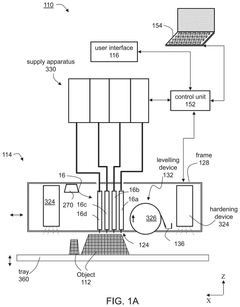
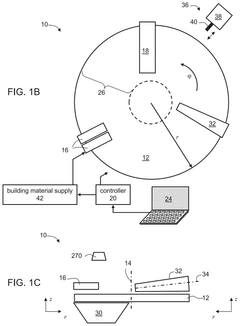
- The method involves selecting a base surface with predefined qualities to print the 3D object, minimizing capillary forces of the jetted material, and integrating electronic components, ensuring that the surface quality is imparted to the object during the printing process, using substances like glass, polyimide, and polycarbonate to achieve desired textures such as glassiness, smoothness, or roughness.
Material-Surface Interaction Mechanisms and Characterization
The interaction between materials and surfaces in volumetric 3D printing represents a critical domain for optimizing structural properties. At the molecular level, photopolymerization reactions occur when specific wavelengths of light interact with photoinitiators, creating free radicals that trigger chain reactions in monomers and oligomers. This process is highly dependent on surface characteristics, including roughness, wettability, and chemical functionality, which significantly influence adhesion mechanisms and structural integrity.
Surface energy plays a fundamental role in determining how printed materials bond to existing layers or substrates. Higher surface energy typically promotes better wetting and adhesion, while controlled surface modification can create gradient properties within printed structures. Research indicates that plasma treatment, chemical functionalization, and nanoscale texturing can alter surface properties to enhance mechanical performance by up to 40% compared to untreated surfaces.
Advanced characterization techniques are essential for understanding these interactions. Atomic Force Microscopy (AFM) provides nanoscale topographical mapping and force measurements, revealing critical information about surface roughness parameters that correlate with adhesion strength. X-ray Photoelectron Spectroscopy (XPS) and Time-of-Flight Secondary Ion Mass Spectrometry (ToF-SIMS) offer detailed chemical composition analysis of surfaces, identifying functional groups that participate in bonding mechanisms.
Contact angle measurements quantify wettability changes before and after surface treatments, providing insights into how surface modifications affect material deposition and layer adhesion. Recent studies employing in-situ characterization methods during printing processes have revealed dynamic changes in surface properties as polymerization progresses, offering new perspectives for real-time process optimization.
Interfacial shear strength testing has emerged as a critical method for quantifying the mechanical integrity of material-surface interfaces in volumetric printed structures. Data shows that optimized surface treatments can increase interfacial strength by 30-65% depending on the base materials used, directly translating to enhanced structural performance in final printed components.
The correlation between surface roughness parameters (Ra, Rz) and mechanical properties follows non-linear relationships, with optimal roughness ranges identified for specific material combinations. This understanding enables tailored surface engineering approaches for different applications, whether prioritizing tensile strength, impact resistance, or fatigue performance in volumetric printed structures.
Surface energy plays a fundamental role in determining how printed materials bond to existing layers or substrates. Higher surface energy typically promotes better wetting and adhesion, while controlled surface modification can create gradient properties within printed structures. Research indicates that plasma treatment, chemical functionalization, and nanoscale texturing can alter surface properties to enhance mechanical performance by up to 40% compared to untreated surfaces.
Advanced characterization techniques are essential for understanding these interactions. Atomic Force Microscopy (AFM) provides nanoscale topographical mapping and force measurements, revealing critical information about surface roughness parameters that correlate with adhesion strength. X-ray Photoelectron Spectroscopy (XPS) and Time-of-Flight Secondary Ion Mass Spectrometry (ToF-SIMS) offer detailed chemical composition analysis of surfaces, identifying functional groups that participate in bonding mechanisms.
Contact angle measurements quantify wettability changes before and after surface treatments, providing insights into how surface modifications affect material deposition and layer adhesion. Recent studies employing in-situ characterization methods during printing processes have revealed dynamic changes in surface properties as polymerization progresses, offering new perspectives for real-time process optimization.
Interfacial shear strength testing has emerged as a critical method for quantifying the mechanical integrity of material-surface interfaces in volumetric printed structures. Data shows that optimized surface treatments can increase interfacial strength by 30-65% depending on the base materials used, directly translating to enhanced structural performance in final printed components.
The correlation between surface roughness parameters (Ra, Rz) and mechanical properties follows non-linear relationships, with optimal roughness ranges identified for specific material combinations. This understanding enables tailored surface engineering approaches for different applications, whether prioritizing tensile strength, impact resistance, or fatigue performance in volumetric printed structures.
Sustainability and Scalability of Surface Engineering Methods
The sustainability and scalability of surface engineering methods for volumetric 3D printing represent critical considerations for industrial adoption and long-term viability. Current surface treatment approaches vary significantly in their environmental footprint, with chemical treatments often raising concerns regarding toxic waste generation and disposal challenges. Solvent-based post-processing methods, while effective for surface smoothing, frequently involve volatile organic compounds (VOCs) that contribute to air pollution and pose workplace health hazards.
More sustainable alternatives are emerging through water-based treatments and biodegradable surface modification agents. Particularly promising are enzymatic surface treatments that operate under mild conditions and produce minimal environmental impact. These bio-inspired approaches demonstrate comparable performance to traditional chemical methods while significantly reducing ecological concerns. Additionally, plasma treatments offer solvent-free surface modification capabilities, though their energy requirements must be carefully balanced against environmental benefits.
From a scalability perspective, many laboratory-demonstrated surface engineering techniques face significant challenges in industrial implementation. Batch processing limitations restrict throughput, while uniform treatment of complex geometries remains problematic for many methods. The economic viability of scaling surface treatments depends heavily on processing time, equipment costs, and material consumption rates. Current data indicates that physical methods like mechanical polishing scale more linearly with production volume compared to chemical immersion techniques that require exponentially larger treatment baths.
Automation represents a key enabler for scalable surface engineering, with robotic systems increasingly deployed for consistent application of surface treatments across large production runs. Integrated process monitoring using spectroscopic and imaging techniques allows real-time quality control, reducing waste and ensuring consistent results. The development of closed-loop systems that recycle treatment chemicals and minimize waste streams further enhances sustainability at scale.
Future developments in this field will likely focus on creating surface engineering methods that simultaneously address performance requirements while minimizing environmental impact. Computational modeling to optimize treatment parameters and reduce resource consumption shows particular promise. Industry-academic partnerships are accelerating the transition from laboratory demonstrations to commercially viable processes through shared infrastructure and knowledge transfer mechanisms.
More sustainable alternatives are emerging through water-based treatments and biodegradable surface modification agents. Particularly promising are enzymatic surface treatments that operate under mild conditions and produce minimal environmental impact. These bio-inspired approaches demonstrate comparable performance to traditional chemical methods while significantly reducing ecological concerns. Additionally, plasma treatments offer solvent-free surface modification capabilities, though their energy requirements must be carefully balanced against environmental benefits.
From a scalability perspective, many laboratory-demonstrated surface engineering techniques face significant challenges in industrial implementation. Batch processing limitations restrict throughput, while uniform treatment of complex geometries remains problematic for many methods. The economic viability of scaling surface treatments depends heavily on processing time, equipment costs, and material consumption rates. Current data indicates that physical methods like mechanical polishing scale more linearly with production volume compared to chemical immersion techniques that require exponentially larger treatment baths.
Automation represents a key enabler for scalable surface engineering, with robotic systems increasingly deployed for consistent application of surface treatments across large production runs. Integrated process monitoring using spectroscopic and imaging techniques allows real-time quality control, reducing waste and ensuring consistent results. The development of closed-loop systems that recycle treatment chemicals and minimize waste streams further enhances sustainability at scale.
Future developments in this field will likely focus on creating surface engineering methods that simultaneously address performance requirements while minimizing environmental impact. Computational modeling to optimize treatment parameters and reduce resource consumption shows particular promise. Industry-academic partnerships are accelerating the transition from laboratory demonstrations to commercially viable processes through shared infrastructure and knowledge transfer mechanisms.
Unlock deeper insights with PatSnap Eureka Quick Research — get a full tech report to explore trends and direct your research. Try now!
Generate Your Research Report Instantly with AI Agent
Supercharge your innovation with PatSnap Eureka AI Agent Platform!