
Plant high-pH saline-alkaline tolerance gene SucHP and application thereof
A high-altitude and salinity-resistant technology, applied in the fields of plant genetic improvement, application, plant peptides, etc.
- Summary
- Abstract
- Description
- Claims
- Application Information
AI Technical Summary
Problems solved by technology
Method used
Image

Examples
Embodiment 1
[0028] Embodiment 1: Cloning of Suaeda salsa tonoplast proton pump gene SucHP
[0029] 1) Extraction of total RNA: Suaeda salsa seeds were collected from Baicheng, Jilin Province. After sterilizing Suaeda salsa seeds with mercuric chloride, they were sown in MS medium, and after 3 weeks, the seedlings were transferred to the hydroponic system, and after 4 weeks of cultivation in the hydroponic system, they were treated with 100mM NaHCO 3 +200mM NaCl for treatment; after 24 hours of treatment, take the whole plant (including roots and leaves), fix it with liquid nitrogen, and store it in a -80°C freezer for later use;
[0030] Suaeda salsa total RNA was extracted using RNAeasy mini kit (promoga company product);
[0031] 2) Separating the above-mentioned Suaeda salsa total RNA treated with saline, using the magnetic bead method (Promega company) to isolate and purify mRNA, utilizing the Library Construction Kit (Clontech) kit for reverse transcription, and establishing the Sua...
Embodiment 2
[0037] Embodiment 2RT-PCR detects the Suaeda salsa of saline-alkali stress
[0038] RT-PCR detection primers:
[0039] Primer 5 (upstream sequence): 5'-CTgCTggAAACACTACCgCT-3'
[0040] Primer 6 (downstream sequence): 5'-CATTgTCCCAAgCACCTCCT-3'
[0041] Primer 7 (upstream sequence): 5'-TACCACATCCAAggAAggCA-3'
[0042] Primer 8 (downstream sequence): 5'-ACCCAAgTCCAACTACgAg-3'
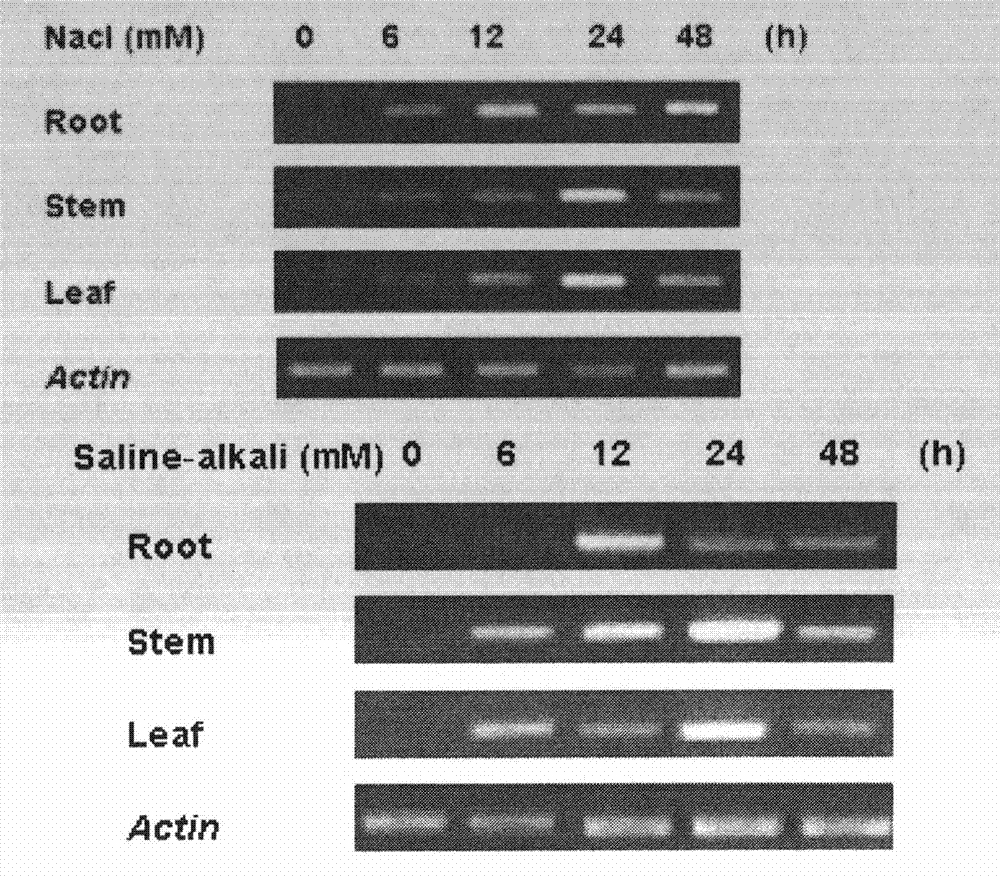
[0043] Primer 5 and primer 6 are the primers of the SucHP gene in the vector, and the amplified fragment is 569bp; primer 7 and primer 8 are the primers of the internal reference gene Actin, and the amplified fragment is 438bp; 3 Treat 0h, 6h, 12h, 24h, 48h. Use the cDNA of Suaeda salsa roots, stems and leaves as templates to detect gene expression; after the PCR reaction is completed, perform 1% agarose gel electrophoresis detection on the PCR products, and the detection results are shown in figure 1 , the results showed that the expression of SucHP gene had a certain salt-alkaline inducibility.
Embodiment 3
[0044] Example 3 Construction of Plant Expression Vector pCB35S-SucHP
[0045] According to the sequence of SEQ ID No.1, design and construct the ATTB1 and ATTB2 adapter primers of the expression vector:
[0046] Primer 1: 5′-AAAAAGCAGGCTATGGGTGTTGTTCTTCTTC-3′
[0047] Primer 2: 5′-AGAAAGCTGGGTTTAGAAAGATCTTGAAGAGCA-3′
[0048] Primer 3: 5′-ggggACAAgTTTgTACAAAAAAgCAggCT-3′
[0049] Primer 4: 5′-ggggACCACTTTgTACAAgAAAgCTgggT-3′
[0050] 1) Using the total cDNA of Suaeda salsa as a template, use primer 1 and primer 2 with ATTB1 and ATTB2 adapters to carry out the first round of PCR amplification. The amplification system is as follows:
[0051] The amplification system and procedures are:
[0052] 2×Taq Mix 12.5μl
[0053] Primer 1 1.0 μl
[0054] Primer 2 1.0 μl
[0055] Template DNA 1.0μl
[0056] ddH2O 9.5μl
[0057] The PCR reaction conditions are:
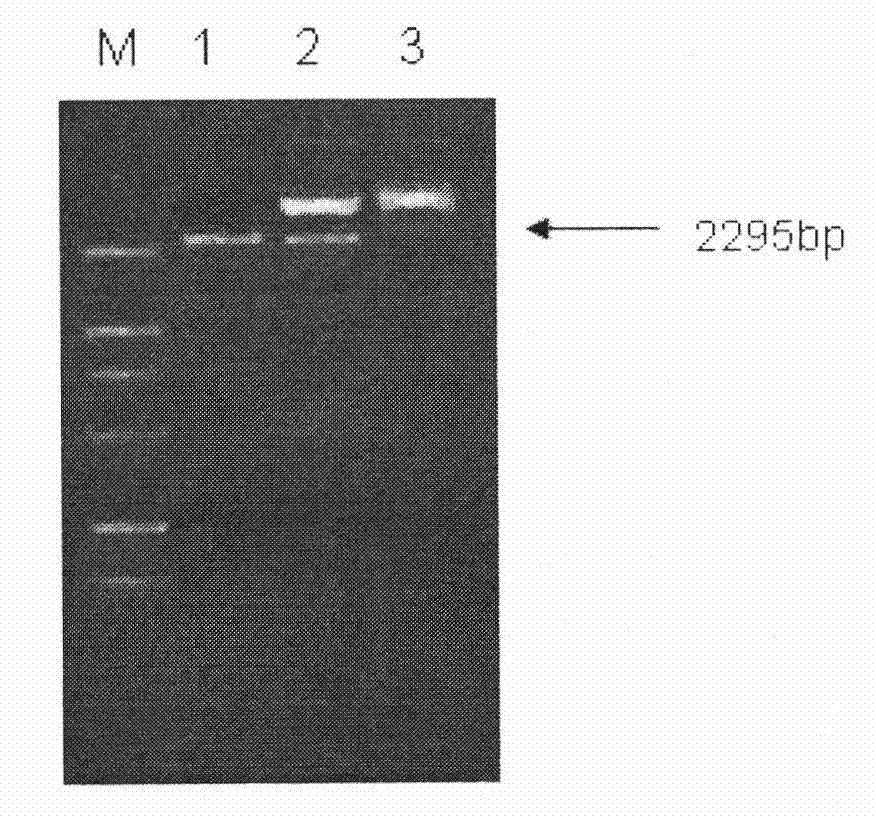
[0058] After the PCR reaction, take 5 μl of the product and mix it in 2 μl of 6×Loading Buffer, and perform electro...
PUM
 Login to View More
 Abstract
Description
Claims
Application Information
 Login to View More