A method for isolating exosomes from animal plasma and performing purity testing
What is AI technical title?
AI technical title is built by Patsnap AI team. It summarizes the technical point description of the patent document.
A technology of purity detection and exosomes, which is applied in the field of cell biology to achieve high biological activity
Inactive Publication Date: 2020-02-07
SICHUAN AGRI UNIV
View PDF2 Cites 2 Cited by
Summary
Abstract
Description
Claims
Application Information
AI Technical Summary
This helps you quickly interpret patents by identifying the three key elements:
Problems solved by technology
Method used
Benefits of technology
Problems solved by technology
Since the identification of exosome purity requires the use of some expensive instruments such as electron microscopes, this is a great limitation for many laboratories
Method used
the structure of the environmentally friendly knitted fabric provided by the present invention; figure 2 Flow chart of the yarn wrapping machine for environmentally friendly knitted fabrics and storage devices; image 3 Is the parameter map of the yarn covering machine
View more
Image
Smart Image Click on the blue labels to locate them in the text.
Viewing Examples
Smart Image
Click on the blue label to locate the original text in one second.
Reading with bidirectional positioning of images and text.
Smart Image
Examples
Experimental program
Comparison scheme
Effect test
Embodiment 1
[0047] A 2.7Kg rabbit was collected 10ml of blood by way of jugular vein blood collection, and the anticoagulant was EDTA. The anticoagulated blood was transferred into a 2ml centrifuge tube and centrifuged at 3000rpm for 30min to separate the plasma. The separated plasma was used for exosome extraction.
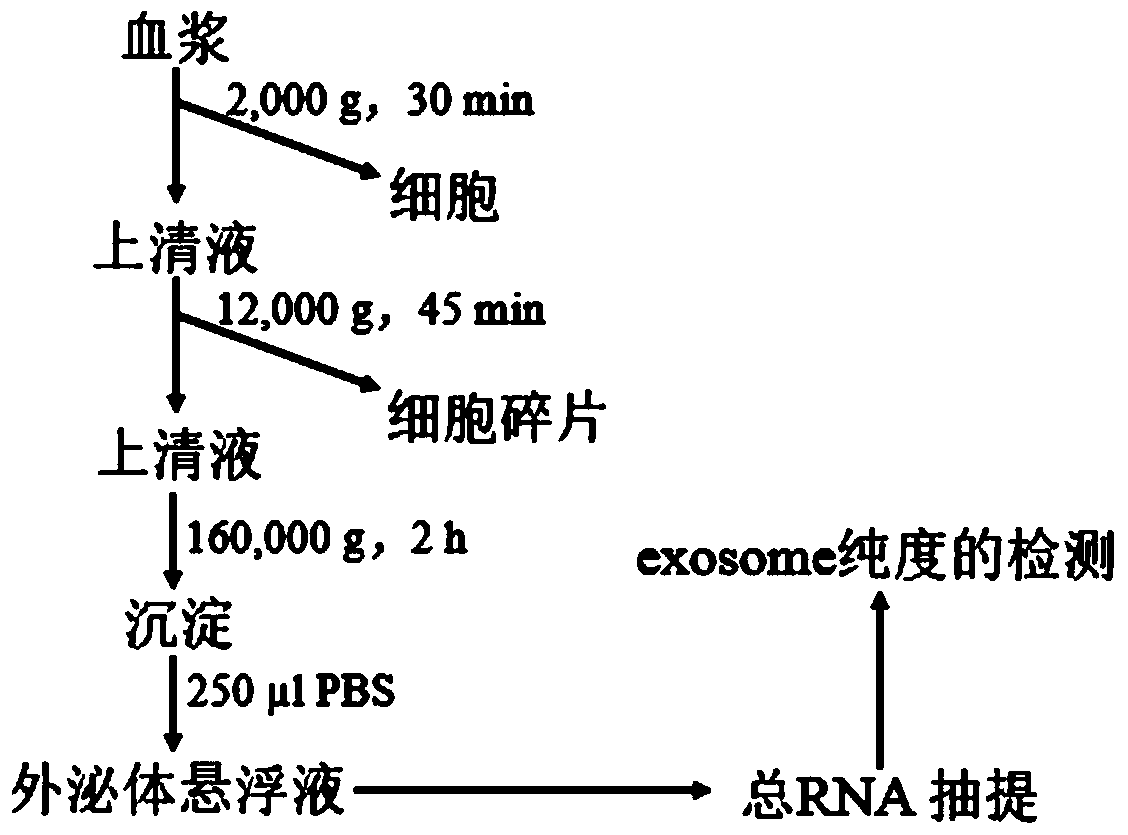
[0048] Methods for isolating exosomes from rabbit plasma, such as figure 1 shown, including the following steps:
[0049] (1) Dilute 2ml of plasma with PBS solution at a ratio of 1:1;
[0050] (2) Centrifuge at 2000g for 30min at 4°C to remove cellular components in the plasma, and retain the supernatant after centrifugation;
[0051] (3) Collect the filtrate into a centrifuge tube again, and centrifuge at 12,000 g for 30 minutes at 4°C to remove cell debris. If the plasma needs to be frozen, store it at -80°C after this step;
[0052] (4) Collect the supernatant into a centrifuge tube, filter the supernatant with a 0.22 μm filter membrane, so that microcapsules smaller ...
Embodiment 2
[0061] The exosomes isolated in Example 1 were subjected to total RNA extraction, miRNA quantification and purity detection, and the miRNA extracted in Example 1 was subjected to poly(A) reverse transcription and quantification.
[0062] The present invention utilizes 6 highly expressed miRNAs identified in human plasma for miRNA quantitative detection, namely miR-93a-3p, miR-451a-5p, miR-21-5p, miR-16-5P, miR-181 -5p, miR-92a; two additional intracellular genes were used: U6 and 5S. U6 is a small nuclear molecule RNA, which mainly exists in the nucleus. 5S rRNA is a component of the large ribosomal subunit. Both prokaryotes and eukaryotes have 5S rRNA, and their structures are similar. Both types of genes are not present in exosomes and thus serve as negative controls. The primer sequences of the 12 genes are shown in the list. Specific steps are as follows:
[0063] Poly(A) tailing reaction reverse transcribes miRNA into cDNA. Specific steps are as follows:
[0064] (1...
the structure of the environmentally friendly knitted fabric provided by the present invention; figure 2 Flow chart of the yarn wrapping machine for environmentally friendly knitted fabrics and storage devices; image 3 Is the parameter map of the yarn covering machine
Login to View More
PUM
Property
Measurement
Unit
diameter
aaaaa
aaaaa
Login to View More
Abstract
The invention provides a method for separating exosomes from animal plasma and for detecting purity. The method mainly comprises the following steps: first, thinning the plasma by virtue of a PBS (phosphate buffer solution) at the ratio of 1 to 1; removing cell components and cell debris in the plasma through centrifuging; precipitating the exosomes through ultrahigh-speed centrifugation; suspending the exosomes by virtue of 250[mu]l of the PBS solution; extracting total RNA in an exosome suspension by virtue of Trizol LS; and conducting poly (A) reversing and related gene quantification on the extracted total RNA, and detecting the purity. The method disclosed by the invention is conducive to researches on plasma exosome contents and exosome related functions in the future.
Description
technical field [0001] The invention belongs to the field of cell biology, and in particular relates to a method for isolating exosomes from animal plasma and performing purity detection. Background technique [0002] Exosomes are membranous vesicles with a diameter of about 50-200 nm. Cells produce small vesicles through endocytosis, and the small vesicles fuse to form early endosomes, which gradually become late endosomes. With the entry of some "cargo" such as miRNA, enzyme molecules, and heat shock proteins in the cytoplasm, many small vesicles (intraluminal vesicles, ILVs) will be produced in the late endosome, and gradually evolve into multivesicular bodies (MVB); These vesicles are then released outside the cell to form exosomes. Exosomes exist in cell culture fluid and body fluids, mainly including saliva, pleural fluid, cerebrospinal fluid, ascites, urine, plasma, serum and other body fluids. Exosomes contain a variety of biomolecules, such as mRNA, miRNA, mtDNA,...
Claims
the structure of the environmentally friendly knitted fabric provided by the present invention; figure 2 Flow chart of the yarn wrapping machine for environmentally friendly knitted fabrics and storage devices; image 3 Is the parameter map of the yarn covering machine
Login to View More
Application Information
Patent Timeline
Application Date:The date an application was filed.
Publication Date:The date a patent or application was officially published.
First Publication Date:The earliest publication date of a patent with the same application number.
Issue Date:Publication date of the patent grant document.
PCT Entry Date:The Entry date of PCT National Phase.
Estimated Expiry Date:The statutory expiry date of a patent right according to the Patent Law, and it is the longest term of protection that the patent right can achieve without the termination of the patent right due to other reasons(Term extension factor has been taken into account ).
Invalid Date:Actual expiry date is based on effective date or publication date of legal transaction data of invalid patent.



 Login to View More