A Nocturnal Video Enhancement Method Based on Gradient Fusion

A video enhancement and gradient technology, applied in image enhancement, image analysis, instruments, etc., can solve the problems of video image color drift, unable to enhance video information, etc., and achieve the effect of image color fidelity

CN106296626BActive Publication Date: 2019-06-04SHANGHAI UNIV
3 Cites 0 Cited by

Patent Information

Authority / Receiving Office
CN · China
Patent Type
Patents(China)
Current Assignee / Owner
Publication Date
2019-06-04

Smart Images

  • Figure 1
    Figure 1
  • Figure 2
    Figure 2
  • Figure 3
    Figure 3
Patent Text Reader

Abstract

The invention relates to a night video enhancement method based on gradient integration. Day background frames can be extracted by utilization of spatial constraint conditions and a Gaussian mixture model, and gradient information of day video background frames is integrated into night video gradient images, so the detailed information lost in the night video images can be compensated. Restored images can be obtained by use of a poisson equation and the boundary conditions of the day background frames. The video image brightness is enhanced, and moreover, a color fidelity effect is achieved.
Need to check novelty before this filing date? Find Prior Art

Description

technical field

[0001] The invention relates to a nighttime video enhancement method based on gradient fusion, and belongs to the technical field of video surveillance enhancement. Background technique

[0002] Due to the low illumination conditions at night, the nighttime video images captured by the monitoring system will have relatively low resolution and some area information will be lost, making it difficult to extract effective information from nighttime videos. Enhancement of nighttime video is very important for video target detection and tracking and subsequent analysis.

[0003] At present, the commonly used nighttime video enhancement methods in China include contrast-based video enhancement methods, filter-based video enhancement methods, wavelet transform-based video enhancement methods, and nighttime video enhancement methods based on frame brightness fusion. The first three types of methods are only in the existing The contrast, dynamic range, and gray value ...

Examples

Embodiment Construction

[0049] The specific embodiments of the present invention will be further described below in conjunction with the accompanying drawings.

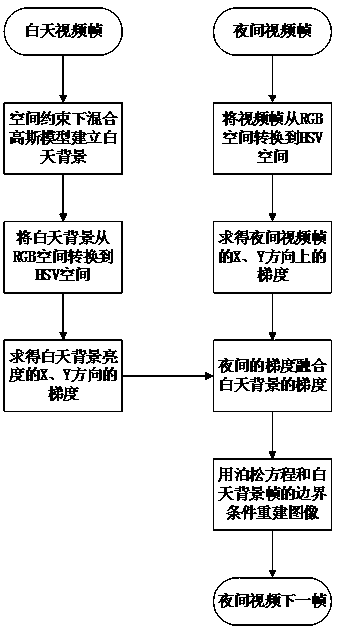
[0050] Such as figure 1 As shown, a nighttime video enhancement method based on gradient fusion consists of the following steps:

[0051] Step 1: Download the night video video taken by the same surveillance camera night (i,j,l), where 1≤i≤M, 1≤j≤N, 1≤l≤L; and daytime video day (i,j,k), where 1≤i≤M, 1≤j≤N, 1≤k≤K; where i and j are the row and column coordinates of pixels in the nighttime video and daytime video images respectively, M, N represents the number of rows and columns of nighttime video and daytime video image respectively; l represents the frame number of nighttime video, L represents the frame number of nighttime video image, k represents the frame number of daytime video, and K represents the frame number of daytime video image; In the embodiment, M, N, L and K are 240, 320, 450 and 300, respectively.

[0052] Step 2: Using ...