
Toothbrush handle and toothbrush
A handle and toothbrush technology, applied in the direction of brushes, brush bodies, bristles, etc., can solve the problems of unfavorable cleaning of gingival sulcus plaque, the brush handle is not easy for users to control or perceive the bristles, and the user is inconvenient to use and experience. Improve the effect of brushing experience
- Summary
- Abstract
- Description
- Claims
- Application Information
AI Technical Summary
Problems solved by technology
Method used
Image

Examples
specific Embodiment 1
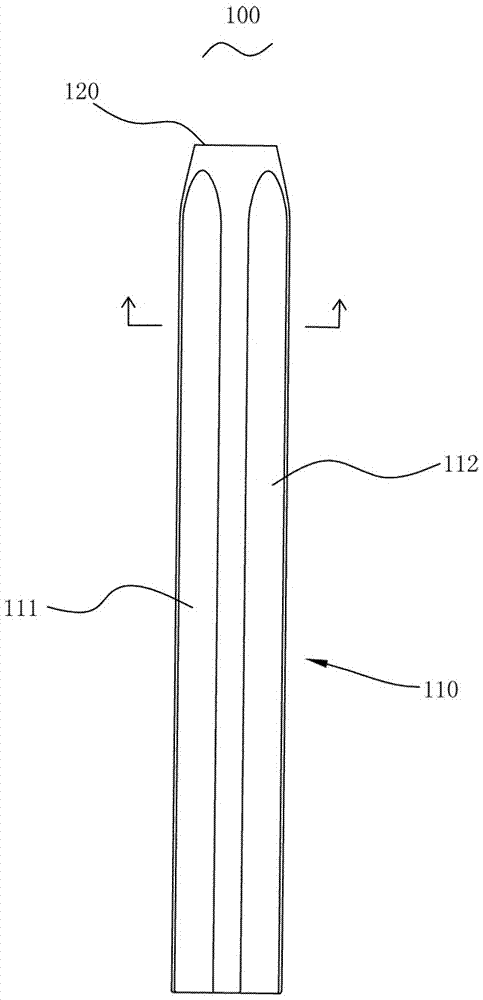
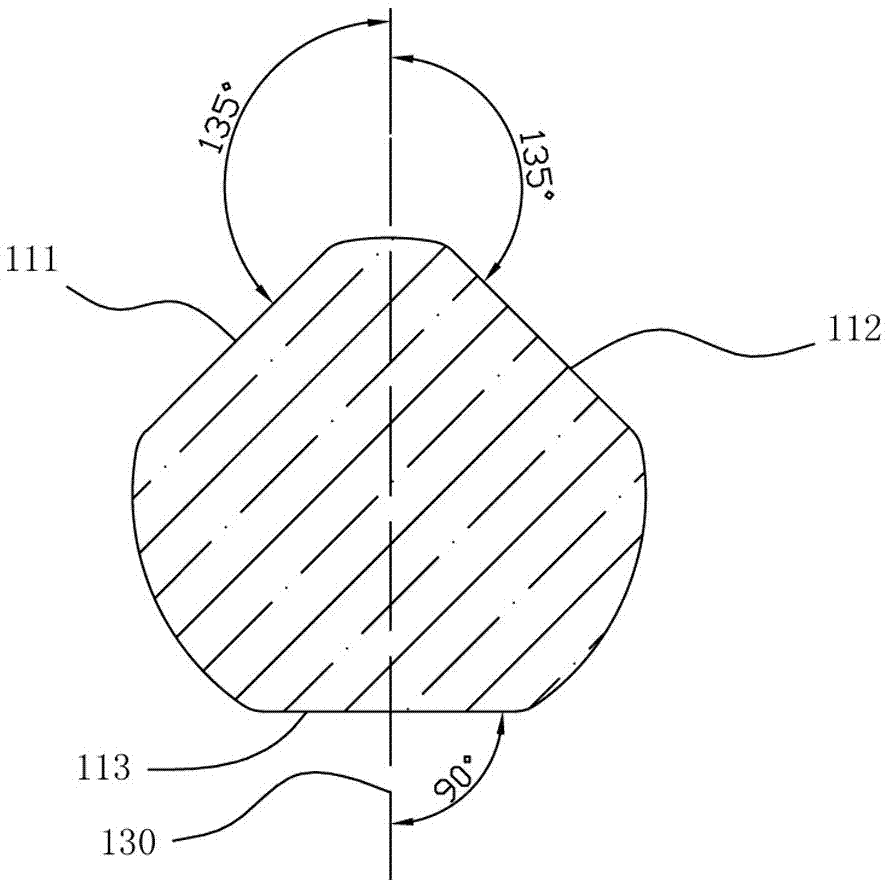
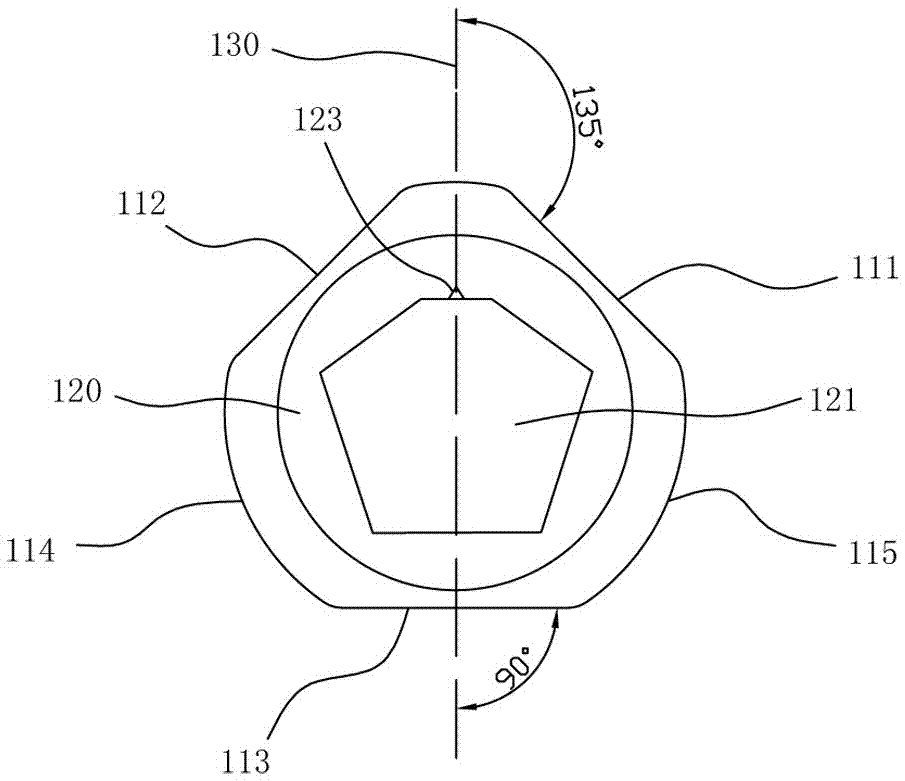
[0037] Such as figure 1 As shown, this embodiment discloses a toothbrush handle 100 , which includes a base body 110 suitable for a user to hold, and one end of the base body 110 is a connecting end 120 for setting an external brush head 200 . recombine figure 2 As shown, a first extension surface 111 and a second extension surface 112 are provided on the handle surface of the base body 110. In the cross-sectional view of the base body 110, the first extension surface 111 and the second extension surface 112 are substantially along the centerline 130 of the base body 110. It is arranged symmetrically, and the obtuse angle formed between the first extension surface 111 and the centerline 130 is preferably in the range of 130°-140°, and the obtuse angle formed between the second extension surface 112 and the centerline 130 is preferably in the range of 130°-140° After the connection end 120 is provided with the external brush head 200 , the center line 130 is basically located...
specific Embodiment 2
[0045] Such as Figure 5 As shown, this embodiment discloses a toothbrush 300, which includes a brush head 310 and a handle 320. The brush head 310 is provided with bristles 311, and the handle 320 is provided with a first extension surface 321 and a second extension surface 322 on the handle surface. Such as Figure 6 As shown, in the sectional view of the handle 320, the first extension surface 321 and the second extension surface 322 are arranged substantially symmetrically along the symmetry plane 330 of the bristles 311, and the angle formed between the first extension surface 321 and the symmetry plane 330 The range is preferably 130°-140°, and the angle formed between the second extension surface 322 and the symmetry plane 330 is preferably in the range of 130°-140°. In this embodiment, both the first extension surface 321 and the second extension surface 322 are set as planes, the angle formed between the first extension surface 321 and the symmetry plane 330 is 135°,...
PUM
| Property | Measurement | Unit |
|---|---|---|
| Angle | aaaaa | aaaaa |
Abstract
Description
Claims
Application Information
 Login to View More