
Unmanned aerial vehicle used for sea garbage cleaning based on Internet of Things
A technology of garbage cleaning and the Internet of Things, applied in the field of drones, can solve the problems of consuming a lot of time and energy, complex marine environment, and few drones with garbage cleaning functions, and achieve the effect of exquisite structure.
- Summary
- Abstract
- Description
- Claims
- Application Information
AI Technical Summary
Problems solved by technology
Method used
Image

Examples
Embodiment Construction
[0030] The present invention is described in further detail now in conjunction with accompanying drawing. These drawings are all simplified schematic diagrams, which only illustrate the basic structure of the present invention in a schematic manner, so they only show the configurations related to the present invention.
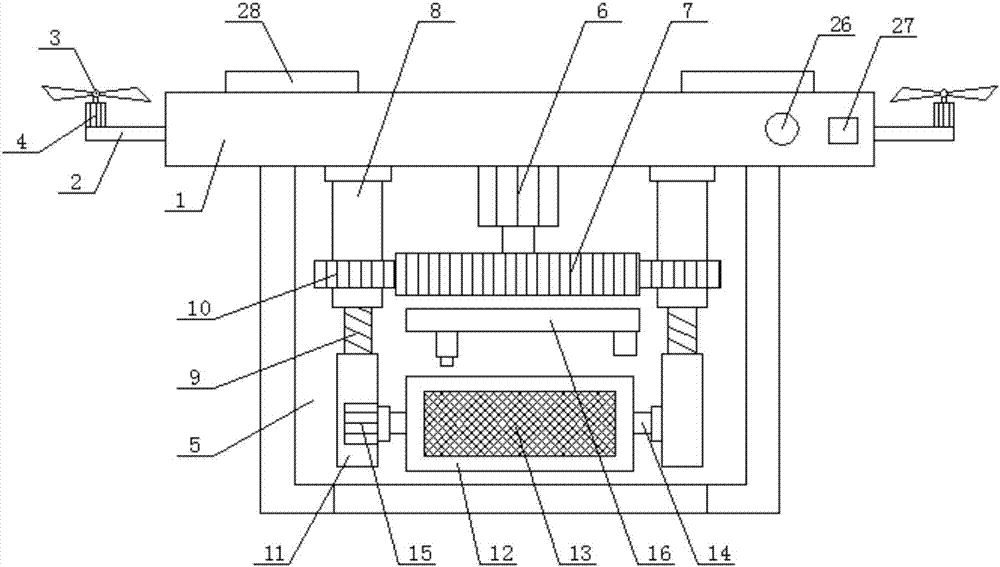
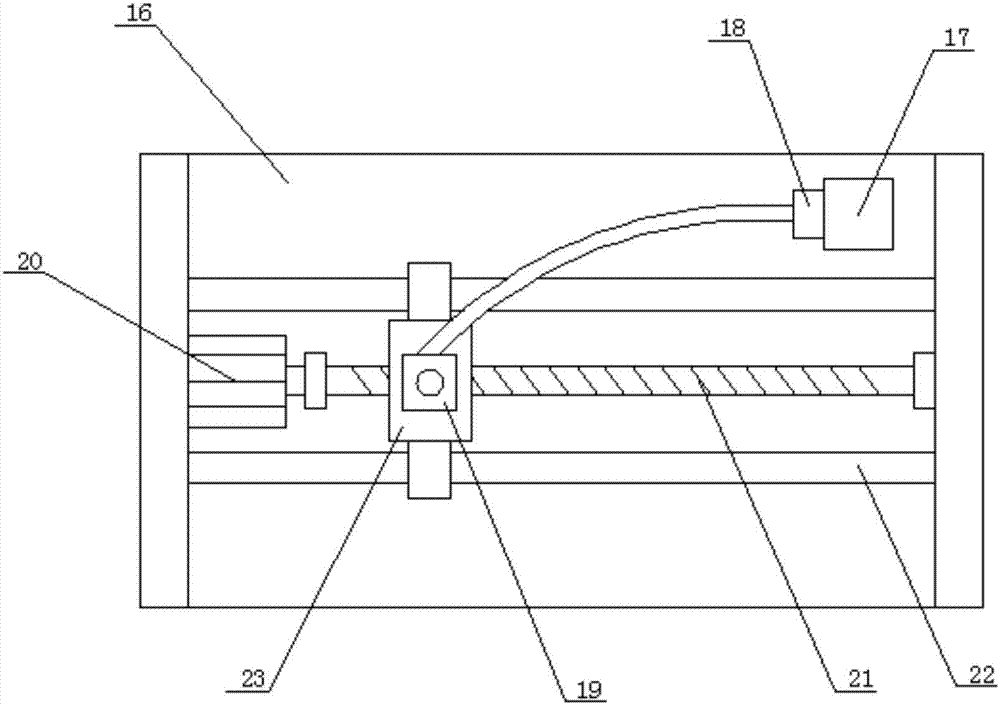
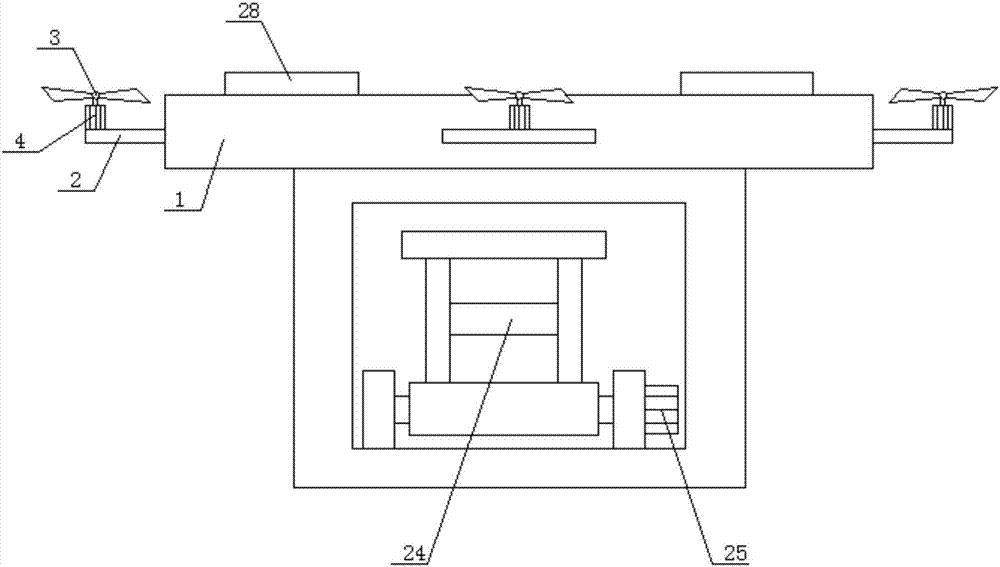
[0031] Such as Figure 1-4 As shown, a kind of unmanned aerial vehicle for sea surface garbage cleaning based on the Internet of Things includes a fuselage 1, a flight control module, a flight mechanism and a salvage mechanism;
[0032] The flight control module is located in the fuselage 1, the flight mechanism and the salvage mechanism are electrically connected to the flight control module, and the flight mechanism includes several flight components evenly distributed in the circumferential direction of the fuselage 1;
[0033] The flight assembly includes a cantilever 2, a rotor 3 and a rotor motor 4, the rotor motor 4 is connected to the fuselage 1 throu...
PUM
 Login to View More
 Abstract
Description
Claims
Application Information
 Login to View More