
Calculation method of energy storage capacity index of multi-energy system based on load forecast error
A load prediction error and prediction error technology, which is applied in the field of multi-energy systems, can solve problems such as the weakening of stable operation capabilities of multi-energy systems, and achieve the effects of improving stable operation capabilities, ensuring stable operation, and ensuring stability
- Summary
- Abstract
- Description
- Claims
- Application Information
AI Technical Summary
Problems solved by technology
Method used
Image



Examples
Embodiment 1
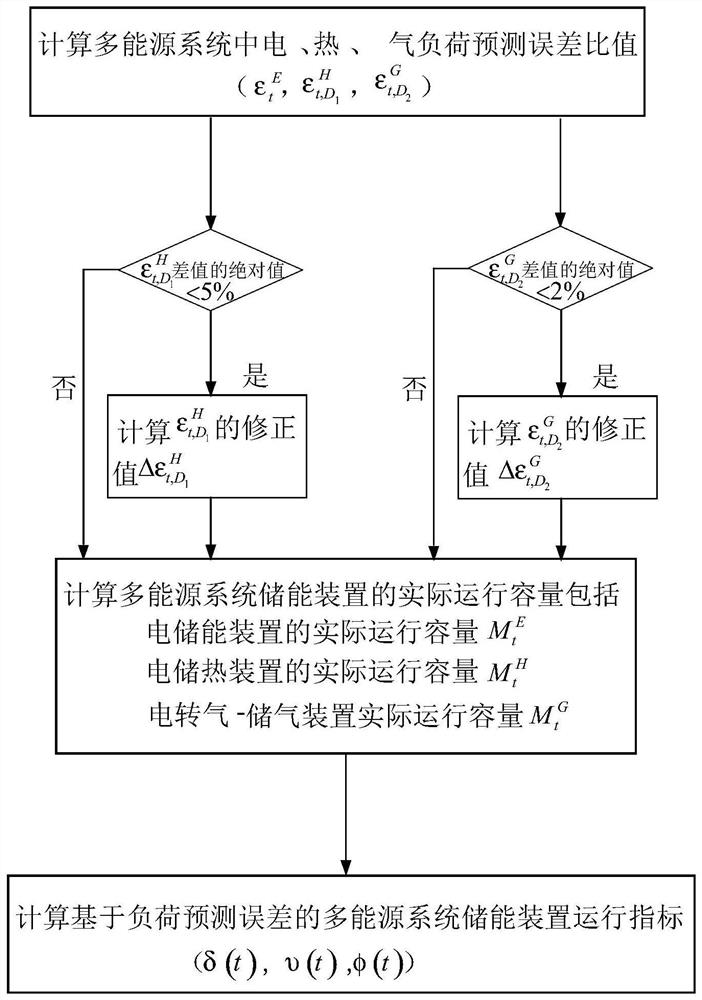
[0050] like figure 1 As shown in the figure, a method for calculating an energy storage capacity index of a multi-energy system based on a load prediction error includes the following steps:
[0051] Step 1: Calculate the estimation error ratio of electricity, heat and gas loads in the multi-energy system, which includes the following steps:
[0052] Step 1.1: Generally, in a multi-energy system, in order to make the prediction results more in line with the objective requirements, the predicted electric load is regarded as a random variable, and the electric load prediction error has different errors due to different time periods. , the peak-valley period has a large error, and the average period has a small prediction error. The short-term electric load forecast of the day before is regarded as a random variable, and its multiple prediction values are the center. The mean value of the m electrical load forecast values arbitrarily selected in the t period constructs the e...
Embodiment 2
[0095] The parameter value and calculation process are the same as those in Embodiment 1, the difference is:
[0096] In step 1.2, considering that the heat load has a large time inertia, when the heat load prediction error ratio in different time periods is When the absolute value of the difference is less than 5%, the heat load prediction error ratio needs to be calculated by the multivariate binomial linear regression equation given by formula (12) to the heat load prediction error ratio. make corrections;
[0097]
[0098] In the formula, is the correction value of the heat load prediction error ratio, β 0 ,β 1 ,β 2 is the weight factor for the prediction error ratio of different heat loads under the same confidence level, when the confidence level is 95%, β 0 =0.0308,β 1 =0.0307,β 2 =0.0031.
[0099] In this embodiment 2, it is assumed that the period of t=1 is 0.97%, when the heat load prediction confidence is 95%, select the following parameter β 0 =0.0...
PUM
 Login to View More
 Abstract
Description
Claims
Application Information
 Login to View More