

Screening Method With The Use Of TBK1 Knockout Mouse
a mouse and tbk1 technology, applied in the field of screening methods with the use of tbk1 knockout mice, can solve the problems of severe impairment of ifn- and ifn-inducible genes
Patent Information
- Authority / Receiving Office
- US · United States
- Patent Type
- Applications(United States)
- Current Assignee / Owner
- Publication Date
- 2008-07-31
- Estimated Expiration
- Not applicable · inactive patent
Smart Images
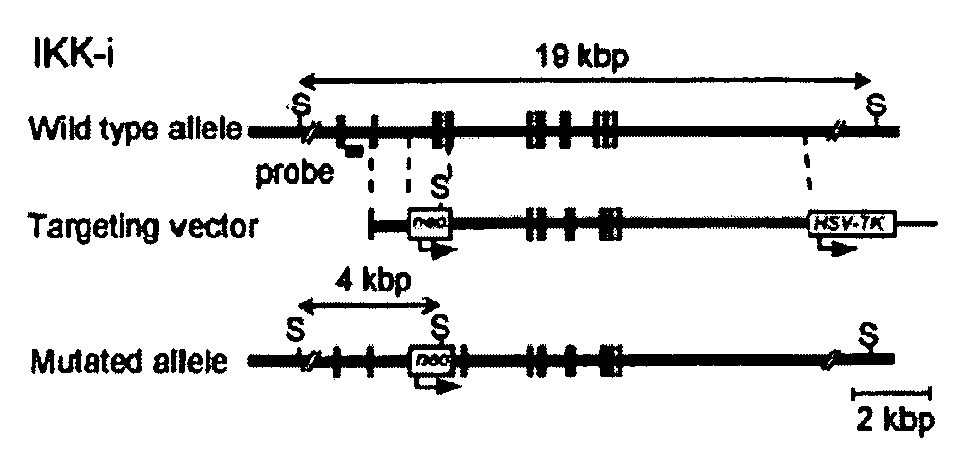
Figure 1 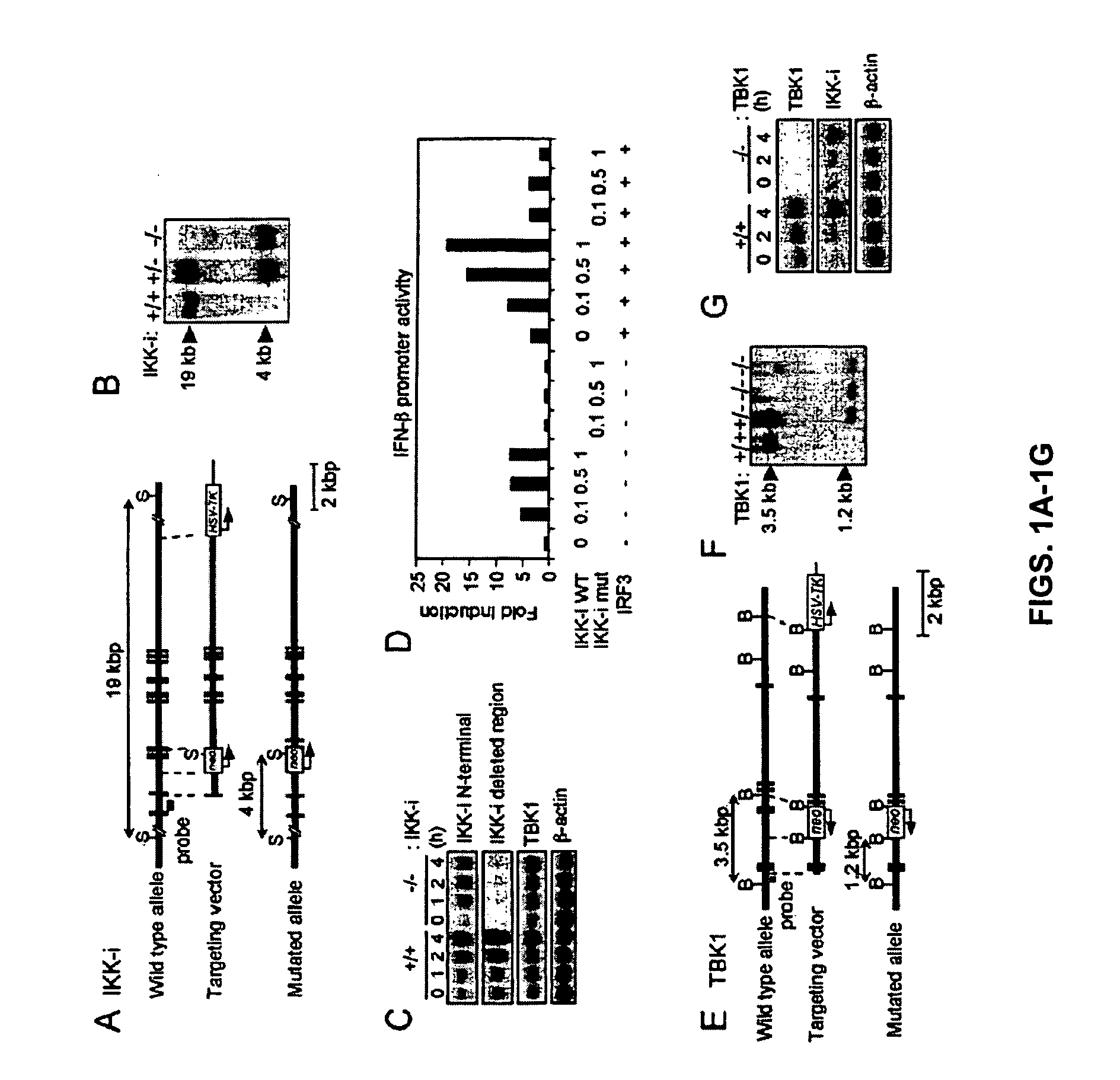
Figure 2 
Figure 3
Abstract
Description
INCORPORATION BY REFERENCE
[0001] This application is a continuation-in-part application of international patent application Serial No. PCT / JP2004 / 016404, filed Nov. 5, 2004, which claims benefit of Japanese patent application Serial No. 2003-380435, filed Nov. 10, 2003.
[0002] The foregoing applications, and all documents cited therein or during their prosecution (“appln cited documents”) and all documents cited or referenced in the appln cited documents, and all documents cited or referenced herein (“herein cited documents”), and all documents cited or referenced in herein cited documents, together with any manufacturer's instructions, descriptions, product specifications, and product sheets for any products mentioned herein or in any document incorporated by reference herein, are hereby incorporated herein by reference, and may be employed in the practice of the invention.FIELD OF THE INVENTION
[0003] The present invention relates to a method for screening inductive promoting substance...
Examples
example 1
Materials and Methods
(Cells, Virus, and Reagents)
[0029]Thioglycollate-elicited peritoneal cells were collected 3 days after intraperitoneal injection of 2 ml of 4% thioglycollate. Embryonic fibroblasts (EFs) were prepared from embryonic day 12.5 embryos as described previously (J. Immunol. 167:5887-5894, 2001). Recombinant vesicular stomatitis virus (VSV) was provided by Dr. Yoshiharu Matsuura and Dr. Takayuki Abe (Osaka University). Sendai virus (SeV) was provided by Dr. Tatsuo Shiota (Osaka University). EFs were infected with 1×10⁹ RNA copies / ml of VSV or multiplicity of infection (MOI) 10 of SeV. LPS from Salmonella Minnesota (S. minnesota) Re-595 was purchased from Sigma-Aldrich. Synthetic Pam3CSK4 (bacterial lipopeptide, BLP) was obtained from Boehringer Mannheim. TNF-α and IL-1β were purchased from Genzyme.
(Plasmids)
[0030]To construct the expression vectors for wild-type IKK-i and mutant IKK-i derived from the IKK-i mutated allele, RT-PCR products of IKK-i cDNA from wild-type ...
example 2
Results
(Generation of IKK-i− / − and TBK1− / − Mice)
[0038]To investigate the physiological role of IKK-i and TBK1, IKK-i− / − and TBK1− / − mice were generated by gene targeting. Targeting vectors used to generate IKK-i− / − mice were constructed to replace exons 7 and 8 of the IKK-i gene encoding a part of the second kinase domain with a neomycin resistant gene cassette (FIG. 1A). IKK-i− / − mice were born at the expected Mendelian ratio, were fertile, and appeared to be healthy (FIG. 1B). By using an N-terminal fragment of the IKK-i gene as a probe, IKK-i transcripts in thioglycollate-elicited peritoneal cells from homozygous mutant mice were detected (FIG. 1C). However, sequencing analysis showed that the IKK-i mRNA from the mutant allele lacked the targeted exons, contained a premature stop codon, and generated a truncated protein containing only one of the two kinase domains (data not shown). Transient transfection assay was used to estimate biological activity of wild-type and mutant IKK-...