
Method and apparatus for processing logistic information
a logistic and information technology, applied in the field of information processing, can solve the problems of large amount of storage and computing resources, increased complexity of three-dimensional simulation operations, and waste of space of transportation tools,
- Summary
- Abstract
- Description
- Claims
- Application Information
AI Technical Summary
Benefits of technology
Problems solved by technology
Method used
Image


Examples
embodiment 1
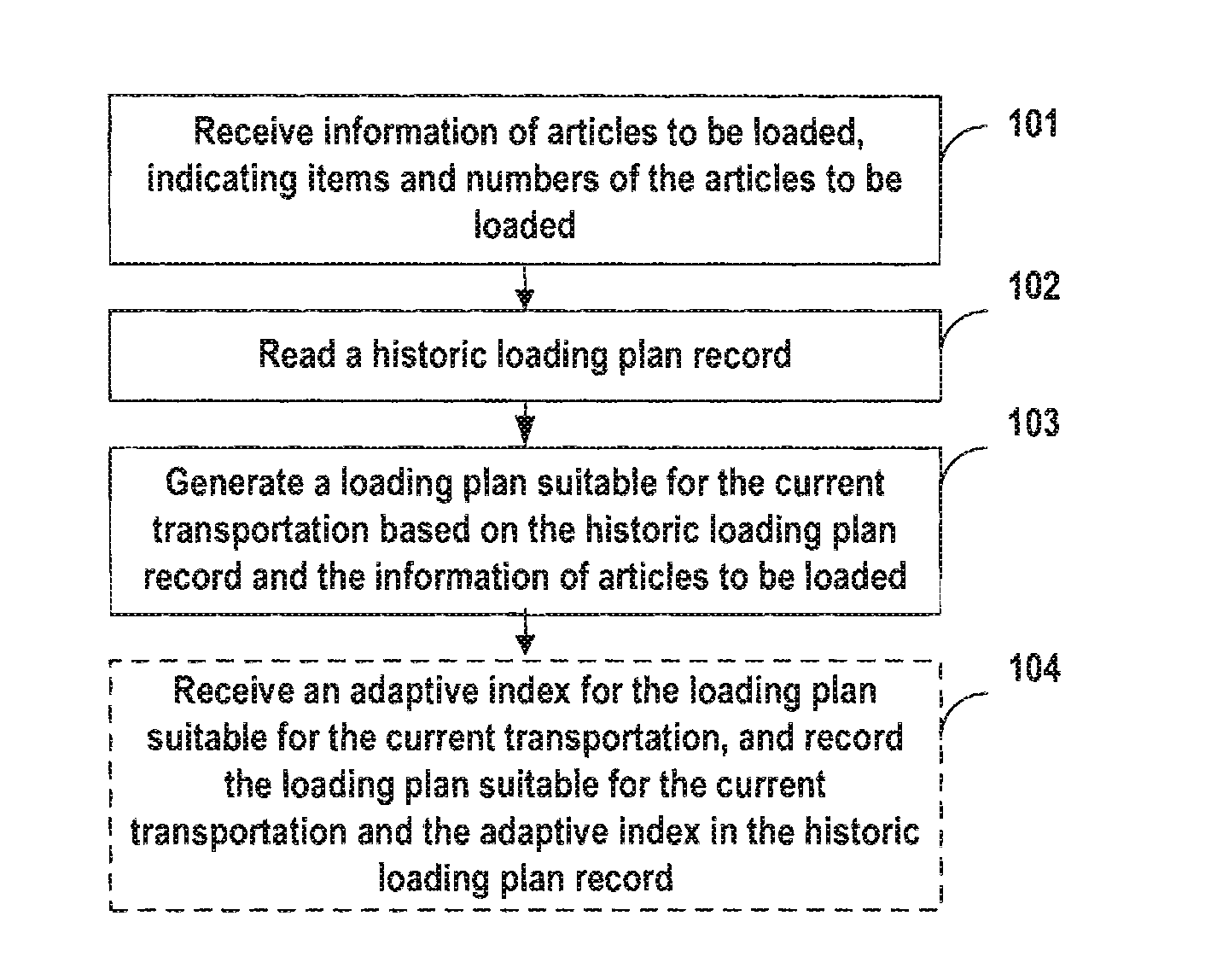
[0027]According to this embodiment, relevance between every two articles to be loaded is calculated based on a historic loading plan record. According to an embodiment of the present invention, the relevance between two articles may be obtained by calculating the ratio between the following two quantities: the number of loading plans simultaneously including these two articles in the historic loading plan record, and the number of loading plans merely comprising one of the two articles in the historic loading plan record. At least one of the above numbers may be a number that is weighted by the adaptive index, and the outcome is the relevance between two articles weighted according to the adaptive index. For example, when calculating the number of historic loading plans, it is possible to merely calculate the number of historic loading plans whose adaptive indexes are higher than a threshold. For another example, a relevance between article i and article j may be calculated accordin...
embodiment 2
[0038]According to this embodiment, a historic loading plan that is most approximate to the article to be loaded is sought. An approximation index between the articles to be loaded and the historic loading plan may be calculated by the means of Euclidean distance. For example, it is assumed that the articles to be loaded comprise articles A, B, C, and D. A first historic loading plan comprises articles A, B, E, and F, and a second historic loading plan comprises articles A, C, D, and F. The articles to be loaded may be expressed by a vector for articles to be loaded {1, 1, 1, 1, 0, 0}, where the first four 1's indicate that the articles to be loaded comprise articles A, B, C, and D, while the latter 0's indicate that the articles to be loaded do not include articles E and F. Similarly, the first historic loading plan may be expressed by a vector for the first historic loading plan {1, 1, 0, 0, 1, 1}, and the second historic loading plan may be expressed by a vector for the second hi...
PUM
 Login to View More
 Abstract
Description
Claims
Application Information
 Login to View More