
Computer program product and method for sales forecasting and adjusting a sales forecast
a computer program and sales forecasting technology, applied in the field of forecasting, can solve problems such as insufficient provision, insufficient use of inventory and resources, and inability to optimally use the enterpris
- Summary
- Abstract
- Description
- Claims
- Application Information
AI Technical Summary
Benefits of technology
Problems solved by technology
Method used
Image

Examples
example 1
[0068]Assume that there are: (a) 100 stores within a distribution center (DC) or cluster;
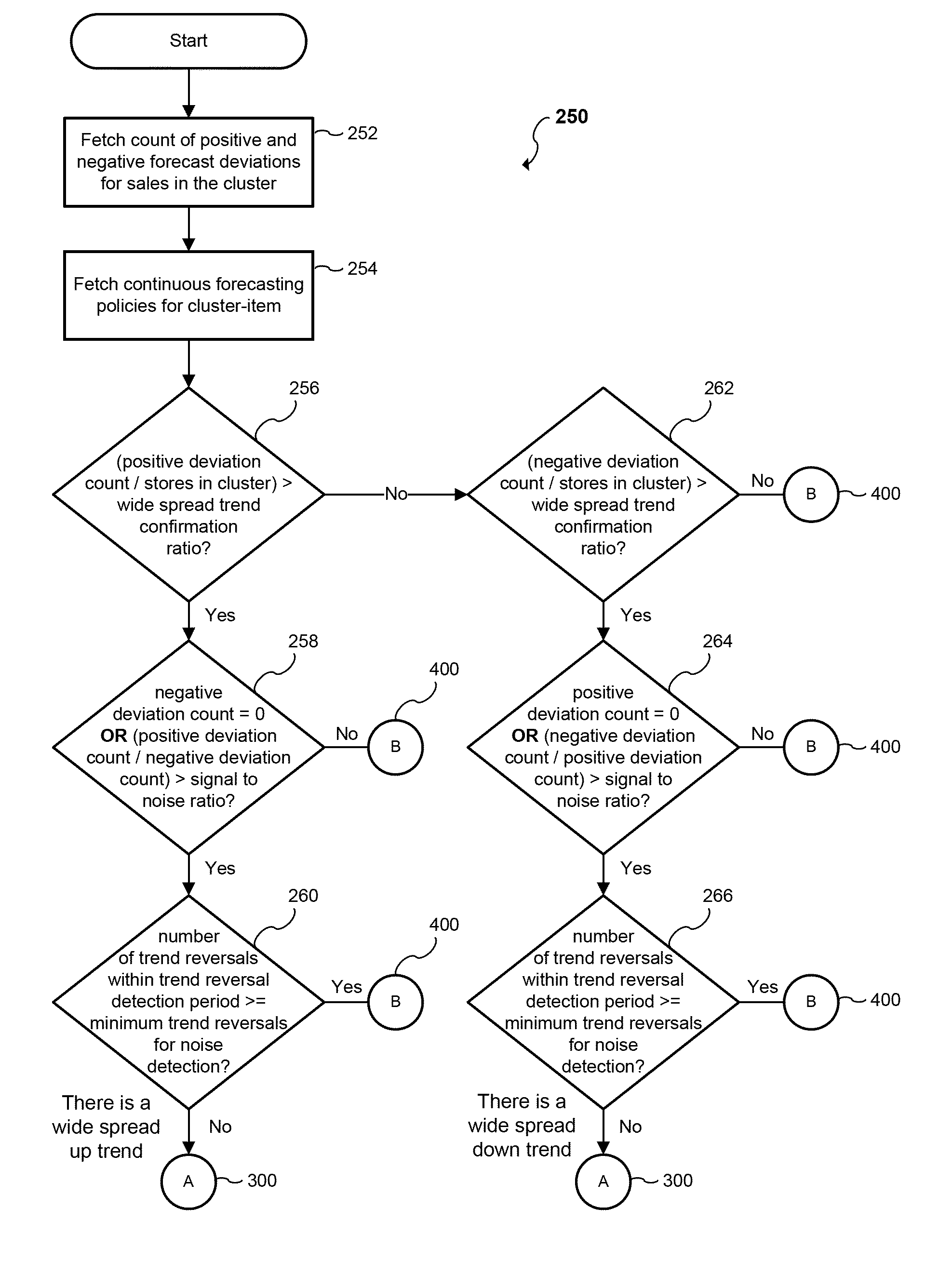
[0069](b) there are 50 alerts with a positive deviation from 22 distinct stores within the distribution center (DC) or cluster and that out of these 50 alerts, 10 are severe alerts and 40 are minor alerts (where severity is determined by the amount of sales deviation from forecast, in other words 10 occurrences are real big deviations and 40 are small deviations relatively); (c) there are 30 alerts with a negative deviation from 10 distinct stores within the distribution center (DC) or cluster; (d) WSTrendConfirmationRatio is equal to 0.22; and (e) SignalNoiseRatio is equal to 2.
[0070]This is a wide spread trend.
[0071]However, when the smoothing index is computed to update the forecast instead of purely taking the cumulative sales / cumulative forecasts across all stores, there is a grouping by severity. In other words, the stores that are part of the 10 severe alerts should receive a higher for...
example 2
[0075]The forecasting engine is run on Tuesday. It identifies all alerts having an alert type of “Store Daily Forecast Vs Sales Deviation” for Sunday, Monday, Tuesday, which have a positive deviation from the forecast, and all alerts which have negative deviation. Assume that there are: (a) 100 stores within the distribution center (DC) or cluster; (b) there are 50 alerts with a positive deviation from 22 distinct stores within the distribution center (DC) or cluster; (c) there are 45 alerts with a negative deviation from 15 distinct stores within the distribution center (DC) or cluster; (d) WSTrendConfirmationRatio is equal to 0.2; and (e) SignalNoiseRatio is equal to 2.
[0076]The first condition would be satisfied (22 / 100>0.2), but the second condition would not be satisfied (22 / 15<2). This would be considered noise or a no-trend situation.
example 3
[0077]The forecasting engine is run on Tuesday. It identifies all alerts having an alert type of “Store Daily Forecast Vs Sales Deviation” for Sunday, Monday, Tuesday, which have a positive deviation from the forecast, and all alerts which have negative deviation. Assume that there are: (a) 100 stores within the distribution center (DC) or cluster; (b) there are 50 alerts with a positive deviation from 22 distinct stores within the distribution center (DC) or cluster; (c) there are 30 alerts with a negative deviation from 10 distinct stores within the distribution center (DC) or cluster; (d) WSTrendConfirmationRatio is equal to 0.2; and (e) SignalNoiseRatio is equal to 2.
[0078]The first condition would be satisfied (22 / 100>0.2), and the second condition would also be satisfied (22 / 10>2). This would be considered a wide-spread up-trend.
Local Trends
[0079]A local trend is typically a trend within a store. According to at least one embodiment of the present invention, if only one item, ...
PUM
 Login to View More
 Abstract
Description
Claims
Application Information
 Login to View More