
Method and Device for Watermarking a Sequence of Images, Method and Device for Authenticating a Sequence of Watermarked Images and Corresponding Computer Program
a technology of watermarking sequence and watermarking sequence, applied in the field of video data security, can solve the problems of document not being authenticated, document cannot be used to identify the type of modifications undergone by the document, document cannot be authenticated, etc., and achieve the effect of reducing computation tim
- Summary
- Abstract
- Description
- Claims
- Application Information
AI Technical Summary
Benefits of technology
Problems solved by technology
Method used
Image

Examples
Embodiment Construction
[0082]5.1 General Principle
[0083]The general principle of the invention relies on the watermarking of a different message in the different images of a sequence of images, taking account especially of the motion between the successive images.
[0084]It is therefore possible to authenticate a received sequence of watermarked images in ascertaining that the received sequence contains no duplicated, retouched or eliminated images.
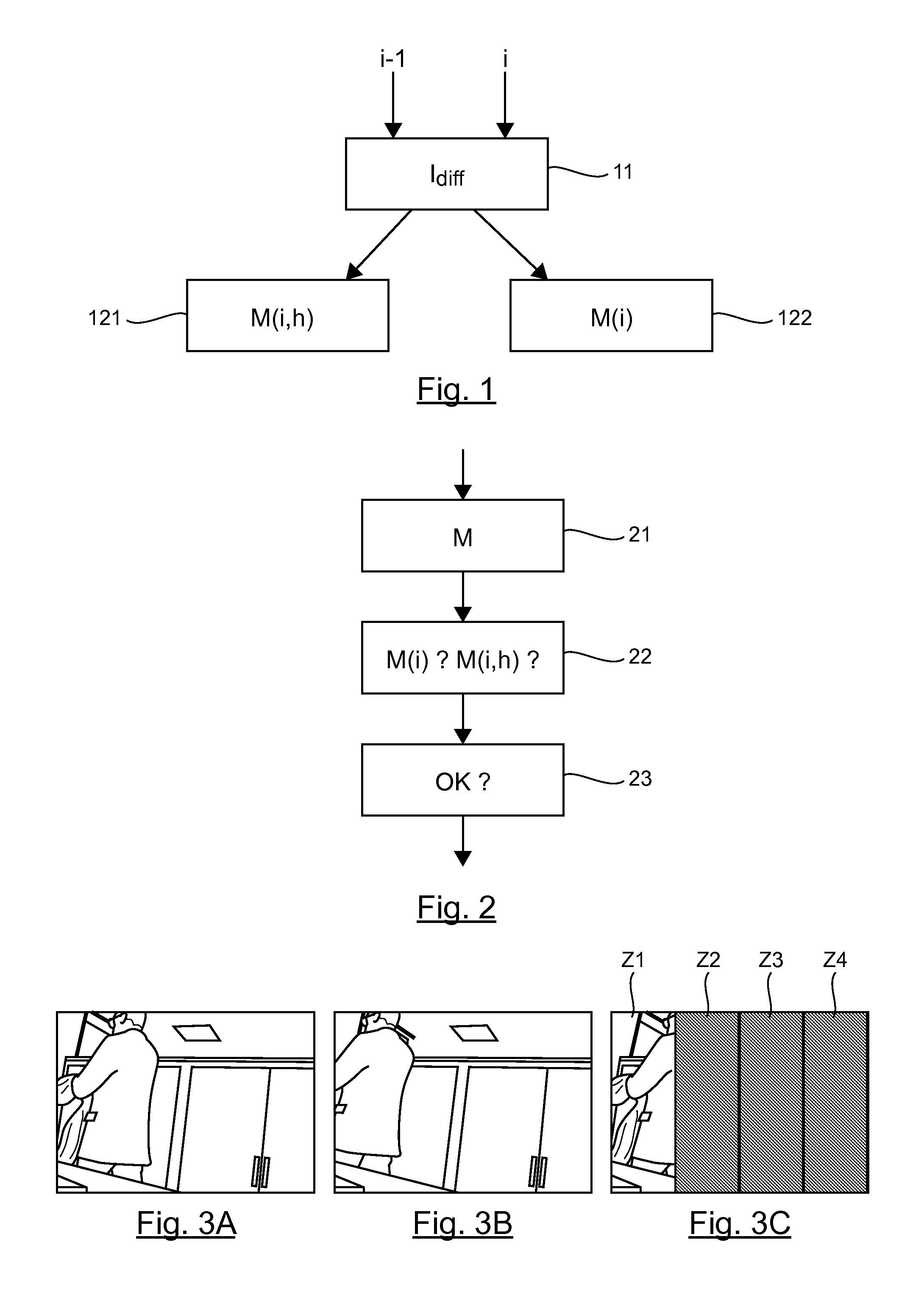
[0085]Referring to FIG. 1, we illustrate the main steps implemented for the watermarking of a sequence of images according to the invention.
[0086]Let's consider an image i of the sequence of images, called a current image, distinct from the first image of the sequence.
[0087]During a first step 11, the current image i is compared with a preceding image of the sequence, denoted as i−1. Thus, a difference image Idiff, is obtained, representing a motion between the preceding image i−1 and the current image i.
[0088]If there are significant differences between the curr...
PUM
 Login to View More
 Abstract
Description
Claims
Application Information
 Login to View More