Thermal sensor position detecting device

a position detection and thermal sensor technology, applied in the field of position detection, can solve the problems of significant distress, long-term, continuous and independent cessation of behavior, interference with social or work functioning, etc., and achieve the effects of improving position assessment, increasing heart rate, and increasing the field of vision of thermal sensors

Active Publication Date: 2018-05-24
CHILD MIND INST INC
View PDF5 Cites 13 Cited by
  • Summary
  • Abstract
  • Description
  • Claims
  • Application Information

AI Technical Summary

Benefits of technology

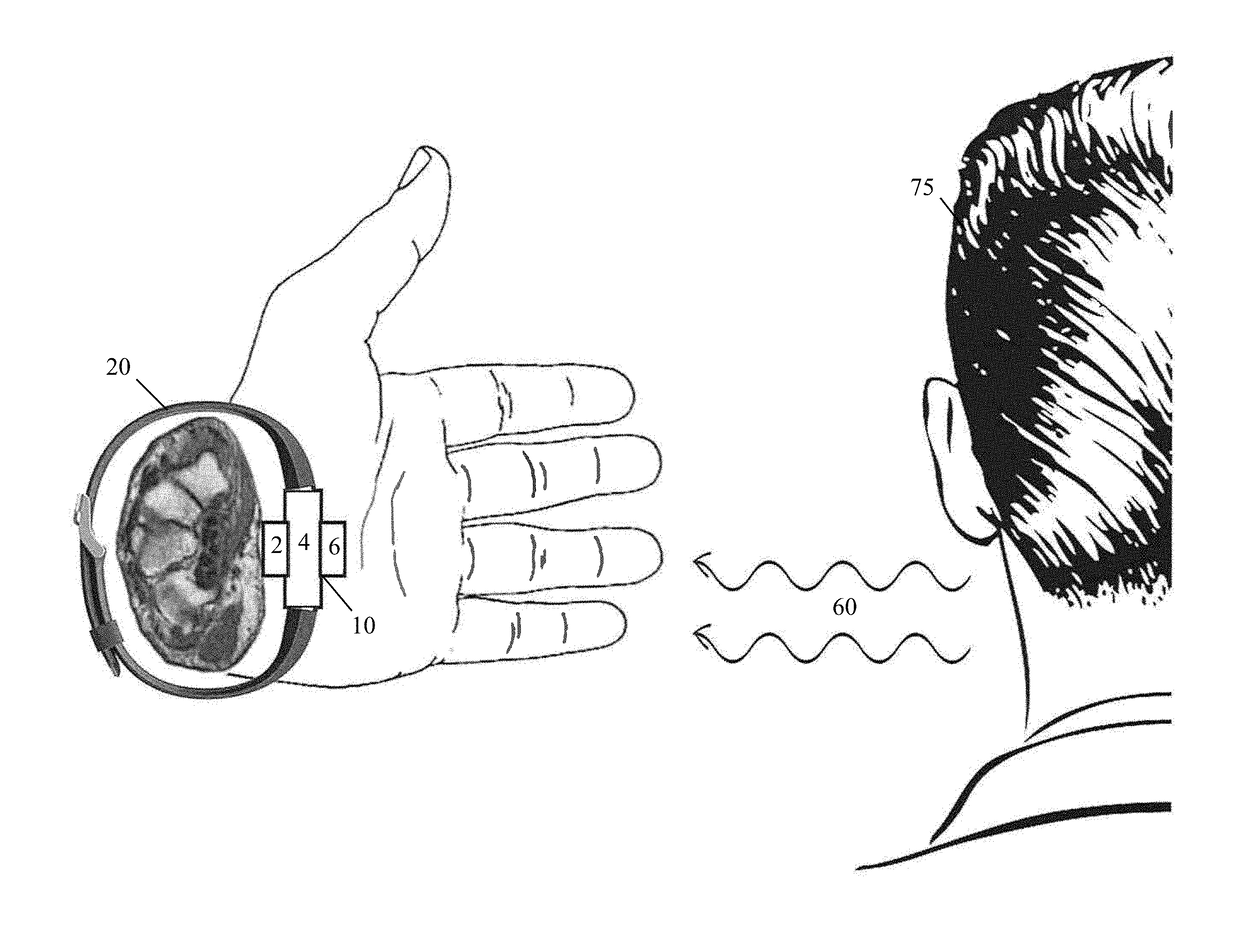
This patent describes a device that uses a thermal sensor to help track the user's body temperature and determine its exact position relative to the device. This technique helps to overcome challenges associated with using only accelerometers and magnetometers. The device can also include sensors to detect physiological characteristics, such as increased heart rate, which may be associated with emotive states, such as stress. This allows the device to better detect and minimize false positives and missed events.

Problems solved by technology

Those who engage in these behaviors are often not aware that they are engaging in them.
Studies have shown that devices that provide this service can lead to long term, continual and independent cessation of the behavior.
Hair pulling from the scalp often leaves patchy bald spots, which cause significant distress and can interfere with social or work functioning.
People with trichotillomania may go to great lengths to disguise the loss of hair.
For others, the compulsive urge to pull hair is overwhelming or unconscious.
Excoriation disorder, also known as skin-picking disorder, involves repetitive and compulsive picking of skin which results in tissue damage.
Damage from picking can be so severe as to require skin grafting.
Studies have shown that making individuals more aware that they are participating in these behaviors greatly decreases their propensity to engage in these behaviors in the future.
CBT (Cognitive Behavioral Therapy) and ACT (Acceptance and Commitment Therapy) are both used to treat harmful hair-pulling and skin-picking behavior, but are not always effective.
Children who suck their thumbs often or with great intensity around age four or five, or those who are still sucking their thumbs at age 6 or later, are at risk for dental or speech problems.
Prolonged thumb sucking may cause the teeth to become improperly aligned (malocclusion) or push the teeth outward.
Both of these treatments may be uncomfortable or even painful to a child.
Both of these treatments may also be outside the bounds of culturally acceptable child care.
Prior devices that rely on accelerometers and other relative position sensors cannot “dead reckon” their position relative to another object.
For example, the sensors may detect the angular position of the device relative to gravity, but they cannot detect whether the device is above, below or to the side of the user's head or any other object.
The present inventive device further increases the likelihood of detecting unwanted behavior events which warrant feedback.

Method used

the structure of the environmentally friendly knitted fabric provided by the present invention; figure 2 Flow chart of the yarn wrapping machine for environmentally friendly knitted fabrics and storage devices; image 3 Is the parameter map of the yarn covering machine
View more

Image

Smart Image Click on the blue labels to locate them in the text.
Viewing Examples
Smart Image
  • Thermal sensor position detecting device
  • Thermal sensor position detecting device
  • Thermal sensor position detecting device

Examples

Experimental program
Comparison scheme
Effect test

Embodiment Construction

[0038]The invention may be understood more readily by reference to the following detailed descriptions of preferred embodiments of the invention. However, techniques, systems, and operating structures in accordance with the invention may be embodied in a wide variety of forms and modes, some of which may be quite different from those in the disclosed embodiments. Consequently, the specific structural and functional details disclosed herein are merely representative, yet, in that regard, they are deemed to afford the best embodiment for purposes of disclosure and to provide a basis for the claims herein, which define the scope of the invention. It must be noted that, as used in the specification and the appended claims, the singular forms “a”, “an”, and “the” include plural referents unless the context clearly indicates otherwise.

[0039]Referring to FIG. 1, there is shown sensor device (10), an embodiment in accordance with the present invention. Sensor device (10) is shown worn on th...

the structure of the environmentally friendly knitted fabric provided by the present invention; figure 2 Flow chart of the yarn wrapping machine for environmentally friendly knitted fabrics and storage devices; image 3 Is the parameter map of the yarn covering machine
Login to View More

PUM

No PUM Login to View More

Abstract

Devices and methods for determining the position of a device relative to a person using the device, or the position of a part of a user's body relative to the user. One or more thermal sensor may be used to determine the relative position of the device or part of the user's body.

Description

CROSS-REFERENCE TO RELATED APPLICATIONS[0001]This application claims the benefit of U.S. Provisional Patent Application No. 62 / 424,131, filed Nov. 18, 2016. The entire contents of that application are incorporated herein by reference.FIELD OF THE INVENTION[0002]This invention relates to the field of position detection and, more particularly, to the use of one or more sensors to determine the position of the sensors or a device containing the sensors relative to a person's body.BACKGROUND OF THE INVENTION[0003]In various fields and applications, accurately determining the position of an object relative to a person holding or wearing the object, or the position of part of a person's body (e.g., a person's hand) relative to another part of the person (e.g., the person's head) is critical to successfully achieving a desired outcome. For example, virtual reality applications being developed today seek to render parts of a user's body, e.g., their arms and hands, within the digital world ...

Claims

the structure of the environmentally friendly knitted fabric provided by the present invention; figure 2 Flow chart of the yarn wrapping machine for environmentally friendly knitted fabrics and storage devices; image 3 Is the parameter map of the yarn covering machine
Login to View More

Application Information

Patent Timeline
no application Login to View More
IPC IPC(8): G01B11/14G01V8/10G01B11/26
CPCG01B11/14G01V8/10G01B11/26G06F3/011A61B5/486A61B5/165A61B5/02405A61B5/024A61B5/14551G01B11/002A61B5/7264A61B5/7267A61B5/1114A61B5/16A61B5/6802A61B5/681G06F3/017G06F3/014G06F3/012G16H50/20
InventorWHITE, CURTIS P.
OwnerCHILD MIND INST INC