Continuous On-Board Processing of Seafood After Fishing on the Sea
Active Publication Date: 2018-11-22
ZHEJIANG UNIV OF TECH
View PDF0 Cites 3 Cited by
Summary
Abstract
Description
Claims
Application Information
AI Technical Summary
This helps you quickly interpret patents by identifying the three key elements:
Problems solved by technology
Method used
Benefits of technology
Benefits of technology
[0006]To solve the problems such as low freshness processing on the land, and quality and safety decrease for seafood, the present invention provides a method of con
Problems solved by technology
Especially for the polar resource, Antarctic krill, is small-size, easy to be deteriorated, and hard to preserve.
According to the traditional production ways for seafood, the products have several problems such as low-fresh raw materials, quality decrease after processing (high-content of TVB-N, colour decrease, etc.).
This model not only keeps the freshness for raw materials by solving
Method used
the structure of the environmentally friendly knitted fabric provided by the present invention; figure 2 Flow chart of the yarn wrapping machine for environmentally friendly knitted fabrics and storage devices; image 3 Is the parameter map of the yarn covering machine
View more
Image
Smart Image Click on the blue labels to locate them in the text.
Viewing Examples
Smart Image
Click on the blue label to locate the original text in one second.
Reading with bidirectional positioning of images and text.
Smart Image
Examples
Experimental program
Comparison scheme
Effect test
example 1
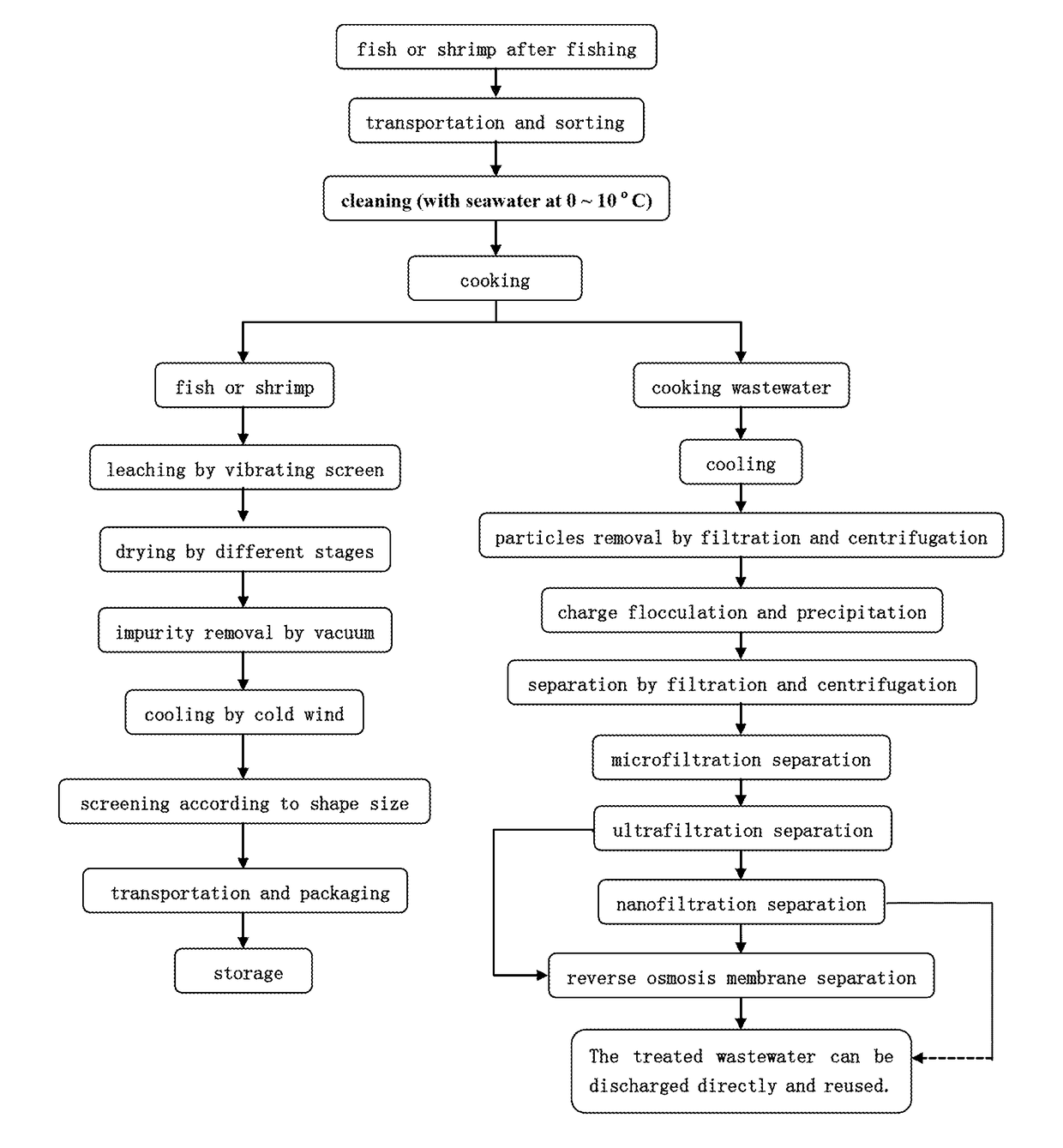
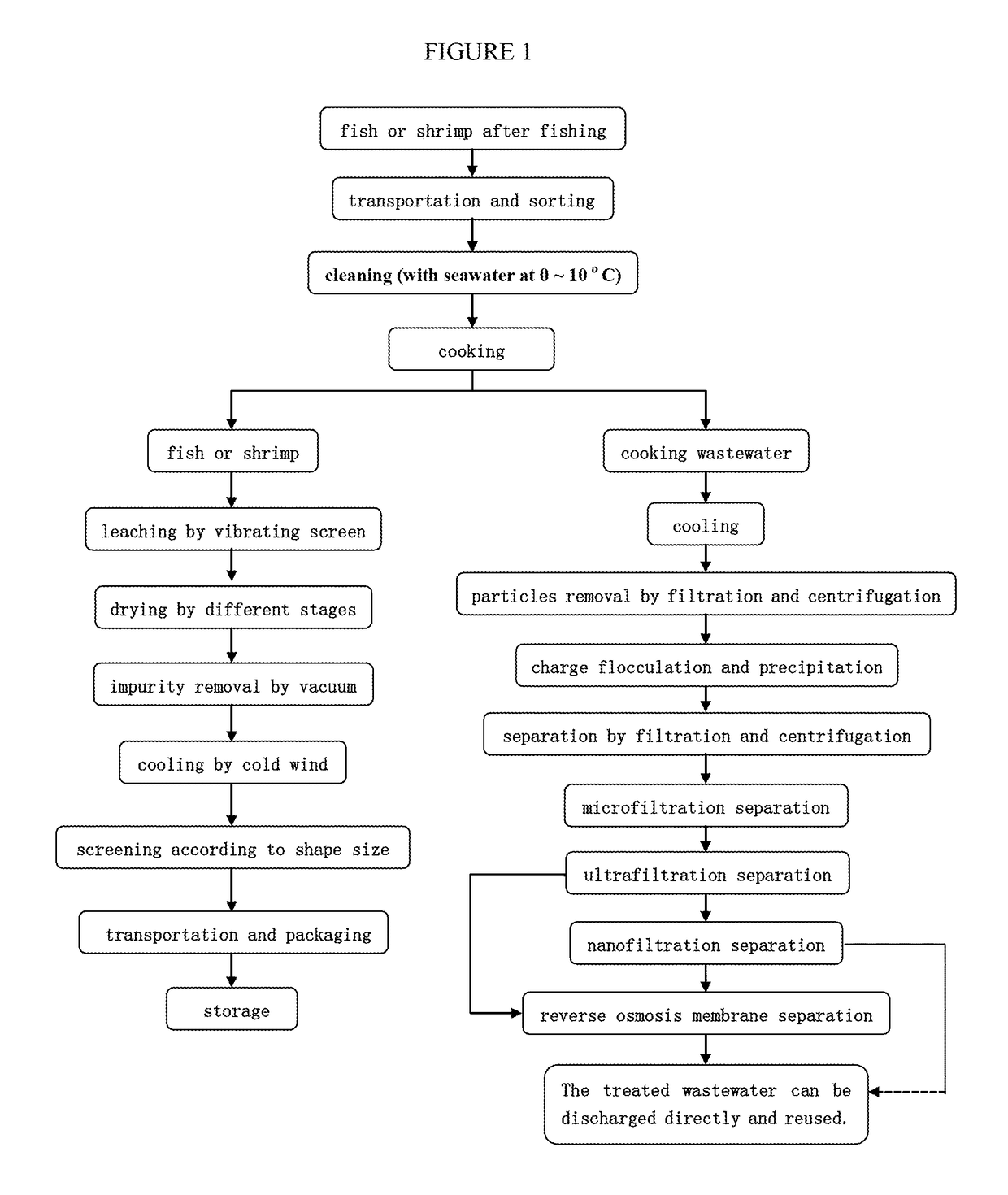
[0046]Referring to FIG. 1, a continuous on-board processing of fish or shrimp after fishing on the sea is executed as follows:
[0047]1) Cleaning and sorting of fishing shrimp: The fresh and live shrimp is cleaned by seawater, sorted. The temperature of seawater is controlled between 0° C. to 10° C.
[0048]2) Cooking: 2000 L of cooking soup containing a quality improver are put into a cooking tank. The cooking soup containing the quality improver is composed of edible alcohol (2 kg, produced by Jiangsu Donghai Shuntai Alcohol Co. Ltd.), glucono-delta-lactone (1 kg), tea polyphenol (4 kg), perilla juice (2 kg, produced by Zhejiang Shizi Bio-tech Co. Ltd.), hexametaphosphate (5 kg), and water. The cooking soup in the tank is heated until the temperature is up to 90° C. The shrimp is added into the tank to cook for 6 min, with the purpose of inactivation of enzyme (mainly endogenous proteases), reduction of microorganism, and meat dewatering. The solid-liquid ratio is controlled at 1:10. T...
example 2
[0056]1) 200 kg of clove fish are cleaned by seawater, and sorted. The temperature of seawater is controlled between 0° C. and 10° C.
[0057]2) 1000 L of cooking soup containing a quality improver are put into cooking tank. The cooking soup containing the quality improver is composed of salt (60 kg), edible alcohol (2 kg, produced by Jiangsu Donghai Shuntai Alcohol Co. Ltd.), glucono-delta-lactone (4.5 kg), tea polyphenol (200 g), perilla juice (1 kg, produced by Zhejiang Shizi Bio-tech Co. Ltd.), hexametaphosphate (500 g) and water. The cooking soup in the tank is heated until the temperature is up to 100° C. The clove fish (200 kg) is added into the tank to cook for 2 min. The cooking soup is replaced with new one every 2 hours. The replaced cooking soup (i.e., heat processing wastewater) should be treated to become more suitable for environment.
[0058]3) After leached on a stainless steel net, the cooked clove fish is put onto a vibrating screen with vibrating frequency of 750 r / min...
example 3
[0065]1) 250 kg of acete chinensis with 2 cm length are cleaned by seawater, and sorted. The temperature of seawater is controlled within 0˜10° C.
[0066]2) the acete chinensis is brought into cooking tank with a bucket elevator. 2000 L of cooking soup containing a quality improver is put into cooking tank. The cooking soup containing the quality improver is composed of salt (50 kg), edible alcohol (6 kg, produced by Jiangsu Donghai Shuntai Alcohol Co. Ltd.), glucono-delta-lactone (5 kg), tea polyphenol (2 kg), perilla juice (1 kg, produced by Zhejiang Shizi Bio-tech Co. Ltd.), hexametaphosphate (5 kg), and water. The cooking soup in the tank is heated to 98° C. and maintained for 4 min. The cooking soup is replaced with new one every 2 hours. The replaced cooking soup (i.e., heat processing wastewater) should be treated to become more suitable for environment.
[0067]3) After leached on a stainless steel net, the cooked acete chinensis is put onto a vibrating screen with vibrating freq...
the structure of the environmentally friendly knitted fabric provided by the present invention; figure 2 Flow chart of the yarn wrapping machine for environmentally friendly knitted fabrics and storage devices; image 3 Is the parameter map of the yarn covering machine
Login to View More
PUM
Property
Measurement
Unit
Temperature
aaaaa
aaaaa
Temperature
aaaaa
aaaaa
Temperature
aaaaa
aaaaa
Login to View More
Abstract
The present invention relates to a continuous on-board drying method for Antarctic krill and a continuous on-board processing method of shelled Antarctic krill. The drying method includes the following steps: 1) subjecting fishing materials to cleaning, sorting, and dewatering with a vibrating screen; 2) rapidly heating the krill to the temperature of up to 70° C. using infra-red rays; 3) hot-air drying; 4) impurity removal by vacuum; 5) cooling to obtain dried krill. The processing method includes the following steps: a) subjecting fishing materials to cleaning, sorting, and dewatering with a vibrating screen; b) rapidly heating the krill to the temperature of up to 70° C. using infra-red rays; c) hot-air drying; d) subjecting the dried krill to shelling treatment to separate shell from meat, to obtain shelled krill; e) impurity removal by vacuum to obtain shelled krill product. The methods in the present invention are highly efficient, energy saving, green and environmental protection, and the krill products have high quality and safety.
Description
CROSS-REFERENCE TO RELATED APPLICATIONS[0001]This application is a continuation of U.S. application Ser. No. 15 / 597,737, filed May 17, 2017, which is hereby incorporated by reference in its entirety.TECHNICAL FIELD OF THE INVENTION[0002]The present invention relates to a method of continuous on-board processing of seafood after fishing on the sea, specifically relates to a method of continuous on-board processing of seafood, and high efficient and energy-saving processing of its wastewater on the sea.BACKGROUND OF THE INVENTION[0003]For a long time, the production of seafood adopts the following traditional ways: firstly, marine fishing; secondly, salting processing or ice preservation and transportation; finally, traditional processing on the land. There is a strong seasonality of marine resources such as fish and shrimp. Especially for the polar resource, Antarctic krill, is small-size, easy to be deteriorated, and hard to preserve. According to the traditional production ways for...
Claims
the structure of the environmentally friendly knitted fabric provided by the present invention; figure 2 Flow chart of the yarn wrapping machine for environmentally friendly knitted fabrics and storage devices; image 3 Is the parameter map of the yarn covering machine
Login to View More
Application Information
Patent Timeline
Application Date:The date an application was filed.
Publication Date:The date a patent or application was officially published.
First Publication Date:The earliest publication date of a patent with the same application number.
Issue Date:Publication date of the patent grant document.
PCT Entry Date:The Entry date of PCT National Phase.
Estimated Expiry Date:The statutory expiry date of a patent right according to the Patent Law, and it is the longest term of protection that the patent right can achieve without the termination of the patent right due to other reasons(Term extension factor has been taken into account ).
Invalid Date:Actual expiry date is based on effective date or publication date of legal transaction data of invalid patent.



 Login to View More