
Synthetic process for water soluble sulfoalkyl ether-beta-cyclic dextrine
A synthesis process and sulfoalkyl ether technology are applied in the field of new synthesis process of water-soluble sulfoalkyl ether-β-cyclodextrin, which can solve the problems of low accuracy, increased production of by-products, increased separation difficulty and the like , to achieve high accuracy
Patent Information
- Authority / Receiving Office
- CN · China
- Patent Type
- Patents(China)
- Current Assignee / Owner
- Publication Date
- 2008-03-12
- Estimated Expiration
- Not applicable · inactive patent
Smart Images
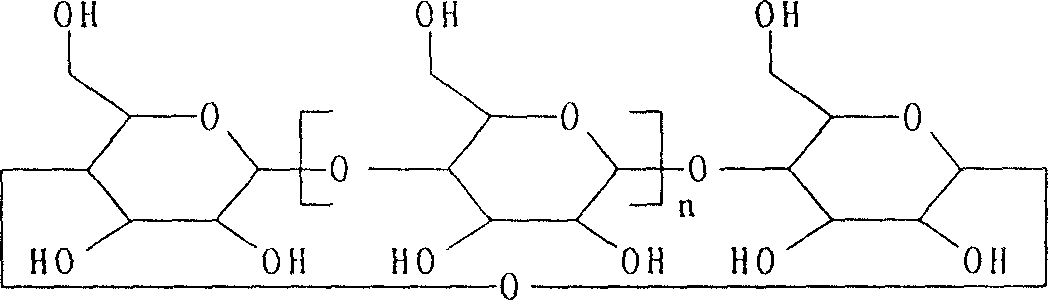
Figure 1 
Figure 2
Abstract
Description
technical field
[0001] The invention relates to a new synthesis process of a water-soluble sulfoalkyl ether-β-cyclodextrin, and belongs to the technical field of synthesis of pharmaceutical auxiliary materials. Background technique
[0002] Cyclodextrin (CD for short) is a cyclic oligosaccharide of D-glucose, which is isolated from the reaction of starch cyclodextrin glycosyltransferase, and is formed by β-glucopyranose in chair conformation through α-(1,4) It is connected by glycosidic bonds and has a special non-polar tire-like ring structure. Its chemical structure is as follows:
[0003]
[0004] Natural cyclodextrins include 6 (n=4, also known as α-CD), 7 (n=5, also known as β-CD), 8 (n=6, also known as γ-CD) chair conformations β-glucopyranose ring. In the field of pharmaceutical formulations, cyclodextrin and its derivatives are known as the perfect "host" body, which can encapsulate various organic and inorganic guest molecules and form non-covalent host-guest c...
Examples
Embodiment 1
[0021]Under stirring, dissolve 10 grams of β-cyclodextrin (8.8 mmol) in 20 mL of anhydrous dioxane solvent, and add 0.24 grams of sodium metal (10.6 mmol) in batches until the sodium metal is completely reacted, and add to the above reaction system 1.8 g of sultone (13.2 mmol) was slowly added dropwise, and the etherification reaction was carried out under reflux at 70° C. for 3 hours. After the reaction was complete, the amorphous solid was separated, washed with methanol three times, and dried. After drying, the solid was dissolved in 100 ml of deionized water, neutralized with 1N hydrochloric acid to pH 8, desalted and purified through a Sephadex column (G-25), the filtrate was concentrated, and freeze-dried to obtain white water-soluble sulfobutyl Ether-β-cyclodextrin 4.7 g (yield about 41%). The average molecular weight is 1307, elemental analysis: measured value C42.75%, H5.96%, S2.71%, Na1.93, C / S=15.77, calculated value (substitution degree is 1.1) C / S=15.7.
Embodiment 2
[0023] Under stirring, dissolve 10 grams of β-cyclodextrin (8.8 mmol) in 20 mL of anhydrous dioxane solvent, add 0.97 grams of sodium metal (42.3 mmol) in batches until the sodium metal is completely reacted, and then add to the above reaction system Slowly add 7.2 g of sultone (52.8 mmol) dropwise, and carry out etherification reaction at 90° C. for 3 hours under reflux reaction. After the reaction is complete, an amorphous solid is separated, washed with methanol three times, and dried. After drying, the solid was dissolved in 150 ml of deionized water, neutralized with 1N sulfuric acid to pH 8, desalted and purified through a Sephadex column (G-25), the filtrate was concentrated, and freeze-dried to obtain white water-soluble sulfobutyl Ether-β-cyclodextrin 8.3 g (yield about 52%). The average molecular weight is 1813, elemental analysis: measured value C39.35%, H5.65%, S7.49%, Na5.52, C / S=5.25, calculated value (substitution degree is 4.3) C / S=5.26.
Embodiment 3
[0025] Under stirring, dissolve 10 grams of β-cyclodextrin (8.8 mmol) in 20 mL of anhydrous dioxane solvent, and add 1.70 grams of sodium metal (73.9 mmol) in batches until the sodium metal is completely reacted, and then add to the above reaction system 12.57 g of sultone (92.4 mmol) was slowly added dropwise, and the reaction was carried out under reflux at 105° C. for etherification for 3 hours. After the reaction was complete, an amorphous solid was separated, washed with methanol three times, and dried. After drying, the solid was dissolved in 200 ml of deionized water, neutralized with 1N hydrochloric acid to pH 8, desalted and purified by ultrafiltration membrane permeation (500 MWCO fiber ester membrane), the filtrate was concentrated, and freeze-dried to obtain a slightly yellow water-soluble sulfonate Butyl ether-β-cyclodextrin 11.4 g (yield about 57%). The average molecular weight is 2271, elemental analysis: measured value C37.44%, H5.32%, S10.21%, Na7.26, C / S=3.67...