
Peer-to-peer (P2P) flow recognizing method and device
An identification method and identification technology, applied in the field of point-to-point traffic identification methods and devices, can solve problems affecting users, network congestion, and lower network performance, and achieve the effect of improving processing performance
Patent Information
- Authority / Receiving Office
- CN · China
- Current Assignee / Owner
- Publication Date
- 2011-04-27
- Estimated Expiration
- Not applicable · inactive patent
Smart Images
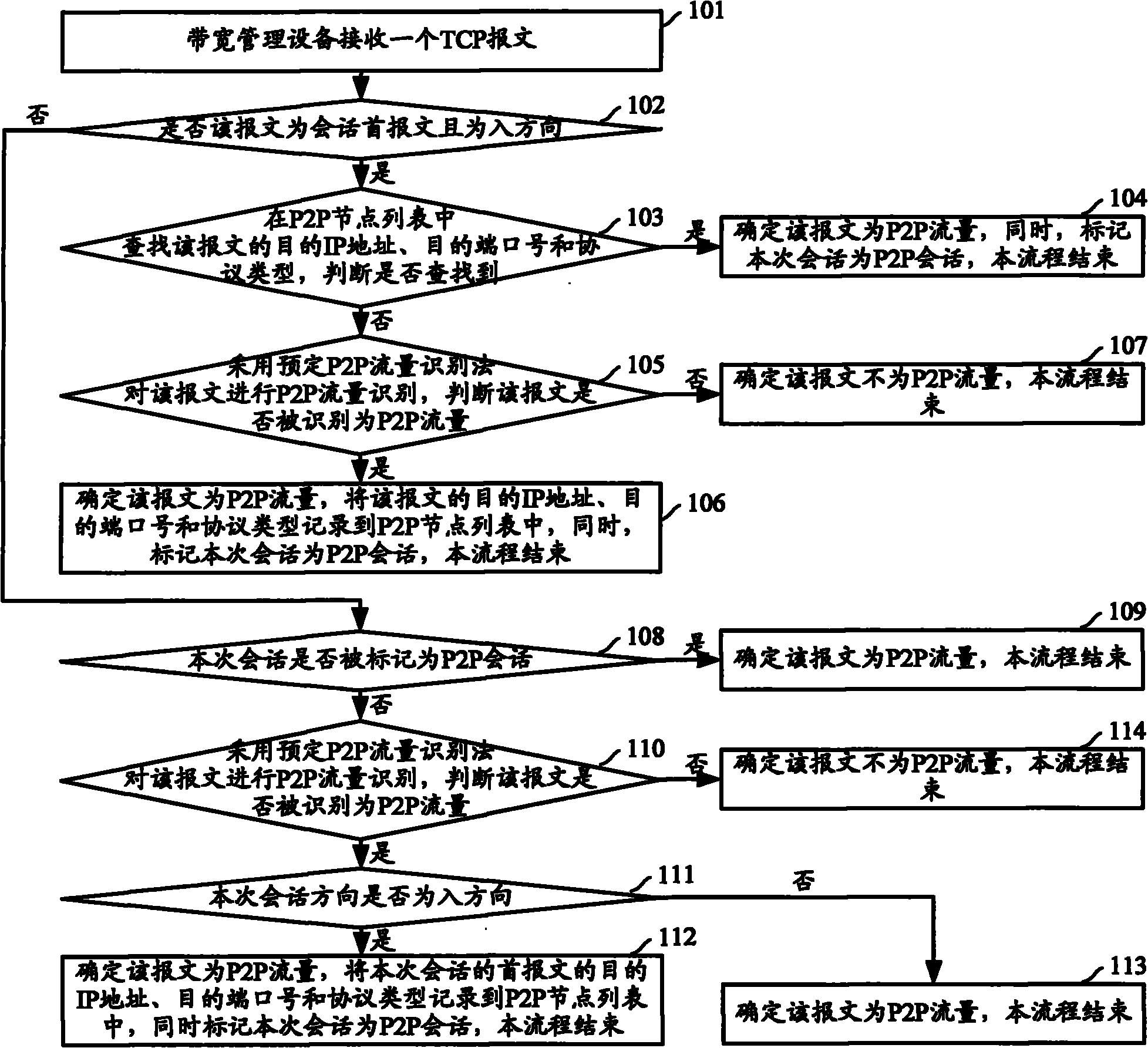
Figure 1 
Figure 2 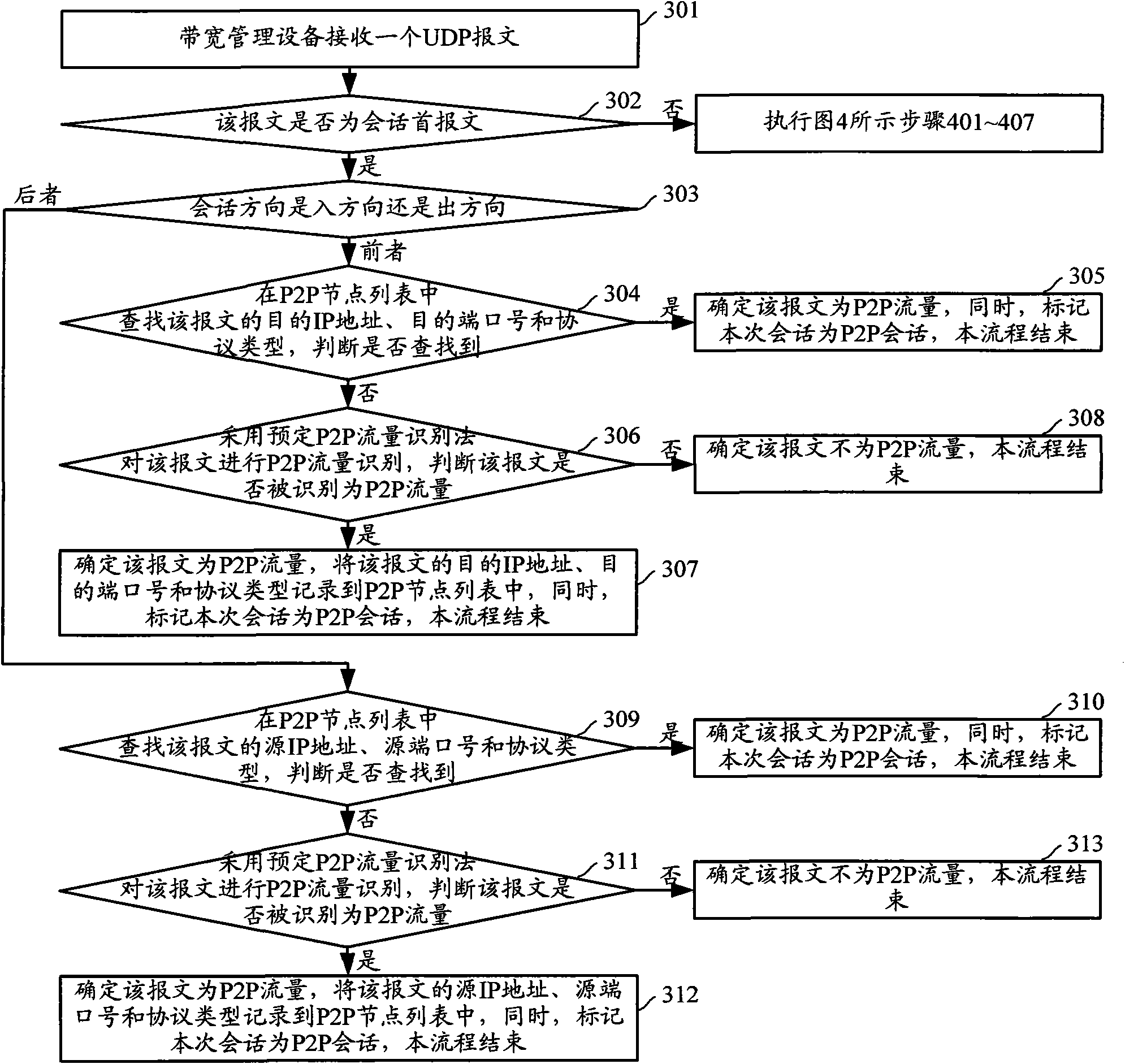
Figure 3
Abstract
Description
technical field
[0001] The invention relates to the technical field of traffic identification, in particular to a point-to-point traffic identification method and device. Background technique
[0002] In a peer-to-peer (P2P, Peer to Peer) network, all nodes are equal, and nodes are directly interconnected to share information resources or exchange files without relying on a centralized server. Compared with Transmission Control Protocol (TCP, Transmission Control Protocol), User Datagram Protocol (UDP, User Datagram Protocol) is a connectionless protocol, which has the characteristics of fast transmission speed and low resource occupation. Most of the current P2P protocols Both the application software and the application software support the use of UDP to transmit data.
[0003] With the continuous popularization of the Internet (Internet), P2P technology has been widely used. According to authoritative statistics, more than 80% of Internet traffic is P2P traffic. P2P tr...
Examples
Embodiment Construction
[0049] When the P2P software is started, in order to provide download services for other nodes, it is necessary to create a listening port that can handle connection requests. For P2P traffic using TCP, the source port of the TCP connection request is randomly assigned, and the destination port can be specified. Therefore, the incoming direction, that is, the TCP connection request from the outside to the inside direction will use the local listening port, and the outgoing direction, That is, the TCP connection request from the inside to the outside will use the remote listening port; for the P2P traffic using UDP, the source port and the destination port of the UDP connection request can be specified. Connection requests will use the local listening port. Utilize above-mentioned characteristic, provide following embodiment of the present invention:
[0050] The schemes for identifying P2P traffic using TCP and P2P traffic using UDP are respectively given below.
[0051] fi...