
Split magnesium-lithium alloy vacuum smelting furnace
A vacuum smelting furnace and magnesium-lithium alloy technology, which is applied in the direction of furnaces, furnace types, lighting and heating equipment, etc., can solve the problems of smelting time, low vacuuming efficiency, and low production efficiency, so as to shorten the vacuuming time and improve The effect of production efficiency
Patent Information
- Authority / Receiving Office
- CN · China
- Current Assignee / Owner
- Publication Date
- 2012-11-07
- Estimated Expiration
- Not applicable · inactive patent
Smart Images
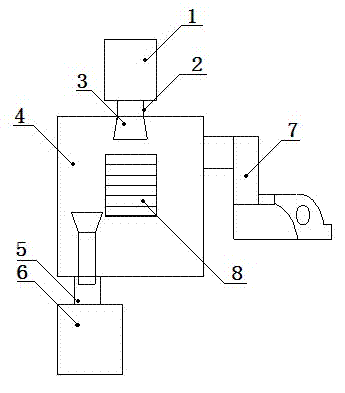
Figure 1
Abstract
Description
technical field
[0001] The invention relates to a magnesium-lithium alloy vacuum smelting furnace, in particular to a split-type magnesium-lithium alloy vacuum smelting furnace, which is used for continuous feeding, vacuum smelting, and continuous casting integrated smelting of the magnesium-lithium alloy. Background technique
[0002] Magnesium-lithium alloy smelting raw materials Magnesium and lithium are extremely active metal elements. Exposure to high temperature in the air will quickly oxidize or even burn and explode. It must be smelted and cast in a vacuum environment. The single-body melting furnace puts the ingredients in the furnace to heat and melt The casting and casting are all completed in one furnace chamber, which has a large volume and low vacuuming efficiency. The vacuuming of each furnace takes up 50% of the melting time, resulting in low production efficiency and unable to achieve large-scale continuous production. Contents of the invention
[0003] In...
Examples
Embodiment Construction
[0009] The present invention will be described in further detail below in conjunction with the accompanying drawings.
[0010] See attached figure 1 , a split-type magnesium-lithium alloy vacuum smelting furnace, including a primary feeding furnace 1, the primary feeding furnace 1 communicates with a feeding mechanism 3 through a vacuum electromagnetic valve 2, and the feeding mechanism 3 is also connected to a secondary melting furnace 4 are connected, the secondary smelting furnace 4 is connected with the tertiary casting furnace 6 through the second vacuum electromagnetic valve 5, and one side of the secondary smelting furnace 6 is also connected with the vacuum device 7.
[0011] The cavity of the secondary melting furnace 4 is provided with an electromagnetic induction heating device 8 .
[0012] The working principle of the present invention is:
[0013] The invention utilizes vacuum electromagnetic valves to control the connection and disconnection of each furnace cav...