

Method for synthesizing 2-amino-4,6-dimethoxypyrimidine
A technology of dimethoxypyrimidine and synthesis method is applied in the field of synthesis of fine chemical raw material 2-amino-4,6-dimethoxypyrimidine, and can solve the problem of large amount of waste water, waste acid, energy consumption and equipment loss, Complex process and other problems, to achieve the effect of high cost, reduce production cost, and simplify the process route
Patent Information
- Authority / Receiving Office
- CN · China
- Patent Type
- Applications(China)
- Current Assignee / Owner
- Publication Date
- 2013-01-30
Smart Images
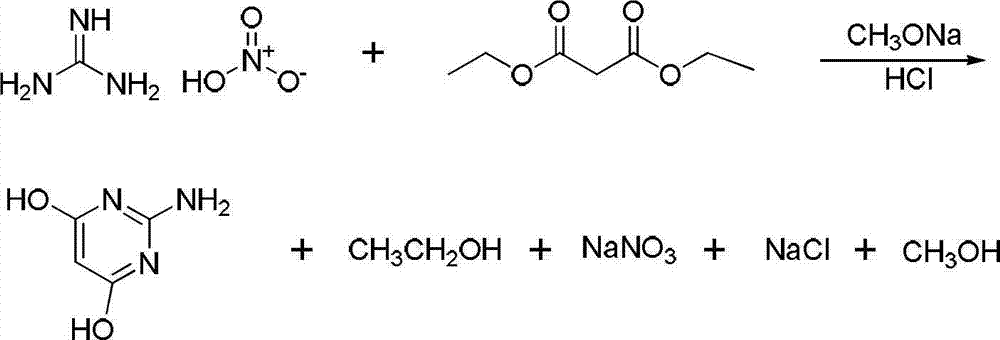
Figure 1 
Figure 2 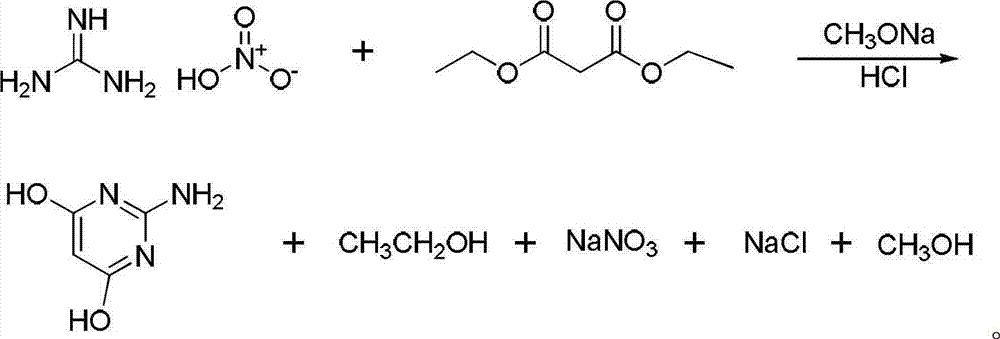
Figure 3
Abstract
Description
technical field
[0001] The invention relates to a method for synthesizing fine chemical raw material 2-amino-4,6-dimethoxypyrimidine. Background technique
[0002] Sulfonylurea herbicides are recognized as high-efficiency and environmentally friendly green pesticides in the world due to their ultra-high activity and low toxicity. Since the advent of chlorsulfuron developed by DuPont in 1979, sulfonylurea The development of herbicide-like varieties has gone through about 30 years, and more than 30 varieties have been developed. In recent years, as some herbicides with environmental problems have faded out of the market, sulfonylurea herbicides have developed rapidly. The current sales market is second only to amino acid herbicides such as glyphosate, and the consumption is very large. 2-Amino 4,6-dimethoxypyrimidine (pyrimidinamine) is a white crystal, which is an important pesticide intermediate, mainly used in the synthesis of sulfonylurea pesticides, such as bensulfuron-m...
Examples
Embodiment 1
[0022] (1) Take 48.8g of guanidine nitrate and 64g of diethyl malonate in a 500ml four-necked bottle (the molar ratio of guanidine nitrate to diethyl malonate is 1:1), add 10g of anhydrous methanol and stir well. Another 216g of liquid sodium methoxide (the molar ratio of liquid sodium methoxide to guanidine nitrate is 1:3) was added dropwise to the mixture at 40°C, and the dropwise addition was completed in about 1 hour, then the temperature was raised to 68°C, and reacted in a reaction device with reflux 3.5h. Add a distillation device to recover methanol, leaving a white solid; then add water to the reaction flask to completely dissolve the white solid, filter to remove insoluble flocs, adjust the pH value to 5-6 with 0.1mol / L HCl solution, and filter with suction , washing with water, drying, grinding, and vacuum drying. 50.6 g of 2-amino-4,6-dihydroxypyrimidine was obtained, with a yield of 83%.
[0023] (2) Add 25.4g of 2-amino-4,6-dihydroxypyrimidine into a 150ml auto...
Embodiment 2
[0025] (1) Take 58.6g of guanidine nitrate and 64g of diethyl malonate in a 500ml four-necked bottle (the molar ratio of guanidine nitrate to diethyl malonate is 1.2:1), add 23.6g of anhydrous methanol and stir well . Another 216g of liquid sodium methoxide (the molar ratio of liquid sodium methoxide to guanidine nitrate is 1:3) was added dropwise to the mixture at 60°C, and the dropwise addition was completed in about 1 hour, then the temperature was raised to 68°C, and reacted in a reaction device with reflux 3.5h. Add a distillation device to recover methanol, leaving a white solid; then add water to the reaction flask to completely dissolve the white solid, filter to remove insoluble flocs, adjust the pH value to 5-6 with 0.1mol / L HCl solution, and filter with suction , washed several times with water, dried, ground, and vacuum-dried. 57.9 g of 2-amino-4,6-dihydroxypyrimidine was obtained, with a yield of 95%.
[0026] (2) Add 25.4g of 2-amino-4,6-dihydroxypyrimidine in...
Embodiment 3
[0028] (1) Take 73.2g of guanidine nitrate and 64g of diethyl malonate in a 500ml four-necked bottle (the molar ratio of guanidine nitrate to diethyl malonate is 1.5:1), add 50g of anhydrous methanol and stir well. Another 360g of liquid sodium methoxide (the molar ratio of liquid sodium methoxide to guanidine nitrate is 1:5) was added dropwise to the mixture at 60°C, and the dropwise addition was completed in about 1 hour, then the temperature was raised to 68°C and reacted in a reaction device with reflux . Add a distillation device to recover methanol, leaving a white solid; then add water to the reaction flask to completely dissolve the white solid, filter to remove insoluble flocs, adjust the pH value to 5-6 with 0.1mol / L HCl solution, and filter with suction , washed several times with water, dried, ground, and vacuum-dried. 58.7 g of 2-amino-4,6-dihydroxypyrimidine was obtained, with a yield of 96.3%.
[0029] (2) Add 25.4g of 2-amino-4,6-dihydroxypyrimidine into a 15...