
A clustering method based on deep learning
A technology of deep learning and clustering methods, applied in the direction of neural learning methods, biological neural network models, instruments, etc., can solve the problems of incompetent clustering tasks, incompetent big data background environment, large memory consumption, etc., to achieve large The effect of memory consumption
Patent Information
- Authority / Receiving Office
- CN · China
- Patent Type
- Patents(China)
- Current Assignee / Owner
- Publication Date
- 2016-01-20
Smart Images
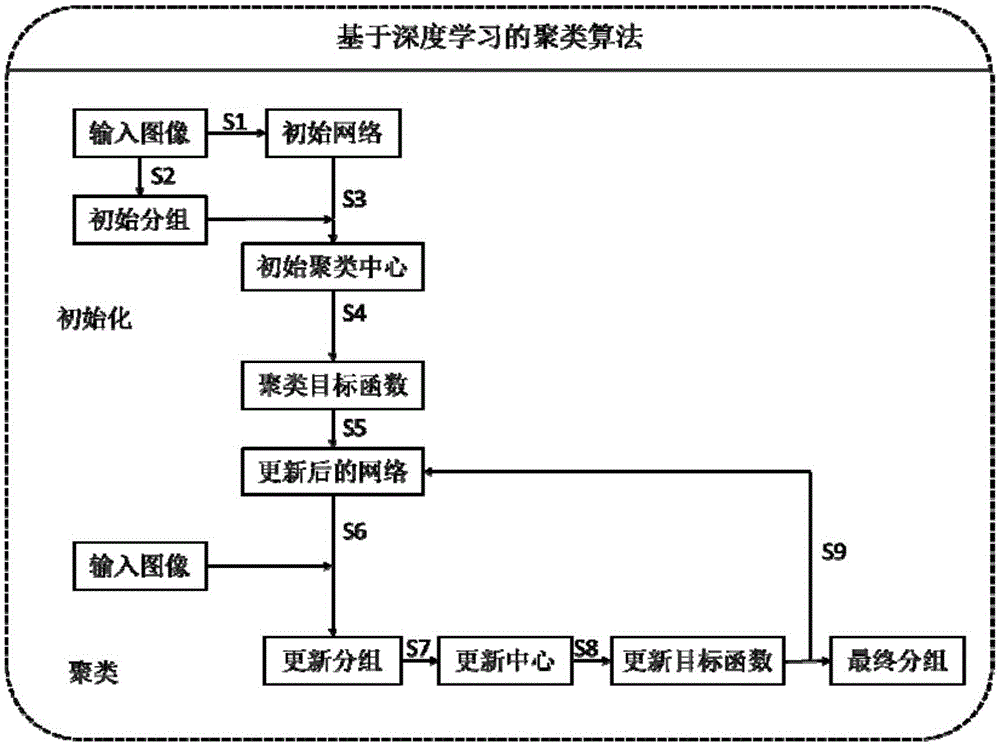
Figure 1 
Figure 2 
Figure 3
Abstract
Description
technical field
[0001] The invention relates to the technical fields of pattern recognition and machine learning, in particular to a clustering method based on deep learning. Background technique
[0002] At present, traditional clustering algorithms are only suitable for situations where the data space is linearly separable, such as the K-means algorithm. However, with the increase of the amount of data and the increase of data complexity, the traditional clustering algorithm has been unable to perform the clustering task under the background of complex large-scale data. Although some clustering algorithms have recently been proposed to solve this problem, such as spectral clustering and other algorithms, such algorithms cannot be used in the background environment of big data because they require huge memory consumption.
[0003] Therefore, in view of the fact that the previous methods are difficult to meet the current needs of large-scale complex data clustering, the pre...
Examples
Embodiment Construction
[0017] In order to make the object, technical solution and advantages of the present invention clearer, the present invention will be described in further detail below in conjunction with specific embodiments and with reference to the accompanying drawings.
[0018] The present invention adopts the nonlinear mapping method of the deep neural network to perform clustering. Traditional clustering mainly includes three parts: spatial mapping, selecting cluster centers and grouping them, and updating cluster centers. On this basis, the present invention first uses the nonlinear mapping of the deep neural network to map the original data to the feature space, then groups in the feature space and calculates the mean value of each group as the cluster center, and on this basis, the objective function of the deep neural network Add intra-class constraints to continue training the network, and finally use the trained network to map the data to the feature space and cluster again until ...