
Standard SiGe bipolar complementary metal-oxide-semiconductor transistor (BiCMOS) process-based optoelectronic integrated receiver
An optoelectronic integration and receiver technology, applied in electromagnetic receivers, radiation control devices, etc., can solve the problem that photoelectric detectors are difficult to take into account the performance of speed and responsivity at the same time, optoelectronic integrated receivers have not entered the practical stage, and monolithic integrated optics are limited. The overall performance of the receiver and other issues can achieve good application prospects, enhanced functions, and high responsiveness.
Patent Information
- Authority / Receiving Office
- CN · China
- Patent Type
- Applications(China)
- Current Assignee / Owner
- Publication Date
- 2014-04-02
- Estimated Expiration
- Not applicable · inactive patent
Smart Images
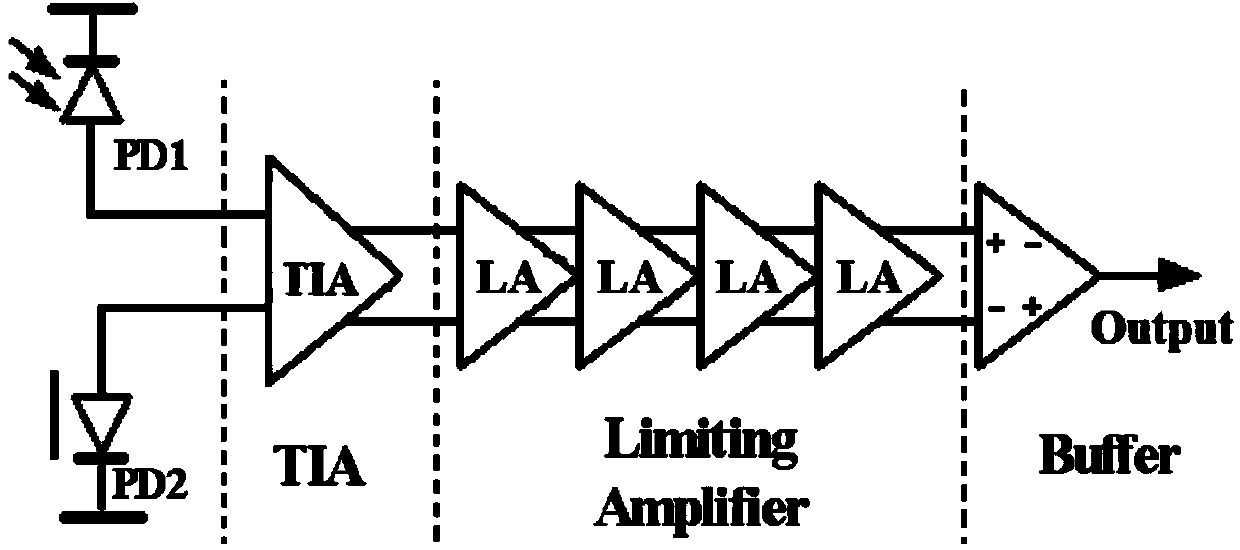
Figure 1 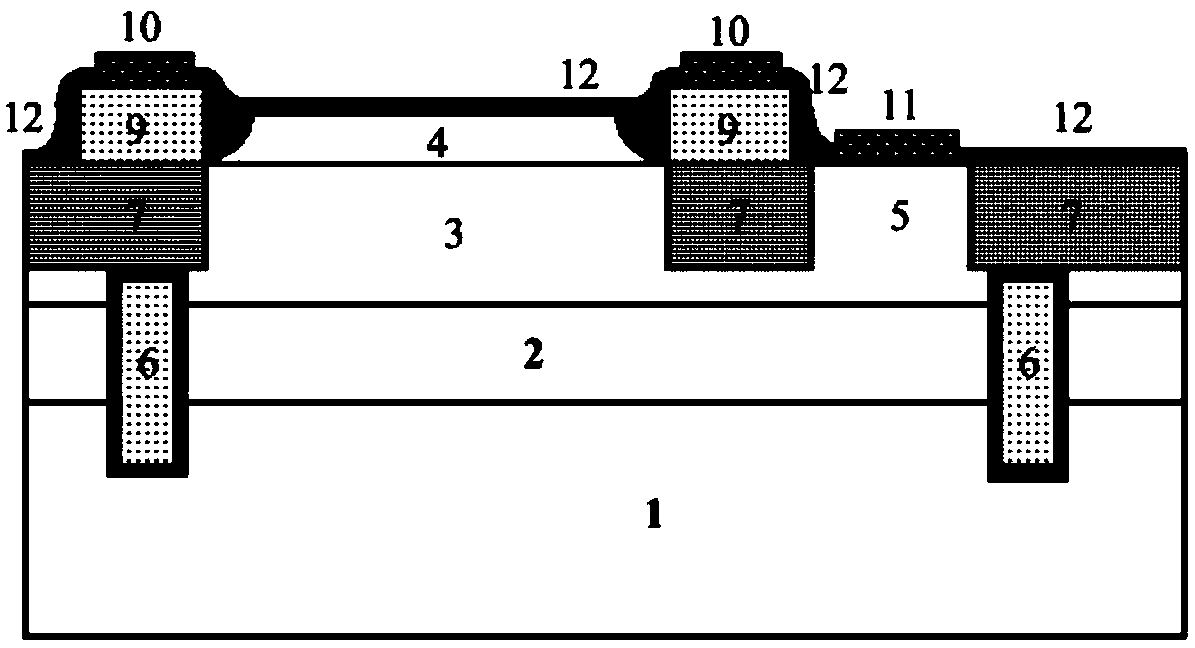
Figure 2 
Figure 3
Abstract
Description
technical field
[0001] The invention belongs to the field of optical fiber communication systems and optical interconnection, and relates to a photoelectric detector compatible with silicon germanium bipolar-complementary metal oxide semiconductor (SiGe BiCMOS) technology, and a high-speed optical receiver monolithically integrating the detector. Specifically, it relates to a photoelectric integrated receiver based on a standard SiGe BiCMOS process. Background technique
[0002] With the continuous development of communication and multimedia technology, people's demand for data information continues to increase. Because optical fiber communication has the advantages of high speed and large capacity, it is widely used in trunk network. However, for user terminals, limited by the cost of optoelectronic integrated chips, it is difficult to continue to advance the "last mile" of fiber-to-the-home. Therefore, the development of low-cost, high-performance optoelectronic integrat...
Examples
Embodiment Construction
[0024] 1. The photodetector proposed by the present invention can make full use of the structural characteristics of the SiGe BiCMOS process to construct various detector structures such as PN junction, PIN, MSM and phototransistor, and can also use the silicon germanium epitaxial layer to improve the responsivity of the detector .
[0025] 2. The optical receiver front-end circuit based on the standard SiGe BiCMOS process proposed by the present invention comprises:
[0026] Two photodetectors with completely symmetrical structures, one of which converts the optical signal input by the optical fiber into a current signal, and the other detector is used to maintain the input load balance of the differential circuit and increase the bandwidth of the receiver;
[0027] A transimpedance amplifier with a fully differential structure, its function is to convert the current signal output by the photodetector into a voltage signal, and perform preliminary amplification;
[0028] A s...