
Preparation method of epoxypropane
A technology of propylene oxide and epoxidation reaction, which is applied in the direction of organic chemistry, etc., can solve the problems such as the increase of reaction temperature, and achieve the effect of controlling the temperature increase of reaction, good technical effect and improved selectivity.
Patent Information
- Authority / Receiving Office
- CN · China
- Current Assignee / Owner
- Publication Date
- 2015-04-29
- Estimated Expiration
- Not applicable · inactive patent
Smart Images
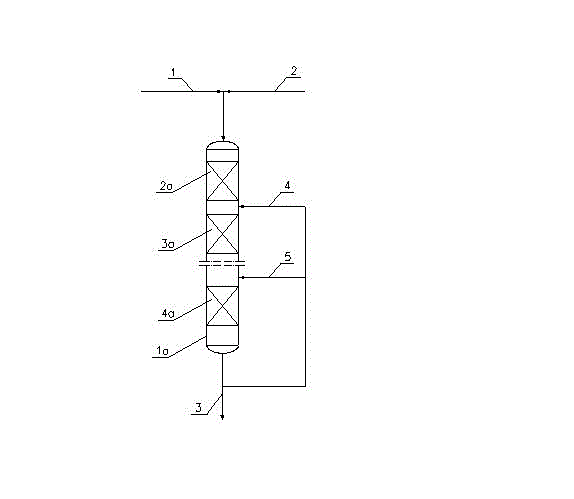
Figure 1
Abstract
Description
technical field
[0001] The invention relates to a preparation method of propylene oxide. Background technique
[0002] Propylene oxide is an important basic chemical raw material and the third largest propylene derivative after polypropylene and acrylonitrile. It is mainly used in the production of polyether and propylene glycol. It is also the main raw material of the fourth-generation detergent non-ionic surfactant, oil field demulsifier, pesticide emulsifier, etc. Propylene oxide derivatives are widely used in industries such as automobiles, construction, food, tobacco, medicine and cosmetics. Nearly 100 kinds of downstream products have been produced, which are important raw materials for fine chemical products.
[0003] The traditional production process of propylene oxide is the chlorohydrin process, which includes three steps: chloroalcoholization of propylene and hypochlorous acid solution, saponification of chloropropanol and milk of lime, and product refining. ...
Examples
Embodiment 1
[0035] according to figure 1 In the technical scheme shown, the raw material contains cumene hydroperoxide mixture with a concentration of 35% by weight, the flow rate is 101166.1 kg / hour, the raw material propylene is 10812.7 kg / hour, and the circulating propylene is 92993.1 kg / hour, and enters a two-stage adiabatic fixed bed Reactor, under the condition of reaction temperature 55℃ and reaction pressure 3.1MPaG, with Ti / SiO 2 Catalyst contact, liquid-phase epoxidation reaction to generate propylene oxide, dimethyl benzyl alcohol and other by-products; the reactants flowing out of the first catalyst bed are mixed with the recycle stream entering the second catalyst bed, and the temperature is controlled at 55°C. into the second catalyst bed, with Ti / SiO 2 Catalyst contact, liquid phase epoxidation reaction produces propylene oxide and dimethyl benzyl alcohol and other by-products. Cumene hydroperoxide weight space velocity 4.5hr -1 , the mol ratio of total propylene and cum...
Embodiment 2
[0038] Same as [Example 1], only the flow rate of circulating propylene is changed: the circulating propylene flow rate is 61995.4 kg / hour, and others are the same as [Example 1]. Cumene hydroperoxide weight space velocity 4.5hr -1 , the mol ratio of total propylene and cumene hydroperoxide is 7.1, the mol ratio of propylene and cumene hydroperoxide of the first catalyst bed layer and the second catalyst bed inlet then reaches 7.1 and 13.9, the first catalyst bed The outlet temperatures of the bed and the second catalyst bed are 86.4°C and 85.1°C respectively, the total conversion of cumene hydroperoxide is 99.2%, and the molar selectivity of propylene oxide is 96.0%,
Embodiment 3
[0040] Same as [Example 1], only the reactor form is changed: two single-bed adiabatic fixed-bed reactors are connected in series, and the others are the same as [Example 1]. Cumene hydroperoxide weight space velocity 4.5hr -1 , the mol ratio of total propylene and cumene hydroperoxide is 10.2, the mol ratio of propylene and cumene hydroperoxide of the first catalyst bed layer and the second catalyst bed inlet then reaches 10.2 and 21.4, the first catalyst bed The outlet temperatures of the bed and the second catalyst bed were 82.2°C and 80.8°C respectively, the total conversion rate of cumene hydroperoxide was 99.2%, and the molar selectivity to propylene oxide was 96.3%.
[0041]