
Double chromophore complex system and its synthesis method and application
A dual chromophore and chromophore technology, applied in the dual chromophore composite system and its synthesis and application fields, can solve macroscopic phase separation, limit the maximum electro-optic coefficient, reduce the phase of polymer and nonlinear optical chromophore Capacitance and other issues, to achieve the effect of improving the electro-optic coefficient and simplifying the synthesis
Patent Information
- Authority / Receiving Office
- CN · China
- Patent Type
- Patents(China)
- Current Assignee / Owner
- Publication Date
- 2017-01-04
- Estimated Expiration
- Not applicable · inactive patent
Smart Images
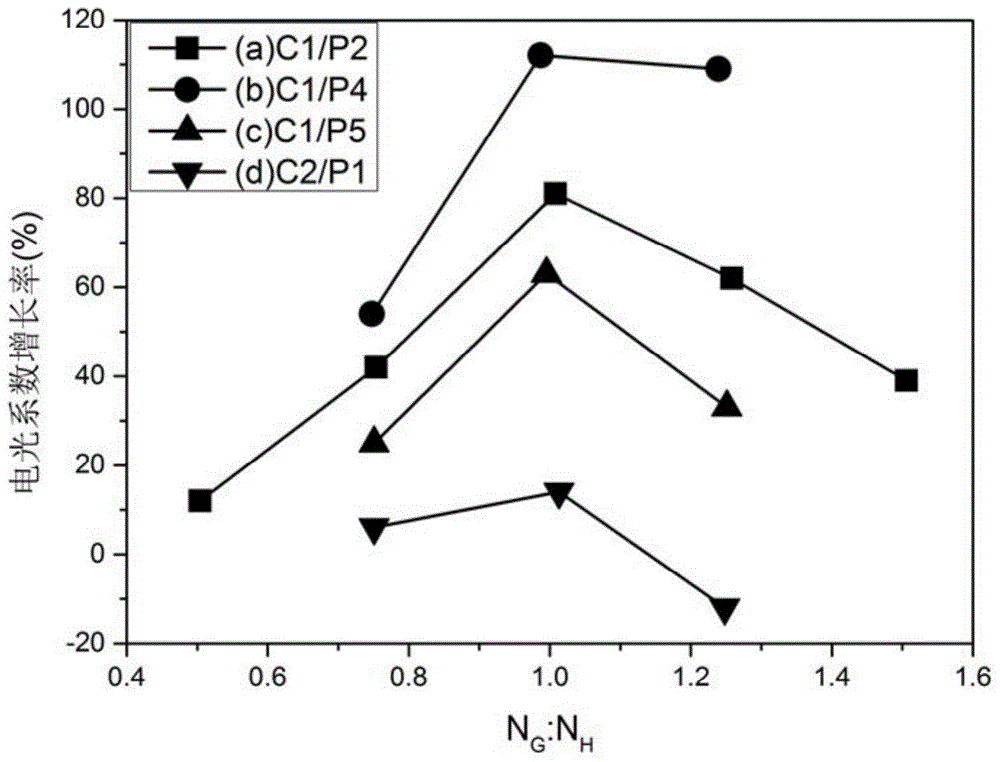
Figure 1 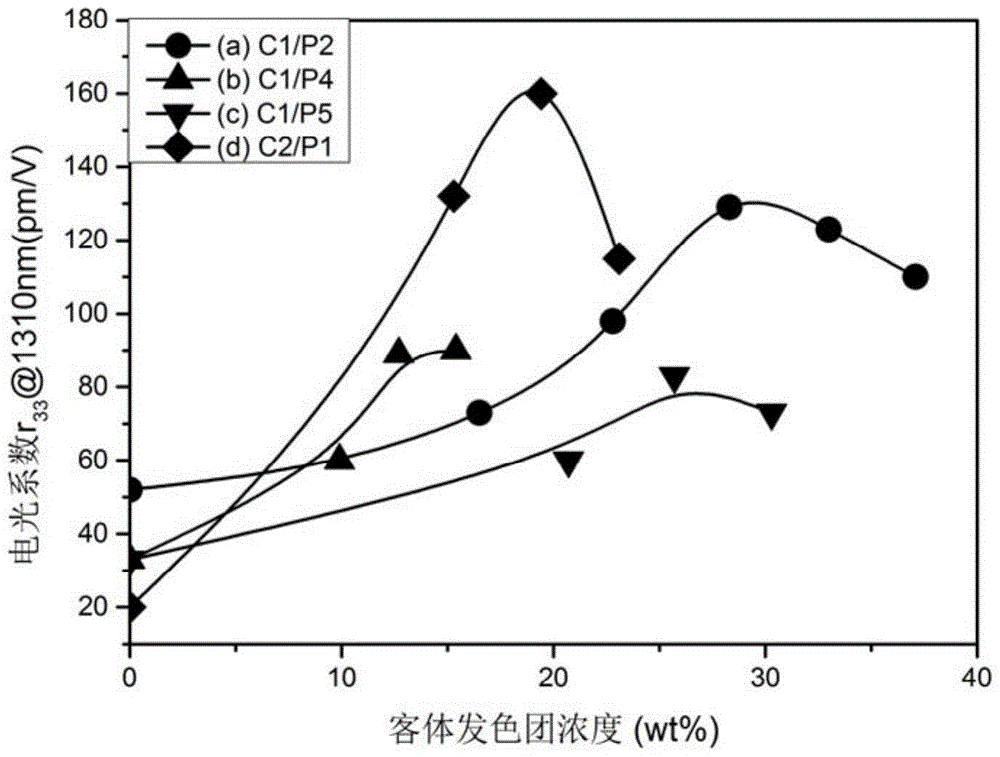
Figure 2 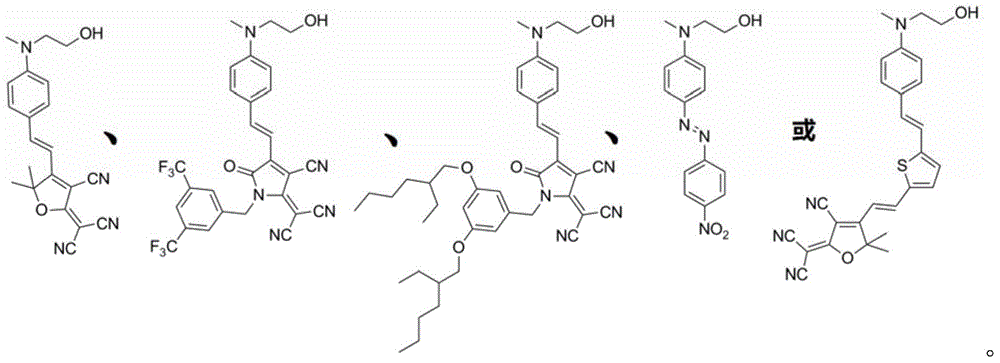
Figure 3
Abstract
Description
technical field
[0001] The invention relates to organic / polymer electro-optical materials, in particular to a double chromophore composite system and its synthesis and application. Background technique
[0002] With the development of the times, people put forward higher and higher requirements for the transmission, processing and storage of information. Compared with traditional metal cables, optical fiber communication mainly has the following advantages: large amount of information that can be transmitted, strong anti-interference ability, low loss, abundant raw materials, low cost, thin wire diameter ratio, light material, etc. Unfortunately, the current material properties and technical level cannot meet the requirements for all-optical treatment. For a long time, it will be a hybrid situation where electronic information transmission and photonic information transmission coexist. Therefore, optoelectronic technology, which is the primary stage of photonic technology ...
Examples
Embodiment 1
[0038] Synthesis of the dual chromophore complex system C1 / P2 with the following structure:
[0039]
[0040] The synthesis method is as follows:
[0041] Weigh 5 parts of 0.04g host polymer P2 containing host chromophore 1, and then add them to 3mL serum bottles numbered 1-5 respectively; according to the molar ratio of guest chromophore to host chromophore is 0.50:1, 0.75:1, 1:1, 1.25:1 and 1.50:1, add 0.0079g, 0.0118 g, 0.0158g, 0.0198g and 0.0237g of the guest chromophore C1, that is, the weight percentages of the guest chromophores numbered 1 to 5 are 16.5%, 22.8%, 28.3%, 33.0% and 37.1% respectively. Chromophore complex system C1 / P2.
Embodiment 2
[0043] Synthesis of the dual chromophore complex system C1 / P4 containing the following structure:
[0044]
[0045] The synthesis method is as follows:
[0046] Weigh 3 parts of 0.04g host polymer P4 containing host chromophore 2, and then add them to 3mL serum bottles numbered 6-8; according to the molar ratio of guest chromophore to host chromophore is 0.75:1, 1:1, and 1.25:1, add 0.0044g, 0.0058g, and 0.0073g of guest chromophores to host polymer P4 containing host chromophore 2 in serum bottles numbered 6-8 in sequence Group C1, that is to obtain the double chromophore composite system C1 / P4 with the weight percentages of the guest chromophores numbered 6-8 being 9.9%, 12.7% and 15.4% respectively.
Embodiment 3
[0048] Synthesis of the dual chromophore complex system C1 / P5 with the following structure:
[0049]
[0050] The synthesis method is as follows:
[0051] Weigh 3 parts of 0.04g host polymer P5 containing host chromophore 3, and then add them to 3mL serum bottles numbered 9-11 respectively; according to the molar ratio of guest chromophore to host chromophore is 0.75:1, 1:1, and 1.25:1, add 0.0104g, 0.0139g, and 0.0174g of guest chromophores to host polymer P5 containing host chromophore 3 in serum bottles numbered 9-11 in sequence Group C1, that is to obtain the double chromophore composite system C1 / P5 with the weight percentages of the guest chromophores numbered 9-11 being 20.7%, 25.7% and 30.3% respectively.