
A Method of Online Identification of Permanent Magnet Synchronous Motor Parameters
A permanent magnet synchronous and electric motor technology, applied in the direction of motor generator control, electronic commutation motor control, control generator, etc., can solve the problems of motor operation efficiency reduction, vector control deviation, and affect the dynamic characteristics of the control system, etc., to achieve the algorithm Simple, low-cost effect
Patent Information
- Authority / Receiving Office
- CN · China
- Patent Type
- Patents(China)
- Current Assignee / Owner
- Publication Date
- 2017-07-28
- Estimated Expiration
- Not applicable · inactive patent
Smart Images
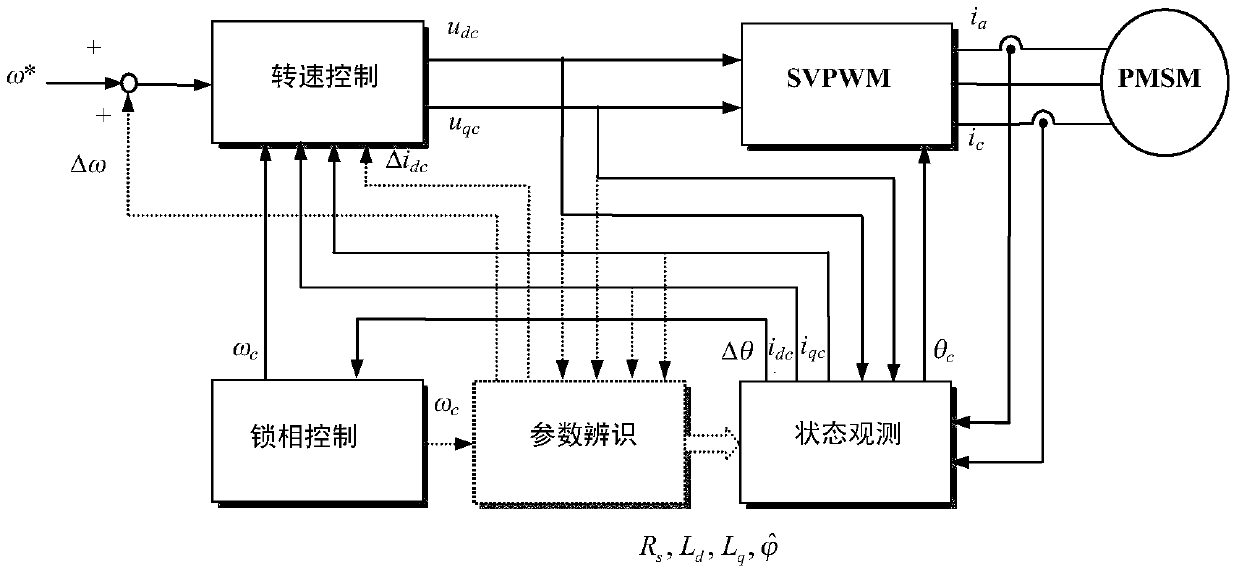
Figure 1 
Figure 2 
Figure 3
Abstract
Description
technical field
[0001] The invention belongs to the technical field of electric transmission and power electronics, and in particular relates to a method for online identification of parameters of a permanent magnet synchronous motor. Background technique
[0002] Permanent Magnet Synchronous Motor (PMSM: Permanent Magnet Synchronous Motor) has the advantages of high specific power, energy saving and high efficiency, and precise control, and has been widely used in various fields []] . The high-performance control methods of PMSM mainly include vector control and direct torque control. Among them, the speed sensorless control system with low system cost and strong environmental adaptability has become a research hotspot.
[0003] The performance of the PMSM speed sensorless control system largely depends on the estimation accuracy of the rotor position and speed, and the detection methods can be divided into two categories. The first type is to estimate the position and s...
Examples
Embodiment
[0081] Embodiment: the system constitution of embodiment and figure 1 Same, the system structure is as mentioned above, it adopts the variable frequency controller and eddy current brake load independently developed by the applicant. The tested motor is not an ideal hidden pole PMSM, and the specifications of the tested motor are shown in Table 1:
[0082] Table 1 Parameters of the tested motor
[0083]
[0084] Use the LCR bridge and offline parameter identification method (DC voltammetry to measure R s , DC decay method to measure L d and L q , measured by the idling terminal voltage method ) Detect the motor parameters and confirm their changing characteristics.
[0085] Figure 5 (a) is the measured temperature characteristics. As the motor temperature T increases, R s , L d and L q increase, while slightly reduced. When the temperature rises from 25°C to 100°C, R s , L d and L q increased by 7.5%, 7.5% and 15%, respectively, 8.1% reduction.
[0086]...