
Nuclear power plant end-of-life reactivity control method
A reactive control, end-of-life technology, applied in nuclear power generation, climate sustainability, greenhouse gas reduction, etc., can solve problems such as deviation of water chemistry working conditions, unreasonable design of boron removal process, increase of alkali metal ions, etc. Huge economic and social benefits, increase utilization rate and economy, reduce the effect of three waste treatment
Patent Information
- Authority / Receiving Office
- CN · China
- Current Assignee / Owner
- Publication Date
- 2015-09-16
Smart Images
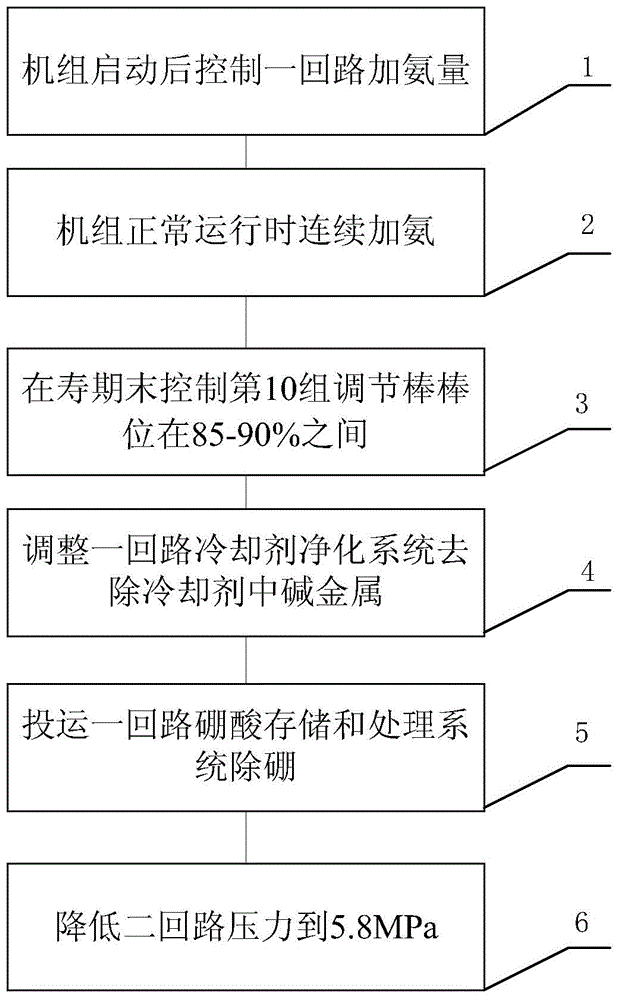
Figure 1
Abstract
Description
technical field
[0001] The invention belongs to the field of reactivity control of nuclear power plants, in particular to a method for controlling reactivity of nuclear power plants at the end of their service life. Background technique
[0002] As the power consumption of the unit increases, the corresponding reactivity needs to be compensated. The first method to compensate the reactivity is to reduce the concentration of boric acid in the primary circuit coolant, and the main way to reduce the concentration of boric acid is to use filters to gradually remove boric acid and boric acid in the primary circuit. Change the water to dilute the operation. At the end of the nuclear power plant's life cycle design, when the concentration of boric acid in the primary circuit coolant is lower than 0.3g / L, the KBB (primary circuit boric acid storage and processing system) filter is put into operation to start the boron removal operation.
[0003] Due to the particularity of the desi...
Examples
Embodiment Construction
[0018] The present invention will be described in further detail below in conjunction with the accompanying drawings and embodiments.
[0019] Such as figure 1 As shown, a kind of nuclear power plant end-of-life reactivity control method provided by the present invention comprises the following steps:
[0020] (1) Add ammonia intermittently after the unit starts
[0021] After the reactor unit is started, when the ammonia concentration in the coolant increases to 20-30mg / L, the ammonia concentration in the primary loop coolant is controlled by reducing the amount of ammonia added, and gradually reaches a dynamic balance with the consumption and input of ammonia. Ensure that the control target of ammonia concentration is 15mg / L. After optimization, the chloride ion concentration in the purification system and coolant is significantly reduced, only 1 / 10 of the original value, and the purification system works stably.
[0022] (2) Continuous ammonia addition during normal opera...