
Synthetic method of 3-bromopyridine
A synthesis method, bromopyridine technology, applied in the field of synthesis of 3-bromopyridine, can solve the problems of expensive raw materials, high requirements for reaction conditions, and low yield, and achieve simple reaction steps, easy-to-obtain raw materials, and high yield Effect
Patent Information
- Authority / Receiving Office
- CN · China
- Current Assignee / Owner
- Publication Date
- 2015-10-14
- Estimated Expiration
- Not applicable · inactive patent
Smart Images
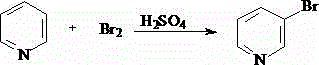
Figure 1
Abstract
Description
technical field
[0001] The invention belongs to the field of organic synthesis, in particular to a synthesis method of 3-bromopyridine. Background technique
[0002] 3-Bromopyridine is often used as an intermediate in medicine, pesticide and organic synthesis. It can be used in the synthesis of 3-methylaminopiperidine, an intermediate of baloxacin, a medicine of the type Floxacin. The synthesis method of 3-bromopyridine, the commonly used methods are: (1) reaction of pyridine with aluminum trichloride and bromine; (2) after bromination of 3-aminopyridine, diazotization and then Sandmeyer reaction to obtain the product . Method (1) has great disadvantages, the yield is low, and the requirement for anhydrous is very high in the reaction process, and the salt formation is not easy to stir, and the positioning effect of pyridinium hydrogen chloride salt bromination is not very strong, and it is easy to generate bromine in other positions The chemical product brings a lot of t...
Examples
Embodiment 1
[0018] Drop 8.8g of bromine (50mmol) into 15ml (185mmol) and 95% sulfuric acid at 0°C, react at 130°C for 8 hours, cool down and pour into ice water after the reaction, adjust the pH to 8 with 6N sodium hydroxide, and 60ml of petroleum ether The extraction was divided into three times, and several layers were dried with anhydrous sodium sulfate after layering. After filtering the desiccant, the organic layer was concentrated, and then distilled with a Vigreux fractionating column. Gas phase analysis of the composition of the remaining substances, detection conditions: N 2 90ml / min, H 2 120ml / min, column temperature 165°C, injection 4ul, yield 75%.
Embodiment 2
[0020] Drop 8.8g of bromine (50mmol) into 15ml (185mmol) and 80% sulfuric acid at 0°C, react at 130°C for 8 hours, cool down and pour into ice water after the reaction, adjust the pH to 8 with 6N sodium hydroxide, and 60ml of petroleum ether The extraction was divided into three times, and several layers were dried with anhydrous sodium sulfate after layering. After filtering the desiccant, the organic layer was concentrated, and then distilled with a Vigreux fractionating column. Gas phase analysis of the composition of the remaining substances, detection conditions: N 2 90ml / min, H 2 120ml / min, column temperature 165°C, injection 4ul, yield 65%.
Embodiment 3
[0022] Drop 8.8g of bromine (50mmol) into 15ml (185mmol) and 90% sulfuric acid at 0°C, react at 130°C for 8 hours, cool down and pour into ice water after the reaction, adjust the pH to 8 with 6N sodium hydroxide, and 60ml of petroleum ether The extraction was divided into three times, and several layers were dried with anhydrous sodium sulfate after layering. After filtering the desiccant, the organic layer was concentrated, and then distilled with a Vigreux fractionating column. Gas phase analysis of the composition of the remaining substances, detection conditions: N 2 90ml / min, H 2 120ml / min, column temperature 165°C, injection 4ul, yield 70%.