
Anti-electromagnetic interference railway digital signal cable
A digital signal cable, anti-electromagnetic interference technology, used in communication cables, circuits, insulated cables, etc., can solve the problems of poor cable bending performance, high construction cost, easy-to-break shields, etc., to improve tensile strength and impact resistance. properties, improve shielding performance and corrosion resistance, improve adhesion and resistance to mechanical external forces
Patent Information
- Authority / Receiving Office
- CN · China
- Patent Type
- Applications(China)
- Current Assignee / Owner
- Publication Date
- 2016-01-06
- Estimated Expiration
- Not applicable · inactive patent
Smart Images
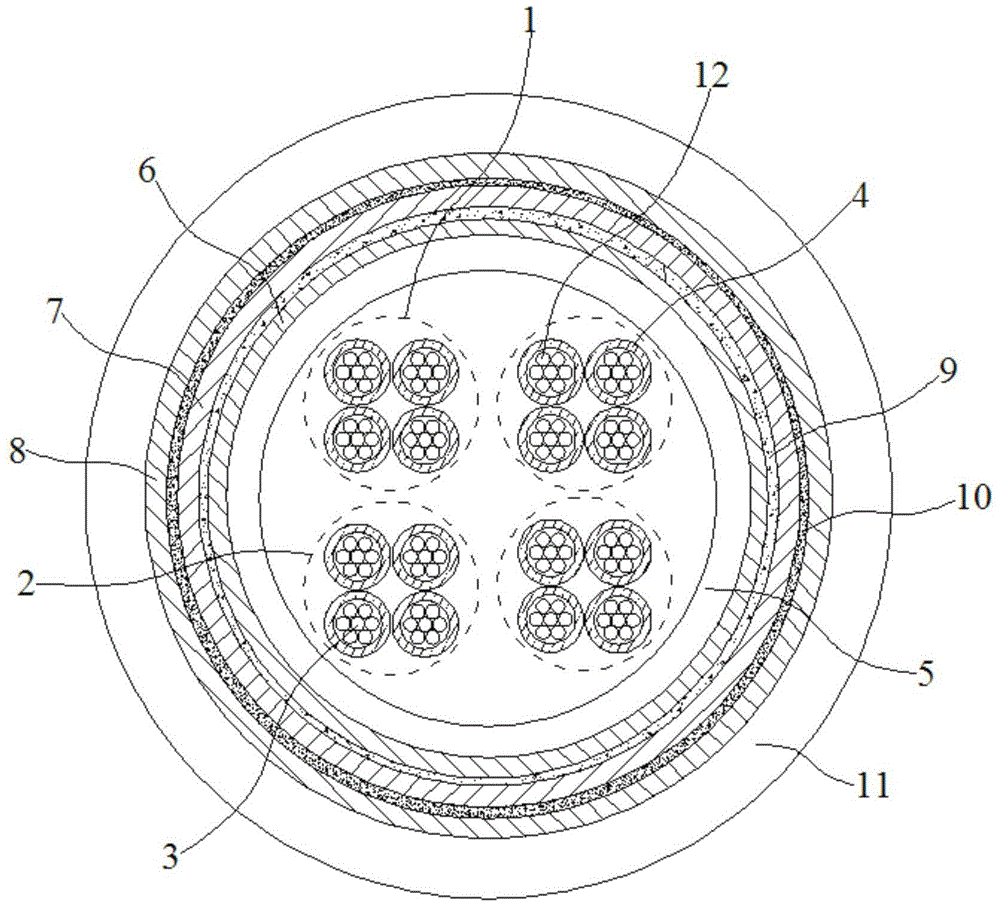
Figure 1
Abstract
Description
technical field
[0001] The invention relates to the field of rail transit signal cables, in particular to an anti-electromagnetic interference railway digital signal cable. Background technique
[0002] In order to improve the cable's ability to resist the interference of external electromagnetic fields and prevent the electromagnetic field from radiating to the outside when the cable is running, and improve the stability and reliability of the cable operation, the sheath structure of the transmission cable generally needs to be equipped with an anti-electromagnetic interference shielding layer. The traditional cable sheath is generally composed of the following structural layers: the cladding layer covering the outer layer of the cable core, the general cladding layer is a cladding layer made of extruded plastic sleeves or various strips, Its function is to make the cable core structure tight and prevent burns or damage during the process, and to protect the cable core. Ou...
Examples
Embodiment
[0013] Embodiment: An anti-electromagnetic interference railway digital signal cable, including 4 wire groups 2 wrapped by polyester tape 1, and the wire group 2 includes four twisted single wires 3 twisted by 7 tinned copper wires , one of the 7 tinned copper wires is located at the center, and the remaining 6 tinned copper wires are twisted on the outer surface of the tinned copper wire located at the center;
[0014] The outer surface of the twisted single wire 3 has an inner insulating layer 4, a cladding layer 5 is wrapped on the outer surface of the four wire groups 2, a first copper layer 6 is wrapped on the outer surface of the inner insulating layer 4, A steel layer 7 is coated on the outer surface of the first copper layer 6, and the outer surface of the steel layer 7 is covered with a second copper layer 8; between the first copper layer 6 and the inner surface of the steel layer 7, a first The alloy layer 9 is sealed and connected, and the second copper layer 8 and...