
Ti-microalloyed Q345B steel plate and production method thereof
A technology of micro-alloying and steel plate, applied in the field of low-alloy high-strength structural steel, can solve problems such as rising cost, achieve the effect of good welding performance, low cost, and suitable for popularization and application
Patent Information
- Authority / Receiving Office
- CN · China
- Patent Type
- Applications(China)
- Current Assignee / Owner
- Publication Date
- 2016-08-31
- Estimated Expiration
- Not applicable · inactive patent
Smart Images
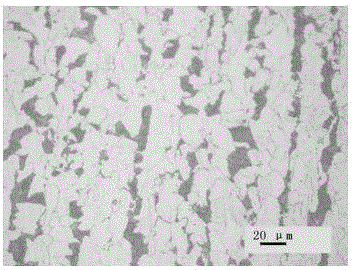
Figure 1 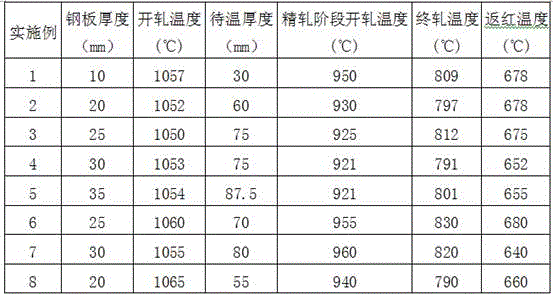
Figure 2 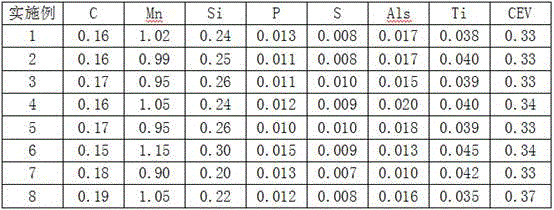
Figure 3
Abstract
Description
technical field
[0001] The invention relates to a low-alloy high-strength structural steel, in particular to a Ti microalloyed Q345B steel plate and a production method thereof. Background technique
[0002] Q345B belongs to the series of low-alloy high-strength structural steel products. It is the most commonly used steel product in China at present. It is widely used in many fields such as construction, bridges, and machinery manufacturing. At present, domestic steel mills mainly have two ideas for Q345B composition design. One is to adopt C and Mn composition system, that is, C 0.14-0.17%, Mn 1.4-1.55%; this is a Q345B composition system with the lowest cost. The biggest defect of steel is that the carbon equivalent is too high, between 0.38 and 0.43%. As we all know, the carbon equivalent CEV is an important indicator to measure the welding performance of steel products. The lower the carbon equivalent, the better the welding performance of the material. The other is to...
Examples
Embodiment 1-8
[0012] Examples 1-8: The composition ratio and production method of the Ti microalloyed Q345B steel plate are as follows.
[0013] 1. Steelmaking process: molten steel is smelted in a converter, LF refining and continuous casting to obtain a continuous casting slab; the chemical composition of the continuous casting slab in each embodiment is shown in Table 1.
[0014] Table 1: Chemical composition of each continuous casting slab (wt%)
[0015]
[0016] In Table 1, CEV=C+Mn / 6+(Mo+Cr+V) / 5+(Ni+Cu) / 15, and the balance is iron and unavoidable impurities.
[0017] 2. Rolling process: the continuous casting slab is rolled to obtain the Q345B steel plate; the specific rolling process parameters of each embodiment are shown in Table 2.
[0018] Table 2: Rolling Process Parameters
[0019]
[0020] 3. Performance testing: The Q345B steel plate obtained in the embodiment was tested, and the performance results are shown in Table 3.
[0021] Table 3: Performance Results
[0022...