
Ultra-fine grain ferrite/low-temperature bainite dual-phase steel and preparation method thereof
A low-temperature bainite and ferrite technology, applied in the field of steel material engineering, can solve the problems of insufficient toughness and low tensile strength, and achieve the effects of easy control, high tensile strength and good comprehensive mechanical properties
Patent Information
- Authority / Receiving Office
- CN · China
- Patent Type
- Applications(China)
- Current Assignee / Owner
- Publication Date
- 2017-06-20
Smart Images
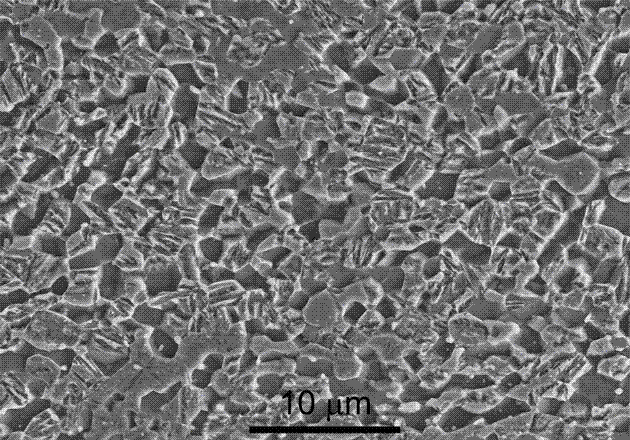
Figure 1 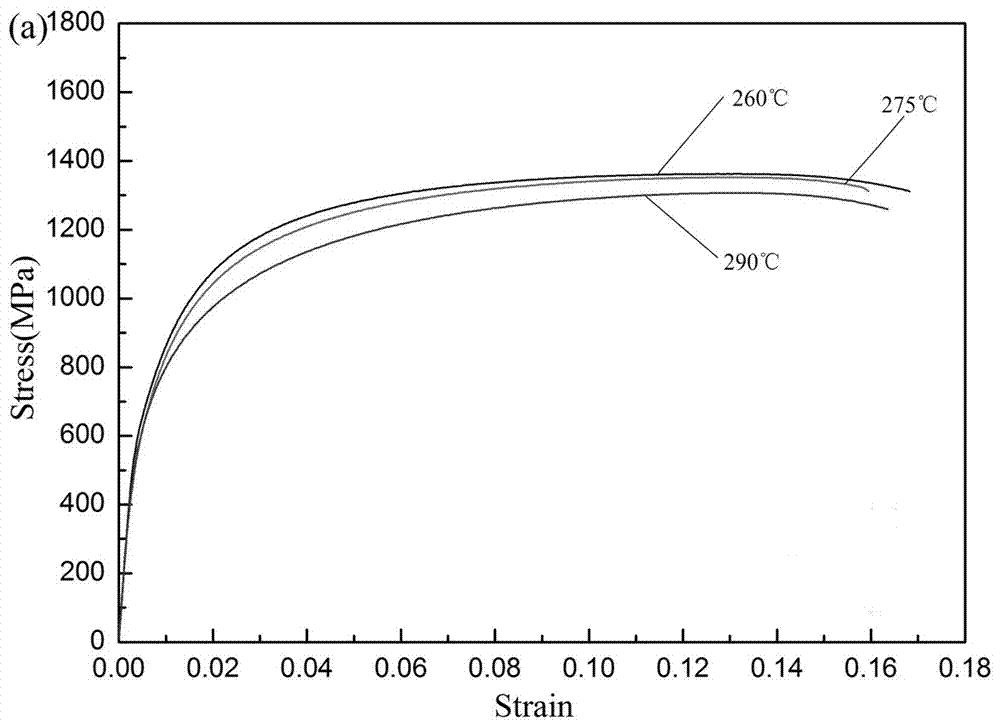
Figure 2 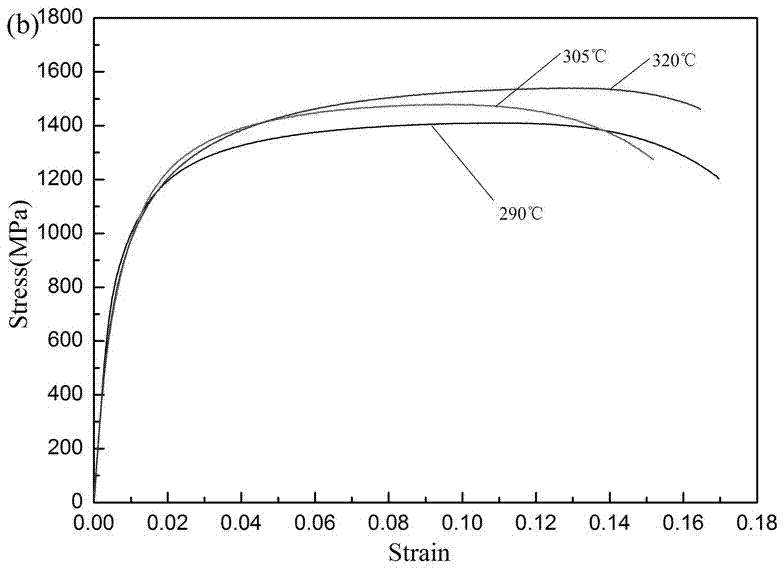
Figure 3
Abstract
Description
technical field
[0001] The invention belongs to the field of iron and steel material engineering, and relates to a dual-phase steel and a preparation method thereof, in particular to an ultrafine-grained ferrite / low temperature bainite dual-phase steel and a preparation method thereof. Background technique
[0002] The traditional ferrite / martensitic dual-phase steel has low yield ratio, high initial work hardening rate and good plasticity and toughness. However, due to the large difference in strength between ferrite and martensite, microcracks tend to expand along the ferrite / martensite phase interface, resulting in poor hole expansion performance, and cracks often occur in the hole expansion and flanging process. The ferrite / bainite dual-phase steel replaces martensite with bainite with better toughness, and has better flanging and hole expansion performance than ferrite / martensitic dual-phase steel, and With better tensile properties and impact toughness, it is more sui...
Examples
Embodiment 1
[0042] A. According to the mass percentage of C 0.3, Si 1.9, Mn 1.6, Cr 1.3, Ni 1.0, W 0.7, P 0.01, S 0.01, the rest is the ratio of Fe and inevitable impurities, calculate the feeding ratio, and frequency in vacuum Melted in an induction furnace and poured into cylindrical ingots with a diameter of 170 mm;
[0043] B1. The steel ingot is heated to 1220°C for 4 h for homogenization treatment, then air-cooled to 1180°C to start rolling, and the final rolling temperature is 880°C. After 6 passes of rolling, the first and second pass reductions are respectively 40 and 30 mm, the reduction in the last four passes is 20 mm, and finally rolled into a hot-rolled slab with a thickness of 20 mm, and air-cooled to room temperature after rolling;
[0044] B2. Reheat the hot-rolled slab to 900°C and keep it warm for 30 minutes, then quickly put it in oil to quench and cool it to room temperature, then put it in a furnace at 500°C and keep it warm for 1 hour, and then take it out of the fu...
Embodiment 2~3
[0053] The difference from Example 1 is that in Step D, the cold-rolled sheet is put into a furnace at a temperature of 760°C, and after being kept for 5 hours, it is heated at a temperature of 275°C (Example 2) and 290°C (Example 3) respectively. Wait for 10 h in a salt-bath furnace, then take it out of the furnace and air-cool to room temperature. The results of its tensile curve and test can be found in figure 2 and Table 1.
Embodiment 4~6
[0055] The difference from Example 1 is that in step D, the cold-rolled sheet is placed in a furnace at a temperature of 780°C, kept for 3 hours, and then quickly placed in a salt-bath furnace at a temperature of 290, 305, and 320°C for 3 hours. , then take out of the oven and air cool to room temperature. Its tensile test curve and results refer to respectively image 3 and Table 1.