
Temperature-responsive AIE fluorescent polymer nanoparticles and its synthesis method and application
A fluorescent polymer and temperature-responsive technology, applied in the field of fluorescence imaging, can solve the problems of few reports, achieve low phase transition temperature, excellent AIE performance, and rapid response to temperature changes
Patent Information
- Authority / Receiving Office
- CN · China
- Patent Type
- Patents(China)
- Current Assignee / Owner
- Publication Date
- 2020-11-17
Smart Images
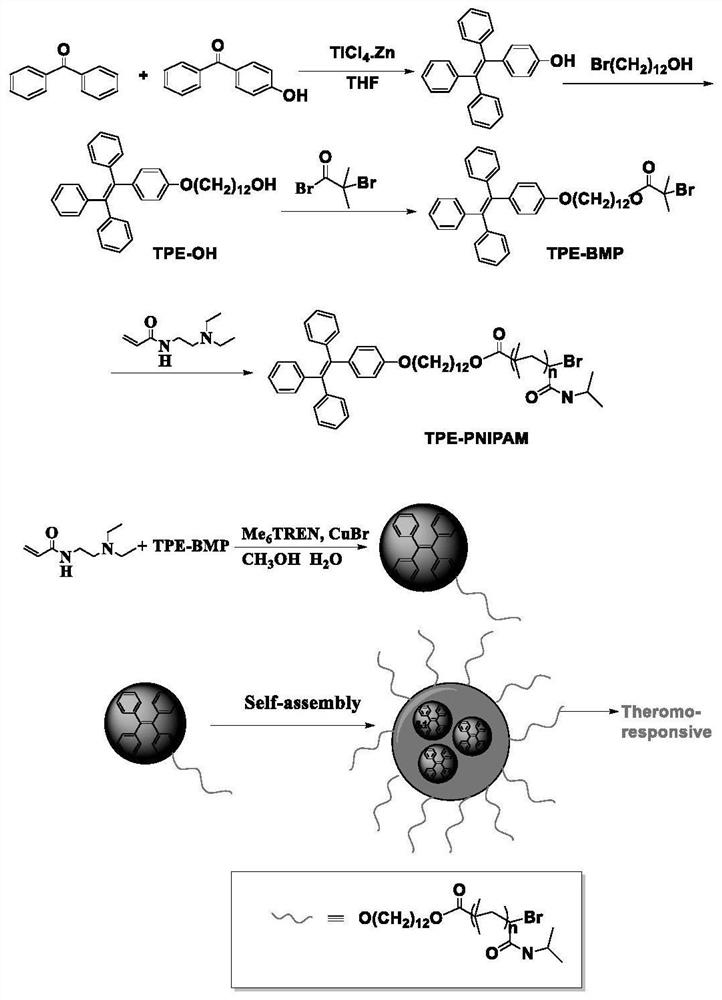
Figure 1 
Figure 2 
Figure 3
Abstract
Description
technical field
[0001] The invention belongs to the field of fluorescence imaging, and relates to a temperature-responsive AIE fluorescent polymer nanoparticle and its synthesis method and application. Background technique
[0002] Stimuli-responsive polymers refer to certain behaviors or properties of which can vary with a given temperature, CO 2 , pH, ion strength, light, heat, and other changes in the external environment and respond to smart materials. Due to the existence of these responsiveness, it has potential application value in biological applications, medicine, chemistry and other related fields. Poly N-isopropylacrylamide (PNIPAM) is a very typical temperature-stimuli-responsive polymer. The polymer has both a hydrophobic isopropyl group and a hydrophilic amide group. The structure is as follows .
[0003]
[0004] Polymer PNIPAM will undergo phase transition behavior at 32°C, that is, the lowest critical solution temperature (LCST) of polymer PNIPAM is 32...
Examples
Embodiment 1
[0051] 1) Synthesis of 4-(12-hydroxydodecyl)tetraphenylethylene (TPE-OH):
[0052] Using 4-hydroxytetraethylene, 6-bromo-1-hexanol and K 2 CO 3 The molar ratio of 1:1.2:1.2 is fed into the ratio of 4-hydroxytetraethylene (3.48g, 0.01mol), 12-bromo-1-dodecanol (0.28mL, 0.012mol) and K 2 CO 3 (1.66g, 0.012mol) was dissolved in 100mL of anhydrous acetonitrile, and refluxed for 24h under the protection of argon. After the reaction finished, the reaction solution was cooled to room temperature, then the reaction solution was filtered, the organic layer was evaporated, and finally the product was separated and purified by column chromatography (eluent: V 乙酸乙酯 :V 石油醚 =1:5), finally obtained 2.6g of light yellow solid 4-(12-hydroxydodecyl)tetraphenylethylene, the yield was about 49%.
[0053] Using 4-hydroxytetraethylene, 6-bromo-1-hexanol and K 2 CO 3 The molar ratio of 1:1:1 is fed into 4-hydroxytetraethylene (3.48g, 0.01mol), 12-bromo-1-dodecanol (0.24mL, 0.01mol) and K 2 C...