
Preparation method and application of flexible transparent SERS substrate
A substrate, transparent technology, applied in Raman scattering, material excitation analysis, etc., can solve the problems of separation, can not truly reflect the surface residue of the object to be tested, etc., to maintain flexibility and viscosity, achieve rapid on-site detection, and enhance the effect. Effect
Patent Information
- Authority / Receiving Office
- CN · China
- Current Assignee / Owner
- Publication Date
- 2018-12-18
- Estimated Expiration
- Not applicable · inactive patent
Smart Images
Figure 1 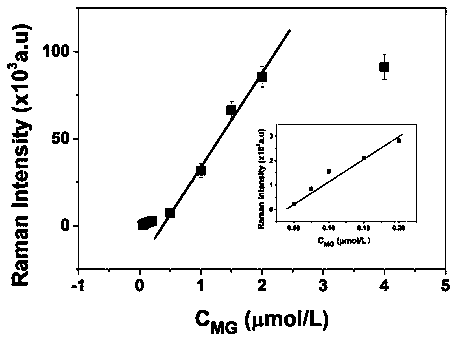
Figure 2 
Figure 3
Abstract
Description
technical field
[0001] The invention relates to a preparation method and application of a flexible transparent SERS substrate. Background technique
[0002] Traditional SERS substrates, such as Ag, Au, and Pt metal electrodes, have the problems of difficult control of roughness and poor reproducibility; gold nanorods with adjustable aspect ratio, silver cubes and silver triangles with controllable size and other noble metal sol SERS Substrates have the problems of poor storage stability, inconvenient portability, and are susceptible to interference from external environments such as temperature, pH, ion concentration and other factors; hard SERS substrates such as metal island films, quartz, and silicon wafers, although the stability has been improved and portability, it is still difficult to carry out effective in-situ detection of the analyte on the irregular surface, and a certain solvent is required for extraction. Therefore, it is of great significance to prepare flexi...
Examples
Embodiment 1
[0027] Put 1g of HAuCl purchased on aladdin 4 4H 2 O (molecular weight 412) is configured into HAuCl with ultrapure water 4 (100 g / L) mother liquor for use, HAuCl in the mother liquor 4 The concentration is 2.43×10 -1 mol / L;
[0028] Preparation of Au MLF / Tape SERS substrate:
[0029] 1) Au sol preparation: using the classic frens method: the above prepared HAuCl 4 (100 g / L) mother liquor was diluted to a concentration of 0.1 g / L, and 100 mL of the diluted solution was placed in a three-neck flask, heated to boiling under vigorous stirring, and then quickly added (directly poured) 2 mL (10 g / L) sodium citrate aqueous solution, the color of the solution gradually changed from light yellow to wine red, after the color of the solution became stable, condensed and refluxed for 15 min, stopped heating, cooled to room temperature under stirring, and obtained 2.43×10 -4 mol / L Au nano-sol, and finally put the synthesized Au nano-sol in a 4°C refrigerator for later use;
[003...
Embodiment 2
[0033] Investigate the effect of malachite green concentration on SERS spectrum:
[0034] Prepare malachite green standard aqueous solution: concentrations are 0.05, 0.075, 0.1, 0.15, 0.2, 0.5, 1, 1.5, 2 and 4 μmol / L;
[0035] For the Au MLF / Tape SERS substrate prepared in Example 1, the malachite green standard aqueous solution prepared above was detected, and the detection results were as follows figure 2 as shown, figure 2 For malachite green 803 cm -1 The variation curve of characteristic peak intensity with concentration;
[0036] The detection conditions are as follows: use a 632.18 nm light source as the excitation light to suppress the fluorescence interference of the sample to be tested, the light energy range is 30-60 mW, and the integration time is 10 s. When performing SERS testing, first drop 0.4 ml of sample solution on the sample cell, cover the Au MLF / Tape substrate on the sample cell port, use a laser light source to irradiate through the substrate, and d...
Embodiment 3
[0042] Embodiment 3 investigates the impact of the volume of chloroauric acid on the SERS spectrum:
[0043] Take different volumes of HAuCl 4 (100 g / L) 0.1 mL, 0.2 mL, 0.4 mL, 0.6 mL and 0.8 mL, add ultrapure water to 100 mL in a three-necked flask. The concentration of the sodium citrate aqueous solution added therein is 20, 40, 60, 80, 160 g / L respectively, and other conditions are the same as the Au MLF / Tape SERS substrate of Example 1, for the malachite green standard aqueous solution with a concentration of 1 μmol / L Detect, detection method condition is with embodiment 2, and detection result sees Figure 4 ;
[0044] The density of gold nanoparticles on the water-oil interface can be controlled by adjusting the concentration of Au sol and the size of the cross-sectional area of the container, and the concentration of Au sol can be controlled according to the volume of chloroauric acid added. When the volume of chloroauric acid added increases, the color of the gold...