
Preparation method of 2-methoxy-4-nitroaniline
A technology of o-methoxyaniline and nitroaniline, which is applied in the field of preparation of 2-methoxy-4-nitroaniline, can solve the problem of producing 2-methoxy-4-nitroaniline, which has not yet been industrialized. Unstable efficiency, high cost of raw materials, etc., to achieve good industrial application value, convenient product post-processing, and low cost of acylation reaction
Patent Information
- Authority / Receiving Office
- CN · China
- Patent Type
- Applications(China)
- Current Assignee / Owner
- Publication Date
- 2019-05-21
- Estimated Expiration
- Not applicable · inactive patent
Smart Images
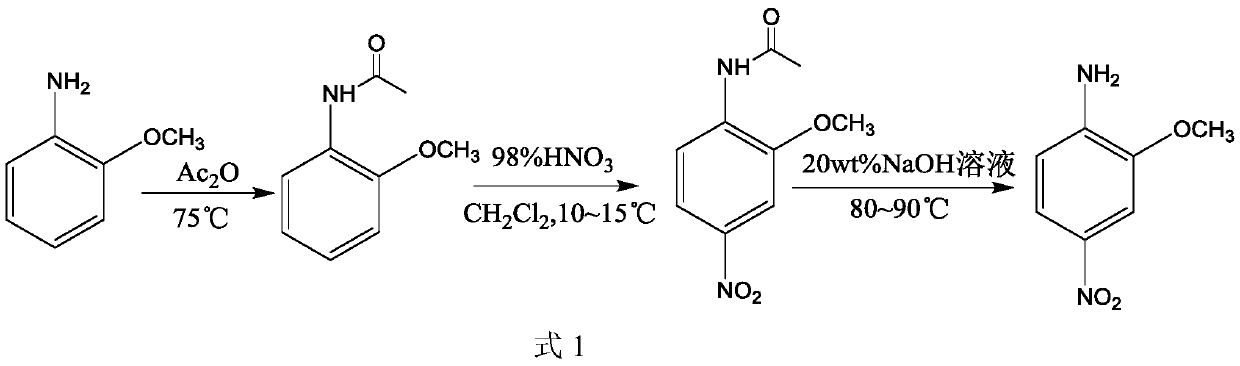
Figure 1 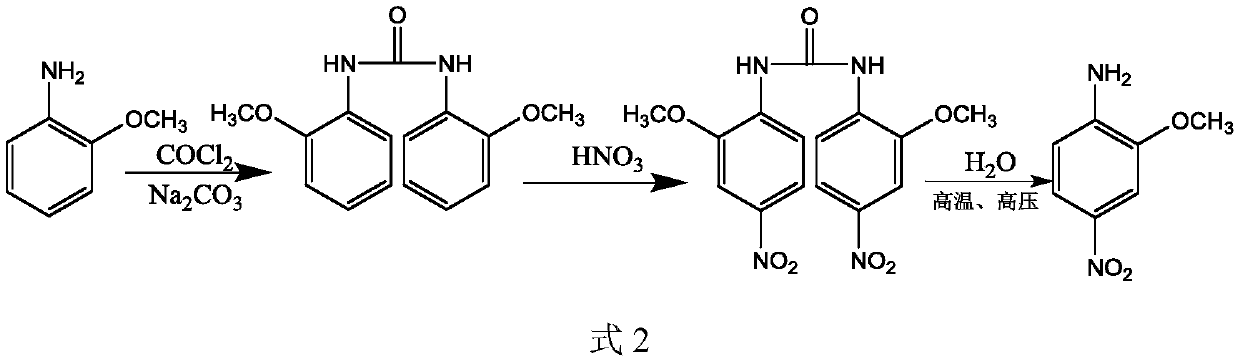
Figure 2 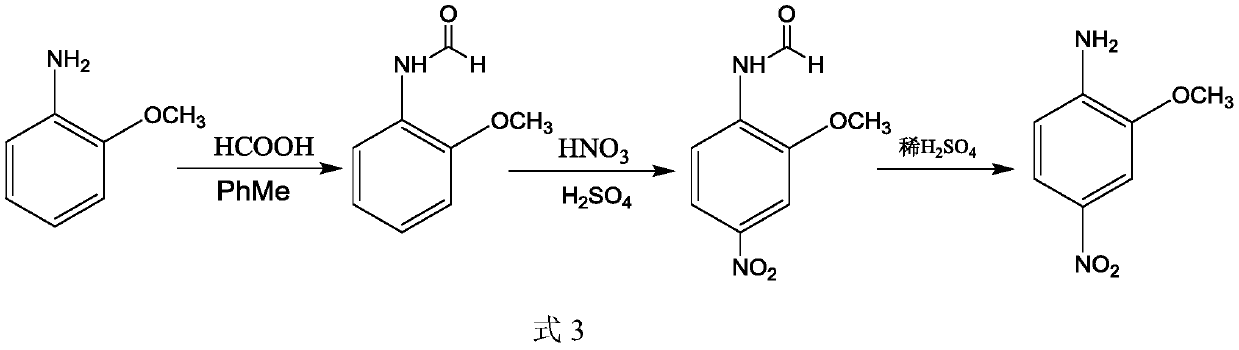
Figure 3
Abstract
Description
technical field
[0001] The invention relates to a preparation method of fine chemical products, in particular to a preparation method of 2-methoxy-4-nitroaniline. Background technique
[0002] 2-Methoxy-4-nitroaniline, yellow or tan powder, is mainly used for dyeing and printing of cotton fiber fabrics, and is also used to make fast pigments, bordeaux, golden yellow, black and other organic pigments. It is widely used. The market demand is high.
[0003] The currently reported preparation method of 2-methoxy-4-nitroaniline is mainly based on 2-methoxyaniline as raw material, which is synthesized through three steps of acylation, nitration and hydrolysis.
[0004] Patent CN 102382109 uses acetic anhydride as an amino-protecting reagent to prepare 2-methoxy-4-nitroaniline through acetylation, nitration and alkaline hydrolysis, with a yield of 93%. When acetic anhydride is used as an acetylation reagent, a molecule of acetic acid will be generated, the utilization rate of ace...
Examples
Embodiment 1
[0051] Embodiment 1, a kind of preparation method of 2-methoxy-4-nitroaniline, carries out following steps successively:
[0052] 1) Take 123.2g (1.0mol) of 2-methoxyaniline and 150g (2.5mol) of acetic acid into a 500ml four-neck flask and raise the temperature to 115°C to start the reaction, and remove the water generated in the system by reactive distillation. After reacting for 6 hours, GC detected that the reaction of 2-methoxyaniline was completed, and the acetic acid solution of 2-methoxyacetanilide was obtained, weighing 233.7 g.
[0053] 2), the temperature of the reaction liquid (2-methoxyacetanilide in acetic acid solution) obtained in step 1) was lowered to 0-10°C, and then 77.2 g (1.2 mol) of fuming nitric acid (1.2 mol, 1 hour for dropping) was added dropwise thereto, and During the addition process, the temperature of the reaction system is controlled at 0-10°C (which can be realized by jacket cooling). Add 100 g of deionized water to the nitration reaction liqu...
Embodiment 2~ Embodiment 10
[0056] Keep steps 2) and 3) unchanged, change part of the reaction conditions in step 1) in Example 1, and the rest of the conditions are the same as in Example 1, to obtain Examples 2 to 10, respectively. The specific process parameters and the obtained results are shown in Table 1 below:
[0057] Table 1
[0058]
[0059]
Embodiment 11~ Embodiment 20
[0061] Keep steps 1) and 3) unchanged, change part of the reaction conditions in step 2) in Example 1, and the rest of the conditions are the same as in Example 1, to obtain Examples 11 to 20, respectively. The specific process parameters and the obtained results are shown in Table 2 below:
[0062] Table 2
[0063]