
Preparation method and application of dual-function biosensor HRP@ZIF-8/DNA
A biosensor, dual-function technology, used in biological testing, analysis by chemical reaction of materials, instruments, etc., to achieve good chemistry, good tolerance, and high selectivity.
Patent Information
- Authority / Receiving Office
- CN · China
- Patent Type
- Applications(China)
- Current Assignee / Owner
- Publication Date
- 2019-08-09
Smart Images
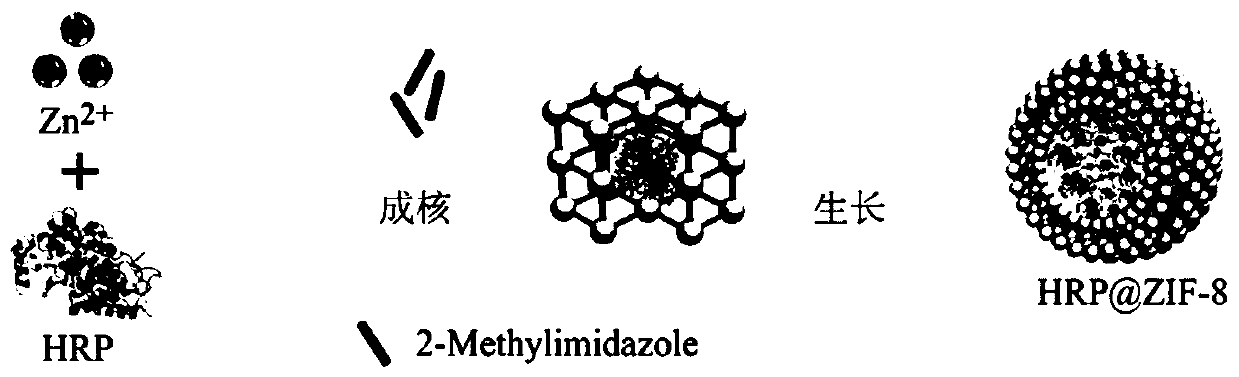
Figure 1 
Figure 2 
Figure 3
Abstract
Description
technical field
[0001] The invention belongs to the technical field of application of inorganic materials, and in particular relates to a preparation method and application of a bifunctional biosensor HRP@ZIF-8 / DNA. Background technique
[0002] Mercury and phenol are toxic pollutants widely present in rivers and food, and have serious harm to protein synthesis, central nervous system and immune system in human body. Therefore, it is of great significance to establish a sensitive, cost-effective and reliable method for the detection of mercury and phenol in water, especially a method suitable for the simultaneous detection of the two pollutants. The traditional methods for detecting mercury ions mainly include cold atomic absorption spectrometry and dithizone colorimetric method; the methods for detecting phenol include electrochemical method, spectrophotometry and chromatography. However, these detection methods have problems such as high cost, complex instruments and equi...
Examples
Embodiment 1
[0043] (1) Preparation of biomineralized HRP@ZIF-8
[0044] Accurately weigh 2 mg of horseradish peroxidase, add it to an aqueous solution of hexahydrate and zinc nitrate (50 mM, 500 μl), shake to dissolve the enzyme in the solution; imidazole solution, the two solutions were mixed thoroughly. The mixture was incubated in a constant temperature water bath at 30°C for 12 hours. After the reaction, the product was centrifuged and washed repeatedly. The resulting precipitate was HRP@ZIF-8. The principle is as figure 1 shown.
[0045] (2) Preparation of HRP@ZIF-8 / DNA hybrid system:
[0046]At room temperature, the HRP@ZIF-8 prepared in step (1) was dispersed in the Hepes buffer solution, and the concentration of HRP@ZIF-8 was 0.07 mg / mL; then, it was mixed with the fluorescently labeled aptamer solution, and the aptamer The concentration of the solution is 100nM; the volume ratio is 1:1; incubate at room temperature for 7min; until the fluorescence quenching is saturated to fo...