
Method for preparing mesophase carbon microspheres with emulsification-hydrogenation-thermal polymerization ternary coupled system
A technology of mesocarbon microspheres and mesophase pitch, which is applied in the field of preparation of mesocarbon microspheres, can solve problems such as unsatisfactory degree of graphitization and complex process, and achieve good sphericity, uniform particle size distribution, and particle size uniform effect
Patent Information
- Authority / Receiving Office
- CN · China
- Patent Type
- Applications(China)
- Current Assignee / Owner
- Publication Date
- 2019-10-22
Smart Images
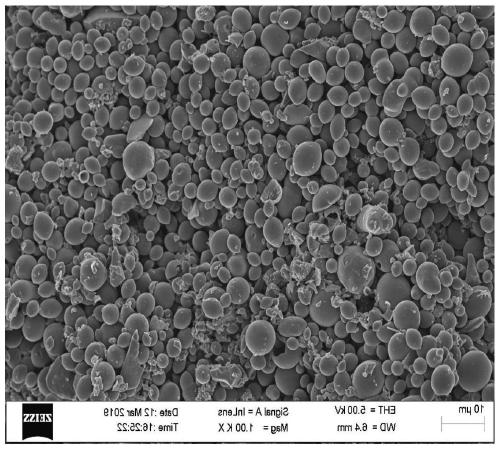
Figure 1 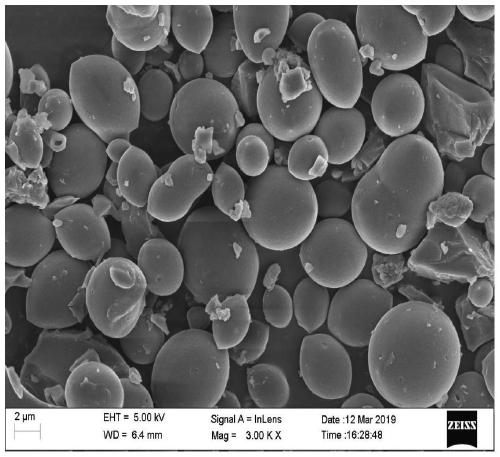
Figure 2 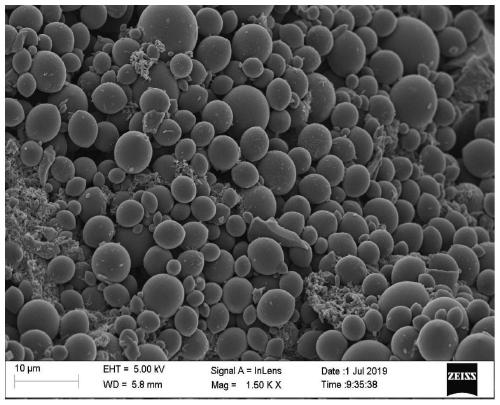
Figure 3
Abstract
Description
technical field
[0001] The invention relates to the technical field of preparation of mesophase carbon microspheres, in particular to a method for preparing mesophase carbon microspheres by using an emulsification-hydrogenation-thermal polymerization ternary coupling system. Background technique
[0002] Mesophase carbon microspheres are a nematic liquid crystal structure formed during the carbonization of polycyclic aromatic compounds (such as coal tar pitch, coal tar, petroleum pitch, naphthalene, etc.). In the initial stage of mesophase transformation, it is spherical due to the effect of surface tension. As time goes on, the mesophase spheres grow up and merge, and finally anisotropic mesophase pitch is obtained. Separating the small balls formed in the early stage of the mesophase transformation from the mother liquor by an appropriate method is the mesophase carbon microspheres. Mesocarbon microspheres have been widely used in high-performance carbon materials, cataly...
Examples
Embodiment 1
[0042] The method for preparing mesophase carbon microspheres in this embodiment is specifically:
[0043] (1) According to the added amount of hydrogen donating solvent is 15.00wt%, the added amount of modified catalyst is 0.05wt%, and the added amount of emulsified solvent is 84.95wt%, and mixed to prepare emulsified-hydrogenation-thermal polymerization three-way coupling solvent system, wherein , the mass ratio of the modified catalyst is blue coke:coke:graphene:modifier=80:10:5:5.
[0044] (2) Put 2.5kg of medium and low temperature coal tar in a rectification kettle for distillation, and distill out soft asphalt with a distillate section at 330-420°C, with a softening point of 40 and an aromaticity of 0.4, according to soft asphalt: three-way coupling Solvent system = 1:3 ratio mixing, placed in a high-pressure reactor for three-stage heating reaction, that is, the first stage is dominated by emulsification and dispersion, rising from normal temperature to 220°C, constant...
Embodiment 2
[0048] The method for preparing mesophase carbon microspheres in this embodiment is specifically:
[0049] (1) According to the added amount of hydrogen-donating solvent is 12.00wt%, the added amount of modified catalyst is 0.5wt%, and the emulsified solvent is added to 100%, and mixed to prepare an emulsified-hydrogenation-thermal polymerization three-way coupled solvent system, wherein, modified The mass ratio of the active catalyst is blue carbon: coke: graphene: modifier = 75:5:15:5.
[0050] (2) Put 2.5kg of medium and low temperature coal tar in a rectification kettle for distillation, and distill out soft asphalt with a distillate section at 330-420°C, with a softening point of 40 and an aromaticity of 0.4, according to soft asphalt: three-way coupling Solvent system = 1:4 ratio mixing, placed in a high-pressure reactor for three-stage heating reaction, that is, the first stage is dominated by emulsification and dispersion, from normal temperature to 200 ° C, constant t...
Embodiment 3
[0054] The method for preparing mesophase carbon microspheres in this embodiment is specifically:
[0055] (1) According to the added amount of hydrogen-donating solvent is 10.00wt%, the added amount of modified catalyst is 0.01wt%, and the emulsified solvent is added to 100%, and mixed to prepare an emulsified-hydrogenation-thermal polymerization three-way coupled solvent system, wherein, modified The mass ratio of the active catalyst is blue carbon:coke:graphene:modifier=88.9:10:1:0.1.
[0056] (2) Put 2.5kg of medium and low temperature coal tar in a rectification kettle for distillation, and distill out soft asphalt with a distillate section at 330-420°C, with a softening point of 70 and an aromaticity of 0.5, according to soft asphalt: three-way coupling Solvent system = 1:5 ratio mixing, placed in a high-pressure reactor for three-stage heating reaction, that is, the first stage is dominated by emulsification and dispersion, rising from normal temperature to 250°C, const...