
Phosphoric acid treated Trogers Base polymer gas separation membrane as well as preparation method and application thereof
A gas separation membrane and gas separation technology, applied in separation methods, gas treatment, semi-permeable membrane separation, etc., can solve the problems of low separation efficiency and low separation selectivity, achieve high selectivity, wide source of raw materials, phosphoric acid treatment The process is simple and controllable
Patent Information
- Authority / Receiving Office
- CN · China
- Patent Type
- Applications(China)
- Current Assignee / Owner
- Publication Date
- 2021-01-29
Smart Images
Figure 1 
Figure 2 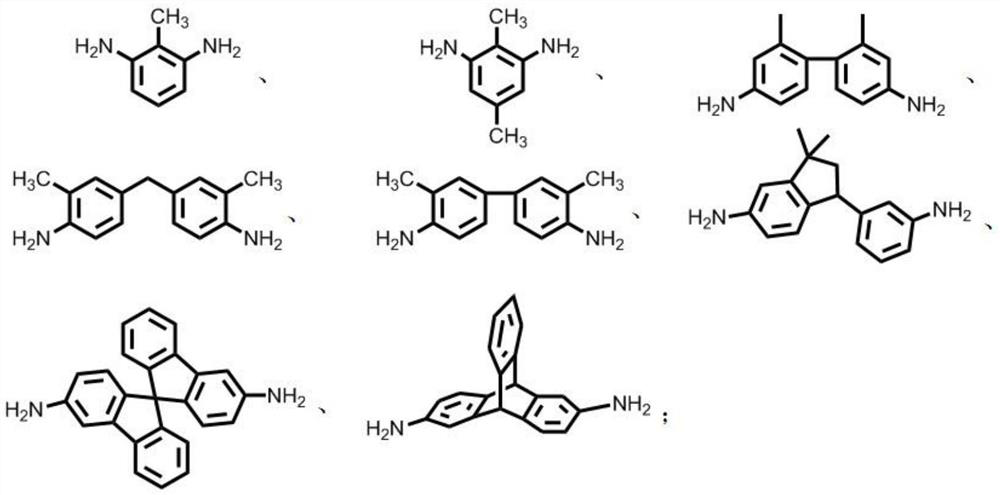
Figure 3
Abstract
Description
Technical field
[0001] The invention belongs to the technical field of membrane gas separation, and specifically relates to a phosphoric acid treatedPreparation method and application of Base polymer gas separation membrane.Background technique
[0002] In today's increasingly serious energy crisis, the development of new energy has become the most important topic. Hydrogen energy as a clean, efficient, and environmentally friendly energy source has received more and more attention. So far, the main way to produce hydrogen is through methane reforming followed by water gas shift reaction. The main by-product of this process is carbon dioxide, which must be removed in order to purify H2Can be used for further applications.
[0003] Compared with traditional separation methods, membrane gas separation technology has the advantages of low energy consumption, simple operation, compact equipment, and easy to scale. It has good development prospects in hydrogen purification, oxygen enrichment, nitr...
Examples
Embodiment 1
[0037]Example 1: D-Preparation of base polymer film:
[0038](1) Synthesis of polymer: Under ice bath, add 4,4'-diamino-3,3'-dimethylbiphenyl 10g (47.169mmol) into a three-necked flask with mechanical stirring, and dimethyl biphenyl 21ml (235.8mmol) of formaldehyde was fully dissolved, 80ml of trifluoroacetic acid was slowly added dropwise into it, after stirring at room temperature for 96 hours, the solution was slowly poured into ammonia water, filtered, washed with methanol 3-5 times, and dried.
[0039]
[0040](2)D-Preparation of base polymer film: 0.3g D-The base was dissolved in 3ml of chloroform, filtered, and the obtained polymer solution was slowly poured on a clean glass plate, and allowed to flow naturally, so that the solvent was slowly evaporated at room temperature to form a film, and the obtained film was Soak in methanol for 12 hours, and then dry in a vacuum oven at 120°C for 12 hours. The resulting polymer film has a thickness of approximately 50 μm.
Embodiment 2
[0041]Example 2: M-Preparation of base polymer film:
[0042](1) Synthesis of polymer: Under ice bath, add 4,4'-diamino-3,3'-dimethyldiphenylmethane 10.65g (47.169mmol), and two into a three-necked flask with mechanical stirring. Methanol formal 21ml (235.8mmol), fully dissolved, slowly drip 80ml trifluoroacetic acid into it, after stirring at room temperature for 96 hours, slowly pour the solution into ammonia water, filter, wash with methanol 3-5 times, dry,
[0043]
[0044](2)M-Preparation of base polymer film: 0.3gM-The base was dissolved in 3ml of chloroform, filtered, and the obtained polymer solution was slowly poured on a clean glass plate, and allowed to flow naturally, so that the solvent was slowly evaporated at room temperature to form a film, and the obtained film was Soak in methanol for 12 hours, and then dry in a vacuum oven at 120°C for 12 hours. The resulting polymer film has a thickness of approximately 50 μm.
Embodiment 3
[0045]Example 3: Trip-Preparation of base polymer film:
[0046](1) Synthesis of polymer: Under ice bath, add 13.4g (47.169mmol) of 2,6-triptycene diamine and 21ml (235.8mmol) of dimethanol formal into a three-necked flask with mechanical stirring. Dissolve, slowly add 80ml of trifluoroacetic acid dropwise to it, after stirring at room temperature for 96 hours, slowly pour the solution into ammonia water, filter, wash with methanol 3-5 times, and dry.
[0047]
[0048](2)Trip-Preparation of base polymer film: 0.3gTrip-The base was dissolved in 3ml of chloroform, filtered, and the obtained polymer solution was slowly poured on a clean glass plate, and allowed to flow naturally, so that the solvent was slowly evaporated at room temperature to form a film, and the obtained film was Soak in methanol for 12 hours, and then dry in a vacuum oven at 120°C for 12 hours. The resulting polymer film has a thickness of approximately 50 μm.